Quick Summary
What does it take to move a 2-petabyte legacy system to the cloud without disrupting operations? UBS (Union Bank of Switzerland), one of the world’s leading financial institutions, successfully migrated its Electronic Archive (ELAR) platform from Mainframe Db2 to Azure SQL Database Hyperscale. This transformation delivered 60% cost savings, improved performance, and laid the foundation for future growth.
If UBS could modernize at this scale, can you? Let’s uncover the story and strategy behind how they did it with the UBS Azure migration case study.
Table of Contents
Let's Understand About UBS First!
Headquarters: Zurich, Switzerland
Employees: 115,000+
Presence: Operations in 50+ countries
Assets Under Management: $5+ trillion (as of 2023)
Business Model: Wealth Management, Asset Management, Investment Banking, Personal & Corporate Banking
UBS is the world’s largest wealth manager and a global leader in financial services. It serves millions of private, corporate, and institutional clients across regions through both digital platforms and a global network of offices.
In 2023, UBS acquired Credit Suisse, a major global investment bank. Along with the acquisition came several legacy systems, including ELAR (Electronic Legal Archive Repository), a mission-critical, mainframe-based archive containing 2 petabytes of regulatory and transactional data.
Faced with rising infrastructure costs and a growing need for speed, flexibility, and compliance, UBS prioritized modernizing ELAR as part of its cloud-first transformation strategy. By early 2024, the bank had successfully migrated ELAR to Azure SQL Hyperscale, marking a key milestone in its enterprise cloud journey.
So, how did UBS manage a database migration of this scale without risking downtime, data integrity, or compliance issues?
Let’s break down the strategy, technology choices, and key lessons from one of the most complex modernization initiatives in global banking.
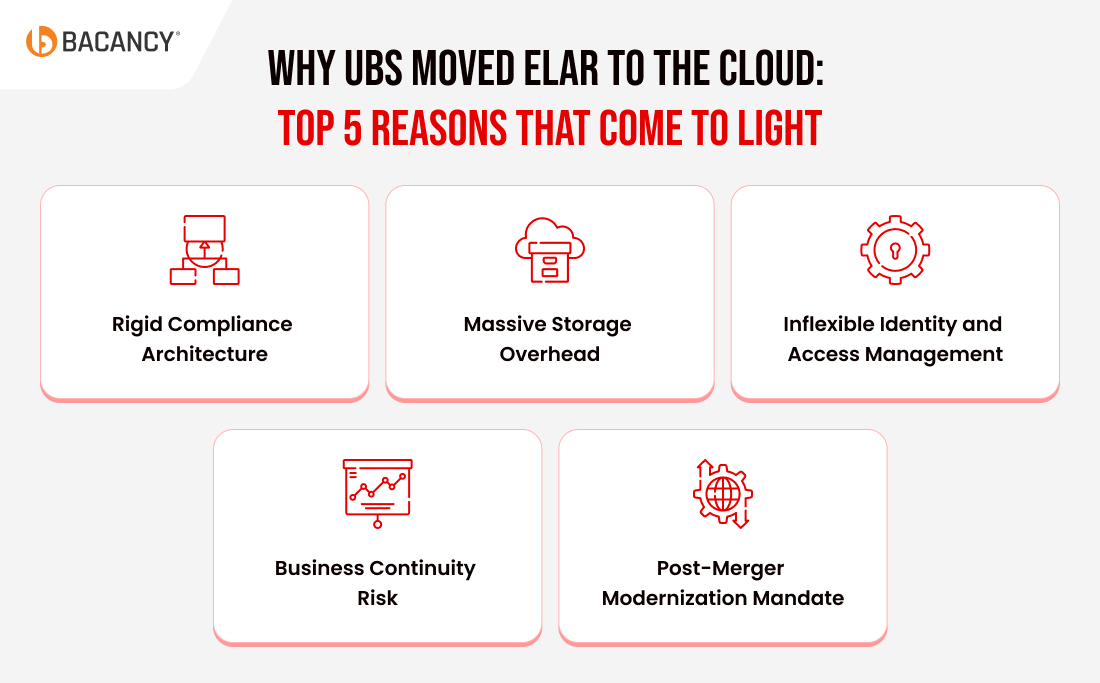
Why UBS Moved ELAR to the Cloud: Top 5 Reasons That Come To Light
Strategic, technical, and regulatory challenges made it clear that ELAR could no longer remain on the mainframe. Here’s what drove the decision to modernize.
-
1. Rigid Compliance Architecture
ELAR’s audit trails and legal hold logic were deeply embedded in RACF (Resource Access Control Facility) and COBOL (Common Business-Oriented Language), making it difficult to adapt to changing global compliance mandates.
-
2. Massive Storage Overhead
Managing over 2 petabytes of immutable regulatory and transactional data on aging mainframe infrastructure was expensive, inefficient, and non-scalable.
-
3. Inflexible Identity and Access Management
ELAR relied on legacy RACF-based access controls that couldn’t support Azure Active Directory, role-based access, or modern zero-trust security models.
-
4. Business Continuity Risk
Any performance lag or failure in ELAR could disrupt regulatory audits and legal processes. Migration to Azure SQL Hyperscale improved resilience and ensured uninterrupted access.
-
5. Post-Merger Modernization Mandate
Legacy systems inherited post-acquisition added architectural debt. ELAR’s modernization was essential for aligning with UBS’s cloud-first, automation-driven future.
Why Microsoft Azure Was the Right Fit for a Mission-Critical Migration?
UBS needed more than just a cloud provider; it needed a platform that could handle large-scale data, reduce operational complexity, and align with strict regulatory and business goals. Here’s why Azure stood out:
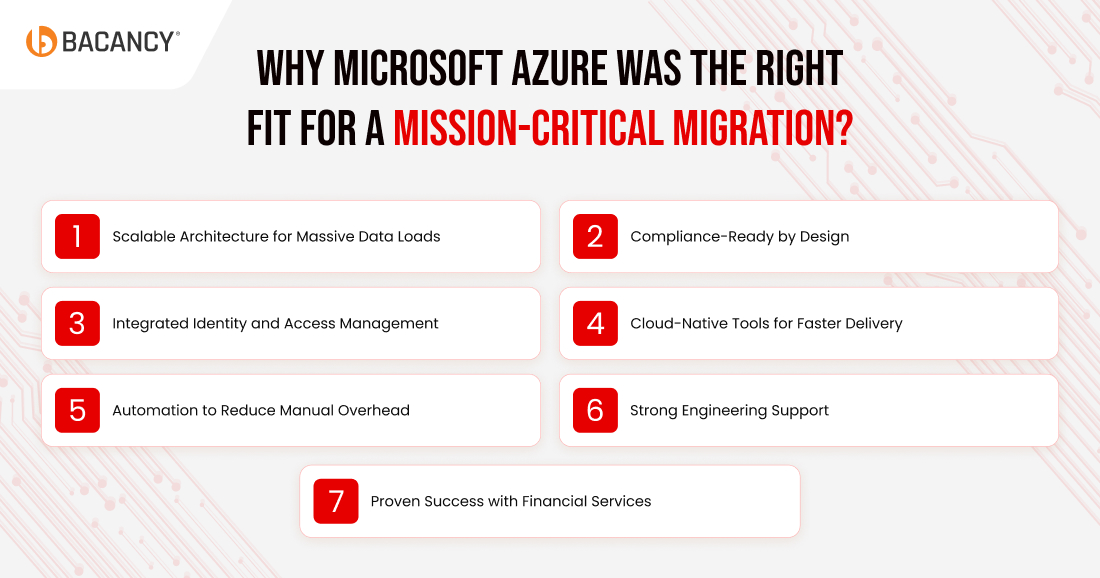
1. Scalable Architecture for Massive Data Loads
Azure SQL Database Hyperscale offered flexible storage and compute scaling, helping UBS manage nearly petabytes of data efficiently without compromising performance or uptime.
2. Compliance-Ready by Design
Azure’s built-in data governance, audit logging, and region-based data residency controls supported UBS’s strict legal and regulatory standards across multiple regions.
3. Integrated Identity and Access Management
With Microsoft Entra ID, UBS was able to modernize identity controls by replacing legacy RACF mainframe authentication with secure, cloud-based access policies.
4. Cloud-Native Tools for Faster Delivery
Azure’s ecosystem, including Azure Web Apps, Azure DevOps, and Azure Data Lake, enabled UBS to build and manage services faster while reducing dependency on custom infrastructure.
5. Automation to Reduce Manual Overhead
CI/CD pipelines and automated deployment tools helped UBS streamline code delivery, testing, and rollout, making development cycles more efficient and error-free.
6. Strong Engineering Support
UBS collaborated closely with Microsoft engineers throughout the migration, leveraging Microsoft’s expertise in financial services architecture, performance tuning, and security configuration to reduce risk and accelerate timelines.
7. Proven Success with Financial Services
Azure has a strong track record with tier-1 global banks, including JPMorgan Chase, HSBC, and Standard Chartered, successfully running regulatory workloads and core banking platforms. This industry validation gave UBS the confidence to entrust ELAR to Azure’s mature and secure ecosystem.
Inside the Tech: Azure Services That Drove UBS’s Database Migration
UBS selected key Azure services to support its transition from mainframe to a modern cloud environment. Each service was chosen for a specific purpose and played a critical role in the success of the ELAR migration.
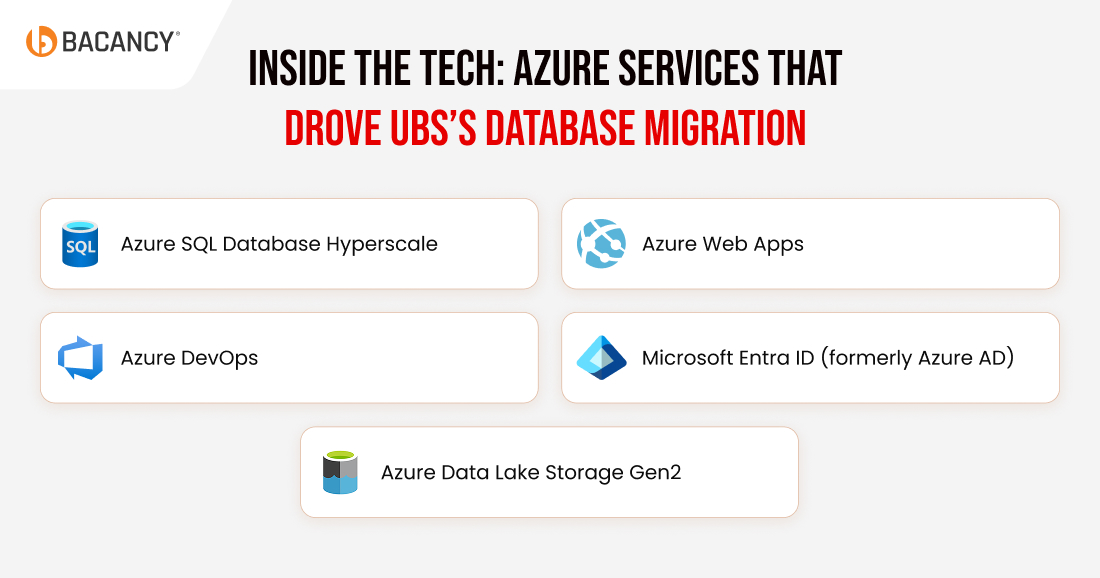
1. Azure SQL Database Hyperscale
Azure SQL Database Hyperscale is a cloud-native relational database designed for large, high-throughput workloads. Its architecture separates computing and storage, enabling an elastic scale of up to 100TB.
UBS used it to deliver high-speed query performance, fast recovery, and seamless scale, all while maintaining uptime during migration. The solution helped reduce long-term TCO and met SLAs for regulatory workloads.
2. Azure Web Apps
Azure Web Apps is a fully managed PaaS offering for deploying and scaling modern web applications. UBS re platformed its Java-based ELAR application using Azure Web Apps, enabling decoupled architecture, automatic scaling, and zero-downtime deployments.
By offloading infrastructure management to Microsoft, the engineering teams were able to focus on delivering new features and improving user experience.
3. Azure DevOps
Azure DevOps provides tools for automating software delivery through continuous integration and continuous deployment (CI/CD). UBS used Azure DevOps to automate deployments and manage code pipelines.
This supported the transition to containerized microservices, enabled flexible rollout strategies, and ensured consistent delivery through scheduled pipelines, all aligned with compliance and governance needs.
4. Microsoft Entra ID (formerly Azure Active Directory)
Microsoft Entra ID is a cloud-based identity and access management solution that supports secure authentication and policy enforcement.
UBS migrated its mainframe identities (RACF) to Microsoft Entra ID to maintain access control across its cloud ecosystem. Location-based access policies helped UBS preserve strict compliance standards while modernizing its identity architecture.
5. Azure Data Lake Storage Gen2
Built on Azure Blob Storage, Azure Data Lake Storage Gen2 is designed for secure, scalable handling of large, regulated datasets. UBS leveraged it to archive ELAR documents while ensuring compliance with global data retention policies.
Its features, such as immutable Write Once Read Many (WORM) storage, time-based retention, and legal holds, allowed UBS to enforce strict governance and apply legal preservation rules. It also ensured seamless integration with Azure SQL for audit-ready access.
Note: Azure Data Lake Storage Gen2 is built on top of Azure Blob Storage and is now part of the unified Azure Storage platform. Microsoft refers to it under “Azure Data Lake Storage,” but Gen2 is the default and recommended version.
Inside UBS’s 8-Step Plan to Modernize Without Disruption
UBS followed a planned and phased approach to modernize its ELAR platform and ensure a smooth transition from mainframe to cloud. Key steps in the process included:
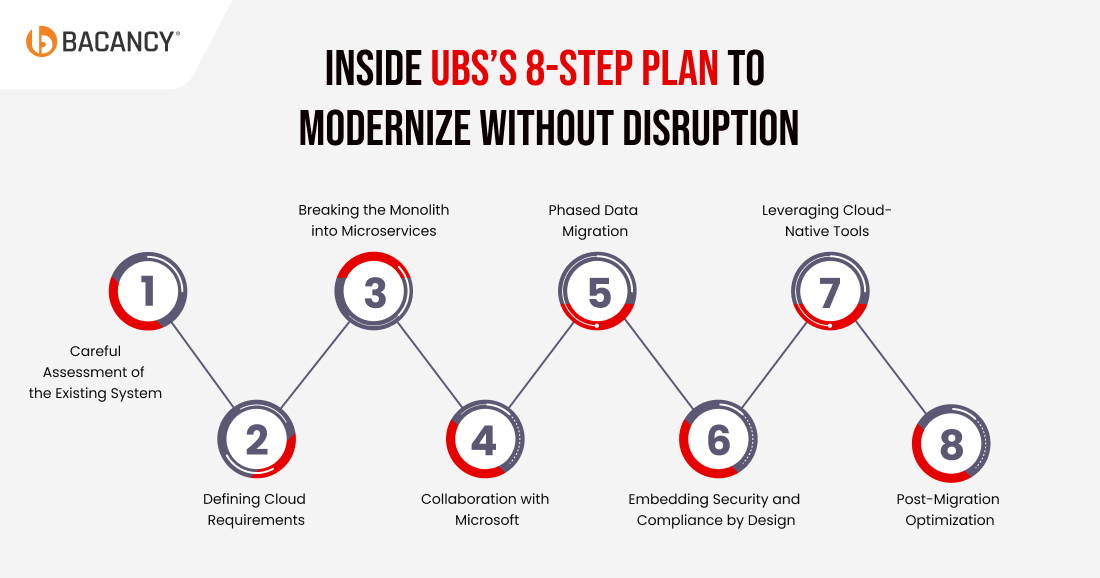
1. Careful Assessment of the Existing System
UBS began by analyzing the ELAR platform to understand its technical dependencies, data volume, compliance needs, and usage patterns. This helped identify what the new cloud environment needed to support.
2. Defining Cloud Requirements
UBS defined a clear set of criteria for the target solution: high performance, elasticity, high availability, cost optimization, and integration with managed Azure services.
3. Breaking the Monolith into Microservices
The legacy mainframe system was re-architected into a modern, modular microservices-based design. This improved flexibility made the system easier to manage and allowed different application parts to scale independently.
4. Collaboration with Microsoft
UBS worked closely with Microsoft’s Azure experts and internal teams to plan the migration architecture and ensure every stage of the process was aligned with UBS’s strategic goals.
5. Phased Data Migration
Data migration was executed in phases to reduce risk and avoid disruptions. Automation tools and CI/CD pipelines handled deployments, testing, and monitoring.
6. Embedding Security and Compliance by Design
Azure-native governance tools such as Microsoft Purview, Defender for Cloud, and Entra ID were used to enforce access control, apply data retention policies, and ensure compliance with financial regulations.
7. Leveraging Cloud-Native Tools
Azure services, such as SQL Database Hyperscale, Azure Web Apps, and Azure DevOps helped streamline development, increase operational efficiency, and reduce manual tasks.
8. Post-Migration Optimization
After stabilization, UBS decommissioned its legacy mainframe systems. The result was a 60% lower total cost of ownership (TCO), improved time to market, and a future-proof platform ready for digital innovation.
Looking to transform your legacy infrastructure without disruption?
Partner with experts and leverage Database Migration Services for a smooth, future-ready modernization.
Beyond Migration: How UBS Future-Proofed Its Operations
UBS’s successful modernization of its ELAR platform brought a range of business and technical benefits that go far beyond infrastructure upgrades. The migration to Azure SQL Database Hyperscale positioned UBS for long-term innovation and operational efficiency. Key gains include:
- 60% Lower Total Cost of Ownership: Shutting down legacy mainframes and using Azure’s pay-as-you-go model helped UBS reduce operational expenses by more than half.
- Flexible and Independent Scaling: Azure SQL Hyperscale allowed UBS to scale compute and storage separately, supporting large data volumes without impacting performance.
- Faster Delivery of New Features: The shift to microservices and CI/CD pipelines enabled UBS to release updates in days instead of weeks.
- Built-in Compliance Controls: Azure security tools helped UBS automate data retention, legal holds, and access policies to meet regulatory standards like the General Data Protection Regulation (GDPR) and the Swiss Financial Market Supervisory Authority (FINMA).
- Improved System Reliability: High availability and built-in fault tolerance provided 99.99 percent uptime and reduced the risk of outages.
- Freedom from Legacy Technology: By retiring COBOL-based mainframe systems, UBS eliminated outdated dependencies and embraced a modern, flexible architecture.
- 30% Increase in Developer Efficiency: Engineering teams are focused more on delivering features than on managing infrastructure, thanks to Azure’s managed services.
- Foundation for Future Technologies: With centralized data and API-based access, UBS is ready to adopt artificial intelligence and machine learning without major rework.
5 Tips Our CTO at Bacancy Recommends for Zero Downtime
At Bacancy, we don’t just migrate, we modernize with precision, security, and scale. Our Azure migration services are tailored for enterprises with complex, compliance-heavy systems and a strong need for agility.
We’ve helped Fortune 500 companies and global banks transition from rigid mainframes to flexible, cloud-native architectures.
If you’re considering an Azure migration like UBS, here are 5 field-tested recommendations from our CTO to ensure a seamless transition:
1. Start with a Risk-Free Roadmap
Map all dependencies, define clear milestones, and address compliance gaps before execution begins.
2. Use Phased Migration
Migrate in logical batches rather than all at once to reduce risk and enable faster rollback if needed.
3. Automate Everything
Leverage CI/CD pipelines, testing scripts, and monitoring to ensure repeatability and speed.
4. Build for Compliance
Integrate security policies, access controls, and data retention rules.
5. Prepare for AI and Optimization
Fine-tune your systems for better performance and costs after migration. Centralized cloud data also makes it easier to add AI and analytics later.
Want to Achieve a Similar Transformation? Let’s Talk
If the UBS Azure migration case study inspires you to modernize your legacy systems, we’re here to help. At Bacancy, we specialize in delivering seamless Azure migration services tailored to complex enterprise needs.
Here’s how we can support your modernization journey:
▶ Assess your legacy systems and define a clear, risk-free migration roadmap.
▶ Re-architect monolithic applications into scalable, cloud-native solutions.
▶ Implement Azure SQL Hyperscale, Entra ID, DevOps, and Data Lake for performance and compliance.
▶ Ensure zero downtime, solid security, and post-migration optimization.
Whether you’re just starting or already on the cloud journey, Bacancy brings the strategy, tools, and expertise to make it a success. Ready to Modernize Like UBS?
Let’s Build Your Cloud Success Story.
Frequently Asked Questions (FAQs)
Yes, Bacancy has deep experience handling complex, compliance-driven cloud migrations, especially in banking, finance, and healthcare. We offer risk-free assessments, phased migration strategies, and automation-driven execution to ensure zero downtime and full data integrity.
Absolutely. We specialize in modernizing legacy mainframe applications, whether built in COBOL (Common Business-Oriented Language), PL/1 (Programming Language One), or assembler. We re-architect them into modern microservices using Azure SQL Database, Microsoft .NET Framework, and containerized services. No lift-and-shift, just a complete transformation built for the cloud.
It is unnecessary to migrate everything at once. Like UBS, you can take a phased approach, starting with high-impact, low-risk workloads. We help define logical migration waves, implement CI/CD pipelines, and ensure fallback mechanisms for uninterrupted operations.
We can assess your existing Azure environment, identify bottlenecks, reduce overprovisioning, and re-architect workloads using services like Azure SQL Hyperscale, Azure Monitor, and cost optimization tools. We’ve helped clients cut TCO by 30–60%.