Quick Summary
Organizations generate large volumes of data, but real value comes from interpreting that data through the right analytical approach. However, when you compare business intelligence vs data science, BI helps in understanding past and present performance, while data science focuses on predicting future outcomes and guiding strategic decisions.
This blog explains how both approaches work, how they differ, and where they overlap. It also helps you identify the approach that aligns best with your organization’s goals and analytical needs.
Table of Contents
Introduction
Most organizations today collect massive amounts of data, yet leaders still struggle with one core question: How do we turn this data into decisions that actually move the business forward? This uncertainty is exactly why the comparison of business intelligence vs data science has become so important.
Businesses are no longer seeking additional reports; they are looking for clarity, prediction, and direction. BI helps teams monitor ongoing performance, but data science brings deeper analytical power that uncovers patterns and future possibilities.
Understanding how these two approaches fit into your decision-making process can help you build a stronger, more confident data strategy.
In this blog, we have set the stage for exploring the difference between business intelligence and data science, when each method delivers the most value, and how choosing the right approach can strengthen both operational insight and long-term strategy. But let’s understand the basics first!
What is Business Intelligence?
Business Intelligence, or BI in short, basically refers to the concept of utilizing the potential of data to drive meaningful actions and strategies. It represents a comprehensive suite of tools and technological processes used to collect, organize, analyze, and visualize data in an easily understandable format.
Business Intelligence, or BI in short, basically refers to the concept of utilizing a structured approach that helps organizations convert raw data into clear, meaningful insights. It focuses on understanding past performance and current business conditions by using analytical reports, dashboards, and visualizations.
BI consolidates data from multiple systems, organizes it in a consistent format, and presents it through intuitive visuals that support daily decision-making. The purpose of BI is to help teams monitor key metrics, identify trends, and understand operational outcomes with clarity and accuracy.
Core Components of Business Intelligence
- Data Integration: Collects and combines data from sources such as CRMs, ERPs, and spreadsheets into a unified view.
- Data Warehousing: Stores structured business data in a centralized and accessible repository.
- Data Analysis: Examines data to uncover patterns, trends, and insights for informed decision-making.
- Reporting and Dashboards: Provides real-time visual summaries of performance indicators.
- Data Visualization: Represents complex datasets in charts and visual formats that simplify interpretation.
Expert Insight: BI is most effective for organizations that require reliable historical insights, performance tracking, and accessible analytics for non-technical users.
What is Data Science?
Data science is an advanced analytical field that focuses on extracting meaningful information from large and complex datasets. It applies statistical methods, mathematical models, and machine learning techniques to identify deeper patterns, forecast future outcomes, and support strategic planning.
Data science provides predictive and prescriptive insights by analyzing structured and unstructured data. Its primary purpose is to help organizations anticipate future scenarios, automate data-driven processes, and optimize decision-making across functions.
Core Components of Data Science
- Data Collection and Preparation: Gathers large volumes of diverse data and prepares it through cleaning, formatting, and transformation.
- Exploratory Data Analysis (EDA): Examines data patterns, relationships, and anomalies to form analytical hypotheses.
- Statistical Modeling and Machine Learning: Builds models that predict future outcomes or automate analytical tasks.
- Insight Interpretation: Converts model outputs into business insights aligned with organizational goals.
- Predictive and Prescriptive Insights: Estimates future trends and recommends optimal courses of action.
Expert Insight: Data science is best suited for organizations that aim to forecast performance, understand complex behaviors, and develop long-term, data-driven strategies.
Transform your data into clear, actionable insights with the right expertise.
With our Data science consulting services, we help you boost performance through strategies that convert analytics into real business impact.
Data Science vs Business Intelligence (BI) - Comparison Table
Before we move to the detailed comparison, let us first go through the quick comparison table of business intelligence vs data science.
| Aspect
| Data Science
| Business Intelligence (BI)
|
|---|
| Primary Focus
| Predictive and prescriptive analytics
| Descriptive and diagnostic analytics
|
| Purpose | Predict what will happen and suggest actions
| Understand what happened and why
|
| Data Type
| Structured, semi-structured, and unstructured
| Mostly structured data
|
| Skill Set Required
| Data scientists, ML engineers | Business analysts, data analysts
|
| Tools and Techniques
| Machine Learning (ML), statistical modeling, EDA
| Dashboards, reporting tools, and visualization
|
| End Users
| Data teams, product teams, and tech leaders
| Business users and decision-makers
|
| Complexity
| Higher complexity as compared to BI
| Lower complexity and easy to use for even non-tech users due to predefined queries and dashboards
|
Business Intelligence vs Data Science: What Sets Them Apart?
Here’s a side-by-side comparison between business intelligence and data science to help you decide on the right approach.
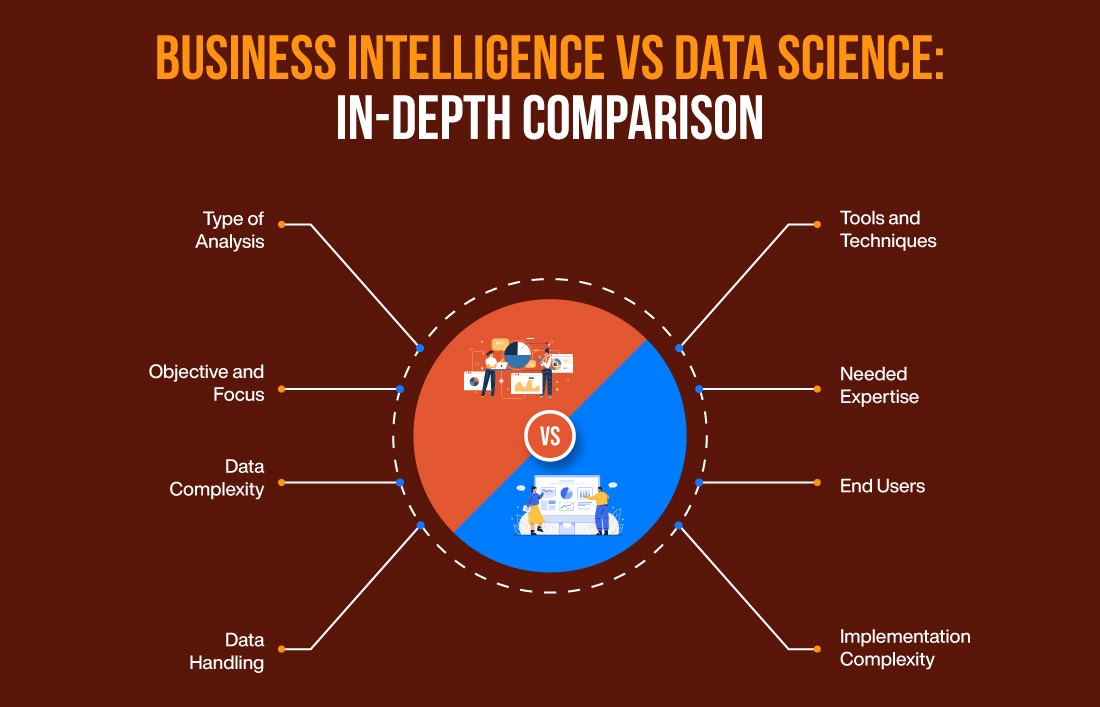
Type of Analysis
When talking about data science vs business intelligence, data science actually focuses on the probability of future scenarios and outcomes through predictive and prescriptive analysis approaches. By utilizing historical data, it is feasible to predict business trends, customer behavior, and performance outcomes.
On the other hand, business intelligence (BI) focuses on descriptive and diagnostic analysis to better understand what has happened in the past and why it happened. BI is often used to generate reports and visualizations that help businesses look at a clear picture of current performance.
Objective and Focus
The primary objective or purpose that business intelligence serves is to help businesses keep track of their past and present performance through interactive, easy-to-understand reports. BI tends to be general in terms of objective and scope. It is often about optimizing processes, improving efficiency, and driving short-term growth.
Data science has a broader scope and focuses on highlighting unknown data patterns, deducing future predictions, and providing actionable insights to make strategic decisions. Through advanced analytics and ML algorithms, data science can be used to support long-term innovation and automate decision-making.
Data Complexity
Data complexity is indeed a decisive factor that can help you select whether data science or business intelligence is beneficial for your business. BI usually works with structured data that’s easy to organize, like sales figures, financial data, and customer transactions. This data is already organized in databases or spreadsheets, so no additional effort is needed for structurization.
While data science deals with complex, vast, and diverse data sets. These diverse data sources may include structured, semi-structured, and unstructured data in the form of text, images, sensor data, or other values. Hence, advanced techniques and tools are required to process and simplify such data complexities.
Data Handling
Talking first about data science, data handling is quite complex as compared to business intelligence. That is because data science involves significant data processing, cleansing, transformation, and feature engineering to prepare data for advanced modelling and analysis.
In business intelligence, data handling basically revolves around data organizing, cleaning, and visualizing through visually appealing dashboards and insightful reports. It’s focused on presenting the data in ways that are accessible and actionable for non-tech stakeholders and decision makers.
When comparing business intelligence vs data science in terms of tools and techniques, business intelligence is more focused on data visualization and reporting. Cutting-edge tools like Power BI, Tableau, Excel, and QlikView enable organizations to create intuitive, visually appealing dashboards and interact with key metrics through descriptive analytics techniques.
Data science, on the other hand, takes a more advanced and technical route. It leverages next-generation ML and AI algorithms, along with statistical modeling, to process data at a deeper level. Tech stacks like Python, R, TensorFlow, and scikit-learn are combined with data science to build predictive models, automate data analysis, and uncover complex patterns that go beyond traditional reporting.
Needed Expertise
Data science is indeed the domain of expertise for data scientists. The advancements of this ML-driven approach demand a higher level of expertise, which includes having deeper knowledge and skills in statistical analytics, programming, machine learning, and data modeling. It typically requires experienced data scientists or ML engineers to get the most out of data science.
Business analysts are closely associated with business intelligence and must possess strong skills in data querying, visualization tools, and business operational knowledge. Business analyst training equips professionals with these essential capabilities, enabling them to analyze data effectively, create insightful visual reports, and support data-driven decision-making within organizations. Analysts and business users who are familiar with such tools can effectively extract actionable insights for informed decision-making.
End Users
Business decision-makers, managers, and executives who need quick, accessible insights to make day-to-day operational or strategic decisions are the end users for business intelligence. Generally, most of the BI users are non-technical stakeholders who make decisions based on dashboards and reports.
Data science insights are used by data analytics teams, product teams, and tech leaders who need to implement models, automate processes, and make strategic predictions. Users who utilize data science are often more technically proficient. And, they are well-versed in working with complex data and algorithms.
Implementation Complexity
When comparing business intelligence vs data science in terms of implementation complexity, BI tools are far easier to deploy and integrate with existing business systems. Even without deep technical expertise, organizations can quickly set up BI platforms, making them ideal for delivering rapid, business-ready insights.
In contrast, implementing data science solutions is more complex and time-intensive. These platforms demand specialized skills, extensive data preparation, and iterative model development, often requiring expert support to ensure successful deployment.
Empower Your Business With Predictive Insights
Hire data scientists from Bacancy who can help transform your complex data into valuable, action-driven insights through building and implementing innovative solutions.
Business Intelligence And Data Science - Key Similarities
The BI vs data science debate leads us to explore the significant differences between data science and business intelligence, but you should know that they also share several similarities. Both these data-driven approaches use data to provide meaningful insights for any business or organization. Here are some other similarities:
- Data-Driven Approach: BI and data science both platforms utilize data to extract meaningful insights that act as a central asset to support decision-making.
- Data Quality Matters: Whether you’re using BI tools or data science models, the principle of “garbage in, garbage out” applies to both of them. In simple terms, poor data quality leads to poor results.
- Business Value Focus: The core aim of BI and data science is to improve business outcomes by using the power of data to analyze trends, patterns, and insights from structured and unstructured data.
- Collaborative by Nature: Neither of them works appropriately in silos. It is crucial to have cross-functional collaboration between departments (IT, marketing, finance, etc.) for both platforms to deliver valuable outcomes.
- Technology-driven Approach: Both data science and business intelligence use modern tools and technologies like dashboards, data warehouses, machine learning, and visualization platforms.
- Supports Strategic Decision-Making: Whether it’s through predictive models or historical reporting, the use of business intelligence and data science both helps drive smarter, strategic, and informed decisions.
How Businesses Benefit From Using Data Science and BI?
By understanding the strengths of data science vs business intelligence, businesses can combine clear reporting with predictive insights. Using both together creates a stronger analytics foundation that supports smarter decisions and long-term growth. Here are some core advantages:
Comprehensive Decision-Making
Business intelligence can provide a clear understanding of past and present performance so that non-tech stakeholders can make informed choices. While data science can help businesses plan for future growth through accurate predictions, enabling proactive decision-making.
Increased Operational Efficiency
Utilizing modern BI tools can help identify inefficiencies in processes and turn data into insightful reports to increase operational efficiency. While data science-driven systems can help automate processes, reduce guesswork, and predict performance bottlenecks.
Customer Behavior Insights
Businesses can use business intelligence (BI) to track customer behavior patterns, achieve KPIs, and analyze trends. Meanwhile, data science models can assist in forecasting customer churn rates, predicting future buying behavior, and personalizing marketing campaigns.
Risk Management
With the help of data science, businesses can enable proactive threat detection by anticipating risks before they occur. Business intelligence tools provide clear visibility and real-time data monitoring to identify patterns and operational disruptions through dashboards and alerts.
Empower Teams Across Departments
From finance and marketing to operations and HR, easy-to-understand BI dashboards and advanced data science solutions empower individuals across different departments with the data-driven insights and strategies they need to perform their best.
Business Intelligence or Data Science: Which One Should You Choose?
After comparing data science vs business intelligence (BI), you will surely think about which one can benefit your business the most. Well, your choice will primarily depend on several aspects, such as your business goals, KPIs, data maturity, team expertise, decision-making needs, and more.
Choose Business Intelligence (BI) if:
- The focus is on analyzing historical data to monitor performance and track KPIs.
- Stakeholders prefer clear, visual dashboards and automated reporting tools.
- Your organization needs user-friendly tools for non-technical decision-makers.
- Most of your data is structured and stored in databases or spreadsheets.
- Operational efficiency and performance reporting are current priorities for your business.
Choose Data Science if:
- Your organization deals with large volumes of complex, raw, or unstructured data.
- There’s a need to predict future trends, model outcomes, or automate decisions using data.
- Data scientists or technical experts are available to build and maintain advanced models.
- You are looking to utilize machine learning algorithms and AI models to go beyond descriptive analytics.
- Strategic decisions of your business rely heavily on forecasting, optimization, or pattern detection.
Choose Data Science and BI if:
- You are seeking a data-driven culture that values both reporting and predictive intelligence.
- The business has enough resources, expertise, and data maturity to integrate both real-time BI dashboards and advanced data science solutions.
- Real-time business data monitoring with advanced forecasting is your priority.
- You need a future-ready, data-centric culture that supports informed decision-making across all business layers.
Conclusion
BI and data science are not rivals; they’re complementary capabilities that answer different kinds of business questions. BI provides dependable, easy-to-consume visibility into how the business is performing today; data science enables you to anticipate what’s likely to happen next and prescribe high-impact actions.
The real advantage comes when an organization uses both together: reliable dashboards to run the business and predictive models to change how the business operates.
If you’d like, we can create an efficient roadmap for your organization, whether it’s a BI rollout, a targeted data science pilot, or both integrated into a single, measurable program. Request a quote and let’s design the path that fits your goals.
Frequently Asked Questions (FAQs)
Business Intelligence focuses on analyzing past and current data to understand what has happened, while data science utilizes advanced models to predict future outcomes and inform decisions.
Small businesses do not have the needed data maturity and team expertise to implement complex data science solutions. So, they can begin with BI tools for real-time reporting and easier data access to boost their business growth through data-driven choices. As they scale, they can adapt data science for deeper, predictive insights.
Suppose your organization or business has been collecting large volumes of datasets from varied sources and has clearly defined goals. They can consider it the right approach to utilize the power of data science and move beyond historical reporting and explore predictive analytics.