Summary
AI is the future, but can it also secure your cloud workloads? In this blog, we highlight security challenges and the top 15 ways you can use AI in cloud security to seamlessly automate, protect, reduce manual effort, and keep your workflows stronger, safer, and more reliable.
Table of Contents
Introduction
Ever wonder how one tiny slip can turn into a massive data disaster? Take February 2024, for example. Change Healthcare, part of UnitedHealth Group, got hit by the ALPHV/BlackCat ransomware gang. They walked away with personal and health info for over 190 million people, all because of stolen credentials and an outdated server. (Source: aha.org).
The attackers gained access using stolen credentials and an outdated Citrix server. Ransomware quickly spread across CVS Health, Walgreens, and BlueCross BlueShield of Montana. However, not all data was recovered after paying a 22-million-dollar ransom, showing that traditional security alone is no longer enough.
Crazy, right? One small mistake, and suddenly, your sensitive data is on the line. This is where AI comes in. In 2026, it helps companies stay ahead of threats by:
- Spotting suspicious login activity before it turns into a breach
- Containing threats in real time before they spread
- Predicting vulnerabilities and risky attack paths before hackers exploit them
- Automating compliance and enforcing security policies without constant manual effort
AI works quietly in the background, helping protect cloud workloads so your business can keep running without interruptions.
In this post, we’ll walk through 15 ways AI in cloud security is making systems smarter and more reliable in 2026, so you can keep your data safe and your operations running smoothly.
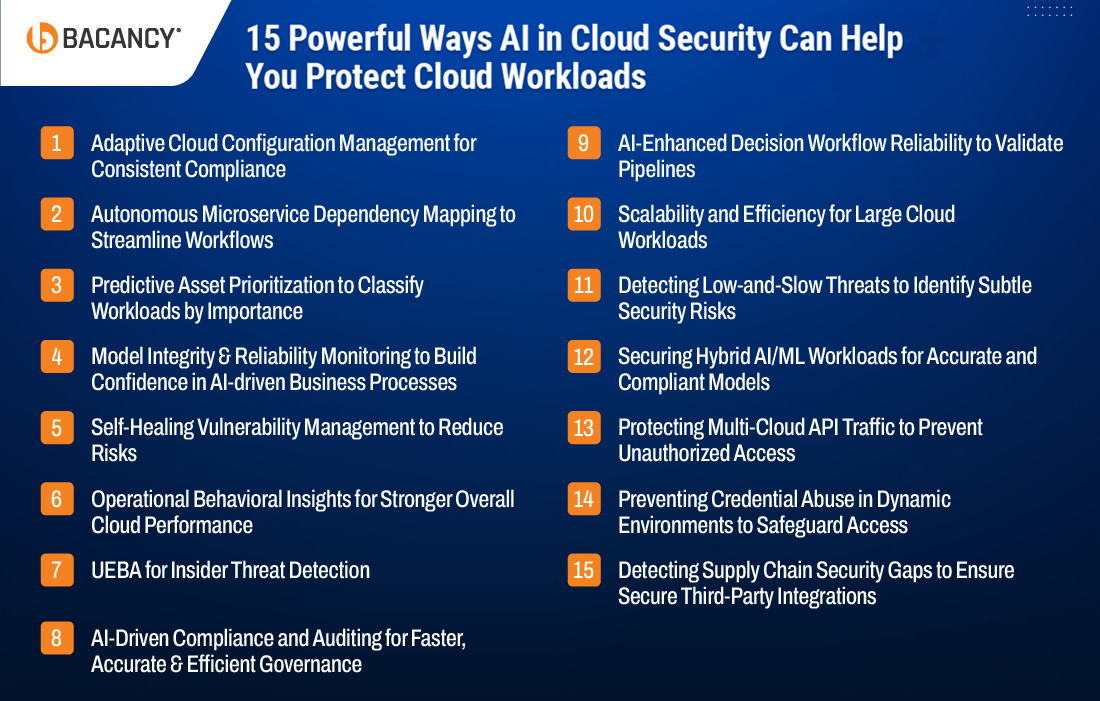
15 Powerful Ways AI in Cloud Security Can Help You Protect Cloud Workloads
AI for cloud security is transforming how organizations protect their environments by enabling smarter, faster, and more precise defenses. These 15 cloud security use cases show how AI in cloud security can proactively safeguard workloads, reduce risk, and streamline security operations.
1. Adaptive Cloud Configuration Management for Consistent Compliance
Managing cloud configurations requires proper alignment of IAM roles, network policies, storage permissions, and APIs across all cloud platforms.
Continuous review, policy simulation, and standards enforcement ensure optimized operations, strengthened security, and consistent compliance across the environment.
How AI Can Help in Cloud Configuration Management:
- Real-Time Drift Detection: Scans VMs, containers, and serverless functions to flag subtle deviations from approved configurations.
- Context-Aware Access Adjustments: Suggests precise permission or network rule changes based on live workload behavior.
- Cross-Cloud Policy Harmonization: Automatically synchronizes AWS, Azure, and GCP configurations to prevent gaps.
- Policy Impact Simulation: Predicts operational and security consequences before implementing changes.
- Continuous Standards Enforcement: Tracks compliance against CIS, ISO 27001, and other niche frameworks in real time.
Use Case
A global fintech company used an AI-based cloud security tool to monitor IAM roles and cloud storage permissions across AWS, Azure, and GCP. The tool detected a newly deployed Lambda function with excessive permissions, recommended stricter access, and simulated the change to ensure workflows continued safely.
2. Autonomous Microservice Dependency Mapping to Streamline Workflows
Maintaining clear visibility of microservice interactions and serverless workflows is essential for optimizing operations, enabling seamless communication, and enhancing overall system performance.
Understanding these dependencies helps teams streamline workflows, reduce latency, and ensure smooth, efficient service delivery.
How AI Can Help in Microservice Dependency Mapping:
- Live Interaction Mapping: Automatically generates up-to-date maps of all microservice and API interactions, revealing dependencies often missed in complex architectures.
- Anomaly Detection Across Services: Identifies unusual sequences or unexpected calls between services that may indicate misconfigurations or security risks.
- Impact-Based Risk Insights: Evaluates each service for potential impact on overall system security and operational performance, highlighting critical components.
- Automated Change Tracking: Monitors updates, deployments, and configuration changes, instantly flagging alterations that could break dependencies or introduce vulnerabilities.
- Actionable Remediation Suggestions: Recommends precise steps such as throttling risky calls, adjusting access rules, or isolating vulnerable services, ensuring smooth operations without manual guesswork.
Use Case
An e-commerce platform running Kubernetes, AWS Lambda, and Azure Functions, integrated Splunk AI and Dynatrace AI monitoring. The AI mapped service dependencies, detected unusual API calls from the payment service to a legacy inventory endpoint, and recommended throttling and updated access rules, preventing failed transactions and misconfigurations.
3. Predictive Asset Prioritization to Classify Critical Workloads
You need Predictive Asset Prioritization to classify workloads by importance, as it helps identify which assets are most critical, allocate monitoring and protection efficiently, and focus security efforts where they matter most.
By predicting asset risk and sensitivity, you can ensure high-value resources get continuous oversight, prevent potential threats from impacting key systems, and optimize resource use across your cloud environment.
How AI Can Help in Asset Prioritization:
- Dynamic Risk Scoring: Continuously evaluates workloads for sensitivity, business impact, and exposure to threats, assigning precise risk levels.
- Focused Monitoring: Highlights high-value resources, ensuring security teams can prioritize real-time monitoring and incident response.
- Adaptive Prioritization: Automatically reclassifies assets as workloads scale, change, or interact with new services.
- Exposure Pattern Correlation: Analyzes access logs, network flows, and API usage to identify assets at unusual risk.
- Actionable Recommendations: Suggests specific resource allocation or protection strategies based on workload behavior and risk trends.
Use Case
A healthcare SaaS provider on AWS RDS, S3, and Azure SQL used Microsoft Sentinel AI analytics. The AI ranked assets by risk, highlighting the primary EHR database as most exposed due to cross-region replication. Security teams applied stricter encryption and tighter access policies, reducing potential HIPAA violations.
4. Model Integrity & Reliability Monitoring to Build Confidence in AI-driven Business Processes
AI and ML models deliver their full potential when they operate with consistent inputs, validated pipelines, and reliable inference.
Maintaining ongoing monitoring and regular validation ensures accurate, trustworthy outputs, reduces errors in automated decisions, and builds confidence in AI-driven processes across your business.
How AI Can Help in Model Integrity & Reliability Monitoring:
- Data Integrity Checks: Continuously scans training datasets for anomalies, corruption, or tampering that could impact model reliability.
- Model Lifecycle Tracking: Monitors updates, deployments, and inference outputs to ensure consistency across environments.
- Prediction Validation: Compares predictions against trusted reference datasets to detect drift or deviations.
- Automatic Isolation: Flags and quarantines models that show inconsistent behavior or unreliable results.
- Retraining Triggers: Initiates targeted retraining workflows when deviations are detected, ensuring sustained accuracy.
Use Case
A bank running fraud detection models on AWS SageMaker and Azure ML deployed AI-driven ML monitoring tools. The system checked incoming data and model outputs, detected anomalies from a new SageMaker model, quarantined the model, and triggered retraining workflows, preventing financial misclassifications.
5. Self-Healing Vulnerability Management to Reduce Risks
Cloud workloads, including VMs, containers, serverless functions, and networks, need continuous monitoring for hidden or emerging vulnerabilities that could be exploited.
You need to monitor system configurations, patch levels, access controls, and network settings to reduce risk and maintain resilient workloads.
How AI Can Help in Vulnerability Management:
- Automated Vulnerability Detection: Continuously scans all workloads for missing patches, insecure configurations, or exploitable misconfigurations.
- Configuration Risk Identification: Identifies IAM role misassignments, excessive permissions, network exposure, and storage misconfigurations.
- Seamless Remediation: Suggests or applies corrective actions automatically, minimizing manual intervention and operational disruption.
- CI/CD Integration: Ensures security checks are embedded in deployment pipelines to prevent insecure code or configurations from going live.
- Predictive Prevention: Leverages historical vulnerability trends to proactively anticipate and prevent recurring security issues.
Use Case
A SaaS provider with multi-region containers in EKS and AKS used AWS GuardDuty AI to scan for misconfigurations. When a container exposed sensitive ports publicly, AI applied correct network policies, patched vulnerabilities, and prevented potential attacks without human intervention.
Understanding normal activity patterns for users, services, and workloads helps identify anomalies and maintain smooth, efficient operations.
Leveraging this strategy provides continuous visibility, prevents disruptions, and enables teams to optimize workflows for stronger overall performance.
How AI Can Help in Operational Behavioral Insights:
- Baseline Behavior Learning: Establishes detailed activity norms for users, services, and workloads across cloud environments.
- Anomaly Detection: Flags unusual behaviors that may indicate performance degradation, misconfigurations, or early security incidents.
- Workflow Optimization: Provides concrete insights to optimize task sequencing, resource allocation, and system performance.
- Hybrid Cloud Correlation: Analyzes activity across multi-cloud platforms to detect cross-environment anomalies or inefficiencies.
- Continuous Updates: Adjusts baselines dynamically as workloads, users, or systems evolve over time.
Use Case
An online gaming platform on AWS and GCP used AI to analyze user and service activity. AI noticed unusual login spikes at 3 AM from a service account with excessive privileges and recommended access adjustments to keep operations smooth.
7. UEBA for Insider Threat Detection
Monitoring privileged accounts, service accounts, and unusual access patterns through User and Entity Behavior Analytics (UEBA) helps identify early signs of insider threats and compromised credentials before they escalate.
Adopting this approach ensures enhanced visibility into user and entity behavior, strengthens oversight, and enables timely, targeted responses to high-risk activities that might otherwise go unnoticed.
How AI Can Help in UEBA for Insider Threat Detection:
- Advanced Account Risk Scoring: Continuously evaluates user and service account behavior to determine potential insider threat risk.
- Suspicious Activity Detection: Identifies unusual login locations, privilege escalations, or irregular API usage that could indicate account compromise.
- Cross-Service Threat Correlation: Links suspicious activity across multiple accounts, cloud services, and applications to detect coordinated misuse.
- Automated Threat Containment: Recommends or initiates isolation of high-risk accounts, temporary revocation of access, or session termination to limit exposure.
- Subtle Threat Recognition: Detects low-and-slow insider attacks, such as minor but persistent privilege abuse, that may otherwise go unnoticed.
Use Case
A media company using Office 365, G Suite, and AWS IAM integrated UEBA AI tools like Exabeam AI and Splunk User Behavior Analytics. The AI monitored account activity, detected a marketing employee attempting to download large datasets outside working hours, temporarily blocked access, and alerted security teams before data leakage occurred.
8. AI-Driven Compliance and Auditing for Faster, Accurate & Efficient Governance
Key areas like cloud configurations, user access controls, resource usage, encryption settings, and logging policies must be continuously monitored to ensure compliance with standards like CIS Benchmarks, SOC2, or ISO 27001.
Following these practices helps maintain alignment with industry frameworks, strengthens governance, and makes compliance management faster, more accurate, and more efficient.
How AI Can Help in Compliance & Auditing:
- Continuous Compliance Tracking: Monitors every configuration, access control, and encryption setting across cloud resources.
- Real-Time Dashboards: Provides actionable dashboards highlighting deviations from compliance frameworks.
- Actionable Remediation: Suggests specific steps to correct gaps before they impact audits or security posture.
- Operational Integration: Embeds compliance checks into daily workflows to prevent drift.
- Audit Automation: Generates ready-to-use reports, reducing manual review while improving accuracy.
Use Case
A global manufacturing firm using Azure, AWS, and connected IoT devices deployed Microsoft Sentinel AI analytics. The AI scanned all cloud configurations in real time, comparing them against ISO 27001 and CIS Benchmarks. It detected unencrypted IoT data in an S3 bucket, applied the correct encryption automatically, and generated audit-ready reports, reducing manual effort and ensuring continuous compliance.
Transform your approach to cloud protection with AI-powered automation and intelligent risk detection.
Partner with Bacancy’s cloud consulting services to secure workloads, simplify audits, and ensure business continuity.
9. AI-Enhanced Decision Workflow Reliability to Validate Pipelines
AI/ML-driven workflows need to process data consistently and deliver accurate outputs to support dependable operations.
Using AI in cloud security to validate pipelines, monitor transformations, and secure each step ensures results remain trustworthy, protected, and free from errors.
How AI Can Help in Workflow Reliability:
- Pipeline Monitoring: Tracks all stages of AI/ML workflows to detect anomalies in real time.
- Transformation Validation: Ensures data transformations comply with reference datasets and business rules.
- Deviation Detection: Flags inconsistencies or unexpected outputs in workflow processes.
- Automated Isolation: Quarantines problematic components to prevent downstream errors.
- Retraining Recommendations: Suggests targeted adjustments to restore workflow reliability and maintain accuracy.
Use Case
A logistics company using Azure ML pipelines integrated AI-driven workflow monitoring tools. The AI monitored all pipeline stages and data transformations in real time, detected invalid routes caused by a corrupted CSV file, quarantined the affected pipeline, corrected the data automatically, and retrained the model, ensuring accurate route optimization decisions without manual intervention.
10. Scalability and Efficiency for Large Cloud Workloads
Securing large cloud environments means monitoring massive volumes of logs, events, and network flows across regions to maintain continuous visibility and control.
Understanding these patterns ensures faster detection of issues, smarter allocation of resources, and consistent protection at scale.
How AI Can Help in Scalability & Efficiency:
- Real-Time Log Processing: Continuously analyzes logs from CloudTrail, CloudWatch, Stackdriver, and Azure Monitor to provide instant visibility into activities.
- Cross-Cloud Correlation: Links events across hybrid and multi-cloud platforms, creating a unified view of potential risks.
- Threat Prioritization: Assigns high-fidelity risk scores to incidents, ensuring security teams focus on the most critical issues first.
- Anomaly Detection at Scale: Detects unusual patterns in massive datasets, helping uncover hidden threats and irregular activities.
- Efficiency Optimization: Automates repetitive monitoring tasks, reducing manual effort while strengthening overall security oversight.
Use Case
A multinational retailer using AWS CloudTrail, Azure Monitor, and GCP Stackdriver integrated AI-driven monitoring tools. These tools analyzed millions of daily events in real time, detected unusual spikes in checkout API requests across regions, prioritized incidents based on risk, and automatically triggered throttling to prevent system overload and potential fraud.
11. Detecting Low-and-Slow Threats to Identify Subtle Security Risks
In cloud environments, it’s important to pay attention to subtle patterns that can indicate a potential breach. Accounts accessing unusual resources, irregular login times, and slow data transfers over weeks or months are signs that need careful monitoring.
Tracking these behaviors consistently and identifying anomalies early is essential to preventing small issues from turning into serious security incidents.
How AI Can Help in Low-and-Slow Threat Detection:
- Behavior Monitoring: Continuously tracks user activity across SaaS applications like Salesforce, Office 365, and Workday to identify unusual patterns.
- Long-Term Pattern Analysis: Observes extended access trends to detect slow or subtle anomalies over weeks or months.
- Data Flow Insights: Analyzes interactions between internal databases and cloud storage to spot irregular activity.
- Risk Prioritization: Flags abnormal account behavior and highlights the most critical threats first.
- Automated Alerts: Provides timely notifications to security teams, reducing manual oversight while maintaining vigilance.
Use Case
A healthcare provider’s AI security system flagged a developer account accessing patient records across multiple regions at unusual hours over several months. The investigation revealed a misconfigured backup process that exposed sensitive data. Early action prevented a HIPAA violation and costly breach.
12. Securing Hybrid AI/ML Workloads for Accurate and Compliant Models
AI and ML workloads often span cloud platforms such as AWS SageMaker, Azure ML, and on-prem environments. These distributed models rely on sensitive datasets and critical training pipelines, so unauthorized access, misconfigurations, or unexpected changes can affect predictions, compromise data integrity, and introduce compliance risks.
Closely tracking access and monitoring model operations is essential to ensure accuracy and security.
How AI Can Help in Hybrid AI/ML Security:
- Pipeline Monitoring: Continuously observes ML pipelines for unauthorized access or unexpected changes.
- Data Access Tracking: Monitors access to training datasets stored in S3, Azure Blob Storage, or on-prem repositories.
- Inference Analysis: Evaluates inference outputs in production to detect anomalies or deviations from expected behavior.
- Policy Enforcement: Automatically enforces compliance rules and access policies to maintain model accuracy and regulatory standards.
Use Case
A financial services firm running fraud detection ML models used Azure Sentinel AI and UEBA tools to detect a researcher querying production models from an unregistered Azure VM. The system immediately blocked access, logged the incident, and sent detailed reports, protecting sensitive predictions and ensuring regulatory compliance.
13. Protecting Multi-Cloud API Traffic to Prevent Unauthorized Access
APIs connecting AWS, Azure, and GCP handle large volumes of traffic and critical service integrations. Unusual request sequences, sudden usage spikes, or misconfigured integrations can introduce vulnerabilities, enabling attackers to steal data or escalate privileges. Monitoring API activity across multiple clouds is crucial to maintain security and operational continuity.
How AI Can Help in Multi-Cloud API Security:
- API Call Inspection: Monitors calls for AWS API Gateway, Azure Functions, and GCP Cloud Endpoints to detect unusual activity.
- Pattern Analysis: Identifies irregular sequences, spikes, or malicious payloads in multi-cloud API traffic.
- Automated Blocking: Instantly blocks risky requests before they can cause harm.
- Threat Alerts: Sends timely notifications to security teams for investigation and remediation.
Use Case
An e-commerce company integrating Shopify with AWS Lambda and Azure Logic Apps used AWS GuardDuty AI and Azure Sentinel AI to detect unusual bulk API requests. The system automatically blocked the requests and alerted the security team. Investigation revealed a compromised vendor integration, preventing large-scale data leakage.
14. Preventing Credential Abuse in Dynamic Environments to Safeguard Access
Temporary cloud resources, ephemeral containers, and short-lived access keys (such as AWS IAM temporary credentials or Azure Managed Identities) can be misused for privilege escalation or unauthorized access. Monitoring these fast-changing credentials and identifying abnormal usage patterns is critical to maintaining secure cloud environments.
How AI Can Help in Credential Abuse Prevention:
- Credential Activity Tracking: Observes activity across ephemeral containers and temporary access keys.
- Abnormal Access Detection: Flags unusual access to cloud databases or sensitive resources.
- Privilege Escalation Alerts: Detects sudden or unauthorized privilege changes in real time.
- Automated Remediation: Revokes suspicious keys or triggers MFA to prevent unauthorized access.
Use Case
A SaaS platform managing ephemeral developer keys in Kubernetes used an AI-driven credential monitoring system to spot a key being accessed outside its assigned cluster and time window. The system automatically revoked the key, alerted administrators, and prevented unauthorized access to production databases.
15. Detecting Supply Chain Security Gaps to Ensure Secure Third-Party Integrations
Third-party services, vendor tools, and external integrations such as ERP systems, CRM plugins, and CI/CD pipelines can introduce hidden risks. Misconfigurations, insecure data flows, or non-compliant transfers may compromise sensitive information if not closely monitored.
Keeping track of these dependencies is essential to prevent potential security breaches.
How AI Can Help in Supply Chain Security:
- External Data Flow Monitoring: Tracks data movements from SaaS tools, CI/CD pipelines, and API connectors.
- Configuration Analysis: Flags insecure setups and unusual activity in third-party services.
- Compliance Checks: Detects non-compliant data transfers and policy violations.
- Risk Mitigation: Isolates risky services and recommends corrective actions for security teams.
Use Case
A logistics company utilizing Salesforce, NetSuite, and a third-party shipment tracking SaaS had Azure AI Anomaly Detector identify a service transmitting shipment data over HTTP instead of HTTPS. The system isolated the service, alerted the security team, and recommended secure updates, preventing potential data exposure.
7 Best Practices for Implementing AI-Driven Cloud Security
Here’s how you can implement AI and cloud security best practices to strengthen your environment and stay ahead of threats:
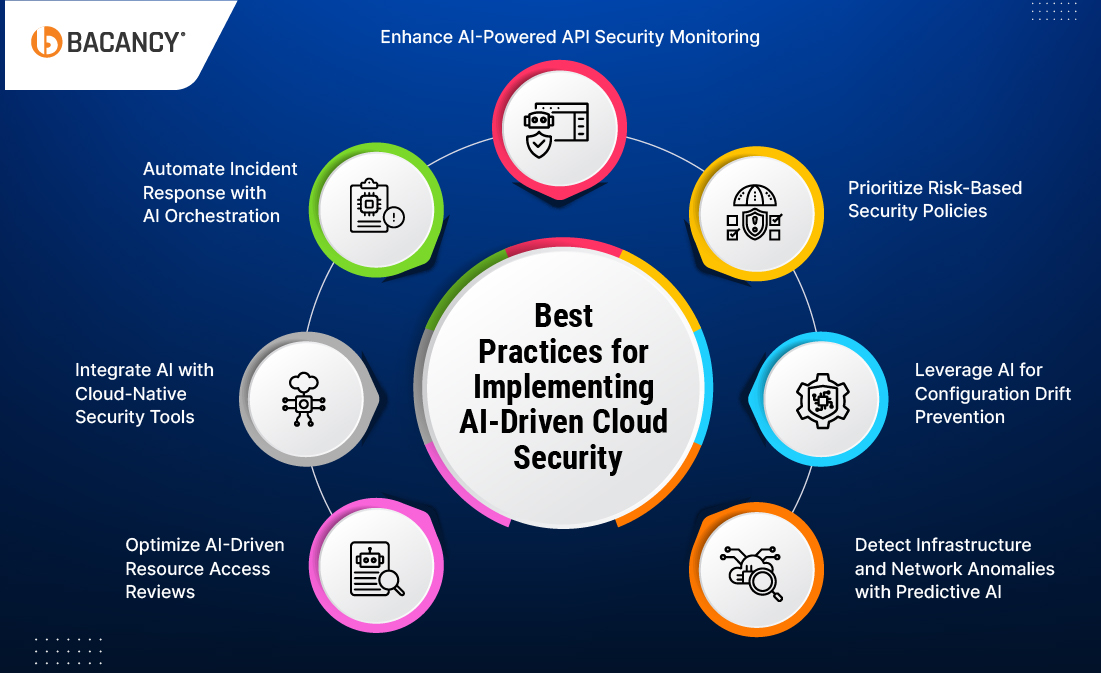
1. Optimize AI-Driven Resource Access Reviews
Continuously monitor who accesses cloud resources, how often, and for what purpose. With AI systems analyzing access logs and permissions, you can identify inactive accounts or users with excessive privileges and adjust access proactively.
Example: A financial services company used an AI system to scan AWS S3 access logs. It detected a developer account with full admin rights that hadn’t been used in months. The AI recommended revoking access, reducing the risk of misuse without affecting active workflows.
Combine AI with native security platforms like AWS GuardDuty, Azure Sentinel, or Google Security Command Center. Correlate events across tools to detect threats faster and uncover patterns that manual checks might miss.
Example: AI detected that a user had an unusual login in Azure AD while simultaneously attempting to access restricted S3 data in AWS. This correlated activity triggered an automated alert, preventing a potential cross-cloud breach.
3. Automate Incident Response with AI Orchestration
Link AI to automation services such as AWS Systems Manager, Azure Logic Apps, or GCP Cloud Functions. This allows immediate actions against threats, reducing response times and human error.
Example: During a Kubernetes cluster breach, the AI system detected abnormal activity on one node, automatically isolated it, revoked suspicious IAM permissions, and alerted the security team, stopping lateral movement before sensitive data was compromised.
4. Enhance AI-Powered API Security Monitoring
Monitor API usage in real time. AI can detect abnormal activity, flag misuse, and prevent unauthorized access to sensitive data.
Example: A SaaS company noticed unusual API calls that attempted to extract customer data. AI flagged these calls as anomalous, allowing the security team to block them before any data was exposed.
5. Prioritize Risk-Based Security Policies
Not all resources are equally critical. Use AI to rank workloads by risk and apply stricter controls to high-value assets. Continuous monitoring ensures sensitive resources stay protected.
Example: An e-commerce platform used AI to identify the payment processing services that were most at risk. The platform then applied stricter access controls and continuous monitoring specifically for those services, reducing potential financial loss.
6. Leverage AI for Configuration Drift Prevention
Cloud configurations change constantly, which can introduce vulnerabilities. Use AI to detect deviations from approved baselines and recommend corrective actions.
Example: An AI-integrated system noticed that a previously secure database had its encryption settings altered during an update. It automatically suggested reverting to the approved baseline, maintaining compliance and preventing exposure of sensitive data.
7. Detect Infrastructure and Network Anomalies with Predictive AI
Use AI to analyze traffic and system behavior, predicting potential threats before they happen. Early detection helps prevent attacks like DDoS or lateral movement.
Example: A media company’s AI system detected unusual traffic spikes from an external IP, predicting a possible DDoS attack. Automated throttling and alerts allowed the IT team to mitigate the attack without downtime.
How Bacancy Strengthens Your Cloud Security with AI
Bacancy provides advanced cloud security services using AI in cloud security to protect and automate your cloud workloads. Our solutions address cloud security threats and risks, ensure compliance, enable multi-cloud monitoring, and secure AI models to keep your environment safe and efficient. Here’s how we help:
- AI-Powered Threat Detection & Automated Response: Implement Cloud Detection & Response (CDR) using AI/ML to monitor workloads, detect anomalies, and automatically mitigate threats in real time.
- Behavioral Analytics & UEBA Implementation: Deploy User and Entity Behavior Analytics to uncover insider threats, compromised accounts, and unusual activity across your cloud environment.
- Continuous Compliance Automation: Enable AI-driven compliance checks aligned with GDPR, HIPAA, SOC 2, and ISO standards. Automate audit reporting and enforce policies proactively.
- Multi-Cloud Monitoring & Risk Management: Centralize visibility and monitoring across AWS, Azure, GCP, hybrid, and containerized environments. Detect misconfigurations, suspicious API calls, and unusual traffic patterns as they happen.
- AI Model & Data Security in the Cloud: Protect proprietary AI models and sensitive datasets from unauthorized access, tampering, or adversarial attacks.
- Integration with Existing Security Workflows: Seamlessly connect AI insights to SIEM, IAM, incident response pipelines, or automation platforms like n8n without disrupting your current processes.
With these AI-powered practices in place, our team ensures that your cloud environment stays protected, resilient, and optimized for safety.
Frequently Asked Questions (FAQs)
AI in cloud security uses machine learning and artificial intelligence tools to monitor cloud environments, detect anomalies, automate threat responses, and enhance compliance. It helps organizations proactively secure workloads across AWS, Azure, GCP, and hybrid setups.
AI analyzes logs, user behavior, network traffic, and API calls in real time. It identifies unusual patterns, such as abnormal login attempts, sudden spikes in API requests, or misconfigurations, and prioritizes incidents based on risk.
Yes. Using User and Entity Behavior Analytics (UEBA), AI monitors account activity, detects unusual actions, and alerts security teams. It can even automatically isolate high-risk accounts to prevent potential data breaches.
AI continuously monitors configurations, access controls, encryption settings, and logging policies. It generates real-time dashboards, suggests remediation, enforces standards like CIS, SOC2, and ISO 27001, and automates audit reporting.
AI is especially effective for large-scale, multi-cloud workloads, including hybrid AI/ML pipelines, serverless functions, containers, databases, and APIs, where manual monitoring is challenging and risk exposure is high.
Yes. Advanced AI tools can detect vulnerabilities, recommend or apply corrections, enforce network policies, and patch systems without human intervention, reducing risk and operational overhead.
AI correlates events across AWS, Azure, GCP, and on-prem systems. It provides unified visibility, detects cross-cloud risks, harmonizes policies, and enables consistent protection across distributed workloads.
Absolutely. AI-driven monitoring tools can process millions of logs and events in real time, detect anomalies at scale, prioritize critical incidents, and optimize resource allocation, ensuring continuous cloud protection.