Quick Summary
At Bacancy, we see AI systems transforming businesses every day, but without proper governance, they can introduce bias, errors, and compliance risks. To tackle this issue, our experts have shared 10 proven AI governance best practices to help organizations build trustworthy, reliable systems that deliver measurable business results.
Table of Contents
Introduction
When you look at the current state of modern businesses in 2026, you’ll notice AI integrated into rapid decision-making, trend analysis, and improved customer experiences. But here’s the catch: most companies don’t really know if their AI is making the right choices or following proper rules.
When we talk about “AI governance,” we refer to the process of ensuring that your AI systems act as intended, follows proper procedures, and produces fair, safe, and reliable outcomes. But, here’s a quick question; is your AI system actually being led by a sound process that produces trustworthy results every time?
A good example that comes to mind is Microsoft’s Responsible AI Program. After its chatbot Tay started posting offensive and harmful content because it had no safety guardrails.
Microsoft built a governance framework that includes an ethics review committee, tools to identify and address bias, and clear principles to ensure AI behaves fairly and safely. This shows how strong AI governance can prevent real problems before they reach users.
At Bacancy, with years of expertise, our AI experts have identified 10 non-negotiable AI governance best practices. Following these tips can ensure your AI systems are safe, reliable, and actually useful, whether you are just starting with AI or managing multiple systems.
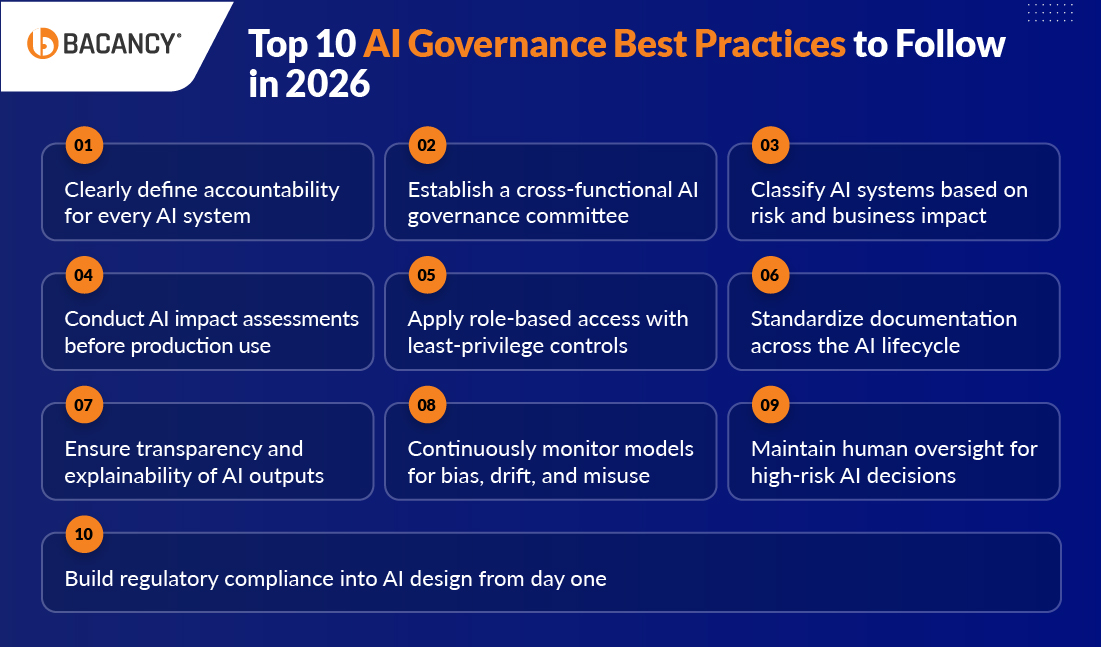
Top 10 AI Governance Best Practices to Follow in 2026
Here are the AI governance best practices recommended by our experts to help you keep your AI systems safe and reliable.
1. Clearly Define Who Is Accountable for AI Decisions
In a traditional software cycle, the “Product Owner” is the boss. With AI, it’s messier because the data, the model, and the deployment environment all keep changing constantly. AI accountability here means identifying the right person who “owns” the risk at every stage of the lifecycle.
Key Actions To Follow:
- Pick a person or team to lead every AI model, system, or project, specially in high-risk areas like healthcare or finance.
- Keep a complete record of which data was used, how the model was built, and any changes made, making it easier to trace decisions later.
- Check AI systems regularly, weekly or bi-weekly, to identify any unwarranted behavior or risks in time.
- Hold regular review meetings to discuss AI behavior, spot risks, and decide on corrective actions.
How Bacancy Can Help:
At Bacancy, we don’t just provide guidelines; we build systems that enforce accountability in practice. We:
- Integrate “Fail-Safe” Gatekeepers using tools like AWS SageMaker Model Monitor, MLflow, or Databricks Feature Store into your system to catch and remove outputs that are biased or don’t follow rules before they reach users.
- Implement “Versioned State Tracking” so you can see exactly how any AI decision was made, even months later.
- Build custom “Expert-in-the-Loop” interfaces so your staff can correct AI mistakes and use those corrections to improve future decisions.
- Automate the full compliance “paper trail” by generating real-time logs that meet strict audits like the European Union Artificial Intelligence Act (EU AI Act) or NIST standards.
2. Establish a Cross-Functional AI Governance Committee
The choices made by AI systems not only impact the engineers who develop them, but can also create a ripple effect throughout the entire organization.
For instance, an AI system that determines who qualifies for a loan can frustrate customers, create more workload for employees, or even create legal problems.
If only engineers are responsible for them, the potential risks may not be considered. Following AI governance best practices means bringing in legal, compliance, risk, and business experts to ensure that AI choices are thoroughly reviewed and aligned with the organization’s policies.
Key Actions To Follow:
- Bring legal, compliance, risk, and business teams together, not just engineers, so every perspective is considered.
- Never deploy an AI system live without formal sign-off, helping prevent costly mistakes later.
- Test models in real-world “what-if” scenarios to understand how they behave under pressure.
- Update rules and governance practices regularly, as laws, business priorities, and data evolve over time.
How Bacancy Can Help:
At Bacancy, we turn governance decisions into enforceable systems. We:
- Set up governance workflows so AI models cannot move forward without documented approvals.
- Build clear bias and risk reports that legal and compliance teams can easily understand using Power BI and Tableau dashboards.
- Implement policy-driven controls that restrict or halt models when predefined risk thresholds are exceeded.
- Create executive dashboards that give leaders a clear, real-time view of model health and compliance status.
- Automate pre-production checks using CI/CD tools like GitHub Actions, Jenkins, or CircleCI to ensure only approved and compliant models reach users.
3. Classify AI Systems Based on Risk and Business Impact
Not all AI systems require the same level of attention. A chatbot is low risk, whereas a system that chooses loans or approval can have an impact on the lives of the people and your business.
When you categorize AI according to impact, you can spend your time and resources where they actually count, and your decisions are less risky, and your business operations can run smoothly.
Key Actions To Follow:
- Create a simple AI risk governance framework with low, medium, and high levels based on decision impact, data sensitivity, and regulatory requirements.
- Include strict evaluation procedures for high-risk AI systems, requiring them to pass multiple tests before public release.
- Apply tighter review, testing, and approval processes for high-risk AI systems before they go live.
- Review AI models periodically, as their behavior, impact, or influence on business decisions can change over time.
How Bacancy Can Help:
At Bacancy, we turn AI risk management decisions into enforceable systems. We:
- Design a practical AI risk classification model aligned with your industry, regulations, and business priorities.
- Assign a risk level to every AI system and define appropriate governance controls.
- Integrate risk classification directly into your existing AI workflows so governance becomes part of delivery, not an afterthought.
- Provide structured evaluations for high-risk AI systems without slowing down innovation.
4. Conduct AI Impact Assessments Before Production Use
Before an AI system is used in real business workflows, it’s important to understand the impact it can create. An AI impact assessment can help your teams determine how their system will affect users and their data, decision-making processes, and business operations.
This process requires identification of potential risks, which must occur before the system becomes available to customers or starts operating in critical areas.
Key Actions To Follow:
- Review what the AI system is designed to do and which operational decisions it will influence.
- Identify who may be affected by the system, including customers, employees, and external partners.
- Check whether the system uses sensitive data and confirm that the data usage is permitted for its intended purpose.
- Assess what could go wrong if the model makes incorrect or biased decisions.
- Document the findings and obtain approval before allowing the AI system to move into production.
How Bacancy Can Help:
At Bacancy, we help teams clearly understand the real impact of AI before it goes live. We:
- Help teams focus on real business impact rather than only technical performance.
- Guide teams through practical impact and risk questions that are often overlooked.
- Create clear, audit-ready documentation to support regulatory and compliance reviews.
- Ensure that only reviewed and approved AI systems are released into production.
5. Apply Role-Based Access Along with Least Privilege Controls
AI systems involve multiple teams. Engineers build the models, data teams help you manage them, technical staff operate them, and business users rely on the results. However, not everyone needs full access to the models or data.
When too many people have access to sensitive data or can alter your AI model, even small mistakes can lead to major security or operational problems. Following AI governance best practices, you can implement Role-based access control, limit permissions, and give each person only the access they require to carry out their responsibilities.
Key Actions To Follow:
- Define clear responsibility for who will develop, test, operate, and modify the AI system.
- Grant access only to the information, configurations, and resources required for each role.
- Review access regularly and remove permissions when roles change or access is no longer needed.
- Monitor how sensitive AI systems are used to quickly detect any unusual or unauthorized activity.
How Bacancy Can Help:
Apart from defining clear access roles, setting up controls, and limiting permissions, here’s how we help:
- Replace broad roles like “engineer” or “analyst” with task-level access for activities such as data labeling, feature experimentation, model retraining, deployment approvals, and incident response.
- Enable fast experimentation while strictly securing production models, training data, and inference pipelines to prevent accidental changes from reaching live systems.
- Align permissions across cloud IAM, data platforms, model registries, and CI/CD tools such as AWS IAM, Azure RBAC, and GCP IAM to eliminate access gaps across training, deployment, and monitoring.
- Periodically review and adjust access as models evolve, responsibilities change, or new data sources are introduced to prevent long-term permission risks.
6. Standardize Documentation Across the AI Lifecycle
AI systems are continuously in the process of being developed, tested, and updated. Without proper documentation, it is very easy for your teams to lose track of which data is being used, the model version, or the assumptions applied.
It can easily lead to mistakes, slow down troubleshooting, delay audits, and make compliance checks more difficult. Standard documentation can help you make sure that everyone on your team is informed about what happened, why it was done, and who was involved in the process.
Key Actions To Follow:
- Record every AI model version, including the data used for training and any changes made.
- Document key decisions, assumptions, and testing results at every stage of the AI lifecycle.
- Track who reviewed, approved, or updated the model at each stage.
- Use consistent tools and templates so documentation remains clear and easy to understand.
How Bacancy Can Help:
Apart from setting up templates and guidelines, we:
- Help teams establish clear and consistent documentation practices across all AI projects.
- Assist in setting up workflows and tools to capture and automatically track model versions, critical decisions, and data changes.
- Ensure documentation stays up to date to support audits, troubleshooting, and smooth team handovers.
- Provide centralized dashboards and reports so teams can quickly access model history, data usage, and key decisions across all AI initiatives.
Ready to build and scale AI systems that remain compliant and trustworthy as regulations evolve?
Hire AI developers from Bacancy who can help you design reliable, scalable, and well-governed AI systems for 2026
7. Explain Transparency and Explainability of AI Outputs
AI systems can make decisions that can easily affect your customers, employees, or business processes. With unclear explanations, it might be difficult for your teams or even stakeholders to understand why a model produced a particular result.
Again, this can lead to misunderstandings, wrong business decisions, or even create difficulty in meeting compliance requirements. You need to make sure to follow AI governance best practices that include transparency and explainability, which helps everyone on the team understand how AI makes decisions and why.
Key Actions To Follow:
- Track how the AI model makes decisions and document which factors have the greatest influence on outcomes.
- Record important predictions, especially in high-impact areas such as lending and healthcare.
- Log all model updates, including new data, feature additions, or changes that may affect decision-making.
- Present results using clear charts, summaries, or simple explanations so they are easy for anyone to understand.
How Bacancy Can Help:
Apart from guiding your team on transparency and explainability, we:
- Set up practical tracking of model decisions to clearly show which factors influence each prediction.
- Build automated workflows that capture every model change and update, ensuring explainability is never missed.
- Deliver dashboards and visual tools that make AI outputs easy to interpret for both technical and non-technical teams.
- Provide ongoing support to maintain clear reasoning and confidence as models evolve over time.
8. Continuously Monitor Models for Bias, Drift, and Misuse
Once the AI models are deployed, over time, changes in data patterns, user behaviour, or even the business environment can cause models to behave differently, become biased, or work in ways you did not originally intend. They can slowly become biased, lose accuracy due to shifts in the data, or even be misused.
This can result in unfair decisions, outputs that cannot be relied upon, regulatory risks, and, most importantly, loss of trust from users and shareholders. However, continuous monitoring can help you to make sure that your AI systems remain reliable, ethical, and in alignment with your AI governance best practices.
Key Actions To Follow:
- Regularly monitor AI model performance to detect data drift, accuracy drops, or unexpected behavior.
- Track bias indicators to ensure decisions remain fair across different user groups.
- Set alerts for abnormal usage patterns that may signal misuse or unintended applications.
- Conduct periodic reviews of model outputs in high-impact areas such as finance, healthcare, and customer scoring.
How Bacancy Can Help:
Apart from setting up monitoring strategies, we:
- Implement automated monitoring pipelines to continuously track bias, data drift, and performance metrics.
- Define governance thresholds and alerting systems using tools like Prometheus, Grafana, or AWS CloudWatch to identify issues early.
- Build real-time dashboards that provide clear visibility into how AI models behave in production.
- Provide ongoing support for audits, retraining workflows, and compliance reporting to keep AI systems fair, reliable, and trustworthy.
9. Maintain Human Oversight for High-Risk AI Decisions
It is easy for AI systems to process large amounts of data quickly, but they are not able to understand the context or take responsibility like humans. Additionally, in high-risk areas such as lending, recruitment, healthcare, or fraud analysis, if decisions are made entirely by AI, mistakes can have serious consequences.
With human intervention, you can ensure that AI is used in decision-making without replacing accountability. This is because, with the right expertise, individuals can challenge or override the results of AI when the impact is high.
Key Actions To Follow:
- Clearly define which decisions should never be fully automated by AI, especially those affecting people’s rights, finances, health, or employment.
- Create rules that require human intervention when confidence levels are low or irregular situations occur.
- Log and review cases where humans override AI decisions to identify systematic model weaknesses early.
- Provide reviewers with sufficient context, including input data, confidence scores, and decision reasoning, to support informed judgment.
How Bacancy Can Help:
We build workflows and review interfaces that keep humans in the loop for high-risk AI decisions, ensuring accountability and continuous improvement. We:
- Design review workflows that automatically trigger human oversight when AI decisions cross defined risk or confidence thresholds.
- Capture every human correction and feed it back into the system to continuously improve model performance.
- Ensure human intervention is applied only where necessary, so everyday operations remain efficient.
- Build intuitive review interfaces that help teams easily understand AI decisions and quickly approve or correct outcomes.
10. Build Regulatory Compliance Into AI Design From the Start
The majority of AI development teams focus on getting AI systems up and running as soon as possible and consider regulatory compliance as an afterthought. This approach causes problems down the line because it takes longer and costs more to implement, which could have been done from the very beginning.
Today, regulations directly shape how AI systems handle data, make decisions, and reach users. They influence everyday design and operational choices from day one, not just final reviews. Following AI governance best practices means treating compliance as a core requirement from the very beginning, rather than a post-launch task.
Key Actions To Follow:
- Understand the laws and regulations applicable to each AI use case before starting development.
- Translate regulatory requirements into clear rules for data usage, model design, and deployment practices.
- Keep AI systems audit-ready by automatically recording decisions, approvals, and model changes.
- Design AI workflows so systems that do not meet compliance requirements cannot enter production.
How Bacancy Can Help:
We build AI systems with compliance embedded from day one using checkpoints and automated audits. We:
- Convert regulatory requirements into practical design and engineering rules teams follow during development.
- Implement compliance checkpoints that block unapproved or non-compliant models from going live.
- Automate evidence collection so audits are faster and far less disruptive.
- Design AI systems that adapt to evolving regulations, reducing long-term risk and rework.
Let Bacancy Be Your Partner in Responsible AI Adoption
As a trusted AI development company, Bacancy helps organizations build AI systems that remain reliable, compliant, and accountable as they scale. We design and deploy AI governance best practices into everyday development so teams can apply them naturally, without slowing down delivery.
Also, we focus on clear ownership, responsible decision-making, and continuous oversight so your AI systems can scale without introducing risk or uncertainty. Our experts also make sure that AI governance supports long-term trust, regulatory confidence, and sustainable growth, so your AI systems continue to create value well beyond their initial deployment.
Frequently Asked Questions (FAQs)
Here are the top five steps to implement AI governance in 2026:
Assign a clear owner to every AI system to maintain accountability.
Integrate technical, legal, compliance, and business elements in the AI process.
Use a systematic and repeatable approach to risk analysis and impact assessment.
Involve humans in important decision-making and sensitive domains.
Automate monitoring and maintain complete documentation.
Following AI governance best practices ensures disciplined testing, continuous monitoring, and human review of results. Cross-functional teams analyze decisions, perform impact assessments to identify potential bias, and dashboards or human-in-the-loop checks maintain fairness and accountability for high-risk AI models.
Teams can leverage platforms like AWS SageMaker Model Monitor, Databricks Feature Store, MLflow, Power BI, Tableau, Prometheus, Grafana, and CI/CD pipelines like Jenkins or GitHub Actions to enforce AI governance best practices and maintain compliance.
We include AI compliance from the start by identifying required regulations before development begins. Also, we build compliance checks, approvals, and audit trails into the AI pipeline so only approved models are deployed. Our AI systems are designed to adapt easily to regulatory changes, reducing risk and rework later.
Reviews should be conducted regularly to check for bias, drift, and anomalies. High-risk use cases may require weekly or monthly reviews, while lower-risk models can be reviewed quarterly.
Absolutely. Good governance is the foundation that ensures trustworthy AI decision-making, reduces errors and regulatory risks, increases the efficiency of operations, safeguards customer trust, and enables teams to scale AI safely without stifling innovation.