Quick Summary
By the help of this guide, you will notice how Enterprise AI agents are moving from pilots to production faster than ever in 2026, and how Model Context Protocol (MCP) is the reason behind it all. We have included an expert breakdown of real enterprise MCP server use cases, explaining how the MCP server reduces deployment timelines and is becoming a proven driver of enterprise ROI in 2026.
Table of Contents
Introduction
The majority of enterprises have spent the last two years building copilots, experimenting with autonomous AI agents. Yet the majority of those initiatives are stuck in their pilot mode, not because the models are failing, but because the infrastructure around them is. AI Agents break at the integration layer, and context becomes fragmented, governance is delayed, and promising pilots stall before they can become enterprise systems. This is the gap Model Context Protocol (MCP) fills.
When Anthropic introduced MCP in November 2024, it seemed like a technical standard for agent interoperability. By March 2026, it looked more like foundational infrastructure. SDK downloads grew from roughly 100K to 97 million per month; a 970x surge in 18 months, making MCP one of the fastest adopted enterprise integration standards in recent memory.
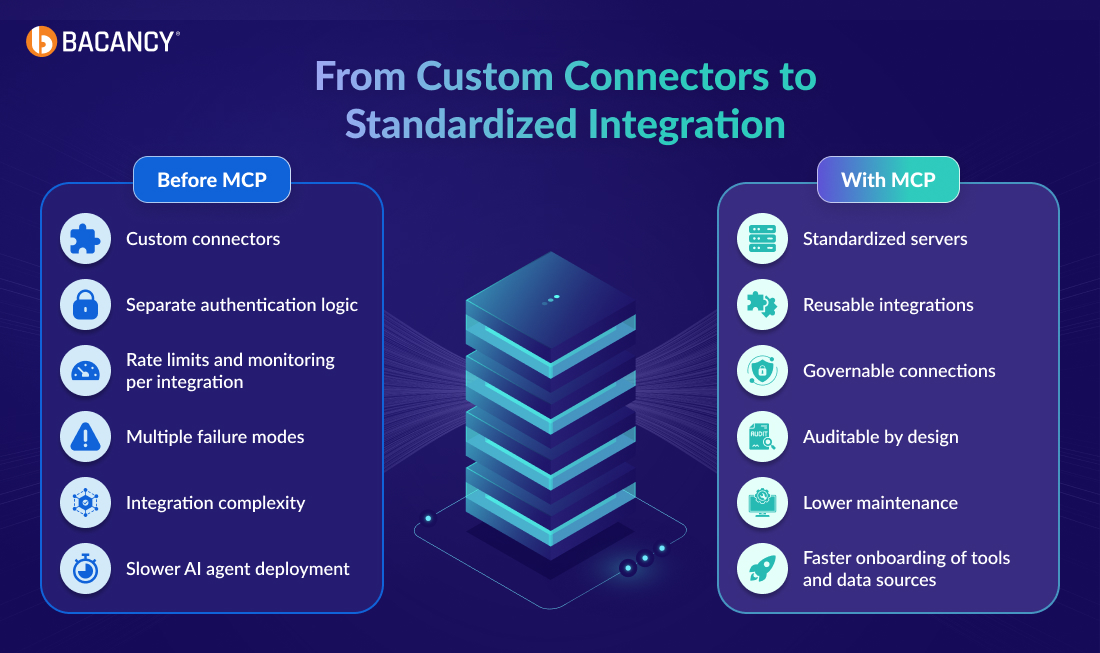
Before MCP, every enterprise AI agent needed its own custom adapters to reach CRMs, ERPs, ticketing systems, and internal databases. And each came with its own authentication logic, rate limits, monitoring, and failure modes. MCP introduced standardized servers that make integrations reusable, governable, and auditable by design.
This blog guide walks through how this shift unlocks value, the real enterprise MCP use cases delivering results across sectors, and how enterprise teams are prioritizing their own rollout.
The Enterprise Shifts From Standalone Chatbots to MCP Connected AI Agents
The biggest shift behind emerging use cases of MCP in enterprise is the evolution from chat-based assistants to agents who can actually perform tasks. At the beginning, enterprise chatbots were limited to answering questions, but they had little access to live systems and to complete multi-step tasks. That model created useful assistants, not autonomous workflows.
Employing the MCP server business use cases, agents can access live enterprise systems, retrieve real-time data, chain tools together, and conduct governed action across workflows. Instead of responding to prompts, they can also coordinate across work systems.
Pre-MCP Agent Stack (Chatbots) vs MCP-Based Agent Stack
| Capability | Pre-MCP Agent Stack (Chatbots) | MCP-Based Agent Stack |
|---|
| Tool Integration | Hard-coded per agent | Standardized through the MCP servers |
| Data Access | Limited or stale | Real-time enterprise access |
| Actions | Mostly read-only | Scoped actions with controls |
| Multi-System Workflows | Brittle orchestration | Native MCP tool chaining |
| Security | Fragmented controls | Centralized governance layer |
| New Tool Onboarding | Days to weeks | Hours |
Industry-Wise Enterprise MCP Use Cases & Their Real World Results
The strongest use cases of MCP in enterprise don’t behave like generic copilots. They are domain-centric agents connected through the MCP architecture integrated to live enterprise systems and operate inside governed workflows. Across industries, you will notice how agents are creating value and reducing manual work, improving decisions, or accelerating workflows.
Use Case 1: Healthcare & Life Sciences
Problem
Clinical workflows have been fragmented across systems such as EHRs, lab reports, imaging, and research databases. Accessing the complete patient report context takes a significant amount of time and increases administrative burden, delaying medical decisions.
What changes with AI Agents + MCP
Since AI agent deployment gets powered by MCP, it pulls structured patient data from multiple systems in real time and presents it in a single workflow.
- Retrieve patient history, medications, vitals, and labs instantly
- Support triage decisions with a complete clinical context
- Draft clinical notes from structured EHR data
- Match patients to trial criteria using live data
- Access systems like Epic Systems and Oracle Health through standardized MCP servers
- Combine structured (labs) and unstructured (notes) data in one context layer
- Enforce secure, audit-ready access aligned with healthcare compliance
How widely has it impacted the sector?
- Faster triage and clinical decision-making
- Reduced documentation workload for clinicians
- Shorter clinical trial recruitment cycles
- Safer and governed access to patient data within workflows
Build Scalable MCP AI Agents with Enterprise-Ready Expertise
If you already have a clear use case and need expert execution, you can hire AI agent developers from Bacancy to design, build, and deploy MCP-powered AI agents faster.
Use Case 2: Banking, Financial Services, and Insurance
Problem
Financial workflows such as fraud detection, underwriting, and compliance checks rely on fragmented data spread across transaction systems, KYC/AML databases, and policy platforms. Teams spend significant time consolidating this information manually, slowing decision-making while increasing exposure to fraud, regulatory risks, and operational inefficiencies.
What changes with AI Agents + MCP
Since AI agent deployment gets powered by MCP, it unifies financial data across systems and enables real-time risk analysis and workflow automation.
- Detect suspicious transaction patterns using live data streams
- Correlate KYC, AML, and behavioral signals across systems
- Generate investigation summaries and audit evidence automatically
- Assemble underwriting data and risk indicators in one workflow
- Connect transaction systems, policy tools, and audit logs through MCP
- Enable secure, permissioned access with complete traceability
How widely has it impacted the sector?
- Faster fraud detection and response times
- Reduced manual investigation and compliance workload
- Shorter underwriting and claims processing cycles
- Stronger auditability and regulatory compliance
Use Case 3: Retail and eCommerce
Problem
In the retail and e-commerce sector, customer, order, inventory, and logistics data are spread across disconnected systems, making it difficult to deliver fast support assistance and accurate forecasting. This fragmentation slows response times, creates missed sales opportunities, and leads to inconsistent customer experiences across channels.
What changes with AI Agents + MCP
Since AI agent deployment gets powered by MCP, it unifies customer and operational data into a real-time decision layer across retail workflows.
- Retrieve orders, shipping, and returns context in one interaction
- Resolve support queries faster with complete customer visibility
- Predict stock risks using demand and supplier signals
- Deliver personalization using live behavioral data
- Connect order systems, CDPs, and logistics platforms through MCP
- Enable cross-system orchestration across support, inventory, and fulfillment
How widely has it impacted the sector?
- Lower support handle time and faster resolution
- Fewer stockouts and improved inventory planning
- Higher conversion through real-time personalization
- Improved customer experience across touchpoints
Use Case 4: Manufacturing and Supply Chain
Problem
In manufacturing and supply chain operations, data across ERP, MES, SCADA, and sensor systems often exists in silos, limiting real-time visibility into inventory, production, and supplier performance. As a result, equipment failures, stock shortages, and quality defects are identified too late, increasing downtime, operational costs, and supply chain disruptions.
What changes with AI Agents + MCP
Since AI agent deployment gets powered by MCP, it connects operational systems and enables real-time, event-driven decision-making across manufacturing workflows.
- Monitor equipment and sensor data to detect failures early
- Trigger procurement using real-time inventory and supplier signals
- Identify defect patterns across production and supplier inputs
- Support faster root-cause analysis across operations
- Integrate ERP, MES, SCADA, and IoT data through MCP servers
- Enable automated workflows based on live operational events
How widely has it impacted the sector?
- Reduced equipment downtime and maintenance costs
- Faster detection and resolution of quality issues
- More efficient procurement and inventory management
- Improved end-to-end supply chain resilience
Use Case 5: Legal and Professional Services
Problem
Legal teams often rely on disconnected document systems, research tools, and regulatory sources, making contract review and compliance checks highly manual. This slows turnaround times, increases research effort, and raises the risk of missing critical regulatory updates and legal obligations.
What changes with AI Agents + MCP
Since AI agent deployment gets powered by MCP, it integrates internal knowledge and external regulatory data into unified legal workflows.
- Flag contract deviations against approved clause libraries
- Combine precedent analysis with live regulatory research
- Monitor regulatory updates and map impacts to active matters
- Support faster compliance review and approval processes
- Connect document systems and regulatory feeds through MCP
- Enable retrieval across structured and unstructured legal data
How widely has it impacted the sector?
- Faster contract review and turnaround times
- Reduced legal research effort and operational workload
- Improved consistency in compliance and documentation
- Proactive tracking of regulatory changes
Use Case 6: SaaS and Technology Companies
Problem
Engineering, DevOps, and support teams operate across multiple tools, code repositories, ticketing systems, logs, and monitoring platforms that require constant context switching. During incidents and operational workflows, this fragmentation slows diagnosis, increases manual effort, and delays resolution times.
What changes with AI Agents + MCP
Since AI agent deployment gets powered by MCP, it connects development and operations systems into a unified execution layer.
- Resolve tickets using code and issue context
- Correlate logs, metrics, and deployments during incidents
- Detect churn signals from product usage data
- Trigger operational playbooks automatically
- Integrate tools like GitHub, Jira, Datadog, and Snowflake through MCP
- Enable cross-tool orchestration and event-driven workflows
How widely has it impacted the sector?
- Faster incident detection and resolution
- Increased engineering and support productivity
- Reduced manual effort across DevOps workflows
- More proactive customer retention and churn prevention
Use Case 7: Logistics and Transportation
Problem
Logistics operations rely on coordination across routing systems, warehouses, carriers, and external data sources such as traffic and weather platforms. Since these systems often operate in silos, responding to real-time disruptions becomes difficult, leading to delivery delays, inefficient routing, and increased operational costs.
What changes with AI Agents + MCP
Since AI agent deployment gets powered by MCP, it enables dynamic, system-wide coordination across logistics and supply chain workflows.
- Adjust routes based on traffic, weather, and capacity conditions
- Optimize warehouse task allocation dynamically
- Match freight capacity faster across transportation networks
- Detect and respond to operational disruptions early
- Integrate TMS, WMS, telematics, and external data through MCP
- Enable continuous optimization through event-driven workflows
How widely has it impacted the sector?
- Lower delivery and operational costs
- Fewer delays and improved delivery timelines
- Better fleet and asset utilization
- Smarter capacity planning and routing decisions
Why is MCP the Foundation of Enterprise AI Agents?
Early enterprise AI agents often struggled not because models were weak but because integration didn’t scale. Every new agent needed custom connections into CRMs, ERPs, databases, and internal tools. Each workflow introduced responsibility to maintain APIs, authentication reviews, and orchestration overhead. Because of the constant weight of integration complexity, AI agent deployment slowed. But that has thoroughly changed with the adoption of the Model Context Protocol, which now makes it far easier to build AI agents that connect, scale, and operate across enterprise systems.
From Custom Connectors to Standardized Integration
Before MCP, scaling agents often led to integration debt. Every new use case needed another custom connector, another authentication pattern, and another point of failure. MCP brought standardized servers that made connections reusable, governable, and auditable by design. With this shift, the economics of AI agent deployment have improved in several ways:
- Lower maintenance across integrations
- Faster onboarding of new tools and data sources
- Reusable infrastructure across teams and business units
- Easier portability across models and agent frameworks
- Reduced vendor lock-in through standardized interfaces
Governance Became Part of the Architecture
Integration alone can’t explain the rapid Model Context Protocol enterprise adoption. Governance also plays a significant role. As enterprise AI agents proceed from answering questions to executing actions, they require control and supervision. MCP introduced governance as its protocol layer, not as an afterthought. Through MCP servers, enterprises can enforce:
- Least-privilege access controls
- Scoped read and write permissions
- Human approval for sensitive actions
- Audit logging and end-to-end observability
- Policy enforcement across tools, agents, and workflows
AI Agent Deployment Patterns Built on MCP Server
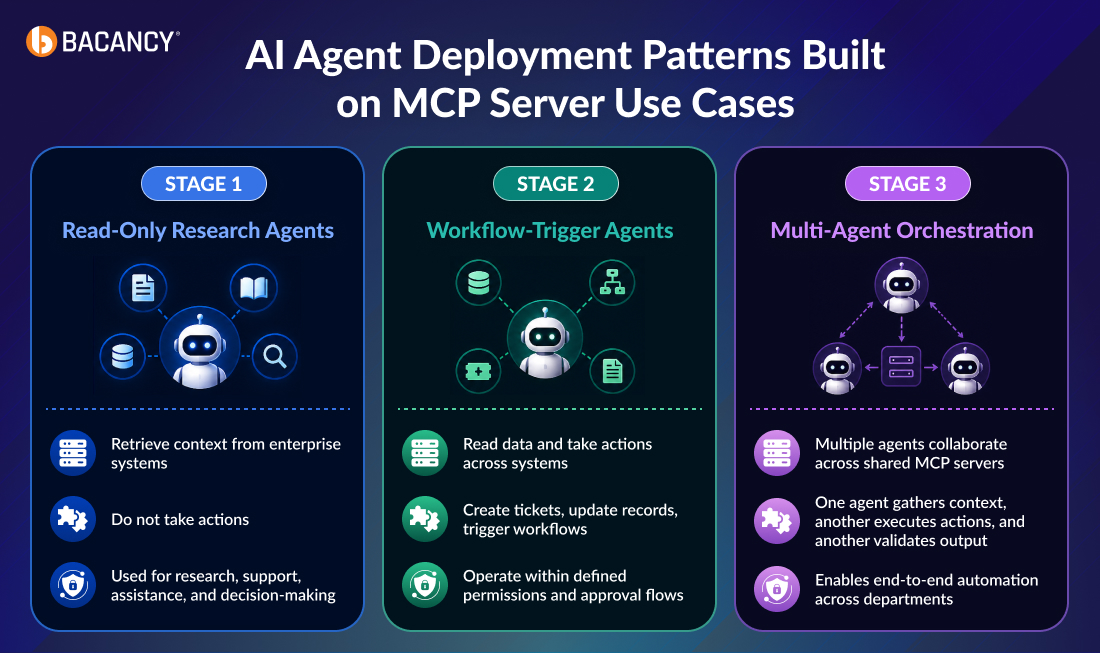
No matter how successful enterprise MCP use cases look, teams are not starting with fully autonomous systems. Instead, AI agent deployment, even with MCP, follows a mature curve based on the risk involved, control, and ROI.
Read-Only Research Agents
These agents are the fastest yet low-risk entry point for enterprise AI agents. Even after connecting with MCP servers, these agents can only retrieve context from enterprise systems, but do not take actions. They are generally used for internal research, support assistance, and decision-making.
Note: Ideal for validating the MCP server business use cases before scaling.
Workflow-Trigger Agents
Workflow trigger agents are where Model Context Protocol enterprise deployments begin to showcase real ROI. Agents here not only read data but also have the scope to take actions across systems via MCP. Tasks they can perform are:
- Create tickets, update records, trigger workflows
- Operate within defined permissions and approval flows
- Combine multiple systems into a single execution path
Multi-Agent Orchestration
The stage of multi-agent systems is more advanced for AI agent deployment. The group of specialized agents collaborates across shared MCP servers to complete complex workflows.
- One agent gathers context, another executes actions, and another validates output
- Enables end-to-end automation across departments
- Requires strong MCP design, orchestration logic, and monitoring
This is where 2026’s MCP-led AI agent deployments are heading beyond 2025 pilots
Pro Tip: To keep human approval for decisions involving money, compliance, or external communication is a core principle for successful enterprise MCP use cases.
Compressed AI Agents Deployment Timelines
Speedy deployment timelines are another prominent factor behind the rise in MCP enterprise use cases. Before MCP was introduced, deploying new agent workflows used to take quarters due to complex integrations, security reviews, and custom orchestrations.
Then, MCP came with its reusable infrastructure, and the timeline has been reduced significantly. Enterprises can now launch their pilots faster, add new features in hours, reuse proven deployment patterns, and move successful pilots into production without the need for reworking.
Move From MCP Pilots to Production With Confidence
Multi-agent orchestration and MCP server design require deep protocol-level expertise. You can hire MCP developers from Bacancy to architect, build, and scale governed MCP deployments without slowing your roadmap.
Security and Governance in Model Context Protocol Enterprise Deployments
As enterprise AI agents make a shift from pilots to production in 2026, security has become a core integral requirement for the deployment. In this shift, the MCP server deployment is no longer just an integration layer; it acts as a control plane for access, actions, and auditability.
| Separate MCP servers for different areas | Allow limited access to agents | Track everything agents do
|
|---|
Separate MCP servers are deployed per business domain
(finance, operations, customer data), each with clearly
defined read, write, and execution capabilities.
- Reduces risk by keeping issues contained within one area
- Makes compliance and audits easier to manage
- Allows better controls for sensitive data like financial records and personal information
|
MCP acts as a permission layer, helping teams avoid giving
agents broad access and keeping system permissions under control.
- Defines permissions for each read, write, and execute action
- Ensures agents only access the systems and data they need
- Prevents unwanted actions across connected platforms
|
With MCP managing the execution pathway for agent actions,
every action, update, and data interaction stays visible for
better trust and governance across enterprise AI systems.
- Records every action, data access, update, and trigger
- Supports compliance, debugging, and system monitoring
- Makes agent decisions easier to review and understand
|
ROI Patterns from MCP Enterprise Use Cases and AI Agent Deployment
As use cases of MCP in enterprise are moving from experimentation to production, it is very clear that ROI is coming from how systems are linked, not just from the AI models themselves. In most cases, the real value of AI agent deployment comes from the MCP server architecture, which reduces integration overhead and enables reusable, scalable workflows.
Where are Enterprises seeing ROI?
PwC research shows 79% of organizations now use AI agents to some degree, with 66% reporting measurable productivity improvements and 62% expecting ROI exceeding 100%.
| Faster time-to-deploy | Reduced engineering and maintenance effort | Productivity gains across teams |
|---|
Before MCP, every system required custom connectors, approvals,
and long testing cycles. With Model Context Protocol, enterprise
AI deployments become faster and easier to scale.
- Connects systems once and reuses them across multiple agents
- Launches new workflows in weeks instead of months
- Helps teams move from pilot projects to production faster
|
Custom integrations often created long-term maintenance overhead
across enterprise systems. With MCP architecture, teams can
simplify integrations and reduce operational complexity.
- One MCP server supports multiple agents and workflows
- Reduces effort spent maintaining fragile system connectors
- Allows engineering teams to focus more on workflows
|
Enterprise AI agents connected through MCP are improving
operational efficiency by giving teams secure access to
real-time systems, workflows, and business context.
- Support teams resolve queries faster with full context access
- Operations teams make quicker decisions using real-time data
- Engineering teams reduce context switching during incidents
|
Note: So, ROI for the enterprise is not driven by the model alone. It is also driven by the MCP server architecture, enabling reuse, speed, and control. Enterprises that consider MCP as infrastructure, not just integration, secure the fastest ROI.
The Future of Model Context Protocol (MCP), Enterprise, and AI Agent Systems
The next phase of Model Context Protocol enterprise adoption is already taking shape. The way MCP came as a standardized integration has quickly become the foundation for enterprise AI systems. It has evolved, defining how agents connect, collaborate, and operate under restrictions.
Vendor-native MCP ecosystems
Enterprise software vendors are beginning to ship built-in MCP servers.
- Reduces the need for custom integrations
- Standardizes how agents connect to widely used platforms
- Accelerates the adoption of enterprise AI agents across organizations
Cross-agent collaboration over shared MCP layers
AI agents are moving beyond isolated tasks toward coordinated workflows.
- Multiple agents operate over a shared MCP infrastructure
- One agent retrieves data, another executes actions, and another validates outcomes
- Enables end-to-end automation across business functions
Industry-specific MCP standards
Highly regulated industries are starting to define MCP-based standards.
- Pre-configured compliance and access controls
- Standardized data models and workflows
- Faster deployment in regulated sectors like healthcare and finance.
How Bacancy Helps Enterprises Deploy MCP-Powered AI Agents
Most MCP enterprise use cases did not fail because they chose the wrong model, but they failed because of architecture, governance, and integration, especially when connecting agents were never designed for AI support. Bacancy helps enterprises design MCP servers and deploy AI agents that scale beyond pilots. You can also refer to our well-descriptive guide based on AI agents’ use cases across industries in 2026.
AI Agent Strategy and MCP Server Architecture
The first step that needs to be taken before building anything is to decide what should be built and how. Many pilots fail because teams skip this layer, knowing which workflows actually justify an agent, where read-only ends and action comes, and how the MCP server architecture should be structured across business units.
Our team at Bacancy collaborates with stakeholders to identify the high ROI enterprise MCP use cases across departments, defining agent scope permissions and approval boundaries. Next, we map agent workflows to existing systems and data flows. Then our building phase starts, where we research agents, workflow agents, and multi-agent orchestration.
Custom MCP Server Development for Internal Systems
Many enterprises don’t solely run on SaaS. They also support legacy ERPs, internal tools, proprietary systems, and databases that don’t support MCP connectors.
We build custom MCP servers that bring these systems into your AI layer with full control and consistency. Each implementation includes scoped permissions, centralized audit, rate limiting, reusable design, and clear documentation for internal engineering teams.
Compliance-Ready AI Agent Deployment
In regulated industries or environments, compliance cannot be added later. It must be built into the Model Context Protocol enterprise layer from day one.
We design deployments aligned with:
- HIPAA (healthcare): PHI scoping, data residency, audit-ready logs
- SOC 2 Type II (SaaS/B2B): secure handling of customer data
- GDPR: privacy and data protection across regions
- ISO 27001 / PCI DSS (finance): security and risk alignment
Conclusion
Enterprise AI agents are not failing because of weak models, but because of the architecture they are built on. That’s what has changed in 2026. Model Context Protocol enterprise adoption didn’t grow rapidly because it was new, but because it solves the biggest challenges in AI agent deployment. It helps agents to connect to real systems in a way that is scalable, secure, and maintainable.
One thing is quite similar and prominent across industries: they are moving from pilot to production faster using the MCP server architecture. Their enterprise AI agents operate with clear restrictions, auditability, and control. As a trusted AI agent development company, Bacancy helps enterprises design and deploy MCP-powered agents that actually scale. The advantage in 2026 won’t come from better models alone, but from how well your enterprise connects, governs, and scales them through MCP server business use cases.
Frequently Asked Questions (FAQs)
The majority of enterprises follow an analytical approach, identifying workflows that are repetitive, regular, and time-consuming. The ideal starting point is not the most complex use case, but one where MCP in enterprise environments can clearly reduce integration effort and improve cross-system visibility.
Yes, this is one of the practical MCP server business use cases that enables connectivity with legacy systems. Enterprises can develop custom MCP servers that act as an abstraction layer and enable AI agents to interact efficiently with older ERPs, databases, or internal tools without needing a full system upgrade.
MCP AI agents can access both structured and unstructured data. But with Model Context Protocol enterprise deployments, access is controlled through permissions, ensuring agents only retrieve relevant and authorized data.
The actual deployment timeline for enterprise MCP use cases varies based on their complexity, but with an MCP-based architecture, initial real-only agents can be deployed in a few weeks, workload-based agents can take a few weeks to months, and advanced multi-agent systems can require phased implementation.
The biggest challenges in scaling enterprise MCP use cases across enterprises include integration across multiple systems, a lack of governance, poor visibility, and difficulty in managing workflows across teams. That’s the reason enterprise MCP use cases focus primarily on standardized architecture, governance, and enabling scalable AI agent deployment.