Quick Summary
CI/CD pipelines are the backbone of software delivery, but managing them has become more complex. This article breaks down ten essential CI CD best practices to help DevOps teams improve reliability, prevent failures, and optimize release workflows in 2026.
Table of Contents
Introduction
If you have ever managed a production deployment, you already know that CI/CD pipelines are not just some fancy tools to automate your DevOps setup. They form the base of how modern software gets shipped from development to production. A smooth pipeline can help keep your releases steady, predictable, and on schedule. And, a weak one can easily turn your release day into a nightmare of failed tests, delayed builds, and endless troubleshooting.
With time, as software systems grow and delivery expectations increase, it has become more challenging to maintain these pipelines. Larger systems, faster release cycles, and more complex integrations mean that even small oversights in your CI/CD setup can cause major disruptions. Teams that don’t actively manage their pipelines often spend more time fixing issues than actually delivering new features.
We even have research data to back our claims: According to a GitLab survey, 60% of organizations that adopted CI/CD practices can release code twice as fast as they did before, highlighting the real impact of effective CI/CD management.
So, we have curated an article that covers the top ten CI CD best practices that can help DevOps teams stay ahead in 2026.
Top 10 CI CD Best Practices for DevOps Teams
Here’s a detailed breakdown of the ten CI CD best practices that DevOps teams can follow to build reliable pipelines, automate deployments, improve code quality, and deliver software faster and more consistently.
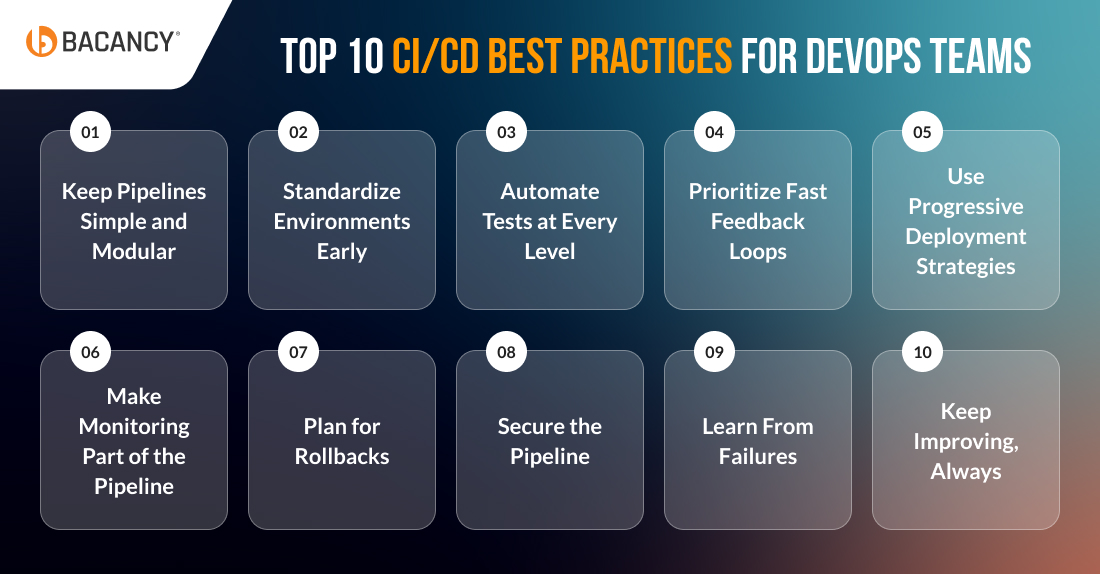
1. Keep Pipelines Simple and Modular
The first mistake teams make is trying to do everything in one massive pipeline. It looks neat at first, but breaks easily and takes forever to fix. A reliable CI/CD pipeline should be modular (broken down into small, clear stages). This stages mostly include Build, Test, and Deploy. Each stage should do one job well.
When you break a pipeline into separate stages, it becomes easier to find where things are going wrong. Instead of going through the entire pipeline to locate a failure, you know exactly where to find it. You save time finding and fixing what’s broken, and keep moving. Teams that follow this have to spend less time troubleshooting and could use their time on testing and shipping new features.
2. Standardize Environments Early
One of the common reasons why CI/CD pipelines fail is that the environments do not match. You may have seen your developers saying, “It worked on my machine,” but the same is not always the case for others.
Let’s understand this with an example: The code works fine on development, but breaks on staging, and crashes on production. This mismatch consumes a lot of time fixing and frustrates everyone.
So, what to do? Use Infrastructure as Code. This CI/CD best practice ensures your environments are consistent across every stage. When the pipeline runs against a stable and predictable environment, you catch fewer surprises. The goal here is to make the excuse “it worked on my machine” a thing of the past.
3. Automate Tests at Every Level
You can’t let your teams waste time manually testing every pipeline. They may spend a lot of time doing it and still make mistakes. These mistakes may also impact the releases, resulting in deployment failures and numerous other negative consequences.
So, consider going for automated testing in DevOps pipelines. Automate every test, whether they are unit tests (to catch basic errors), integration tests (to check if services work together), or end-to-end testing (to check if everything works as expected).
This way, the faulty code will never reach production, and time otherwise wasted on testing manually and still fixing errors will be saved. It is safer and cost-efficient to catch problems early than to fix them after your users have suffered.
4. Prioritize Fast Feedback Loops
Slow feedback is one of the most frustrating things for a DevOps developer. If developers wait 30 minutes or more to know if their build passed, the entire delivery pace slows down.
But if the feedback loops are made shorter, that means faster iteration, quicker builds, automated checks, and instant notifications. This helps teams act quickly and reduce the window between making a change and seeing if it works. This helps maintain strong momentum and avoid disruptions that frustrate both developers and release managers.
5. Use Progressive Deployment Strategies
Releasing everything at once can be very risky. If something goes wrong, it affects everyone, and rolling back to a stable version or the last working version becomes complicated. This problem is commonly faced by our clients, and here’s what we advise them when they come to us for DevOps consulting services:
- Start with smaller rollouts: Deploy changes to a small group of users or a single environment first. This helps find issues early without affecting everyone.
- Adopt blue-green deployments: Keep two environments, one live and one idle. If the new version fails, switch back quickly and avoid downtime.
- Use canary releases for safer testing: Send a small part of the traffic to the new version first. If it works well, expand the release to more users.
These steps help teams release updates safely and progressively, reduce stress, and keep everything stable even during frequent changes.
6. Make Monitoring Part of the Pipeline
Many times, clients come to us saying that we would have fixed this problem if we knew about it. Well, obviously, you can’t fix what you can’t see. A CI/D best practice we suggest is implementing real-time monitoring. So the next time your pipelines break, you know what causes it and how to fix it before it goes further.
For better visibility, you can integrate DevOps tools like Prometheus, Grafana, Datadog, or New Relic into your CI/CD pipelines. These tools provide you with logs, alerts, and metrics that make failures easier to understand and faster to fix.
7. Plan for Rollbacks
No matter how good your pipeline is, something will eventually fail. So, instead of trying to be perfect, stay prepared. Have a rollback plan in place in case your CI/CD deployment fails. This CI/CD best practice can help you recover fast from failures, minimizing the impact and downtime.
Every deployment should have a simple and reliable way to return to the last working version. Keep backups ready, track versions clearly, and document the recovery steps. This makes failures easier to handle and turns a potential crisis into a quick fix. A strong rollback plan builds confidence and protects trust.
Hire DevOps engineers to build a reliable, zero-downtime rollback strategy for your pipeline.
8. Secure the Pipeline
Even after doing everything right, teams still leave behind some weak links that can affect the whole deployment process. And, sometimes, this weak link is not a technical failure, but a security gap. Exposed credentials, outdated libraries, or poor access control are the potential gaps in security that can easily get your deployments stalled.
Security should not be the last tick in the checklist, it should be at the core of your pipeline. You can use automated scans, permission checks and dependency audits to keep things clean and safe. As long as your pipeline is secure, your delivery is safe.
9. Learn From Failures
This is one of the key CI CD best practices that most teams ignore. Every team can face failures, what’s important is how they respond to it. Instead of running from failures, or blaming it on others, the team should try to understand the reason for failure and work upon it to ensure it doesn’t happen again.
This habit builds trust and maturity in a DevOps culture. Over time, the number of repeated failures drops. Pipelines get stronger not because of perfection, but because the team keeps learning.
10. Keep Improving Always
CI/CD is not something that you set up once and forget. It is a growing infrastructure. New tools keep adding up, better practices require attention and workloads keep changing, all of which demand continuous improvement.
High-performing DevOps teams treat their pipeline like a product. They review it, refine it, and keep it in the best form. Small, steady improvements help keep the delivery predictable and efficient.
Final Thoughts
In 2026, the speed of delivery is only increasing, but teams with unstable or poorly managed CI/CD pipelines will keep facing delays, downtime, and frustration. The CI CD best practices we shared are not just some technical guidelines to follow. They are habits that can help your DevOps teams stay resilient and keep growing.
When your pipeline is simple, automated, secure, and easy to monitor, deployments stop being risky events. They become predictable and routine, letting teams focus on delivering value rather than fixing problems.
For organizations that want expert help setting up or scaling their delivery pipelines, partnering with a trusted DevOps managed services provider can accelerate that journey. A strong foundation in CI/CD ensures your teams spend less time firefighting and more time building what matters.