Quick Summary
Emerging AI capabilities are gaining more traction through flexible SaaS-based models that promise easier-to-use and scalable solutions to real-time business problems. In this blog, you will discover how SaaS AI tools offer advanced solutions for addressing real-time business needs. From smarter decision-making to seamless integration, they are creating real business value. With an emphasis on usability and adaptability, these tools are gaining rapid adoption. Read the blog to know more.
Table of Contents
Introduction
Businesses aiming to grow often find themselves stuck dealing with scattered data, delayed reports, and misaligned operations that slow progress. These everyday obstacles don’t just affect performance; in fact, they limit how fast and effectively decisions can be made.
These are where SaaS AI tools play a great role by offering a smart way forward by combining automation, intelligent analytics, and centralized access into one streamlined platform. The tools reduce manual workload and bring clarity, speed, and consistency to your entire business process.
Why Businesses Must Prioritize SaaS AI Tools for Growth
Traditional tools often fail to manage the growing business complexity, leading to delays, siloed processes, and sparse insights. To overcome these challenges with precision and agility, the following section explores how SaaS AI tools are reshaping the way businesses operate and make smarter decisions.
1. Centralized Intelligence for Smarter Decisions
SaaS AI solutions collect intelligence from several sources and present it in a single, combined dashboard to make decision-making quicker and more precise. Companies no longer need to rely on disconnected systems or stand-alone software to know what’s happening across teams or departments. Centralization eliminates guesswork and enhances operational clarity. It also provides benefits such as:
- Real-time dashboards for instant insights
- Smooth integration with existing business platforms
- Predictive suggestions based on historical patterns
2. Cost-Effective Scalability Without Infrastructure Hassles
SaaS AI tools eliminate the requirement of having costly hardware or a cumbersome setup in comparison to traditional AI. On the other hand, businesses can use the tool to the extent they want, paying only for the performance they avail of. This flexibility adds to a fast growth rate, sans overhead. To name some benefits it comes with:
- Subscription-based pricing models
- No maintenance or upgrade worries
- Fast onboarding with minimal IT dependency
3. Automated Workflows That Reduce Manual Bottlenecks
Most of the manual work, repetitive tasks, and time-consuming processes are easily managed with the available SaaS-AI tools so that the teams can concentrate on the much higher value work. Automation means fewer incidents of human errors, and time-wise, efficiency is enhanced, and the whole team is made more productive. It’s not just about working faster, it’s about working smarter. It also offers advantages like:
- AI-powered task assignment and follow-ups
- Auto-generated reports and summaries
- Smart alerts for immediate actions
4. Real-Time Collaboration Across Teams and Tools
SaaS AI applications generate a communal digital workspace where information, messaging, and analysis intersect. Multiple teams can share the same intelligence simultaneously, breaking down silos and latency. This interconnected mode of operation fosters alignment and increases business responsiveness. It also provides advantages such as:
- Cloud-based access from any location
- Unified updates and notifications
- Collaborative insights and shared dashboards
Don’t fall behind; hire SaaS developer today to engineer AI-infused tools that streamline operations and accelerate your digital journey.
Top SaaS AI Tools Powering Business Innovation
Scale-driven innovation demands the precision and flexibility of contemporary SaaS AI tools. The following tools are designed to address actual business needs, providing intelligent automation, accelerated insights, and operational dexterity.
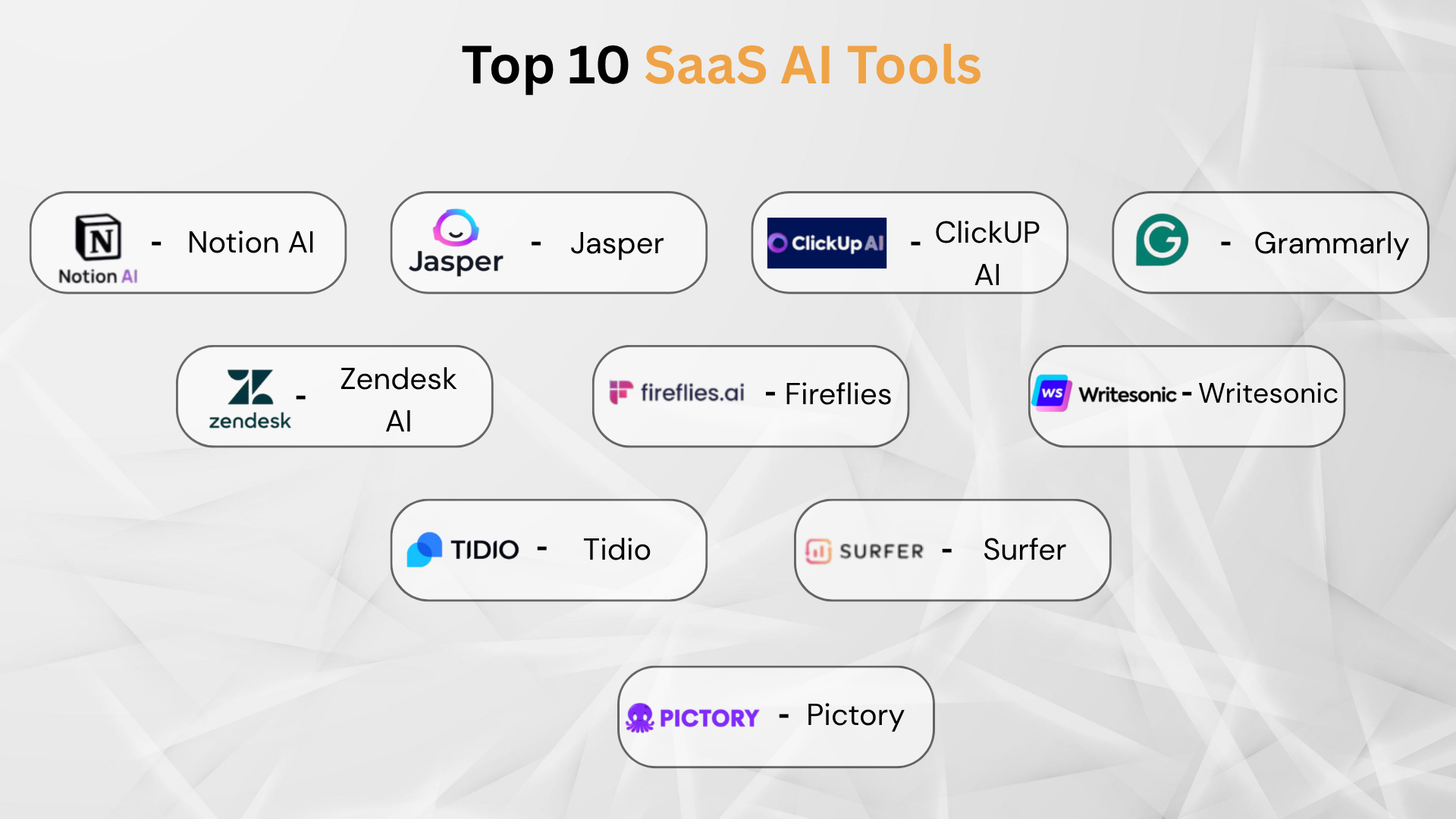
1. Notion AI: SaaS for Intelligent Knowledge Management
Notion is a cloud-first SaaS platform that brings docs, wikis, and task boards into one workspace. Notion’s AI is built in to enable real-time writing, auto-summarization, and smart content creation. Teams are able to have hassle-free collaboration and structured information management. The combination of simple design and AI tools offers a flexible hub for businesses of various sizes.
2. Jasper: SaaS Writing Assistant with AI
Jasper is an AI-powered writing assistant built for content and marketing teams requiring high-volume output. It employs AI to adjust tones, compose long-form content, and create on-demand branded content. All functions are run through a cloud dashboard, providing team templates, workflows, and performance monitoring. Its SaaS licensing accommodates use in collaboration across departments without technical integration.
3. ClickUp AI: SaaS Work Management Platform
ClickUp is an efficient SaaS tool that substitutes several workplace applications by providing project management, docs, chat, and goal tracking under one umbrella. Its AI capabilities aid in summarizing tasks, writing emails, and automating to-do lists for project productivity. The SaaS nature of the tool provides data accessibility, team synchronization, and cross-device readiness. It’s perfect for startups and enterprises to streamline workflows.
4. Grammarly: SaaS-Based Communication Tool
Grammarly is a cloud communication platform offering writing clarity and brand consistency to teams. Its SaaS product supports browser add-ons, native software, and tool integration like Gmail, Slack, and Google Docs. AI is used for sentence rewriting, tone suggestions, and review of clarity without modifying the applications. Centralized admin control and usage reporting are available to meet organizational needs.
5. Zendesk AI: SaaS for Customer Support Operations
Zendesk offers a powerful SaaS customer service ecosystem that’s simple to deploy across channels, such as email, chat, and help centers. AI is embedded in order to categorize tickets, suggest responses, and deflect repeat questions via bots. As a SaaS platform, Zendesk grows seamlessly with your support operations and provides multi-team access and integrations with CRMs. It’s designed for high-growing support teams that require automation without code.
6. Fireflies: SaaS Meeting Recorder with AI
Fireflies is a SaaS-powered meeting assistant that makes it easy to capture and share meeting insights. It joins calls automatically, records calls, live transcribes, and produces intelligent summaries. As SaaS, it integrates with Google Meet, Zoom, Teams, and others, without installation or manual uploads. The searchable transcript center enables cross-team collaboration and immediate reference at any time.
7. Writesonic: SaaS Content Generator Tool
Writesonic is a comprehensive SaaS content generation platform driven by AI, designed for marketing, sales, and SEO purposes. It helps companies write ad copy, blog posts, emails, and landing page content from a single dashboard. The SaaS model of the tool facilitates team-based workspaces, unlimited projects, and live updates. Its intuitive nature facilitates high-quality content production even for non-technical teams.
8. Tidio: AI Live Chat and SaaS Chatbot
Tidio is a SaaS customer communication platform that combines live chat with AI-driven automation. Its cloud-based setup enables instant implementation on any site with integrations in Shopify, WordPress, and email systems. AI assists in managing FAQs, request routing, and user intent analysis to enhance the support flow. Companies enjoy 24/7 automatic service without the use of development capacity.
9. Surfer: SaaS SEO Optimization Tool with AI
Surfer is an AI-powered SEO suite in SaaS form, which provides real-time content optimization supported by AI recommendations. Customers receive on-page advice, keyword grouping, and SERP insights, all within a browser-based dashboard. AI tools in Surfer provide recommendations based on high-performing pages and search intent patterns. SaaS deployment is supported by Surfer, with features for team use, versioning, and integration with Google Docs, among others.
10. Pictory: SaaS AI Tool for Video Creation
Pictory is a user-friendly SaaS platform that converts long-form text and videos into short, branded visual content through AI. No downloads or installations are required, as it runs entirely in the browser with cloud storage. AI does all the work to recognize highlights, provide caption suggestions, and synchronize visuals with narration. It’s best for content marketers seeking regular video production without much editing expertise.
Off-the-shelf AI tools are powerful, but real value comes from the right implementation through custom workflows, API integrations, and advanced automation. Hire AI engineers to ensure your AI stack works seamlessly across systems.
Business Functions That SaaS AI Tools Are Reshaping
Smart organizations are actively rethinking how daily operations are carried out with the help of SaaS AI tools. By embedding these tools into their core workflows, they’re discovering smarter ways to streamline processes and elevate strategic outcomes.
1. Customer Support Operations
SaaS AI solutions make it easier for businesses to support customers through automated responses, ticketing routing, and sentiment analysis. Cloud accessibility allows for handling high volumes without establishing internal infrastructure. Solution tools decrease resolution time and enhance customer retention by providing real-time, consistent support.
2. Sales and Lead Management
By pairing AI with the SaaS delivery model, the sales organization receives predictive insights and lead scoring in real-time. These solutions give high-value leads precedence and automate outreach flows. The outcome is quicker conversions and a streamlined sales process without the necessity for heavy internal systems.
3. Financial Forecasting and Planning
SaaS AI applications allow companies to automate financial models, review trends, and produce forecasts without human intervention. Through AI‑SaaS development, organizations can create custom, intelligent tools tailored to their financial workflows. SaaS AI solutions remove the burden of legacy software updates and allow scenario planning in real-time. This enhances decision-making and maintains financial plans sensitive to changes in the market.
4. Product and Service Personalization
Companies can customize user experiences through SaaS platforms based on preference, behavior, and past interactions. The tools continuously update offerings without developers’ intervention, which enhances customer engagement and allows companies to adapt quickly to market needs.
Conclusion
Developing a successful SaaS product is not just about a brilliant idea; it requires strategy, innovation, and technical precision. All steps, from architecture to user interface, have to coexist in harmony to deliver sustainable value.
A well-developed SaaS development company blends these elements to develop scalable and future-proof solutions. With digital platforms on demand transforming businesses’ ways of working, choosing the correct development company becomes indispensable. The industry’s future looks brighter with SaaS AI tools, which help implement advanced strategies smartly.