Java and C++ are renowned programming languages that have held the title of preferred languages for years. Java is a high-level, object-oriented, and cloud-based language that drives programs from planning to implementation. Conversely, C++ is an object-oriented, general-purpose programming language initiated to extend and enhance the language. In this blog, we will have an in-depth comparison of Java vs C++ to understand which programming language is ideal for you.
Table of Contents
Introduction
Whether you are a novice developer or a seasoned developer, the debate of Java vs C++ never seems to lose steam. These two popular programming languages consistently top the charts in terms of popularity, performance, and memory management. According to the TIOBE Index, C++ and Java secure top ranks in terms of programming languages.
Moreover, both languages offer developers a powerful toolkit for crafting everything from enterprise-level applications to cutting-edge games.
Java was released in 1995 as platform-independent and mainly used as a compiler for any machine. It was initially an extension of the C language to utilize for a more extensive audience than C+.
On the other hand, C Plus Plus was developed to add classes to C in 1985. The platform allows your programmers more control over memory and system resources. Also, some call C++ “C with Class” because it’s the first to introduce object-oriented programming, which implements classes as a core programming principle, something the older ‘C’ programming languages lacked.
C++ is known for its efficiency and control. It is the most utilized in game development, real-time systems, and high-performance computing. Conversely, Java is popular for enterprise-level applications, web services, and Android app development.
However, both share similarities as C++ and Java are object-oriented languages with shared commonalities in syntax but have different uses for classes, user management, and platform dependency.
Comparing Java vs C++ will give you ample reasons to choose the best language for your project.
A Quick Read on the Differences Between Java vs C++
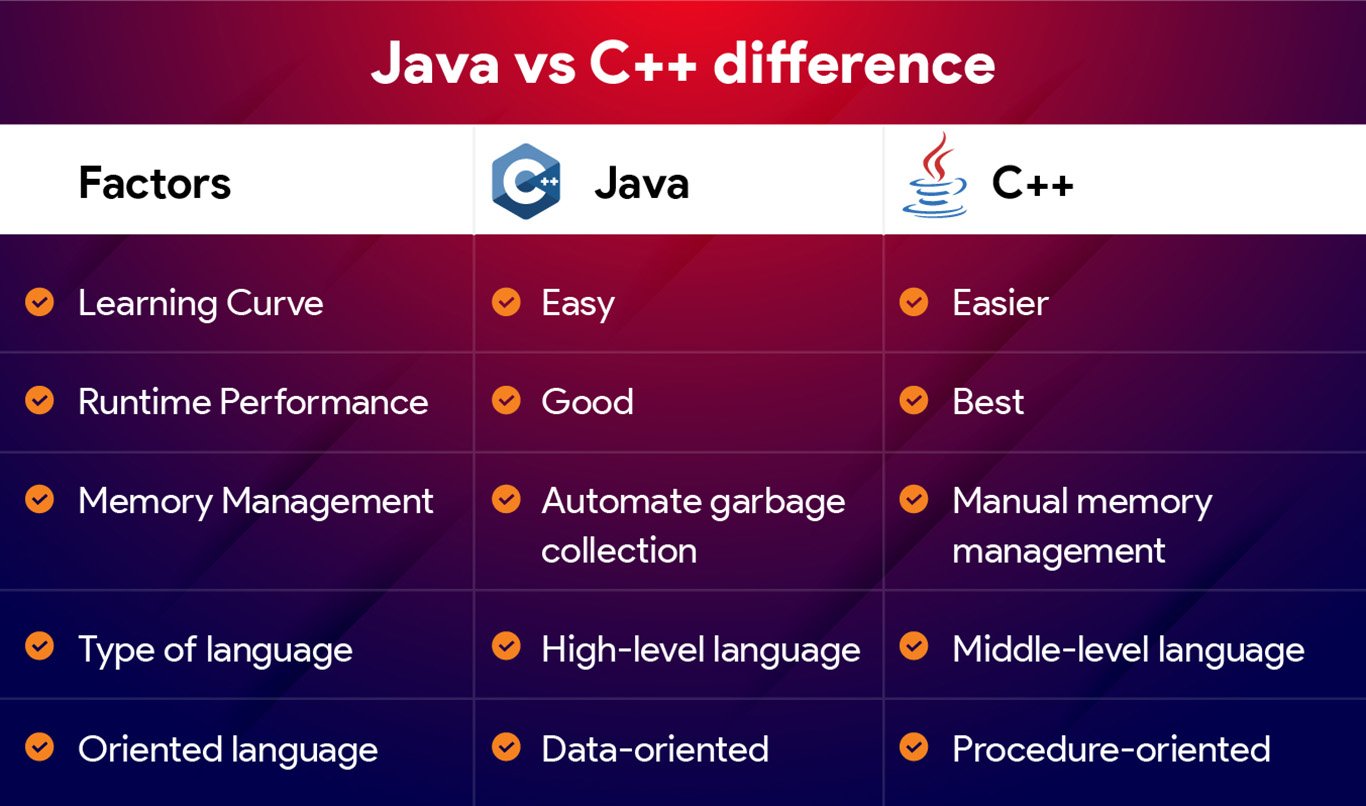
C++ and Java can be used versatile to increase your project’s efficiency, productivity, and deliverability. Here is the list of C++ vs Java differences that will help you make an informed decision:
Factors
Java
C++
Memory Management
Automatic garbage collection and support heap allocation
Manual management and support garbage collection
Input and Output
Utilize ‘System.in’ for input and ‘System.out’ for output
It uses ‘cin for input’ and ‘cout for output’ operations
Portability
Quiet portable due to JVM
It is dependable, so it is less portable
Overloading
Limited options as operation cannot be overloaded
It supports operator overloading and custom method
Compatibility
Easily integrated and depends on JVM
Limited compatibility and depend on OS and compiler
Language
High-level programming
Low-level programming
Pointers
It only exists as an implementation detail for references
A pointer can be incremented or decremented to point to a new address
Libraries
It has in-build standard libraries and a rich ecosystem
It is backward compatible with C, APIs, and operating system
Platform Dependency
Java incorporates platform-independent; once it is compiled into ‘bytecode’, it can be implemented on every platform
C++ facilitates platform-dependent and requires to be compiled on every platform
Type
Strongly typed and object-oriented programming language
Combine procedural and object-oriented programming language
Structures and Union
No structures or unions because of complex data types
Members and inheritance are public by default in C++
Real-World Applications
Gaming application, desktop app, enterprise, financial, web-based, and mobile operating system
Graphic User Interface, database software, video game development, operating system, databases, and web browsers
Performance
Slower performance because of startup loading time
Faster performance due to low-level language
Java or C++?: Expert Opinions to Determine The Best
Let’s break down when to use Java or when to choose C++ with the expert opinion. Despite being a powerful programming language, both have their own strengths and weaknesses.
1. Garbage Collection and Automated Memory Management
“Automatic memory management, specifically garbage collection, is a powerful abstraction that frees programmers from the tedious and error-prone task of manually deallocating memory. However, it’s crucial to understand that this convenience comes at the cost of potential performance overhead due to the background processes involved in memory reclamation.” – James Gosling, creator of Java.
2. Manual Memory Management and Performance Optimization
“C++ empowers developers with fine-grained control over memory allocation and deallocation. This control allows for meticulous optimization, enabling the creation of highly performant systems. However, wielding this power necessitates a deep understanding of memory management principles and practices to avoid memory leaks and other critical errors.” – Bjarne Stroustrup, creator of C++.
3. Considerations for Real-World Applications
“The optimal memory management strategy for a specific application hinges on its unique requirements. Resource-intensive systems or real-time applications might necessitate the precise control offered by C++’s manual memory management. However, for large-scale enterprise applications where development efficiency is paramount, the productivity gains associated with Java’s garbage collection can often outweigh potential performance concerns.” – Grady Booch, author of Object-Oriented Analysis and Design with Applications.
Is Java your preferred choice for application development?
Hire Java developers with proven expertise to build scalable and reliable solutions.
Importance of Java and C++ in Shaping Emerging Technologies
Even as new technologies emerge, Java and C++ continue to power critical systems, making it essential to understand why use Java over C++ in some scenarios and the advantages of C++ over Java in others.
Java's Impact on Emerging Technologies
➤ Cross-platform compatibility: Java’s “write once, run anywhere” principle champions cross-platform compatibility, a crucial aspect of emerging technologies like IoT and AI. Moreover, the programming language can provide seamless communication between systems and diverse devices in IoT. It helps to make AI applications trustworthy and run on various platforms with more accessibility and enhancement.
➤ Large and active community: Java boasts a vast, thriving community of developers and numerous libraries and frameworks readily available. This abundance of resources facilitates rapid development and collaboration in various emerging fields.
➤ Security focus: Java’s built-in security features are essential to developing reliable applications that handle large amounts of data. It is a helpful and critical concern in areas like AI, IoT, and potentially the Metaverse.
Here are specific examples of Java’s use:
➤ AI and ML: Java implemented for developing front-end interfaces, web applications, and data pipelines that support AI and ML models, while C++ might handle computationally intensive tasks behind the scenes, like training algorithms.
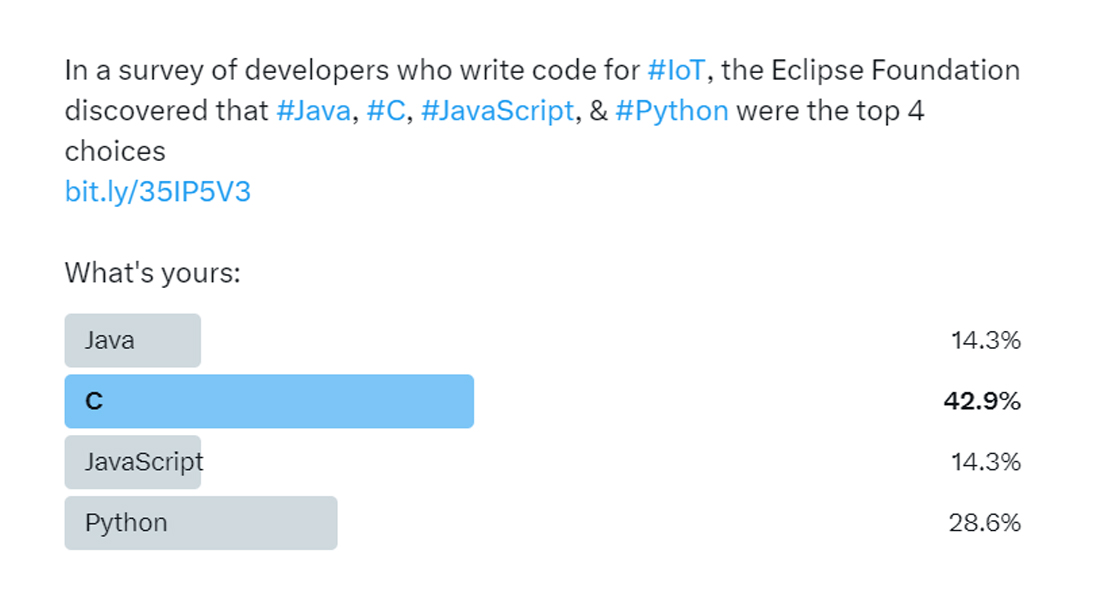
➤ IoT: Java used for building device management platforms, data processing frameworks, and user interfaces for interacting with various IoT devices and sensors.
C++'s Role in Shaping the Future
➤ Raw Performance: C++ offers unparalleled control over hardware and memory. It is ideal for computationally intensive tasks like deep learning in AI/ML or real-time data processing in complex IoT systems.
➤ Fine-grained control: The language allows developers to directly interact with hardware, a key requirement for building drivers and low-level components in various IoT devices, potentially hardware interactions in the Metaverse, and potentially specialized hardware for AI/ML applications.
➤ Resource efficiency: Its memory management and lack of garbage collection contribute to its resource efficiency, which is vital for resource-constrained devices in IoT and potentially certain aspects of the Metaverse.
Following are the examples of C++’s use:
➤ AI and ML: C++ is often used to develop core algorithms, deep learning frameworks, and performance-critical components within AI and ML models, where raw speed and efficiency are crucial.
➤ IoT: C++ language used for programming low-level device drivers, real-time data processing applications, and resource-constrained embedded systems within the IoT ecosystem.
Selected C++ for your application development needs?
Hire C++ developers to ensure efficient, optimized, and reliable implementation.
C++ Vs Java Difference: Which one is Better?
Choosing one robust language – Java vs C++- depends on your requirements, such as whether you want low-level or high-level programming. Both are efficient programming languages that provide strength and flexibility to developers. Java is popular for desktop, web, and other applications; on the other hand, C++ is suitable for system development.
As a result, the decision between C++ and Java comes down to the level of the program, your personal preferences, and your level of expertise. If you need assistance to help with expert skills, you can get in touch with a LeadingJava development company. The expert team enables you to achieve your business goals utilizing their skill set and technical proficiency.
Frequently Asked Questions (FAQs)
Java’s versatility and platform independence make it a go-to choice for developers worldwide. Following are examples to use Java for:
Develop Android apps
Create enterprise software
Create scientific computing applications
Manage application servers
Design wearable tech
Launch Ecommerce portals
C++ is preferable for high-level programming languages like game and software engineering. Following are the examples of C++ used for
Internet browsers, such as Google Chrome and Mozilla Firefox
Graphic design software applications like Adobe Illustrator
Database management software, including MySQL
Multiple video game engines, like Unreal Engine from Epic Games
The primary difference between C++ and Java is their memory management and platform dependence. C++ gives developers direct control over memory allocation and deallocation, whereas Java relies on automatic garbage collection. At the same time, Java code is compiled into bytecode, which can run on any platform with a Java Virtual Machine (JVM), whereas C++ code must be compiled separately for each target platform.
C++ is better suited for system-level programming such as operating systems, game engines, and embedded systems due to its low-level control.
C++ is a better choice when performance, real-time processing, or hardware-level optimization is critical.
Not usually. Java relies on automatic memory management, which can increase memory usage, while C++ allows fine-grained control over memory allocation.
Java offers built-in security features like sandboxing and automatic memory management, making it generally safer against common vulnerabilities.
Both languages have strong communities, but Java has broader enterprise adoption and long-term support from major vendors.
C++ generally delivers better raw performance due to direct hardware access, whereas Java trades some speed for portability and runtime optimization.
Dipal Bhavsar
Tech Geek at Bacancy
Story-driven writer blending research, passion, and full-stack web clarity.