Quick Summary
IoT is revolutionizing healthcare by enabling real-time monitoring, smart medical devices, and data-driven decision-making. From remote patient care to hospital automation, it enhances outcomes, efficiency, and accessibility. While challenges like security and interoperability remain, the future of healthcare is undeniably connected—and IoT is leading the charge.
Table of Contents
Introduction
In today’s data-driven world, healthcare is undergoing a major shift from reactive to proactive and predictive care, thanks in large part to the Internet of Things (IoT). By embedding sensors and connectivity into devices, systems, and even patients themselves, IoT in healthcare enables real-time data collection, analysis, and intervention like never before.
From smart insulin pumps to remote cardiac monitors, IoT is improving outcomes, increasing access, and reducing strain on healthcare systems. This blog will dive deep into the dynamics and significance of IoT in healthcare, covering how it works, where it’s being applied, what challenges it faces, and what the future holds.
What Is IoT in Healthcare?
IoT in healthcare, also known as the Internet of Medical Things (IoMT), refers to a network of connected medical devices and applications that communicate health data over the internet. These smart devices collect, analyze, and transmit information to healthcare providers, enabling real-time decision-making, remote treatment, and better patient outcomes.
Real-World Examples of Healthcare IoT Devices:
- Wearables: Smartwatches measuring ECG, SpO2, or sleep quality
- Implantables: Pacemakers with telemetry to send cardiac data
- Ingestibles: Sensors inside pills to monitor drug adherence
- Connected Imaging: MRI and X-ray machines sending diagnostics to the cloud
- Smart Beds: Tracking patient movement, posture, and vitals in real-time
- RFID-Tagged Equipment: For tracking inventory and preventing loss
IoT isn’t just a technological trend. It’s becoming a strategic necessity in delivering modern, efficient, patient-centric care.
Key Dynamics: How IoT Is Powering Modern Healthcare
Let’s look at the core areas where IoT is making a measurable impact.
1. Remote Patient Monitoring (RPM)
RPM allows patients to be monitored outside the traditional clinical setting, improving quality of life and freeing up hospital resources.
Example:
A patient with COPD (Chronic Obstructive Pulmonary Disease) uses a connected spirometer to measure lung function. The device alerts doctors when breathing worsens, enabling early intervention and avoiding ER visits.
Benefits:
2. Smart Wearables and Personal Health Devices
Wearables are more than fitness tools, they now serve as clinical-grade health monitors.
Example:
Apple Watch can detect atrial fibrillation (AFib) and notify the user to seek medical help. Similarly, diabetic patients use CGMs (Continuous Glucose Monitors) like the Dexcom G7, which syncs with smartphones for live tracking.
Why it matters:
3. Hospital Automation & Smart Infrastructure
Smart hospitals leverage IoT for smoother, safer, and more efficient operations.
Use Cases:
This translates to:
4. Telemedicine + IoT: Bridging the Distance
Telemedicine exploded during the COVID-19 pandemic, and IoT has added an entirely new dimension, biometric data streaming directly to physicians.
Scenario:
A cardiologist consults with a rural patient via video call while monitoring their real-time heart rate and oxygen levels through a connected device.
Combined power:
5. Emergency and Critical Care Enablement
IoT plays a lifesaving role during emergencies by ensuring care teams are prepared before a patient even arrives.
Scenario:
An ambulance sends real-time ECG and blood pressure data from a trauma victim en route to the ER. The surgical team prepares in advance, reducing time-to-treatment by precious minutes.
Impact:
Partner with a leading Healthcare Mobile App Development Company for custom mobile, web, and SaaS services tailored to modern care.
Benefits of IoT in Healthcare: Why It Matters
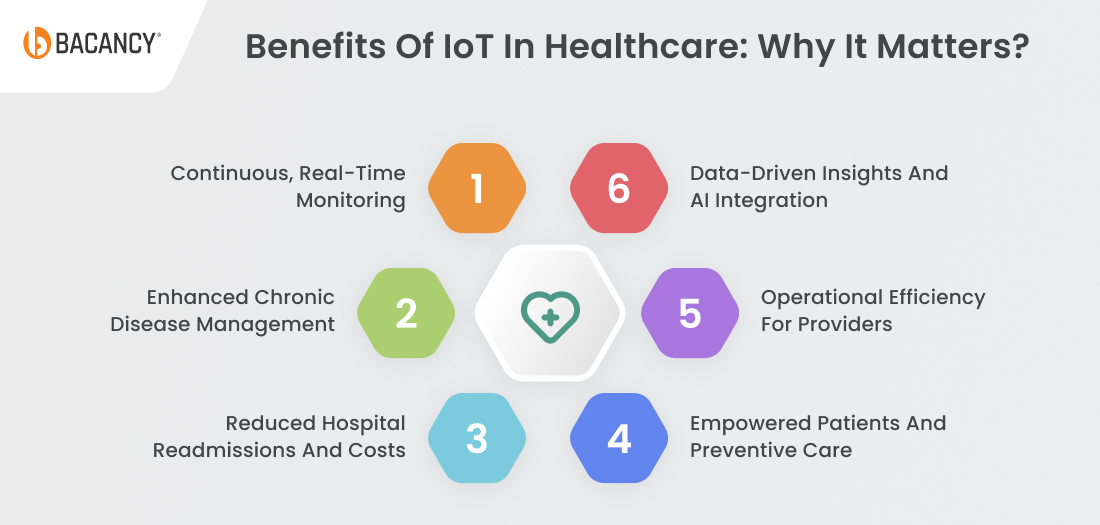
The true significance of IoT in healthcare lies in its ability to shift the care model from reactive to proactive, personalized, and data-driven. These benefits extend across the entire healthcare ecosystem: patients, providers, caregivers, insurers, and policymakers. According to a study published in the Journal of Medical Internet Research, IoT applications have shown measurable improvements in clinical decision-making, patient engagement, and system-wide efficiency (JMIR, 2020).
1. Continuous, Real-Time Monitoring
Unlike traditional episodic care, where data is only gathered during occasional visits, IoT enables round-the-clock monitoring of patient health metrics. This shift supports proactive rather than reactive care.
2. Enhanced Chronic Disease Management
IoT makes it easier to manage conditions like diabetes, asthma, heart disease, or hypertension which require ongoing attention rather than one-time treatment.
3. Reduced Hospital Readmissions and Costs
Remote care and early intervention help avoid unnecessary hospital visits, reduce ER overload, and minimize re-hospitalizations.
4. Empowered Patients and Preventive Care
IoT supports patient-centered care by giving individuals more control and insight into their own health through smartphones, apps, and dashboards.
5. Operational Efficiency for Providers
Hospitals, clinics, and home healthcare systems can use IoT to automate routine tasks, track resources, and improve staff productivity.
6. Data-Driven Insights and AI Integration
When combined with AI/ML, IoT data becomes a goldmine for predictive analytics, risk scoring, and decision support.
Challenges of IoT in Healthcare: Risks and Realities
While IoT offers transformative potential, it also introduces complex challenges particularly when lives and sensitive data are at stake. Organizations must plan strategically to mitigate these risks.
1. Data Privacy and Cybersecurity Threats
Healthcare IoT involves massive volumes of sensitive data (PHI – Protected Health Information) transmitted across networks. This makes it a prime target for hackers.
Organizations must implement end-to-end encryption, identity management, and intrusion detection systems.
2. Interoperability and Data Fragmentation
Different IoT devices often use proprietary protocols or platforms, making integration a nightmare.
Industry-wide efforts like FHIR (Fast Healthcare Interoperability Resources) are gaining traction but adoption is slow.
3. High Upfront Investment and Infrastructure Needs
IoT implementation requires capital expenditure in devices, cloud storage, connectivity, training, and cybersecurity which may not be feasible for smaller organizations or rural clinics.
4. Regulatory and Clinical Validation Hurdles
All IoT devices used for medical purposes must undergo strict validation, certification, and ongoing compliance monitoring.
Stakeholders must factor in FDA or CE Mark timelines during go-to-market planning.
5. User Adoption and Workflow Integration
For IoT to succeed, both patients and providers must change how they interact with technology and each other.
The best IoT solutions are invisible, deeply integrated into existing workflows without adding burden.
What’s Next? The Future of IoT in Healthcare
As IoT matures, its integration with emerging technologies like AI, blockchain, and 5G will shape a more predictive, secure, and scalable healthcare system.
Key Future Trends:
- AIoT (AI + IoT): Using AI to analyze IoT data in real-time, enabling predictive diagnostics and personalized therapies
- Digital Twins of Patients: Virtual replicas of individuals based on sensor data for testing treatment models
- Voice-Assisted Smart Devices: Hands-free interaction in surgical rooms or senior care
- Blockchain for Health Data Security: Decentralized health record management for better trust and control
- IoT in Mental Health: Monitoring sleep, behavior, and speech patterns to support mental wellness
IoT isn’t just extending lives, it’s enhancing how we live and receive care.
Conclusion
The role of IoT in healthcare is dynamic, far-reaching, and deeply transformative. It empowers providers to offer real-time, data-driven, and patient-centric care while improving operational efficiency and lowering costs.
But to unlock its full potential, stakeholders must overcome challenges around security, interoperability, affordability, and regulation. The future of healthcare isn’t just digital—it’s connected. Partnering with a trusted Healthcare AI-based IT services provider can accelerate this transformation, with IoT at the heart of the revolution.