Quick Summary
In this article, you’ll discover the Top 10 AWS Lambda alternatives for 2026 and what makes each one stand out. By the end, you’ll be able to weigh their strengths against Lambda and decide which option fits your serverless needs the best.
Table of Contents
Introduction
For years, AWS Lambda has been the face of serverless computing. It automatically scales, follows a pay-only-for-use model, and works well for a wide range of applications. Yet, it is not always the perfect match for every organization. Some teams face limits with runtime, pricing, or integrations, while others look for solutions that better match their specific needs.
This makes it worthwhile to look at other AWS Lambda alternatives that bring their own strengths to the table. Today, several platforms provide powerful alternatives. Some platforms offer longer execution times, others bring applications closer to users with global edge networks, and many provide simpler pricing or tighter integrations with cloud ecosystems.
Each option comes with its own strengths, making it important to understand what sets them apart. We have listed the Top 10 AWS Lambda Alternatives to help you select the best one for your needs.
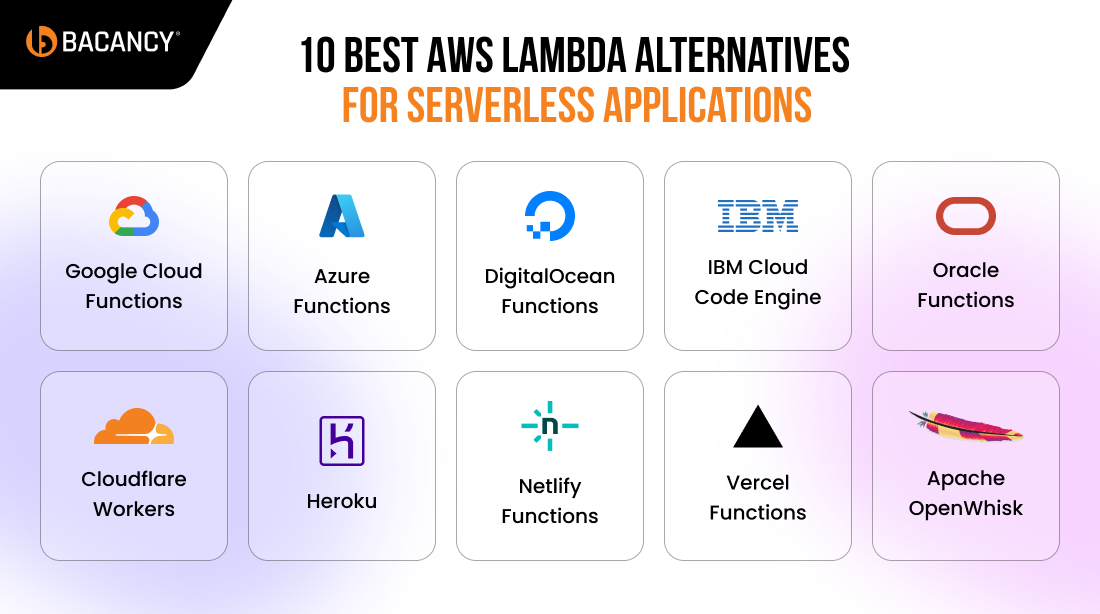
10 Best AWS Lambda Alternatives for Serverless Applications
Explore the top 10 AWS Lambda alternatives, showcasing key features to help you choose the right serverless platform for your needs.
1. Google Cloud Functions
Google Cloud Functions provides a flexible serverless environment that integrates seamlessly with the Google Cloud ecosystem. It enables developers to run lightweight, event-driven applications while benefiting from Google’s global infrastructure. The platform reduces cold starts and offers a larger free tier, making it cost-efficient.
Features:
- Runs tasks for up to 9 minutes, extendable to 60 minutes with Cloud Run
- Processes 2 million free requests each month, double what AWS Lambda offers
- Runs code without managing servers and handles scaling automatically
- Connects easily with Google services like Pub/Sub and Firebase
- Offers direct HTTP/S endpoints without an extra gateway
- Provides monitoring and debugging tools for visibility
- Runs across multiple global regions for wider availability
2. Azure Functions
Azure Functions delivers a powerful alternative that fits well into Microsoft’s cloud ecosystem. It supports long-running workflows, integrates with Azure services, and scales automatically based on demand. Its built-in orchestration tools make it suitable for enterprise-grade applications.
Features:
- Allows you to run long processes that remember past steps, such as approval flows or data processing tasks
- Offers flexible hosting plans: pay-as-you-go, pre-warmed, or dedicated options
- Connects directly with Azure services like Cosmos DB, Event Hubs, and Blob Storage
- Runs scheduled tasks using CRON timers (simple time-based schedules).
- Provides built-in monitoring through Azure Monitor
- Scales automatically with Kubernetes-based autoscaling
3. DigitalOcean Functions
DigitalOcean Functions focuses on simplicity and predictable pricing. Built on Apache OpenWhisk, it offers portability and integrates smoothly with DigitalOcean’s ecosystem. It is easy to use, making it popular among startups and small to medium teams.
Features:
- Offers a simple command-line tool for deployment and local testing
- Charges only for actual usage with straightforward pricing
- Works smoothly with DigitalOcean App Platform for complete software projects
- Provides built-in monitoring and logging options
- Uses an open-source foundation that makes it portable and flexible
4. IBM Cloud Code Engine
IBM Cloud Code Engine replaces IBM Cloud Functions and offers a unified serverless platform. It supports functions, containers, and batch jobs in a fully managed environment. Built on Kubernetes and Knative, it provides scalability across hybrid setups.
Features:
- Runs different workloads, including functions, containerized apps, and batch jobs
- Scales automatically, including scaling down to zero when not in use
- Supports scheduled jobs using cron-style triggers
- Integrates easily with CI/CD pipelines for faster deployments
- Flexible deployment across hybrid and multicloud environments
- Charges only when workloads are active, reducing idle costs
5. Oracle Functions
Oracle Functions leverages the open-source Fn Project, allowing developers to create container-native serverless applications. It integrates tightly with Oracle Cloud Infrastructure while also offering portability across different environments.
Features:
- Uses Docker containers for packaging and deploying functions
- Provides local development tools through the Fn Project CLI
- Offers a catalog of pre-built reusable functions
- Delivers strong security features through Oracle Cloud Infrastructure
- Supports multiple programming languages with container flexibility
- Includes a free tier with cost-effective pricing
Bacancy’s AWS managed services help you implement, optimize, and manage Lambda effortlessly.
6. Cloudflare Workers
Cloudflare Workers run JavaScript-based serverless applications at the network edge. By executing code in lightweight isolates across hundreds of data centers, Workers reduce latency and eliminate cold start issues. The platform suits high-throughput, globally distributed workloads.
Features:
- Deployment across 200+ global edge locations
- Charges based on the number of requests, not execution time
- Deploys instantly across the global edge network
- Provides a built-in key-value store for distributed data storage
- Executes code in lightweight environments for faster performance
- Protects applications in a secure, isolated environment
7. Heroku
Heroku offers a developer-friendly platform that abstracts infrastructure management. It allows applications to scale seamlessly through dynos and supports stateful, long-running processes. It suits teams that prefer a simple platform-as-a-service experience.
Features:
- Deploys applications directly from Git repositories
- Supports many programming languages using buildpacks
- Scales applications easily with dyno-based units
- Provides a marketplace of add-ons such as databases, caching, and monitoring
- Handles infrastructure tasks like patching and scaling automatically
- Let’s developers customize buildpacks for added flexibility
8. Netlify Functions
Netlify Functions bring serverless capabilities to front-end and full-stack developers. The platform integrates with Git workflows and simplifies the process of adding backend functionality to modern web applications.
Features:
- Triggers deployments automatically with every Git push
- Runs background functions for up to 15 minutes
- Handles HTTP requests without the need for an API gateway
- On-demand builders that prepare and optimize your application efficiently
- Offers regional deployment options for performance and compliance
- Fits naturally into Netlify’s static hosting and site management tools
9. Vercel Functions
Vercel Functions specializes in server-side rendering and edge computing for modern web applications. The platform integrates tightly with Next.js and provides global scalability with edge caching.
Features:
- Deploys workloads in 23 regions across the world
- Uses automatic edge caching and clears outdated content in real time.
- Supports API routes without additional setup
- Real-time monitoring and error logging
- Handles multiple concurrent executions for faster processing
10. Apache OpenWhisk
Apache OpenWhisk is an open-source, cloud-agnostic serverless framework. It runs on Kubernetes and other infrastructures, making it flexible and portable. Its modular design enables customization and fine-grained control.
Features:
- Links multiple functions together(action chaining) to form complex workflows
- Runs asynchronous tasks without delays
- Provides a built-in API Gateway for handling HTTP requests
- Uses event triggers and rules for workflow automation
- Offers debugging and monitoring tools for real-time visibility
- Deploys easily on Kubernetes, OpenShift, or standalone servers
Conclusion
These top 10 AWS Lambda alternatives show that serverless computing is no longer limited to one provider. Google Cloud Functions offers longer runtimes and a larger free tier, Azure Functions supports enterprise-grade orchestration, and Cloudflare Workers bring performance closer to users through global edge deployment.
Platforms like Heroku, Netlify, and Vercel simplify modern web development, while Apache OpenWhisk ensures full control through open-source flexibility.
The best choice depends on an organization’s goals, budget, and technical landscape. To make a suitable choice, organizations can consult with cloud consultants who analyze business requirements, compare options, and recommend the most suitable serverless platform for long-term success.