| Feature | Grok | ChatGPT |
|---|---|---|
| Data Access | Real-time via X | Limited (depends on model version) |
| Code Generation | Decent for short snippets | Highly reliable and structured |
| Tone & Personality | Conversational, humorous | Adaptive & professional |
| Integration Options | Mainly X platform | API, ChatGPT app, third-party tools |
| Image Handling | Limited | Supports generation & analysis |
| Developer Ecosystem | Still evolving | Vast with API & SDKs |
| Cost & Accessibility | Included with X Premium+ | Free & Pro versions |
Quick Summary
Grok vs ChatGPT are two powerful AI tools that are gaining attention for their unique capabilities. Both offer features that can boost productivity, support coding, and streamline creative tasks. While each has its strengths, understanding how they differ and complement each other can help you make the most of their potential. This comparison explores their performance and practical use cases in a clear, approachable way.
Table of Contents
Introduction
The discussion around Grok vs ChatGPT has been heating up lately, especially among developers and tech enthusiasts. Both tools are making big waves in the AI space, changing how people code, research, and create content. With their growing popularity, many are curious about which one fits better into modern development workflows.
While Grok impresses with its real-time intelligence and integration with X, ChatGPT continues to set the standard for structured reasoning, coding support, and creative automation. This article takes an honest, developer-focused look at how both tools perform, not to pick a winner, but to help you understand where each shines and how they can enhance your productivity when used smartly.
Grok (by X)
Overview
Grok is an AI assistant integrated with the X platform, designed to provide real-time insights and conversational support. It is especially useful for developers and tech teams looking for quick answers, trending data, and workflow support directly from live sources. While it is conversational in nature, Grok can assist with basic coding tasks, trend monitoring, and summarizing discussions, helping teams stay updated and make decisions faster.
Use Cases
- Quick Coding Assistance: Offers syntax suggestions, code snippets, and lightweight debugging support.
- Trend and Social Insights: Pulls real-time discussions from X, helping developers and product teams track the latest frameworks, tools, and trends.
- Content Summarization: Summarizes technical discussions, project updates, or team conversations.
- Task Automation (Limited): Can handle small-scale automation tasks within supported platforms or prompts.
- Integration with X: Best used for real-time conversational insights rather than deep document or data processing.
Best For:
Developers need fast, real-time answers, trend analysis, or conversational assistance integrated with live social feeds.
ChatGPT (by OpenAI)
Overview
ChatGPT is a versatile AI assistant designed to support developers, product teams, and organizations in complex problem-solving, automation, and knowledge-intensive workflows. Unlike Grok, ChatGPT excels at structured reasoning, multi-step tasks, and integration across systems, making it ideal for enterprise applications and technical development work.
Use Cases
- API and Plugin Integration: Enables developers to integrate AI capabilities directly into applications, CI/CD pipelines, and internal tools.
- Automated Testing and Code Review: Can generate unit tests, review pull requests, and suggest improvements to maintain code quality.
- Technical Documentation and Knowledge Base Support: Helps create and maintain structured internal documentation, guides, and knowledge repositories.
- File and Dataset Processing: Parses complex files (CSV, JSON, PDFs) to extract insights, generate reports, or automate data workflows.
- Scenario Simulation and Prototyping: Assists in simulating workflows, designing proof-of-concepts, and generating technical prototypes.
Best For:
Organizations and development teams seeking structured, in-depth AI assistance for coding, automation, analysis, and technical decision-making, especially for enterprise workflows.
Side-by-Side Comparison: Grok vs ChatGPT
Below is a side-by-side look at how Grok and ChatGPT perform across key features and practical use cases. This comparison will help understand their strengths, differences, and how each can fit into different workflows.
This was a simple overview to highlight the main differences and strengths of Grok and ChatGPT. The in-depth comparison that follows will give a clearer picture of how each tool performs in real-world scenarios and which use cases they handle best.
In-Depth Comparison: Grok vs ChatGPT
Below are the seven most practical AI use cases that matter to organizations and development teams, with examples of how both tools perform and where each shines.
1. Coding
To test their coding capabilities, both tools were given a simple yet practical task: to build a password generator. The goal was to see how each AI handles code structure, interactivity, and usability.
ChatGPT produced well-structured code that ran perfectly without modification. The output included a responsive interface, random password generation, and a fully functional copy-to-clipboard feature. It felt instantly deployable, ideal for teams that prioritize ready-to-use code.
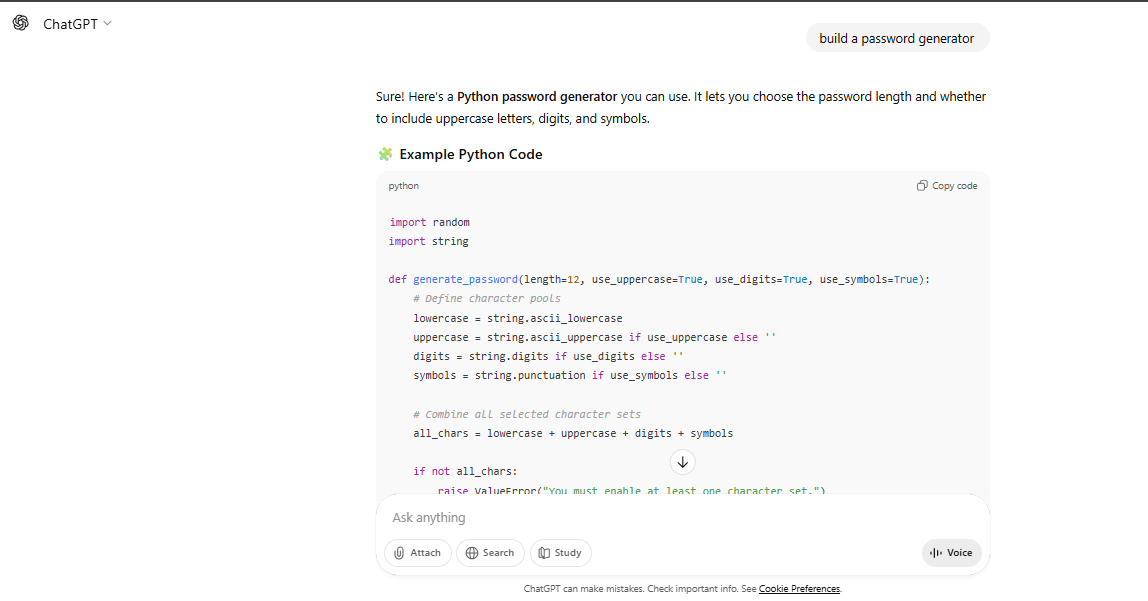
ChatGPT’s response to the coding task
Grok delivered a robust, security-first password generator in Python, leveraging the secrets module for cryptographically strong randomness. It included a full command-line interface with customizable length and character sets, plus built-in validation to ensure at least one character from each selected type. The response also offered a concise one-liner alternative and suggestions for extensions like GUI or web versions, making it immediately practical and highly adaptable.
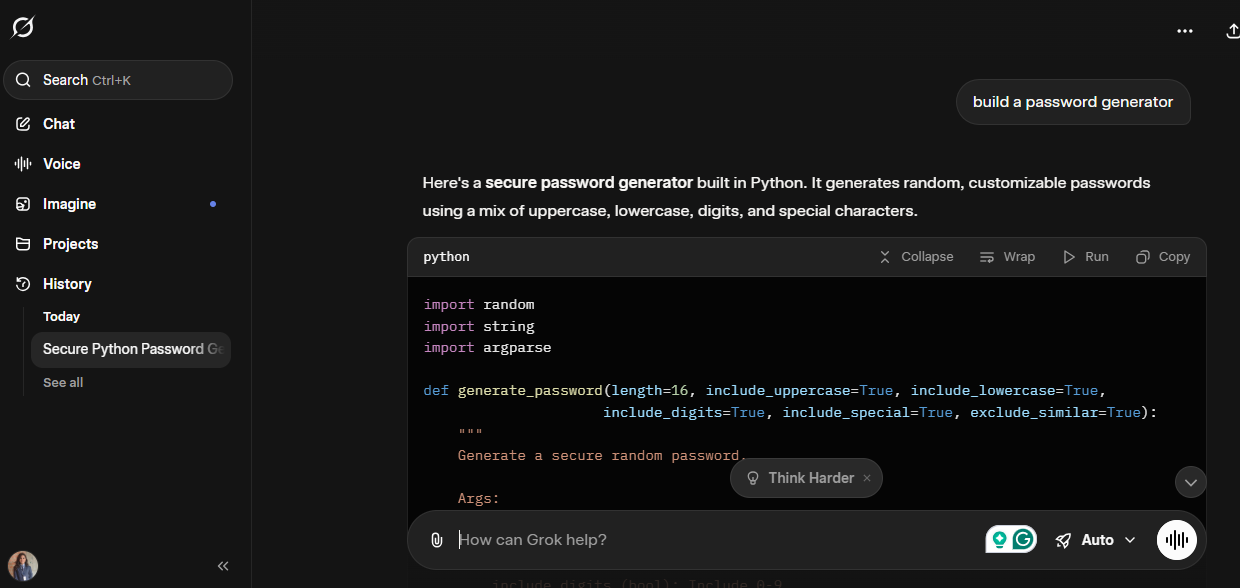
Grok’s response to the coding task
Verdict:
ChatGPT wins for reliability and deployment readiness, while Grok impresses with its smart, assistive debugging that makes it approachable for non-technical users.
2. Code Optimization
Both tools were asked to optimize an existing JavaScript function that calculated API response times, aiming to improve speed and efficiency.
ChatGPT found that the problem occurred because the code attempted to display the results before the responses from the websites were ready. It fixed this by making the code wait until all the websites had replied before showing the results. The new version also handles errors more carefully and is easier to read and use.
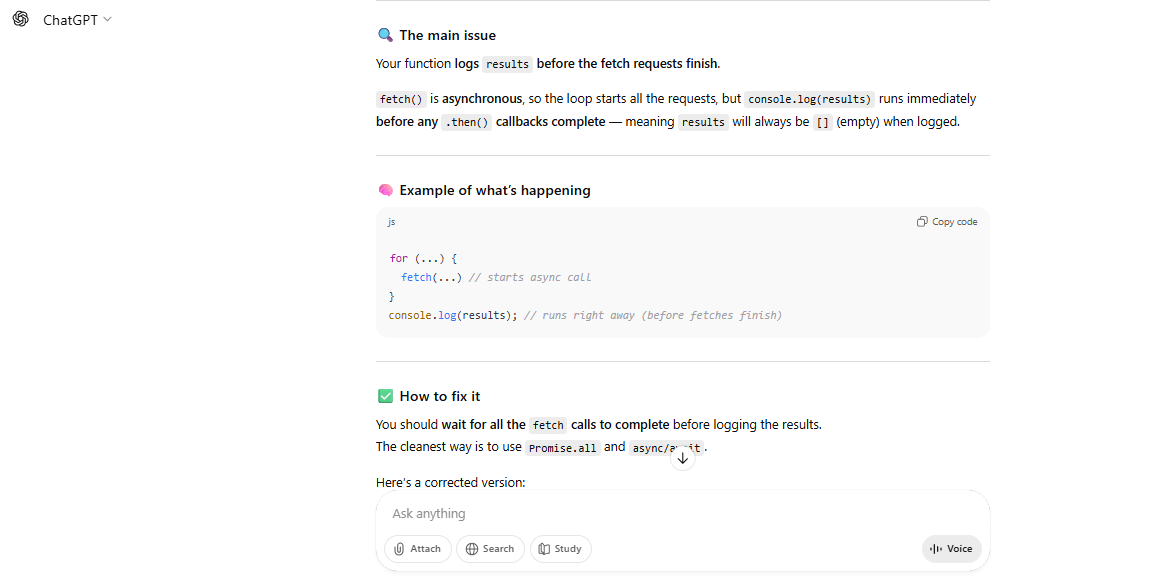
ChatGPT’s response to the code optimization task
Grok, on the other hand, took a practical approach. It quickly identified the timing mismatch and corrected it in one clear step, ensuring the results only appeared after all requests had finished. This straightforward adjustment made the output reliable and ready for immediate use.
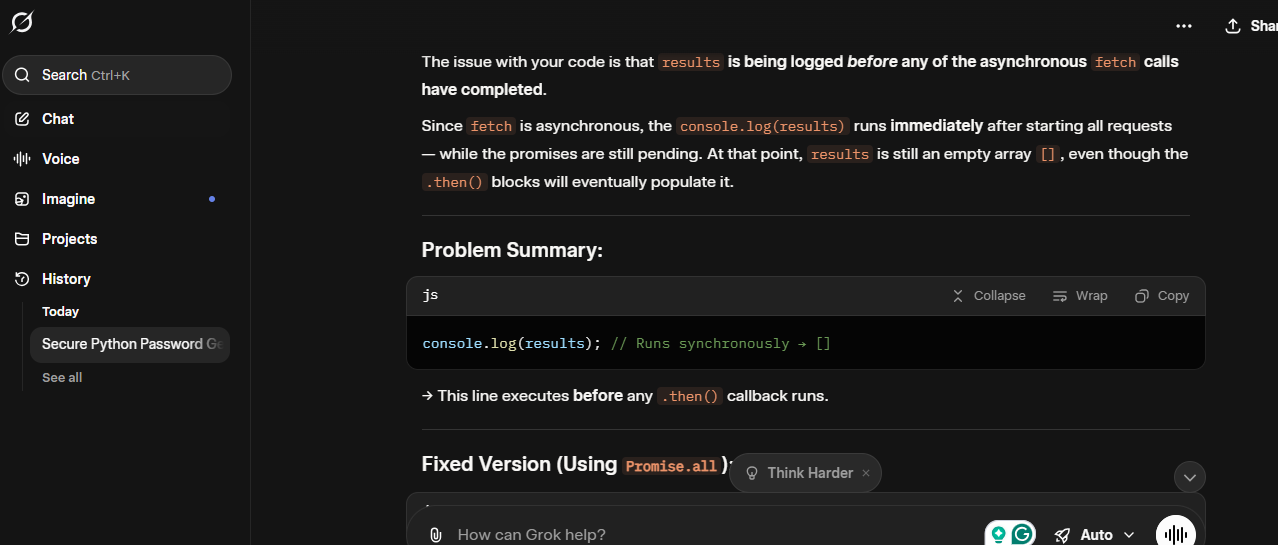
Grok’s response to the code optimization task
Verdict:
ChatGPT delivers more structured and production-level optimization, while Grok adds community-driven intelligence, great for quick learning or cross-checking performance strategies.
3. Image Generation
The prompt asked both AIs to create an image of a futuristic workspace with multiple developers collaborating in front of transparent screens, with some details of what I wanted in the image.
ChatGPT generated output leaned toward a creative, artistic interpretation. The style was more cartoonish, less photorealistic, but visually appealing and conceptually accurate. However, its rendering speed was slower, and the image resolution lacked refinement for production-level creative work.
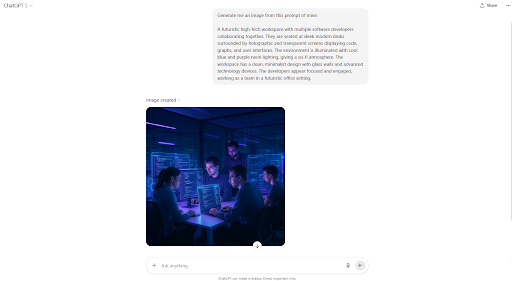
ChatGPT’s response to the image generation task
Grok, when connected to its image generation model, produced highly detailed visuals, realistic lighting, polished office interiors, and human-like figures that conveyed collaboration. It also offered variations and aspect-ratio adjustments without additional prompts.
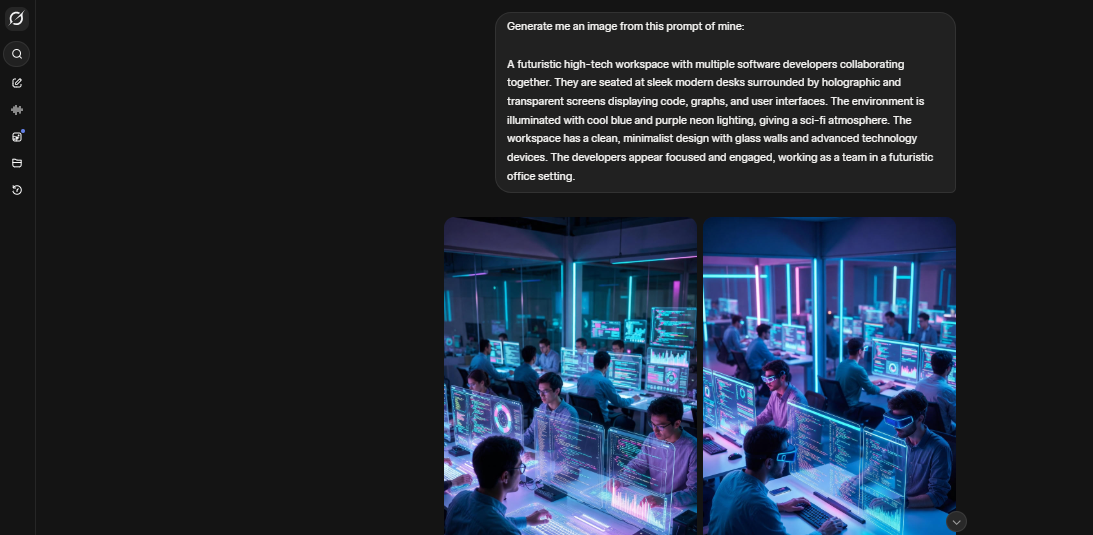
Grok’s response to the image generation task
Verdict:
Grok leads for professional and realistic image output, while ChatGPT performs well for conceptual visuals or quick ideation sessions.
Discover the potential of AI-generated visuals to boost creativity and collaboration.
An LLM development company, such as Bacancy, can help you maximize the creative potential of AI-generated visuals.
4. Image Understanding and Visual Analysis
When both tools were provided an image depicting a warehouse setup, the task was to analyze the scene and describe what was happening.
ChatGPT accurately recognized the scene as a celebration of the 2025 ICC Women’s Cricket World Cup. It identified the team of players holding their trophy and celebrating their victory, with fireworks adding to the festive atmosphere.
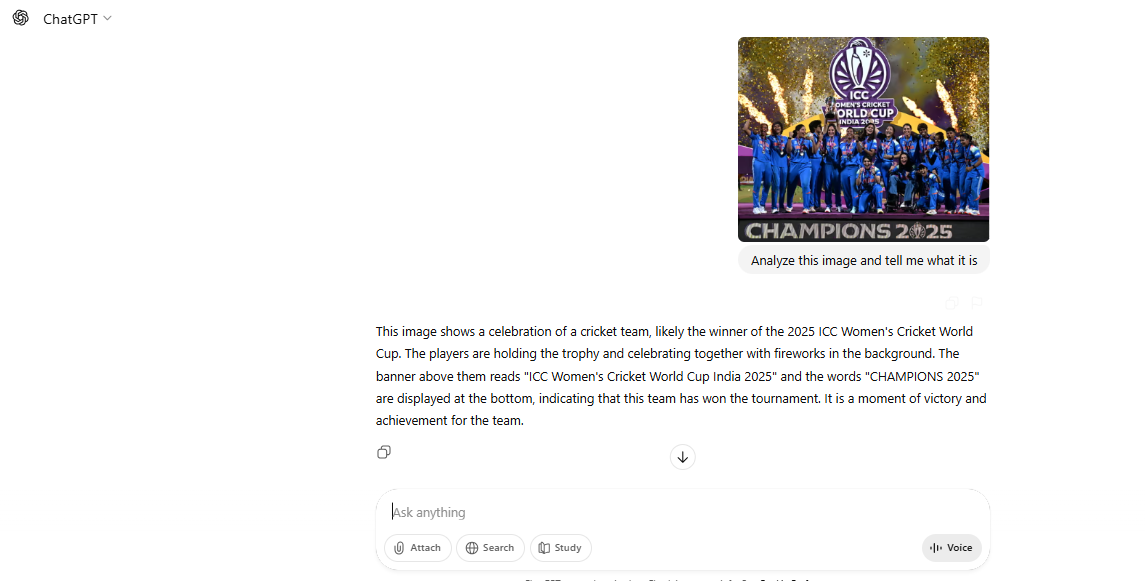
ChatGPT’s response to the image understanding & analysis task
Grok accurately identified the image as India’s women’s cricket team celebrating their 2025 World Cup victory, spotting the ICC trophy, team uniforms, and event branding. It delivered a concise, structured breakdown with key visual cues and concluded that it was a championship moment. To deepen engagement, Grok added three relevant follow-up queries for future research.
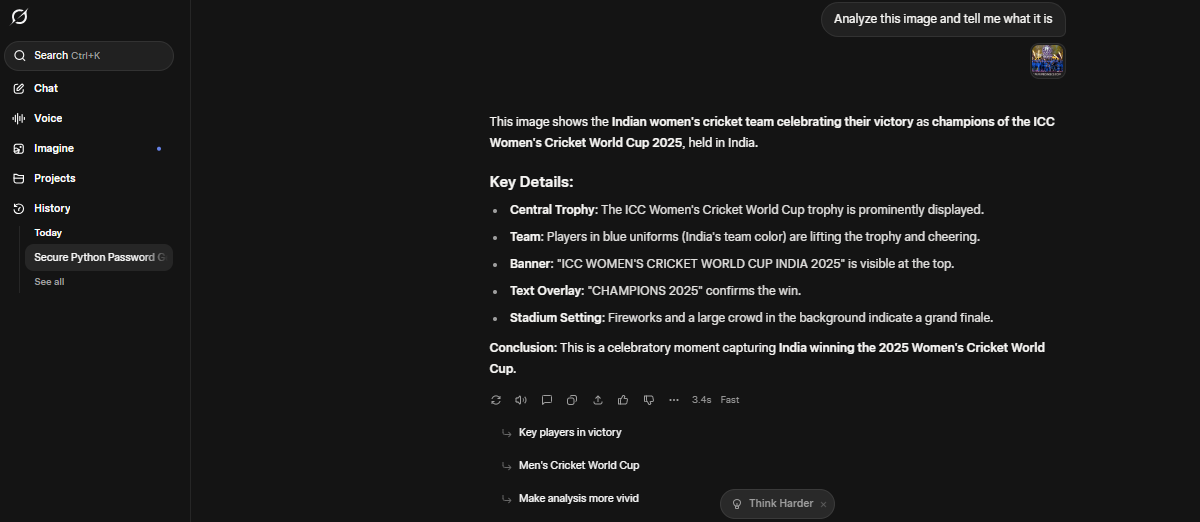
Grok’s response to the image understanding & analysis task
Verdict:
The results from both analyses are similar, and it’s a tie. Both accurately identified the scene and captured the key details. Each description highlights the same key elements, making the analysis equal in accuracy.
5. Document and File Intelligence
Both tools received a PDF report and were asked to extract key decisions and next steps.
ChatGPT summarized the document in bullet format, grouping points under categories like “Completed Tasks,” “Pending Approvals,” and “Future Recommendations.” The structure was organized, perfect for meeting summaries or managerial briefs.
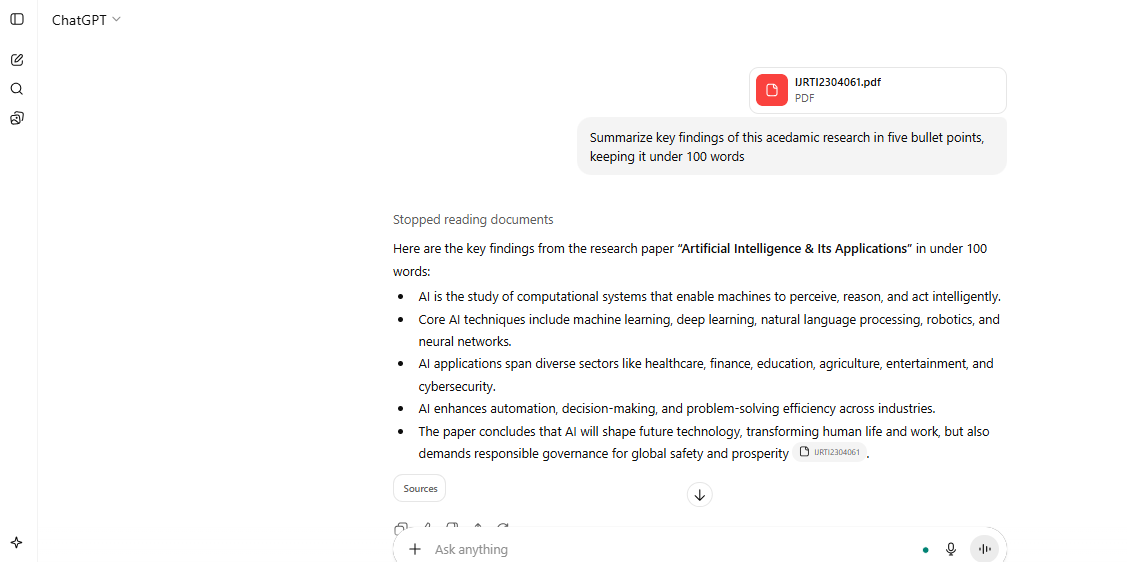
ChatGPT’s response to the file intelligence task
Grok delivered a concise summary too, but its output leaned toward conversational phrasing, highlighting trending keywords and potential next actions. While it captured the essence of the file, it lacked the clear formatting that teams might expect in professional documentation.
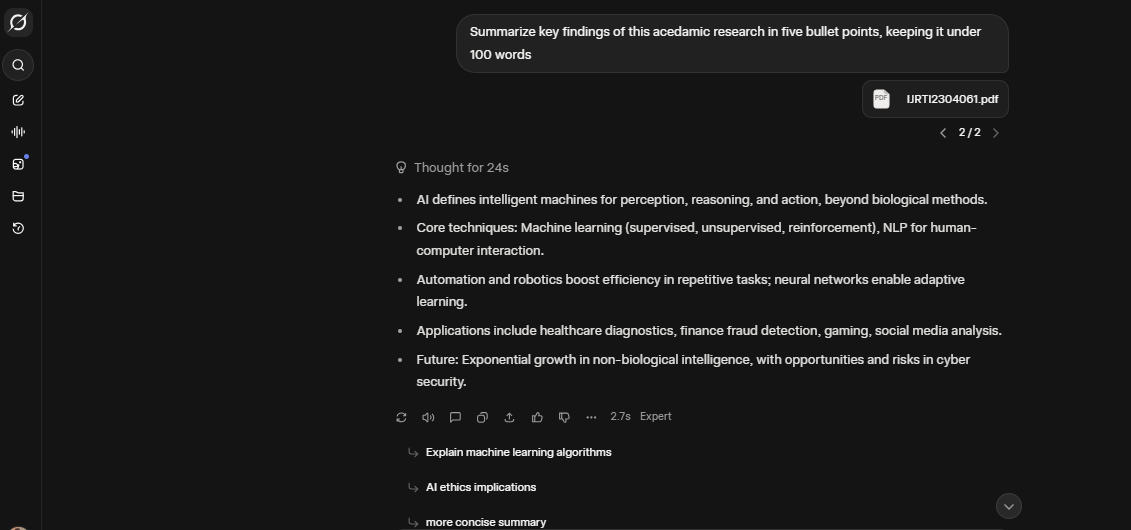
Grok’s response to the file intelligence task
Verdict:
ChatGPT stands out for structured document summarization and clarity. Grok suits quick overviews and short summaries for on-the-go understanding.
6. Data Analysis and Visualization
The test involved uploading an Excel dataset of backlinks. Both tools were asked to identify SEO trends and generate visual output.
ChatGPT analyzed the n-ix.com backlink dataset, revealing steady 2025 growth, strong domain diversity, and 100% dofollow links with no losses. It highlighted consistent link acquisition and generated a sample visualizing backlink table, enabling SEO analysts to easily extend insights and reporting.
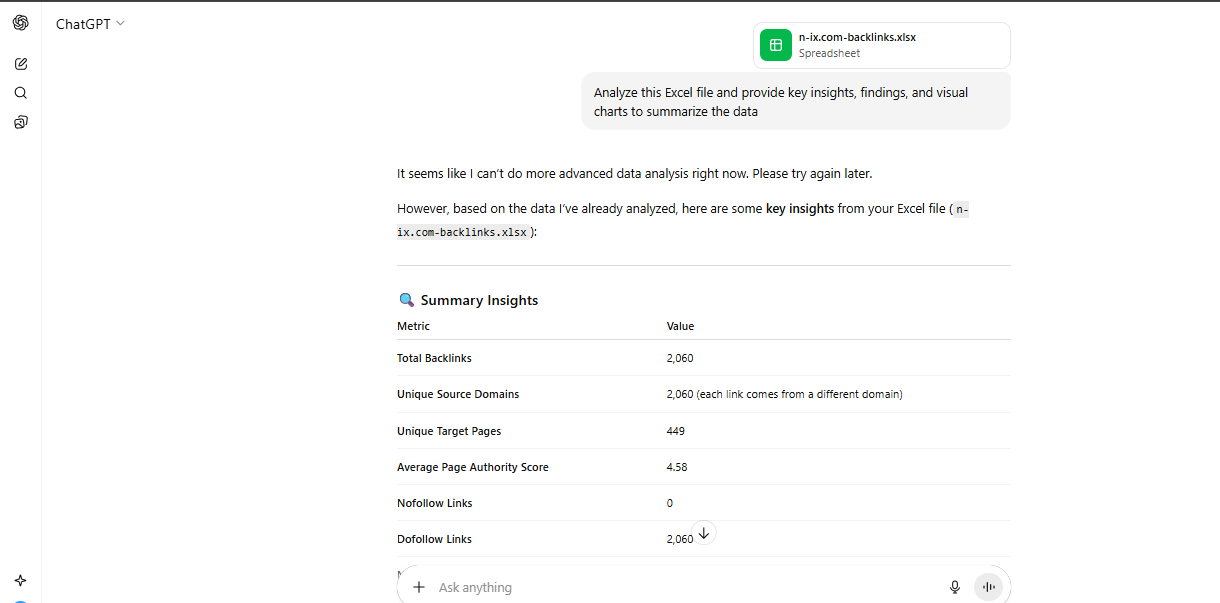
ChatGPT’s response to the data analysis & visualization task
Grok analyzed the uploaded Excel dataset of backlinks to n-ix.com, identifying key SEO trends such as rapid link growth in 2025, dominant brand anchors, and high-value dofollow sources. It also generated four clear visual charts: a score distribution histogram, a top anchor bar chart, an acquisition timeline pie, and a scatter plot of top sources by authority and external links.
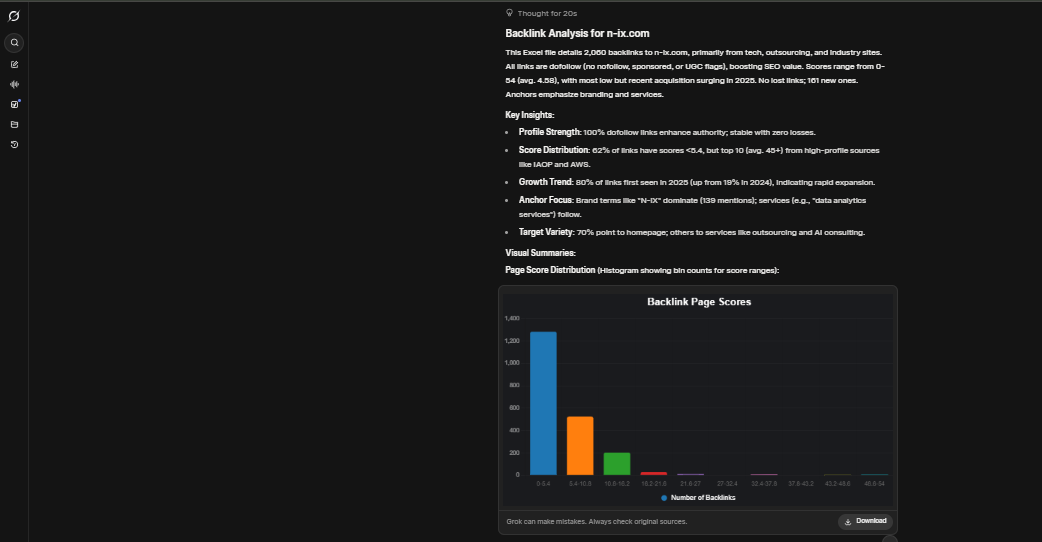
Grok’s response to the data analysis & visualization task
Verdict:
ChatGPT dominates in technical data analysis and contextual market understanding, while Grok performs well for high-level summaries and visualization automation.
7. Real-Time Information Search
The prompt asked both tools to gather the latest updates on AI frameworks launched in the past six months.
ChatGPT researched the latest AI frameworks launched in the past six months and found key developments like AWS’s Strands Agents SDK, LightAgent, and Simpliflow. These frameworks simplify building intelligent agent workflows, offering lightweight, open-source solutions for reasoning, tool integration, and rapid prototyping of AI-driven processes.
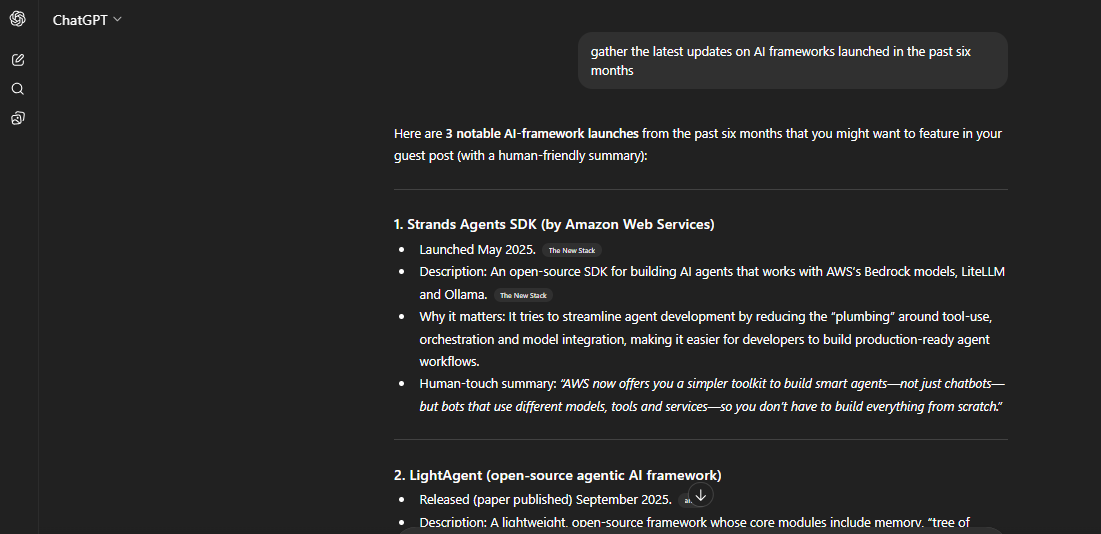
ChatGPT’s response to the real-time information search task
Grok conducted thorough web research and uncovered a surge in AI frameworks since May 2025, spotlighting agentic systems like Microsoft’s multi-agent orchestration, Google’s A2A protocol, and open-source ROMA. It highlighted governance tools and enterprise-grade security frameworks, delivering insights with clarity and depth.
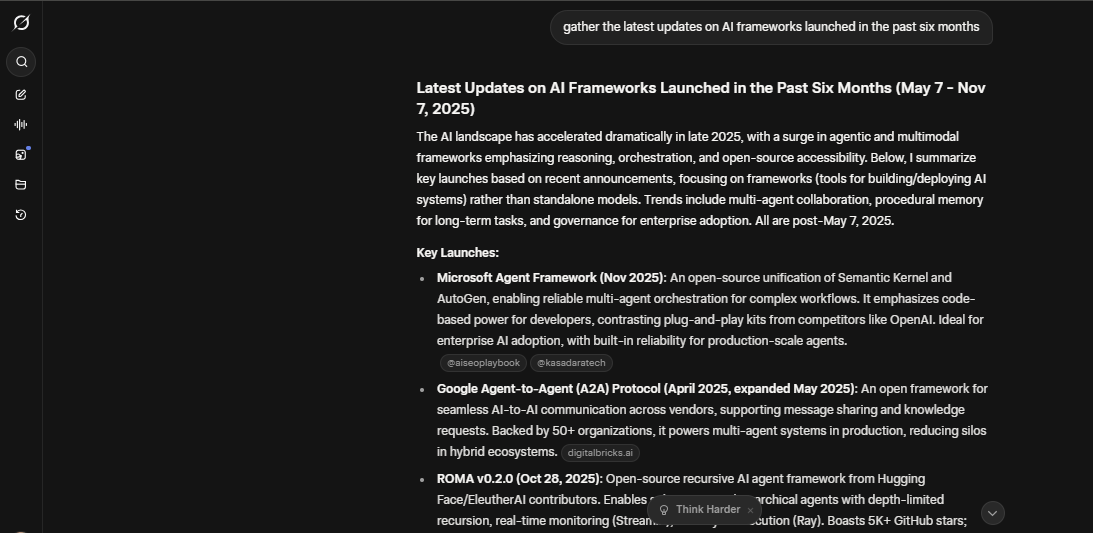
Grok’s response to the real-time information search task
Verdict:
Grok wins in speed and live data access, as well as the depth and wide range of topics; ChatGPT excels in structured and verified information delivery.
8. Deep Research and Technical Exploration
The last test explored how both tools handle complex topics, specifically, the integration of AI with edge computing.
ChatGPT produced a deeply detailed answer, citing challenges like latency, hardware constraints, and data privacy, followed by technical insights into federated learning and model compression. It even referenced potential research papers and prototype architectures.
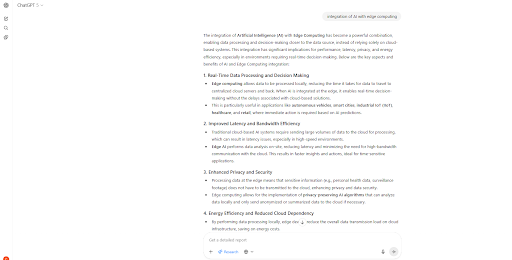
ChatGPT’s response to the deep research task
Grok researched, verified, and synthesized information from web searches and X posts on AI-edge computing integration, structuring a direct answer with key points followed by a detailed survey including benefits, challenges, use cases, trends, tables, and citations.
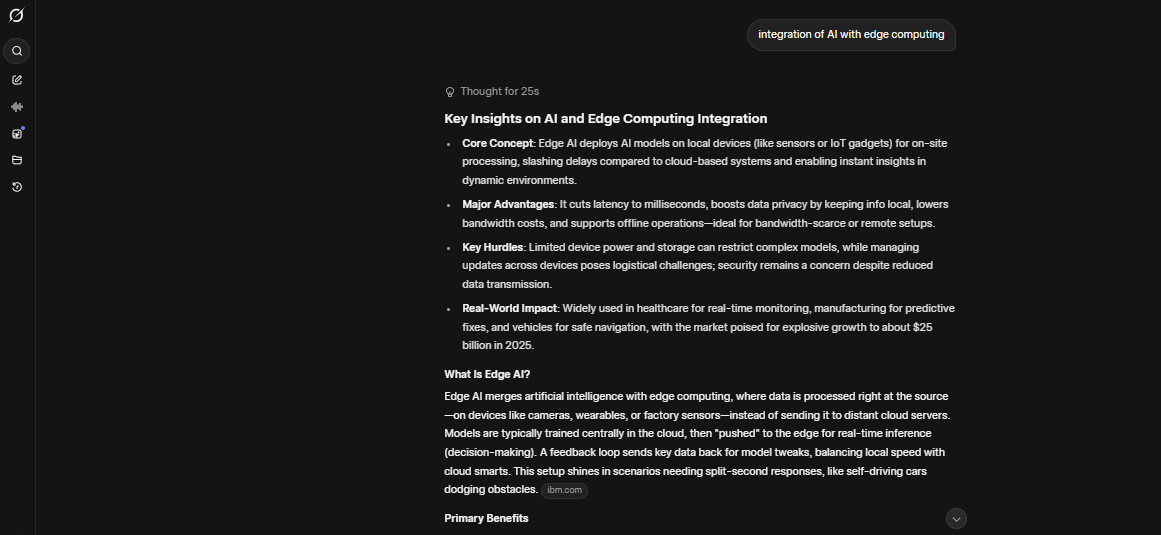
Grok’s response to the deep research task
Verdict:
ChatGPT is better suited for research-driven tasks and whitepaper-level exploration. Grok remains valuable for quick topic familiarization and real-time industry buzz.
Final Verdict: Grok and ChatGPT Working Better Together
Both Grok and ChatGPT bring powerful capabilities to the table, each excelling in different ways. Grok stands out for its real-time awareness, conversational style, and integration with live data from X, making it incredibly useful for fast-moving environments where trends and updates matter. ChatGPT, on the other hand, shines with structured reasoning, code generation, detailed analysis, and its ability to handle complex, multi-step tasks.
Rather than competing, these two tools can complement each other beautifully. Grok can serve as a quick-thinking assistant for instant insights and real-time monitoring. At the same time, ChatGPT can take those findings further, turning them into refined ideas, strategies, or technical solutions.
When used together, they form a balanced AI workflow: one that combines real-time intelligence with deep analytical thinking. To implement and scale this approach effectively across real-world systems, many organizations choose to hire AI engineers who can integrate these tools into existing workflows and ensure they deliver consistent value.
Ultimately, the “best” tool depends less on its name and more on how it aligns with your goals, processes, and creative workflow.