Quick Summary
This guide explores 10 powerful ways to use Generative AI for databases, from query optimization to automated data cleaning. By leveraging these techniques, teams can boost performance, reduce errors, and make smarter, data-driven decisions faster.
Table of Contents
Introduction
The growing complexity of modern databases has made managing, querying, and securing them more challenging than ever. With the explosion of raw data and the increasing demand for real-time, traditional database tools often fall short. This is where implementing generative AI for database solutions steps in, bringing the power of large language models and intelligent automation to transform how organizations interact with their data.
Advanced AI models now enable databases to automate query creation, improve data quality, and provide intelligent analysis. These capabilities are changing how organizations handle their data, allowing teams to work faster and with greater accuracy.
Sundar Pichai, CEO of Google, once remarked, “AI is one of the most important things humanity is working on.” In the context of database management, best practices are already being reshaped, and entirely new capabilities are being enabled. This article will take you through the key ways AI is transforming databases and how you can leverage these advancements to stay ahead in a data-driven world.
What is Generative AI in Database Management?
Generative AI in database management is an advanced AI-driven method that uses deep learning and large language models (LLMs) to automate, enhance, and generate data-related processes. Traditional AI focuses on classification or prediction, but generative models can create:
- New queries for optimization
- Synthetic data for training and testing
- Intelligent summaries of large datasets
- Automated schema designs or recommendations
By understanding both the structure and semantics of data, these systems can provide highly contextual outputs, making them useful in environments where speed and accuracy are equally critical.
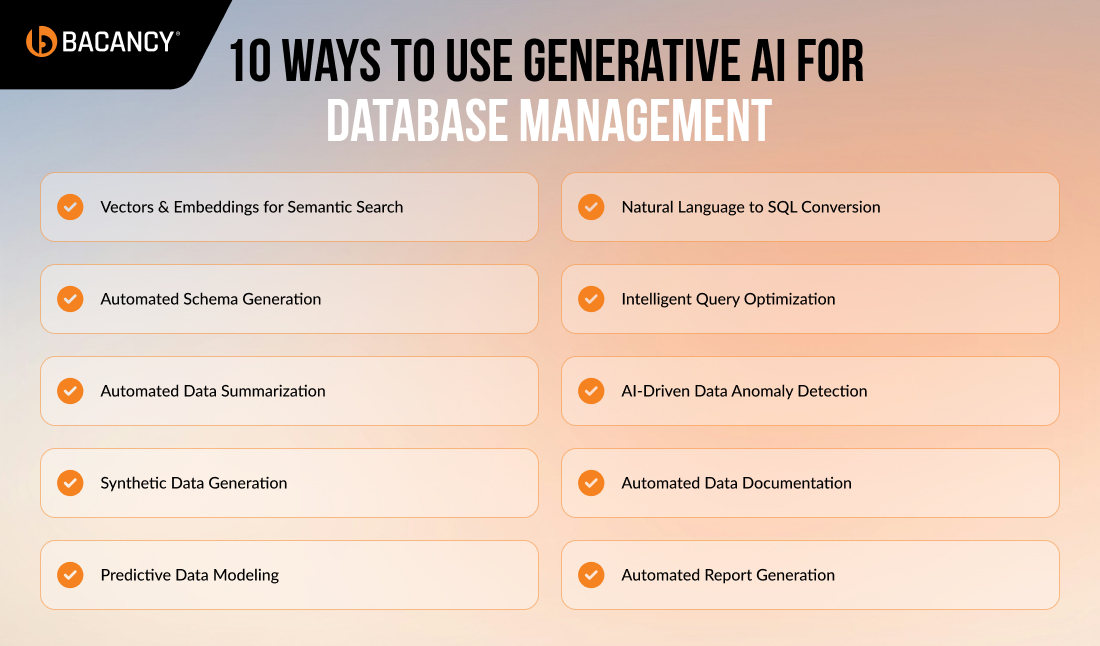
10 Ways to Use Generative AI for Database Management
The following strategies demonstrate how this technology can be applied for practical, measurable benefits in real-world database environments.
1. Vectors & Embeddings for Semantic Search
Traditional database searches rely on exact keyword matches, which can miss relevant results when the language differs. Generative AI introduces embeddings, which are numerical representations of data that capture meaning rather than just syntax.
When embeddings are stored in vector databases such as Pinecone, Weaviate, or FAISS, semantic search becomes possible. Instead of matching words, the AI finds entries with similar meaning.
How it works:
- AI converts data into embeddings.
- Queries are transformed into embeddings as well.
- The system retrieves results with the closest semantic similarity.
Example:
A customer service team searches for “complaints about delivery delays” and retrieves all relevant records, even if they contain phrases like “late shipment” or “package arrived after due date.”
Benefit:
Improved accuracy and relevance in data retrieval, enhancing analytics and decision-making.
2. Natural Language to SQL Conversion
Many non-technical professionals need access to database insights but cannot write SQL. Generative AI solves this by translating plain English into precise SQL queries.
How it works:
- The AI model is trained on pairs of natural language requests and SQL commands.
- The user types a request such as “Show me revenue growth in Q3 2024 compared to Q2 2024.”
- AI generates an optimized SQL query to produce the answer.
Example:
A sales director asks, “List the top 10 products sold in Europe last month,” and gets results instantly without developer intervention.
Benefit:
Reduces dependency on IT teams, speeds up data access, and ensures accuracy in query formulation.
3. Automated Schema Generation
Designing database schemas from scratch can be time-consuming. Generative AI can generate optimal database schemas based on business requirements.
How it works:
- The AI model is built on thousands of existing database schema patterns.
- The user provides the type of data and relationships needed.
- AI outputs a ready-to-use schema with tables, columns, and relationships.
Example:
A startup founder describes their inventory management process, and AI generates a complete PostgreSQL schema within seconds.
Benefit:
Speeds up database design, ensures scalability, and reduces human errors in schema creation.
Leverage our Database Consulting Services that integrate AI, automation, and security for resilient and scalable systems.
4. Intelligent Query Optimization
Slow queries impact application performance. Generative AI can automatically rewrite SQL queries for efficiency.
How it works:
- The AI analyzes historical query performance data.
- It detects inefficient joins, redundant clauses, or missing indexes.
- It rewrites the query to minimize execution time.
Example:
A large retail database query taking 45 seconds is rewritten by AI to execute in under 5 seconds.
Benefit:
Improves system performance, reduces resource usage, and enhances user experience.
5. Automated Data Summarization
Analyzing massive datasets can be overwhelming. Generative AI can summarize large data tables into key insights.
How it works:
- AI identifies patterns, trends, and outliers in the dataset.
- It turns complex information into accessible, human-readable outputs.
- Summaries can be generated daily, weekly, or on demand.
Example:
A financial analyst uploads a 2GB transaction log, and AI produces a one-page summary highlighting unusual spending patterns.
Benefit:
It saves time, provides quick insights, and helps with faster decision-making.
6. AI-Driven Data Anomaly Detection
Detecting anomalies in real-time can prevent fraud, system failures, or bad data entries.
How it works:
- AI learns normal data patterns from historical datasets.
- It monitors incoming data in real-time.
- Any variance from expected standard triggers alerts.
Example:
A banking database receives a sudden spike in overseas transactions at midnight. AI instantly flags it for review.
Benefit:
Enhances security, improves data reliability, and reduces financial losses.
7. Synthetic Data Generation
When real data is sensitive or limited, Generative AI is capable of generating artificial datasets that mirror actual data patterns.
How it works:
- AI analyzes existing datasets to learn patterns.
- It generates synthetic but statistically accurate datasets.
- These datasets are safe for training models without privacy concerns.
Example:
A healthcare startup trains its AI model using synthetic patient records without violating HIPAA regulations.
Benefit:
Protects privacy, accelerates AI development, and ensures compliance.
8. Automated Data Documentation
Keeping database documentation updated is often neglected. Generative AI can create and manage it automatically.
How it works:
- AI scans database schemas, queries, and stored procedures.
- It generates human-readable documentation with explanations.
- It updates documentation automatically when changes are made.
Example:
A development team updates a table, and AI instantly updates the technical documentation with new column details.
Benefit:
Ensures up-to-date documentation, improves onboarding, and reduces confusion.
9. Predictive Data Modeling
Generative AI predicts future trends by learning from historical data patterns.
How it works:
- AI is trained on historical datasets with known outcomes.
- It detects patterns and builds predictive models.
- Users can query future projections directly from the database.
Example:
An e-commerce company leverages AI to forecast demand for the holiday season based on past sales data.
Benefit:
Enables proactive decision-making, reduces overstock or stockouts, and improves profitability.
10. Automated Report Generation
Creating detailed reports manually can take hours. Generative AI can instantly convert raw data into structured reports.
How it works:
- AI pulls relevant data from multiple tables.
- It formats data into visual charts, tables, and narratives.
- Reports can be customized for different stakeholders.
- Start with Clear Use Cases: Define where generative AI will bring measurable benefits before full-scale deployment.
- Ensure High-Quality Training Data: Poor-quality data leads to poor-quality insights, no matter how advanced the AI model.
- Integrate with Existing Tools: Choose solutions that work seamlessly with current database systems.
- Prioritize Security and Compliance: Ensure data privacy, especially for confidential or policy-regulated datasets.
- Monitor and Optimize Continuously: Monitor efficiency and adjust AI models for accuracy based on feedback and results.
Example:
A CEO requests a monthly performance dashboard, and AI generates it within seconds in PDF and interactive formats.
Benefit:
Saves time, ensures consistency, and enables real-time business monitoring.
5 Best Practices for Implementing Generative AI for Database
Implementing generative AI for database systems requires careful planning and proven best practices. In many cases, organizations rely on Generative AI development services to ensure these practices are applied correctly across model selection, database integration, and long-term optimization.
Conclusion
Using generative AI for database is not just an upgrade, but it’s a shift in how organizations interact and manage their data. By adopting these intelligent technologies, businesses can dramatically improve data accuracy, accelerate decision-making, and reduce operational risks. To unlock this potential, most of the enterprises hire Generative AI developers from Bacancy to design, train, and integrate AI-driven database solutions tailored to their unique data ecosystems. The ability to automate complex processes and deliver real-time, actionable insights is shaping the future of modern database management.
As AI researcher Andrew Ng noted, “AI is the new electricity.” For database management, it is becoming an essential power source for innovation and operational excellence. Companies that embrace generative AI today will position themselves at the forefront of innovation and resilience in an increasingly data-driven world.