Last Updated on February 6, 2026
Last Updated on February 6, 2026
Quick Summary:
This blog covers A to Z about the Microservices architecture, usage, needs, and advantages. Hop in to learn Microservices in Laravel along with a practical tutorial where we have built Laravel microservices with Lumen framework. Find why, when, and how businesses need Laravel for microservices.
Table of Contents
As you must know, or as implied by the microservices definition, a microservice is a collection of freely deployable services. It is an approach to building application software as a collection of independently deployable, compact, modular services. Herein, each service executes a different operation and interacts with one another via a simple, well-defined interface.
In light of that, you must ponder how we can implement microservices in Laravel. How does Laravel architecture work on microservices? Well, here’s how PHP Laravel microservices work!
Before beginning with Laravel architecture on Microservices, let’s talk about Laravel first. Laravel is one of the foremost widely used frameworks for developing custom applications. Laravel gives its developers the proper tools to create anything from websites to web applications. All in all, it is quicker to deploy, easier to maintain, and more reliable.
If we speak in numbers, Laravel boasts over 56,000 developers worldwide. It is the highest-starred PHP framework on GitHub and is brimming with powerful features.
In contrast to the monolithic architectural style, which is used when an app is constructed as a single structure, microservices is a method to develop a single program as a suite of separate sections, services connected by APIs. It allows the creation of several microservices that can be controlled by various teams and coded in various programming languages.
Microservices here, a type of software architecture, unifies massive Laravel applications in a modular way depending on Small Building Blocks that concentrate on a specific duty and activity. Blocks interact with one another via a set of language-independent/language-agnostic APIs.
Dew Computing is a notion that correlates to Laravel architecture styles by using a microservices architecture to calculate the potential of numerous little dews (denotes the functional components of microservices).
The 3 prime reasons that modern enterprises need microservice architecture are:
● To defend against a failure of traffic or performance surge.
● To scale graciously
● To reduce the number of individuals engaging in each codebase.
The microservice design has several advantages. Generally, microservice in Laravel is narrowly targeted, allowing them to be lighter and function considerably faster.
Moreover, it only involves microservices API calls. Different languages may be used for certain services. Notification services, for example, might be written in NodeJs. Therefore,it’s not mandatory to use either Laravel or Lumen.
According to usage, every service can be scaled. In summary, it might work well for huge applications. Besides this, some of the advantages of Laravel Microservices are:
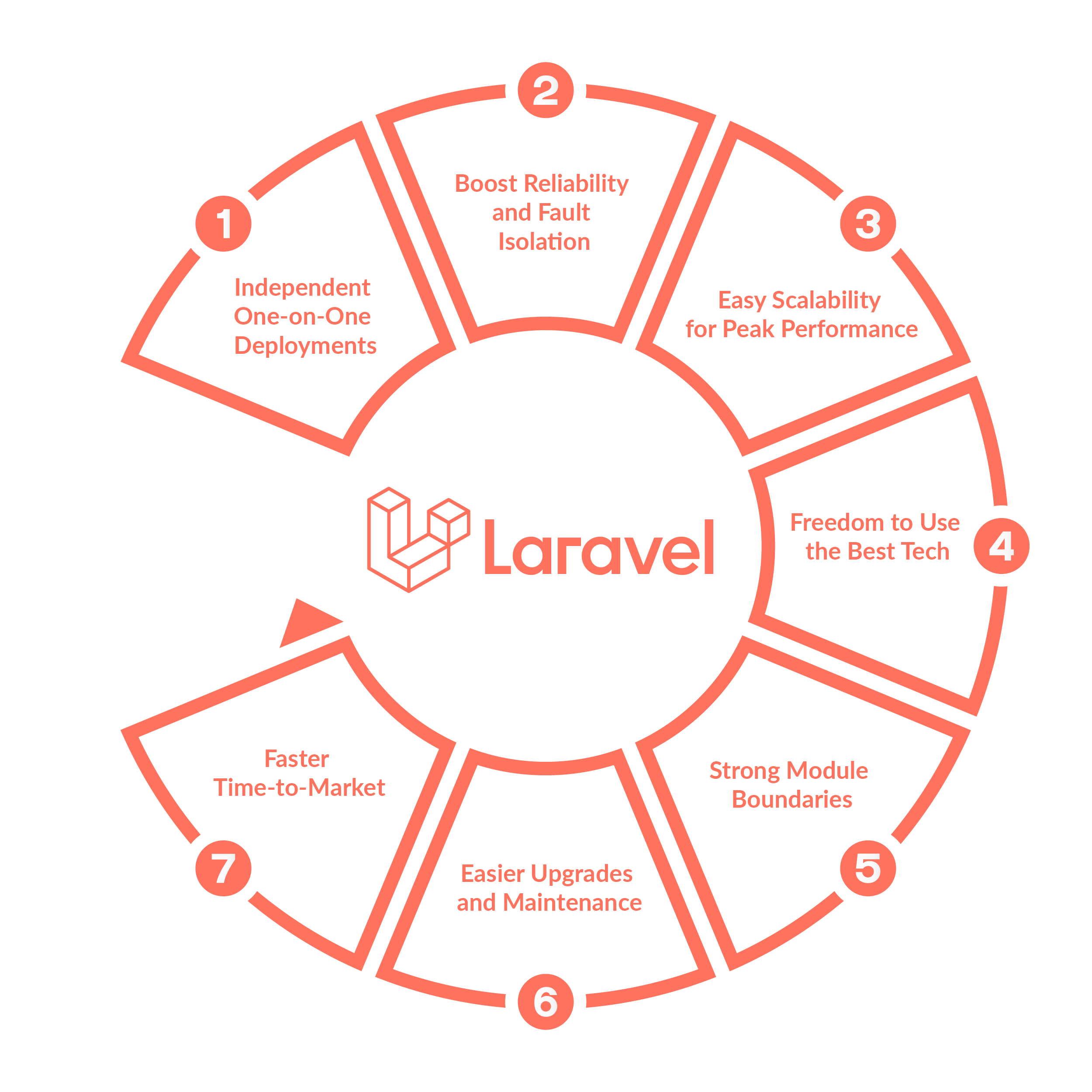
You can deploy each part of your app separately using the Laravel microservices architecture. This means you can scale or update a single component without affecting the rest of your system. If something goes wrong, it won’t take down the whole application. This flexibility makes your business more resilient, helping you fix issues and roll out updates quickly so your users don’t experience disruptions.
When your app is broken down into smaller parts, a problem with one service won’t bring down the entire system. Each service operates independently, so it becomes easier to spot and fix any issues. This results in better uptime and fewer interruptions for your customers. You get a more reliable experience, and your business can run smoothly without worrying about system crashes.
Laravel microservices help you scale parts of your app independently. When payment processing suddenly gets hit with a huge demand, you can particularly scale that service without making any changes in other services. This ensures your app stays fast and performs well, even when traffic spikes. As your business grows, microservices ensure your app keeps running smoothly without complex reconfiguration.
With Laravel microservices architecture, you are not stuck with just one tech stack. Each service can use any tool that works best for its work. This means you can use the right technology to achieve the best results quickly and outperform the competitors. Your application performs the best because of choose the best tool for each task.
Microservices in Laravel split your system into smaller and independent modules. You can manage, develop, and scale your app comfortably with this approach. Each module has clear boundaries, so there are fewer dependencies and less risk of one service affecting the others. For your business, this means more control and the ability to innovate faster without disrupting the rest of the system.
You don’t need to take down your entire system just to update or maintain one service. Each service works independently, so you can upgrade or replace them without interrupting your users. This flexibility reduces the complexity and risk of updates, ensuring your app stays fresh and up to date without delays.
Microservices break your app into smaller parts so that different teams can work on them simultaneously. This speeds up development and update releases. Whether you are adding new features, fixing bugs, or scaling services, you can do so quickly without delay. It will enable you to launch your digital product faster than your competitors.
Leverage the expertise of our Microservice architecture experts to develop low-latency apps for mission-critical business solutions. Partner with the top Laravel Development Company and relish your success.
Generally, you should use Laravel microservices when your application,
In any of these situations, Laravel microservices framework can be implemented. However, it is frequently employed in order to convert monolithic old applications into a microservices architecture.
In essence, there are 4 basic causes for it:
With business owners’ increasing preference for microservices architecture, Laravel’s microservices architecture is a viable choice. It helps boost the overall efficiency and efficacy of your business application. However, certain best practices can be leveraged to bring out the true potential of your business application via Laravel Microservices.
Microservices are introduced to uphold service independence, with each microservice defining specific functions and contributing to overall efficiency. Here are key strategies to ensure this independence:
By implementing these strategies, organizations can effectively harness the benefits of microservices architecture while maintaining service independence and scalability.
Utilizing API gateways means setting up a main access point for all your microservices. This hub manages user authentication, access permissions, and usage limits, making interactions safer and more controlled. It also directs requests to the right microservices and handles technical tasks like logging and monitoring. This simplifies the development of microservices by dealing with common issues in one place. Additionally, an API gateway allows seamless updates and changes to microservices without disrupting client applications.
The mechanisms, such as Consul, function as a centralized entry point for all microservices, streamlining authentication, authorization, rate limiting, simplifying client interactions, and enhancing security scalability. To achieve this, ensure that each microservice registers itself with the chosen service registry upon initialization, making its location and availability known. Utilize the service registry to locate required services, as microservices need to communicate with each other. Activate health checks within the service registry to ensure that only healthy microservices are discovered and utilized. Consider leveraging features of Laravel API Gateway or explore specialized API gateway solutions like Kong and Apigee.
Use the Laravel queue system or messaging platforms like RabbitMQ or Kafka for asynchronous communication between microservices. This enhances performance and facilitates efficient management of background tasks. You can decouple services by leveraging asynchronous events or messages, enabling each microservice to function independently and asynchronously. This promotes an event-driven architecture, facilitating communication between microservices through events and promoting loose coupling and scalability. Developing an error-handling mechanism to manage failures and ensure reliable message delivery in asynchronous communication is essential.
Laravel is a great choice for building web applications thanks to its extensive features and functionalities. However, incorporating microservices with the Laravel framework presents certain challenges. Let’s take a glimpse of those challenges.
To address these challenges effectively, start with the following best practices:
Addressing the demands of microservices involves overcoming a frequent hurdle: accommodating the necessary resources and processing power due to the dispersed design of microservices architecture. As the number of microservices grows, the complexity of managing and coordinating them increases, leading to greater overhead. Development teams can optimize code, utilize efficient communication protocols, and adopt load-balancing techniques to tackle this challenge. Employing automation tools for deployment and monitoring can streamline operations and minimize unnecessary overhead.
Debugging issues across microservices is challenging due to their distributed nature, lack of centralized logging, and increased complexity. However, you can overcome this challenge by implementing comprehensive logging to monitor data flow and errors within each microservice. This makes debugging easier. Integrate tools like Sentry or New Relic for error monitoring and reporting across your microservices architecture, aiding in issue identification and resolution. Additionally, utilize distributed tracing tools such as Zipkin or Jaeger to track requests as they move through different microservices, aiding debugging complexities. Establishing a centralized system for handling exceptions ensures uniform error handling across microservices, streamlining the debugging process.
Data inconsistencies often arise within microservices due to their distributed nature. Factors like network latency and concurrent updates contribute to these inconsistencies across microservices, impacting system reliability and data integrity. However, you can tackle this by adopting strong data consistency strategies like event sourcing or distributed transactions, employing compensating transactions and idempotent operations, implementing event consistency when immediate consistency isn’t necessary, leveraging event-driven architecture and message queues for orderly event processing, and regularly monitoring and reconciling data across microservices can help identify and resolve inconsistencies, ensuring effective management of potential data inconsistencies.
In this Laravel Microservices example tutorial, we will learn how to create microservices in Laravel (Lumen); following this step-by-step tutorial, you can create your APIs for your application.

Like Laravel, Lumen has also been created by Taylor Otwell, And it has been designed keeping in mind the microframework architecture. There are more frameworks (Slim, Silex) like Lumen that you can use for microservices.
To install Lumen, you must first install composer. You can download the latest version of Composer by visiting the getcomposer.org
Install Lumen via Composer:
composer global require "laravel/lumen-installer"
The below command will create a new Lumen project with all required dependencies.
lumen new demo
Serve your application with the below command.
php -S localhost:8000 -t public
Step 1: Configuration
In the .env file, replace the value with the following values and also fill in the details of the database.
CACHE_DRIVER=array
QUEUE_DRIVER=database
DB_DATABASE=application
DB_USERNAME=
DB_PASSWORD=
We will create a migration file. This file automatically creates the table in the connected database by running migrate command. A migration file will be created inside the database/migrationsdirectory.
php artisan make:migration create_products_table
Add this below code to the created CreateProductsTable migration file.
use Illuminate\Database\Migrations\Migration;
use Illuminate\Database\Schema\Blueprint;
use Illuminate\Support\Facades\Schema;

class CreateProductsTable extends Migration
{
   /**
    * Run the migrations.
    *
    * @return void
    */
   public function up()
   {
       Schema::create('products', function (Blueprint $table) {
           $table->bigIncrements('id');
           $table->string('name');
           $table->integer('price');
           $table->longText('description');
           $table->timestamps();
       });
   }

   /**
    * Reverse the migrations.
    *
    * @return void
    */
   public function down()
   {
       Schema::dropIfExists('products');
   }
}
Run this command.
php artisan migrate
Lumen doesn’t support the below-given make: command
php artisan make:model Product
Go to the app directory, create a new model called Product.php and paste the following code.
App/Product.php
namespace App;
use Illuminate\Database\Eloquent\Model;

class Product extends Model
{
   protected $table = 'products';
   /**
    * The attributes that are mass assignable.
    *
    * @var array
    */
   protected $fillable = [
       'name', 'price', 'description'
   ];

}
Now load Eloquent and Facades by uncommenting the following code located in the bootstrap/app.php Directory.
$app->withFacades();
$app->withEloquent();

$app->register(App\Providers\AppServiceProvider::class);
$app->register(App\Providers\AuthServiceProvider::class);
$app->register(App\Providers\EventServiceProvider::class);
Go to the app\Http\Controller and create a new file ProductController.php and paste the below-mentioned code.
// app/http/controllers/ProductController.php
namespace App\Http\Controllers;
use App\Product;
use Illuminate\Http\Request;

class ProductController extends Controller
{
   /**
    * Create a new controller instance.
    *
    * @return void
    */
   public function __construct()
   {
       //
   }

    public function index()
    {

      $products = Product::all();
      return response()->json($products);
    }

    public function create(Request $request)
    {
      $product = new Product;
      $product->name= $request->name;
      $product->price = $request->price;
      $product->description= $request->description;

      $product->save();
      return response()->json($product);
    }

    public function show($id)
    {
       $product = Product::find($id);
       return response()->json($product);
    }

    public function update(Request $request, $id)
    {
       $product= Product::find($id);

       $product->name = $request->input('name');
       $product->price = $request->input('price');
       $product->description = $request->input('description');
       $product->save();
       return response()->json($product);
    }

    public function destroy($id)
    {
       $product = Product::find($id);
       $product->delete();
       return response()->json('product removed successfully');
    }

}
Now add this code to routes/web.php. Create Group routes function to our routes and add the prefix to them.
$router->group(['prefix'=>'api/v1'], function() use($router){

   $router->get('/items', 'ProductController@index');
   $router->post('/items', 'ProductController@create');
   $router->get('/items/{id}', 'ProductController@show');
   $router->put('/items/{id}', 'ProductController@update');
   $router->delete('/items/{id}', 'ProductController@destroy');

});
We can use postman to test APIs; if you use VScode, you can also test APIs with the thunder client. In this tutorial, we will use postman.
Method – GET– Request with all items preview:
URL – http://localhost:8000/api/v1/items
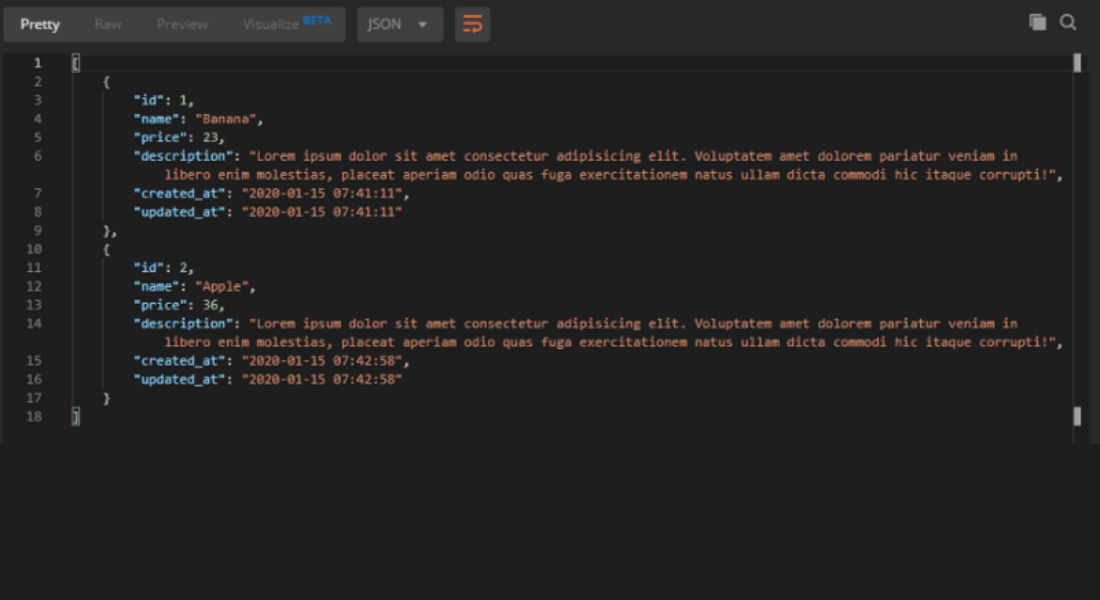
Method – GET-Request with single items preview:
URL – http://localhost:8000/api/v1/items/1
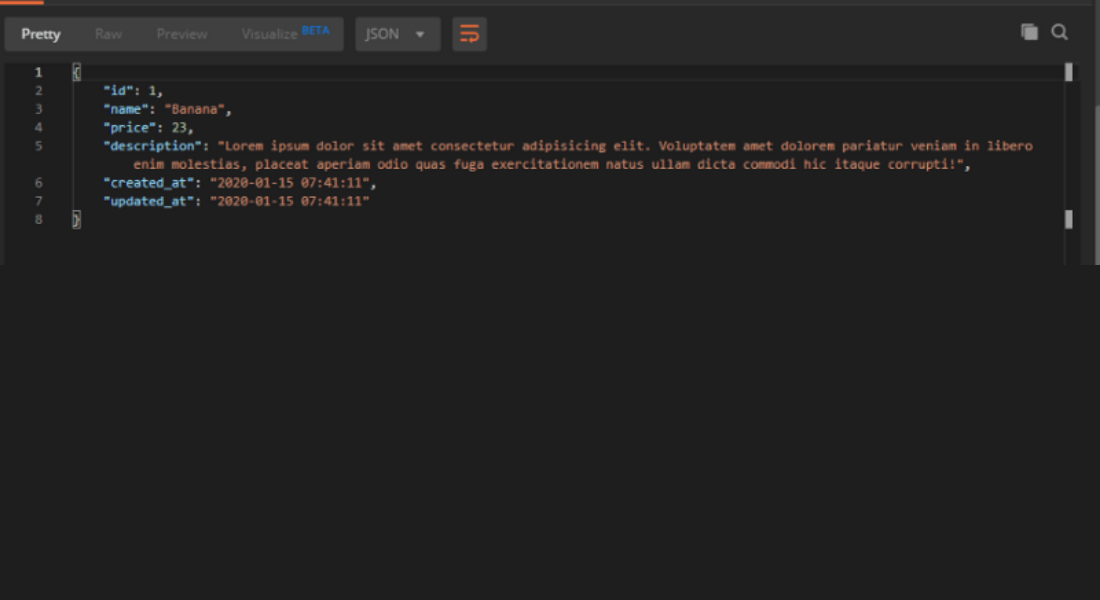
Method- POST – Request for inserting new items preview:
URL- http://localhost:8000/api/v1/items
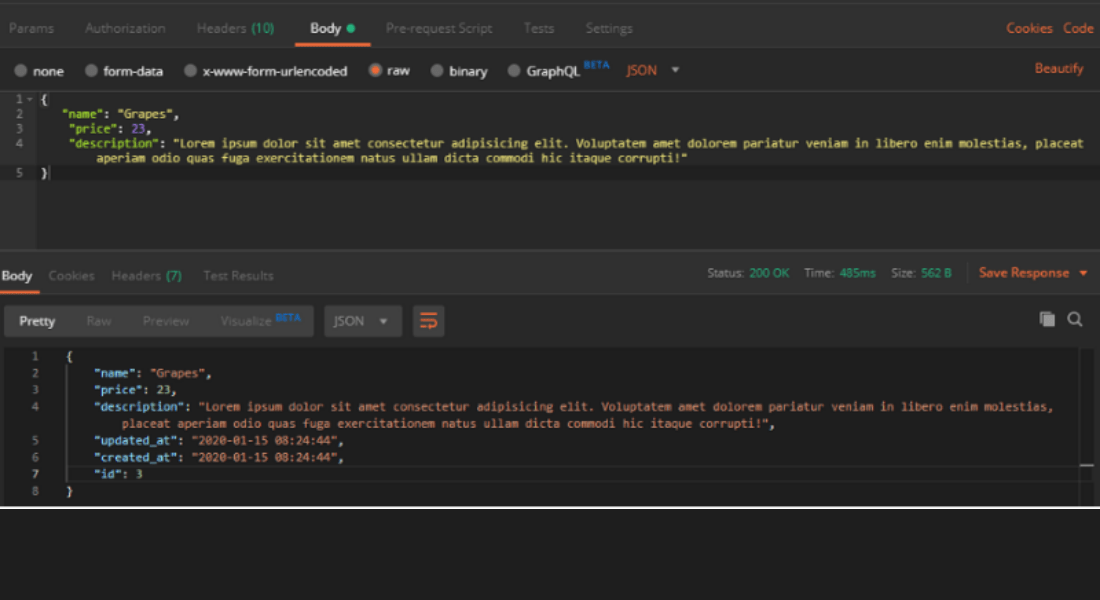
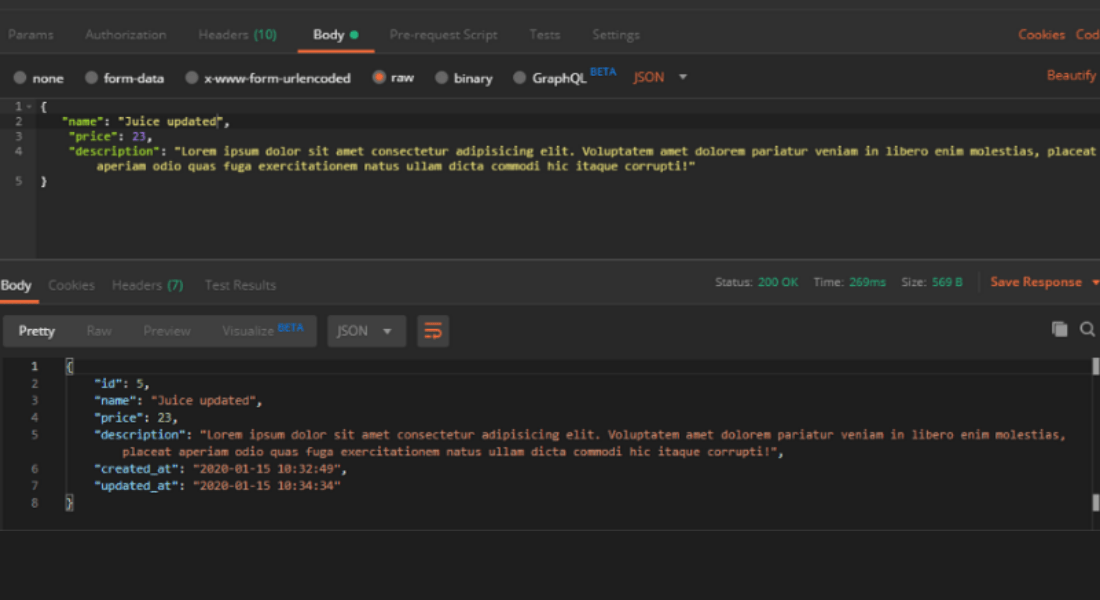
Method – PUT -Request for updating items preview:
URL- http://localhost:8000/api/v1/items/5
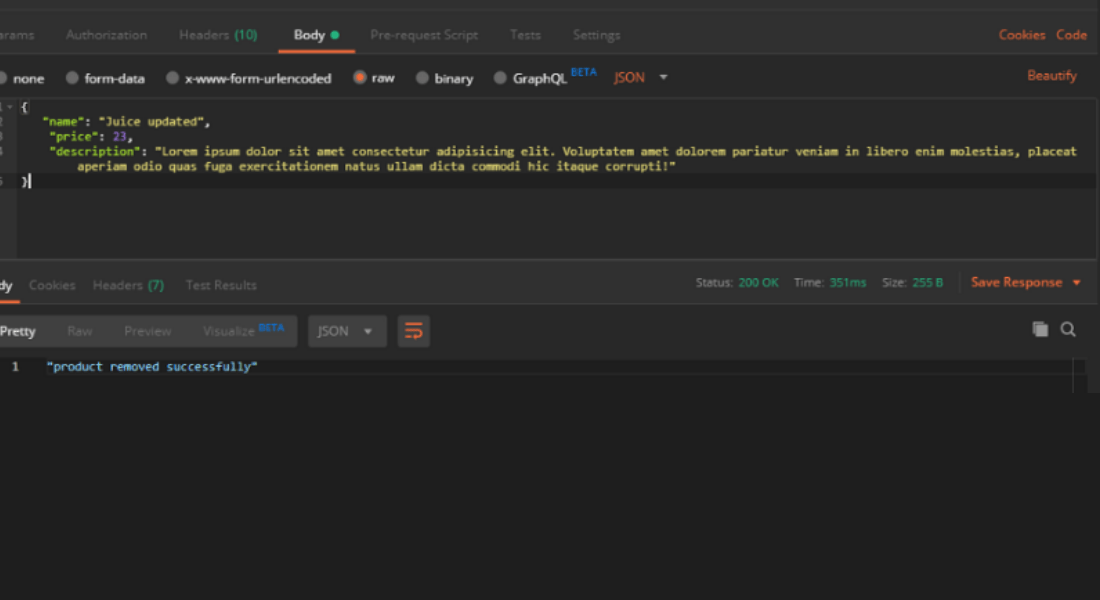
Method – DELETE – Request to delete items preview:
URL- http://localhost:8000/api/v1/items/5
With this practical Laravel Microservices example, we come to the end of this blog post. We will be your best choice if you are a modern business and wish to take advantage of microservices with Laravel framework. Bacancy has a pool of Laravel developers who are vetted with varied industry experiences. Stay ahead of your competition and make your users drool over your services. Hire Laravel developer from us and give your users a nerve-wrecking experience.
You can create microservices in Laravel using the Lumen Microservice framework. Lumen is the best choice for creating microservices because it is fast with all features of Laravel. It is easy to scale, and maintain and is ideal for building APIs.
You can create microservices using Laravel Lumen. The laravel microservices is an approach to developing a single application as a suite of small parts accessed through APIs. To access those parts/services the initial layer or the User-app act as an API gateway. The user calls for API gateway URL and is then authorized by the API gateway which then calls the respective service.
The API gateway keeps a service repository, a singleton class that includes service metadata and hostnames which helps in knowing which service to call.
Laravel is neither Monolithic nor Microservice in itself. Instead, Laravel is a free and open-source PHP framework providing a set of tools and resources to build both Monolithic and Microservice architecture-based applications.
You should consider moving from a monolithic application to Laravel microservices when your app gets too complex or hard to scale. If different parts of your app need to change at different times, or team needs to develop things separately, microservices in Laravel can make things easier and more flexible. They also help when you are facing performance issues.
Yes. At first, it costs more to set up. But later, you definitely save because you are not only scaling busy parts but you will get less downtime and easier bug fixes. Just plan well so complexity doesn’t add extra work.

Tech Geek at Bacancy
Creative content strategist crafting impactful stories around web, mobile, and software.
MORE POSTS BY THE AUTHOR
Your Success Is Guaranteed !
We accelerate the release of digital product and guaranteed their success
We Use Slack, Jira & GitHub for Accurate Deployment and Effective Communication.