| Workflow | Before Automation | After Automation (90 Days) |
|---|---|---|
| Prior Authorization Processing | 3-6 day turnaround & 2 FTEs on portal submissions | 24 hr turnaround & 80% staff effort reduction |
| Insurance Eligibility Verification | Manual check per appointment & 15-20 min each | Real-time automated check at scheduling with zero staff time |
| Claim Scrubbing & Submission | 18% denial rate & manual coding error catch | 7% denial rate within the first 90 days post-deployment |
| Clinical Documentation | 90 min per physician per day spent on notes | 35 min per physician per day & 55 min recovered per doctor |
| Lab Result Delivery to Patient Portal | Manual review queue & 24-48 hr patient wait | Auto-release on result receipt & 21st Century Cures compliant |
| Staff Shift Scheduling | Weekly manual build by the charge nurse with high overtime | AI-generated daily by acuity level & overtime down 22% |
Quick Summary:
This insight covers how Bacancy built a healthcare workflow automation system for a U.S. hospital network, from the discovery phase and architecture design to HIPAA compliance challenges and the results at 3 months and 6 months.
Table of Contents
Introduction
When a mid-size U.S. hospital network running across four locations and 500+ beds reached out to us, they already knew something was wrong. Prior authorizations were piling up. Claim denials were climbing. Physicians were spending more time on documentation than on patients. Their operations team had no single view of what was actually happening across departments.
They had tried two off-the-shelf Healthcare workflow automation tools. One was abandoned after six months. The other was still running but siloed from their Epic EHR instance and producing data no one was acting on. The problem was not that they lacked automation. The problem was that they had automation without integration, and processes that were broken before they were automated.
This insight includes the discovery phase, the architecture we built, the compliance constraints that changed our design mid-project, and the results at 3 months and 6 months. It is a real workflow automation in Healthcare development story, with the client anonymized by agreement.
Their Existing Operational Breakdown
Before writing a single line of code, we spent three weeks in discovery, mapping workflows across all four locations, interviewing clinical staff, billing teams, and the IT department. What we found was a layered breakdown in Healthcare workflow automation with four distinct failure points.
Prior Authorization Backlog
Two full-time employees did nothing but submit prior authorization requests to payer portals all day. Average turnaround was 3 to 6 days per request. Manual prior authorization workflows consume 30 to 60 minutes of staff time per request, and this client’s numbers tracked closely with that benchmark. Procedures were being delayed. Patients were calling to follow up. Staff were burning out on a task that had no clinical value.
Disconnected Scheduling and EHR
The scheduling platform and the Epic EHR instance were not integrated. Staff were manually re-entering patient demographic data, insurance details, and appointment notes across two systems after every booking. This dual-entry process introduced errors at a rate no one had formally measured until we did during discovery.
Revenue Cycle Leakage
The client’s claim denial rate sat at 18%, nearly double the industry benchmark of 9 to 10%. There was no automated claim scrubbing before submission, no denial prediction logic, and no systematic root cause analysis on rejected claims. Billing staff was resubmitting denials manually, with no visibility into which denial categories were most prevalent or which payers were the biggest problem.
No Visibility Across Departments
The operations director was pulling reports from four separate systems to get a picture of what was happening each morning. Authorization queue status, staff coverage gaps, claim pipeline, and lab result backlog all lived in different tools. There was no single operational view, which meant escalations happened reactively, after problems had already affected patients or revenue.
Our Discovery Phase of Healthcare Workflow Automation
Discovery produced findings that shifted the project scope in two significant ways.
The workflow mapping exercise documented 23 distinct manual handoff points across the four locations. Of those, 7 workflows were automation-ready immediately. Four others needed process redesign before automation could work.
The most significant discovery was that no single integration layer existed between the scheduling platform, Epic, and the billing system. The two previous Healthcare workflow automation tools had both tried to sit on top of disconnected systems. Neither had been designed to bridge them. That was the root cause of every downstream problem, and it meant the first thing we had to build was not an automation at all. It was a middleware integration layer.
We also ran a compliance audit of the client’s existing automated processes. Two of them were non-compliant with the HIPAA Security Rule. One transmitted ePHI between systems without encryption, and the other had no audit logging. Both had to be corrected before we could build on top of them.
One more finding that changed this workflow automation in Healthcare project timeline is that clinical staff and billing staff had fundamentally different expectations about the work of workflow automation in Healthcare. Clinicians wanted documentation relief, and billing wanted a denial reduction. Both were right, but building for both simultaneously without aligning them upfront would have created scope conflict mid-sprint.
The Automation Architecture We Built
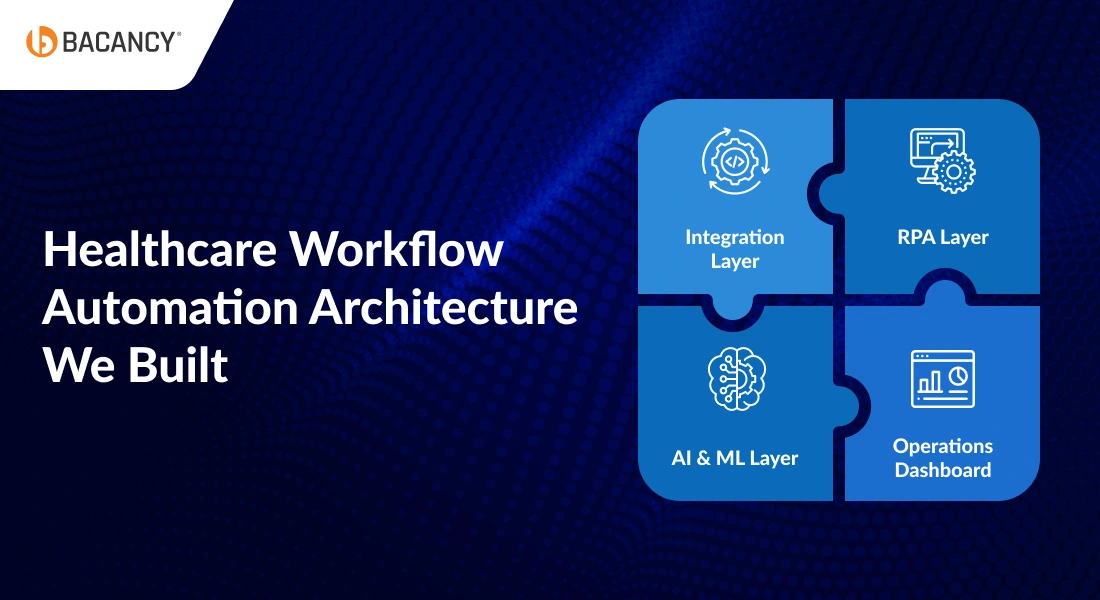
Our Healthcare workflow automation architecture has four distinct layers, each dependent on the one below it. Integration came first. Automation came second. Intelligence came third. Visibility came last.
1. Integration Layer
We built a custom middleware layer connecting the client’s scheduling platform, Epic EHR instance, and billing system using HL7 FHIR APIs. This was the non-negotiable foundation. Without bidirectional data flow across all three systems, every automation above it would be operating on incomplete or stale data. The integration layer also enforced TLS 1.3 encryption for all ePHI in transit and role-based access controls at every data exchange point, addressing the HIPAA security rule gaps found in discovery.
2. RPA Layer
With clean data flowing between systems, we deployed UiPath bots to handle the highest-volume manual tasks like prior authorization submissions, insurance eligibility verification at the time of scheduling, payment posting, and denial categorization. Each bot operated within a logged execution environment, and every action was timestamped, every system-of-record update recorded.
3. AI & ML Layer
We trained a denial prediction model on 18 months of the client’s own claims history. In parallel, we integrated an ambient AI documentation tool into the physician workflow to generate structured SOAP notes automatically from patient-provider conversations and pushed directly into Epic. This eliminates the manual documentation step that was consuming 90 minutes per physician per day.
4. Operations Dashboard
The final layer was a real-time operations dashboard built in React that pulls live data from all connected systems. The operations director now opens one screen each morning to see the authorization queue by status and aging, staff coverage by department, claim pipeline by payer, denial risk score, and lab result delivery status. Every metric that previously required four separate report pulls now lives in one view of the Healthcare workflow automation system.
Do You Want to Build Something Similar for Your Hospital or Health System?
Talk to our expert development team about designing the right Healthcare automation solutions for your operational environment.
The 6 Healthcare Workflow Automations & Their Results
The table below shows the before and after state for each automated workflow in the Healthcare system at the 90-day mark. These are production numbers from the client’s own reporting systems, not projections.
Two notes on the table of the Healthcare workflow automation results. First, the claim denial rate dropped from 18% to 7% within 90 days, which was faster than we projected. The denial prediction model had higher precision than the training run suggested, because the client’s historical data was cleaner in the RCM categories than in the clinical categories. Second, the lab result delivery workflow required a mid-build redesign and went live 3 weeks later than the other 5 workflows as a result.
Navigating HIPAA Compliance Mid-Build
Compliance is where healthcare workflow automation projects most commonly run into trouble. This project surfaced two moments where compliance requirements changed what we were building.
The first was the lab result delivery workflow. Our initial design held results in a review queue for 12 hours before auto-releasing to the patient portal. The 21st Century Cures Act’s information blocking rule prohibits exactly that kind of delay. We redesigned the workflow to release results immediately on receipt. The redesign added three weeks to that workflow’s timeline.
The second was the Business Associate Agreement (BAA) structure. Every third-party vendor in the technology stack required a signed BAA before we could route ePHI through their systems. Two vendors had non-standard BAA language that required legal review and negotiation before integration work could begin. We built a four-week BAA resolution window into the project plan after this experience, and recommend that every healthcare workflow automation engagement do the same.
The principle we came away with: compliance is not a checklist at the end of a sprint. It is a build constraint that changes architecture decisions from the first design session. Teams that understand this spend less time rebuilding and more time shipping.
Need HIPAA-experienced Engineers Embedded in Your Existing Healthcare Team?
Bacancy is a trusted IT staff augmentation company that provides vetted engineers with EHR integration, RPA, and HIPAA-compliant architecture experience directly into your delivery pipeline.
The Results of Healthcare Workflow Automation at 3 Months and 6 Months
At 3 months, the headline numbers were the claim denial rate drop and the prior authorization turnaround reduction. Both results are visible immediately because they were the client’s highest-pain problems and the clearest baselines to measure.
At 6 months, the more durable outcomes became visible. The two FTEs who had spent their days on prior authorization submissions were redeployed into patient coordination roles, adding direct care value rather than administrative overhead. The operations director had eliminated the daily four-system report pull entirely. The first internal HIPAA compliance audit post-implementation returned zero findings related to the automated Healthcare workflows.
One outcome we had not projected in this workflow automation in healthcare was that physician satisfaction scores for the documentation workflow improved measurably within the first quarter. Clinicians who had been resistant to the ambient AI tool at launch became its most vocal internal advocates by 3 months. The 55 minutes per day they recovered did not go back into administrative tasks. It went back into patient time.
Conclusion
Healthcare workflow automation is one of the most high-stakes areas of software development because the environment it operates in carries compliance obligations, clinical safety implications, and organizational change management challenges that most other industries do not face simultaneously.
What this engagement reinforced is that the gap between a successful workflow automation in Healthcare and a failed one is rarely the automation itself. It is the integration architecture underneath it, the compliance design around it, and the discovery work that happens before any of it is built. Organizations that skip discovery and go straight to tooling are automating problems they do not yet fully understand.
For healthcare organizations considering a similar path, the right starting point is a structured discovery engagement with a development partner who has navigated the HIPAA and HITECH as a set of design requirements that shape architecture from day one. Bacancy’s Healthcare IT consulting services are structured to begin exactly there. We will map your current workflows, identify the automation-ready processes, and build a delivery plan that accounts for compliance constraints before the first sprint begins.