| Dimension | C++ | TypeScript |
|---|---|---|
| Released | 1979 (Bjarne Stroustrup, Bell Labs) | 2012 (Microsoft, led by Anders Hejlsberg) |
| Paradigm | Multi-paradigm: procedural, OOP, generic, functional | Multi-paradigm: OOP, functional, structured (superset of JavaScript) |
| Type System | Static, nominal, with unsafe escape hatches | Static, structural, deliberately unsound |
| Memory Model | Manual management with RAII, no garbage collection | Garbage-collected via the JavaScript runtime |
| Memory Safety | Not guaranteed, depends on the programmer's discipline | Safe by default, no raw pointers |
| Compilation Target | Native machine code | JavaScript via tsc or the new Go-based compiler |
| Runtime Performance | Among the highest of any general-purpose language | Dependent on the JS engine, such as V8 |
| Compilation Speed | Slow on large projects | Roughly 10x faster with TypeScript 7.0 |
| Learning Curve | Very steep, years to master | Gentle, builds directly on JavaScript |
| Primary Domain | Systems, embedded, games, HPC, finance | Web, cloud, enterprise apps, APIs |
| Ecosystem | STL, Boost, vcpkg, Conan | npm with over 2 million packages, DefinitelyTyped |
| Government Safety Classification | Memory-unsafe per CISA and NSA | Memory-safe per CISA and NSA |
Quick Summary
The C++ vs TypeScript decision is not about which language is better. It is about which one fits the workload in front of you. This insight walks through how our team guides clients through the trade-off, the 2026 industry data that should inform it, and a real engagement where we helped a client place each language exactly where it belonged.
Table of Contents
Introduction
Somewhere between the architecture whiteboard and the first sprint, almost every client we work with hits the same crossroads. One part of the product needs microsecond-level performance. Another part needs a fast, maintainable user interface that your whole team can contribute to. That is where the C++ vs TypeScript question lands on our desk, and it lands often enough that we have built a repeatable way to work through it with clients.
The answer is that these two languages were never designed to compete. C++ has been the backbone of systems software since 1979. TypeScript was released by Microsoft in 2012 to fix a specific pain point, that JavaScript was not built for large-scale application development. When a client asks us which one to pick, we usually find the real question is not either-or. It is where each one belongs inside their architecture.
This insight lays out how we think about the C++ vs TypeScript trade-off in client engagements, what recent industry data is telling us in 2026, and a real case where our team placed both languages in the same product without forcing one to do the other’s job.
The 2026 Landscape Behind Every C++ vs TypeScript Decision
Two shifts have changed how we advise clients this year. First, TypeScript crossed a threshold nobody thought it would cross this quickly. As per GitHub’s Octoverse 2025 report, TypeScript overtook both Python and JavaScript in August 2025 to become the most-used language on GitHub, reaching 2,636,006 monthly contributors with 66.6% year-over-year growth. GitHub called it the most significant language shift in more than a decade, and the trend is directly tied to how well typed languages hold up under AI-assisted coding. A 2025 academic study cited by GitHub found 94% of LLM-generated compilation errors were type-check failures.
Second, the memory safety conversation around C++ stopped being academic. CISA and the FBI set a January 1, 2026, deadline for software manufacturers supporting critical infrastructure to publish a memory safety roadmap, with the guidance explicitly naming C and C++ as memory-unsafe. That does not mean C++ is being retired. It means clients building anything near regulated or critical systems now carry a documented compliance expectation alongside the technical one.
Any serious C++ vs TypeScript conversation in 2026 has to start with both of these realities in front of the client.
C++ vs TypeScript: Comparison Table at a Glance
Here is the quick reference compiled from our own production experience.

Key Differences Between C++ and TypeScript
Now, here is what actually matters on the ground when we work through a C++ vs TypeScript decision.
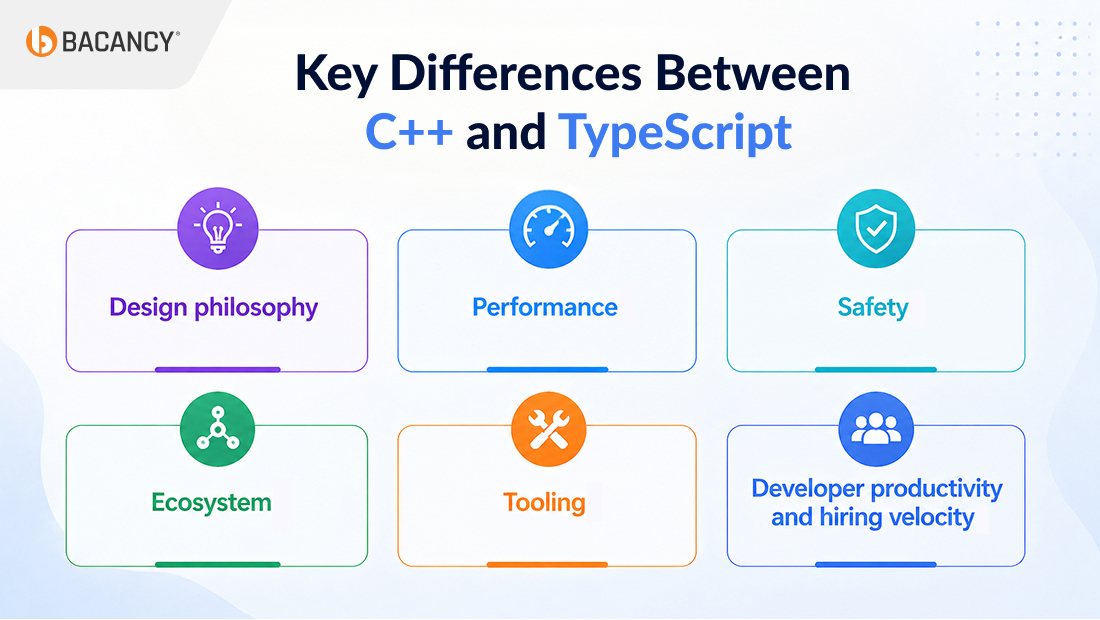
Design philosophy:
The two languages disagree on who should be trusted with control. C++ trusts the developer with memory, hardware, and object lifetimes, which is exactly why it has carried four decades of production systems. TypeScript trusts the compiler to catch the mistakes a human will inevitably make under deadline pressure. Neither is wrong. They are optimized for different team sizes and different tolerances for runtime risk.
Performance:
Clients ask this first, and it is almost always the wrong question to lead with. C++ beats TypeScript on raw compute by a wide margin, but raw compute is rarely the real bottleneck. In most SaaS workloads, the database query is slower than the language, and the network hop is slower than the database. If your latency budget is microseconds, C++ is non-negotiable. If it is hundreds of milliseconds, TypeScript will not hold you back.
Safety:
C++ gives you power and expects discipline, which works when you have senior engineers and careful review, and fails quietly when you do not. TypeScript runs on a garbage-collected engine with no raw pointers, so it sidesteps the entire category. For products touching PHI, payments, or regulated infrastructure, that is no longer a stylistic preference. It is a line on the risk register.
Ecosystem:
C++ has depth through STL, Boost, and managers like vcpkg and Conan, though installing a library still means wrestling with CMake and platform quirks. TypeScript inherits npm, where adding a dependency takes seconds. For teams that need to move fast, that is the difference between shipping an integration this sprint or next quarter.
Tooling:
Compile times have been a C++ pain point forever. TypeScript used to have its own version of this problem on large codebases, but Microsoft’s Go-based TypeScript 7.0 compiler dropped build times for the VS Code codebase from 78 seconds to 7.5 seconds, which is a real quality-of-life change for any client running a large monorepo.
Developer productivity and hiring velocity:
A mid-level TypeScript engineer can ship meaningful changes in their first two weeks. A mid-level C++ engineer needs far more context on the build, the conventions, and the specific landmines in the codebase. That timeline difference shapes how we size and structure teams on both sides.
When to Choose Which: C++ vs TypeScript by Use Case
This is the section clients usually screenshot. Here is the split we recommend based on what we have seen work in production.
Choose C++ When Your Workload Demands Hardware Proximity:
You are building a high-frequency trading engine, a game engine, embedded firmware for automotive or medical devices, operating system components, AI inference runtimes, or anything where the latency budget is measured in microseconds and garbage collection pauses are a non-starter.
Choose TypeScript When You Are Building the Application Layer:
You are building a web frontend in React, Angular, Next.js, or Vue, a Node.js backend, serverless functions at the edge on Cloudflare Workers or Vercel, a type-safe API contract layer with tRPC, or any full-stack application where multiple developers need to refactor shared code safely.
Choose Both When the Product Has a Hot Core and a Rich Surface:
You have a product with a performance-critical core and a rich user-facing layer. This is more common than most expect. A C++ core for the engine and a TypeScript layer for the API and UI is a pattern we ship regularly. The fintech case study below is the cleanest example.
Migrating Between Stacks Without Losing Sleep
A second scenario comes up in almost every enterprise engagement we run. A client already has a legacy codebase, often in C or C++, and is trying to decide whether to rewrite, modernize, or wrap it with a modern TypeScript layer. The C++ vs TypeScript decision here is a migration question, not a greenfield one.
Our approach is boringly consistent. We do not rewrite code that is already working in production unless there is a concrete reason tied to performance, safety, or maintainability. For clients facing the 2026 CISA memory safety expectation, we map which components are safety-critical and prioritize those. For clients whose pain is velocity and hiring, we often wrap the C++ core with a TypeScript service layer and move new feature work to the typed stack, leaving the battle-tested core alone.
Thinking about a migration or modernization from C++ to TypeScript?
Hire TypeScript Developers who have moved clients through rewrites, wraps, and phased migrations without breaking production.
Bacancy Case Study: C++ vs TypeScript Inside One Fintech Product
The clearest example from our recent client work came from a fintech platform that thought it had a C++ vs TypeScript problem, but actually had a placement problem.
The client runs a high-frequency trading platform and was hitting two issues at once. Their core execution engine, written in C++, needed performance tuning because trade execution times were drifting higher as volume grew. At the same time, their internal trader dashboard, stitched together in plain JavaScript over several years, had become a refactoring nightmare. New analyst hires were taking weeks to onboard because nobody could reason about the state flow safely.
Our team split the work into two parallel tracks. On the C++ side, our engineers applied STL-based optimization, multithreading with careful memory management, and template metaprogramming to the execution engine. That work delivered a 50% reduction in trade execution times, which unblocked the latency issue the business was feeling directly.
On the TypeScript side, we did not touch the C++ engine at all. We rebuilt the trader dashboard in a typed React and Node.js stack, defined strict interfaces for every data contract flowing out of the C++ core, and added shared types between the frontend and the backend BFF layer. The onboarding time for new analysts dropped significantly, and the team could finally refactor the dashboard without fear of runtime surprises.
The lesson from that engagement is the one we repeat in every C++ vs TypeScript conversation. Neither language was wrong. They were in the wrong places. Once we put C++ where microsecond latency mattered and TypeScript where team velocity and type safety mattered, the product stopped fighting itself.
Is your C++ core slowing down as trade volume keeps growing?
Hire C++ Developers who have cut execution times in half on production systems where microseconds matter.
Conclusion: Treat C++ vs TypeScript as a Placement Question
The C++ vs TypeScript question is rarely about picking a winner. C++ remains the irreplaceable language for performance-critical systems, embedded software, games, and regulated infrastructure where hardware proximity is not optional. TypeScript has quietly become the default for the entire modern application layer, from web and mobile to cloud and edge, backed by the largest package ecosystem in the world and a compiler that just got ten times faster. The clients who make the best architectural decisions treat C++ vs TypeScript as a placement question, not a competition.
If you are mapping out a new build or rethinking an existing stack, our team can help you draw the line exactly where it should sit. You can hire expert developers from Bacancy to strengthen your application layer while keeping your C++ core exactly where it performs best, or bring us in earlier to design the split from day one.
Frequently Asked Questions (FAQs)
No. C++ compiles to native machine code and runs without a garbage collector, which gives it the edge on CPU-bound workloads. TypeScript runs on JavaScript engines, which are fast enough for web and API work but cannot match C++ on numerical computing, rendering, or real-time systems. The right framing is not which language is faster, but whether your workload is actually CPU-bound in the first place.
For application-layer workloads, yes. TypeScript has replaced a lot of what used to be written in heavier languages. For systems programming, embedded firmware, game engines, high-frequency trading, and anything requiring direct hardware access or microsecond latency, TypeScript cannot replace C++ and is not designed to. The two languages serve different layers of the stack.
Yes. Decades of existing C++ code in operating systems, financial systems, and embedded devices guarantee demand for skilled C++ engineers for the foreseeable future, especially those who understand modern safety idioms like RAII and smart pointers. New government guidance around memory safety has raised the bar, but it has not reduced demand for engineers who can write safe, modern C++.
For almost every startup MVP, TypeScript is the correct choice. You can share types between frontend and backend, hire quickly, and ship a working product in weeks. The exception is startups whose core value depends on raw performance, such as trading infrastructure, game engines, or on-device AI inference. Those teams usually build a C++ core and wrap it in a TypeScript service layer rather than picking one.
Yes, and this is a pattern we ship regularly. A C++ core handles the performance-critical path and exposes a defined interface through something like gRPC, WebAssembly, or a native binding. A TypeScript service and UI layer sit on top of everything else. Each language does what it does best without forcing a rewrite of working code.
Start with the workload, not the team. If your product’s core value is performance-sensitive, you need at least one strong C++ engineer regardless of team size, and you should staff around that. If your product is an application or API, TypeScript lets a small team cover frontend and backend with shared types, which is usually the better bet for early-stage builds. When in doubt, we walk clients through the architecture before the hiring plan, not the other way around.