
How Artificial Intelligence Will Transform Your Businesses?
Unlock Tomorrow: Explore the Possibilities of Artificial Intelligence Today
Unlock Tomorrow: Explore the Possibilities of Artificial Intelligence Today
Get in touch with our AI Expert and discuss your requirements.
Quick Summary
Understand how enterprise AI can thrive your business with its customized capabilities, like handling large traffic volumes, using cognitive technologies, and ensuring data remains protected and secured from vulnerabilities. Leverage Enterprise Artificial Intelligence to understand your customers’ behavior and then offer them products or services that they definitely buy or remain interested in using. Summary format reference:
Well, that time is technically now.
Advances in artificial intelligence (AI) have made it easy for even small businesses to integrate intuitive features and processes into their workflows.
Once deemed something only capable in science fiction films, computers now can perform analysis of data to perform tasks faster and more intricately than any human could do.
As a company, utilizing this type of tech is an excellent way to improve performance, outpace the competition, and lower your bottom line over time.
With AI developments exploding across Big Tech, major advancements in AI are to be expected this year despite the economic challenges many firms are facing.
According to Statstia, in 2023, the global AI market size was close to $208 billion. By 2030, the market size is expected to reach nearly $2 trillion
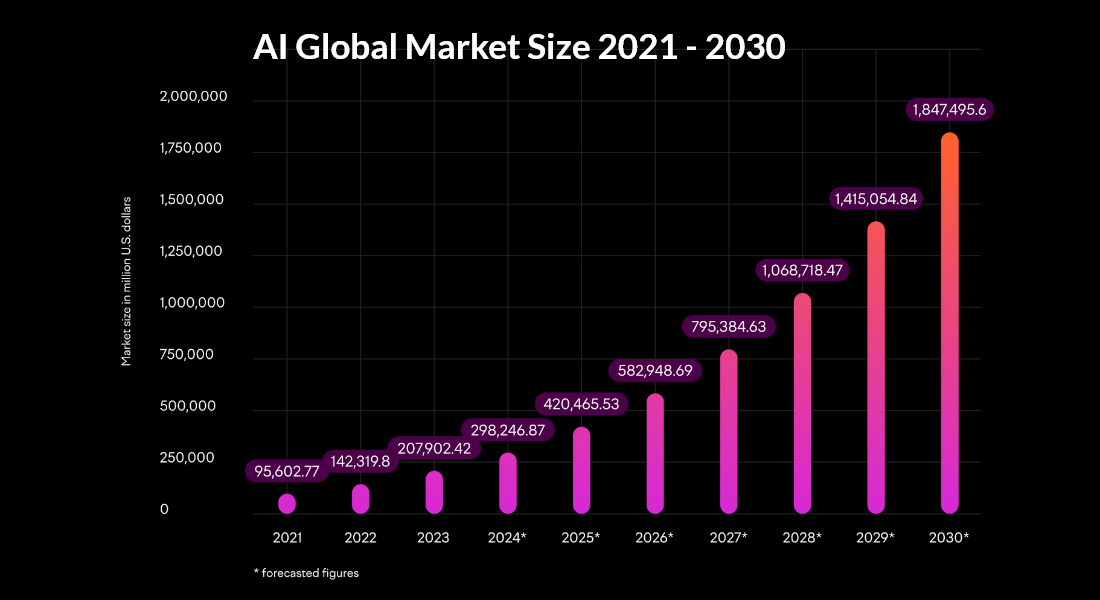
There have been a number of different advances that have been made in the world of business technology in recent years. Nevertheless, none of the innovations that have happened has been as progressive or disruptive as artificial intelligence (AI). With that being said, below, we will look at Artificial Intelligence (AI) in more detail to give you a better understanding.
Firstly, let’s understand what Artificial Intelligence (AI) is. This is a part of computer science that concentrates on the creation of processes and systems that react and function in the same manner as a human operator does.
AI-driven technologies allow computers to leverage substantial amounts of unstructured and structured data to perform near-limitless tasks while applying predictive analysis, rationalization, and problem-solving.
AI is made up of a number of different technological components, each of which will contribute to the overall accuracy and efficiency of the solution. AI systems are created to reverse-engineer the characteristics that we have as humans in machines.
Now, that the basic concept of AI is clear to you, I’m sure you’d be curious to know how it is going to change your business?
Well, then here's your answer!
AI and automation are revolutionizing how businesses run and will keep boosting productivity and revenue. With automation, more human tasks will be completed by machines, even with an increased ability to undertake tasks beyond people’s capabilities. Now, let’s see How AI will impact your business!
Let’s take a look at how AI is going to change your business!
Research from Hubspot found a whopping 63% of business professionals feel that AI already helps their employees understand their customers better.
AI can help you pull data from disparate sources into one single source of truth and glean unique insights about your customers that you otherwise might've missed.
But most importantly, it gives you the time to obsess over your customers again.
One of the most time-consuming aspects of any leader's job is wrangling the right data. It can take hours for a business leader, analyst, or marketer to analyze customer data and uncover meaningful insights, leaving less time to use it to make critical decisions. Not to mention, a manual data analysis process is inherently prone to human error.
Fortunately, Predictive Analytics — which uses machine learning algorithms, data mining, and statistical techniques to analyze large amounts of data and make powerful predictions about future trends or behaviors — can help streamline and supercharge your analytics processes.
Additionally, predictive analytics can help your organization expand its reach. You can leverage AI-based insights to formulate reports, develop key account strategies, and build more powerful forecasts on their pipelines.
My bet? The best leaders of the near future will see AI as an indispensable part of their reporting and analytics processes.
In today's difficult economic climate, business leaders need to do more with less.
There are innumerable ways AI can help your business save money- 28% of business leaders have already found that AI helps their company cut costs.
For one, it will help automate time-consuming, manual tasks. For instance, many customer support reps need to spend extensive time responding to recurring questions from customers. By leveraging AI, you can automate responses to commonly asked questions, which frees up your support reps for more complex issues.
A full 91% of customer support reps who use AI say that chatbots already effectively respond to customer service requests.
Ultimately, AI will improve efficiencies across the business – all while enhancing the customer experience. On average, AI already saves the average employee 2.5 hours per day.
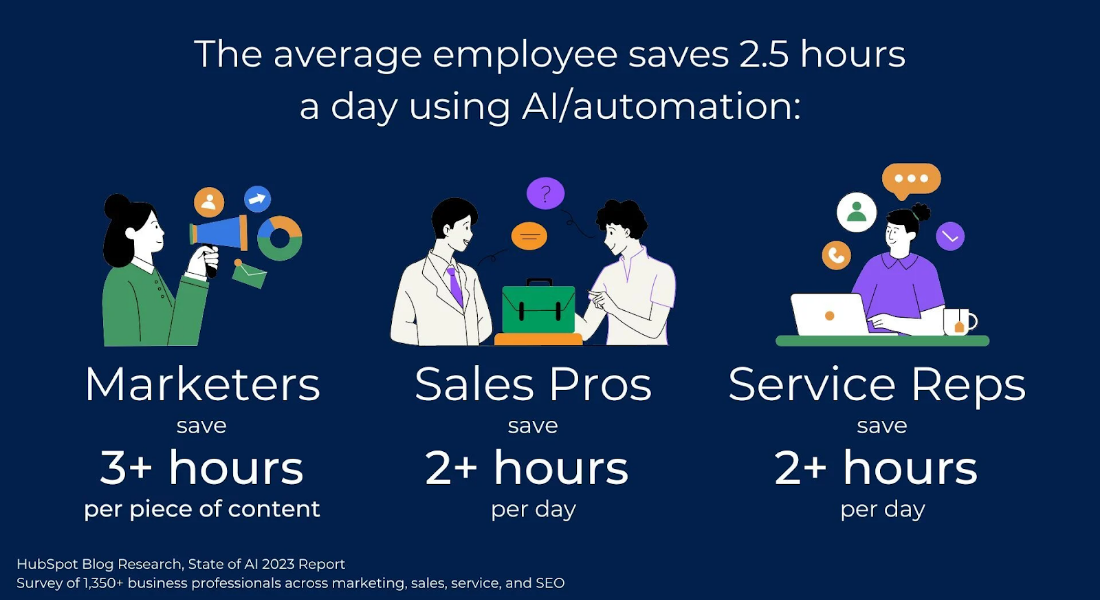
With all that extra time, your business and employees can scale a stronger human connection.
Another benefit of AI? It will make fraud detection easier for businesses of all sizes.
In 2022, 65% of businesses were victims of fraudulent attacks or attempts.
Fraud can be detrimental financially and legally for any business. Fraud is also increasingly challenging to detect as it becomes more sophisticated.
In 2023, businesses will increasingly leverage AI tools to detect and deter fraudulent activity. AI can point out anomalies in data, such as unusual spending behavior, which helps your employees identify potential fraudsters.
Additionally, AI can use data to make predictions on the likelihood that a particular transaction is fraudulent. Over time, AI algorithms will become better at detecting fraudulent activity, such as suspicious logins, odd transactions based on consumer behavior, or identity theft.
In the future, we'll also begin to see business leaders leverage AI to uncover new product opportunities.
For instance, software engineers can use AI tools to sift through feedback, engagement, or other product usage data to determine which features they should improve on an existing product, or discover new product ideas based on gaps in their offerings.
But it goes beyond that. AI algorithms can also help you design your product.
Yep – you heard that right. AI will be able to analyze data on customer usage patterns, feedback, and preferences to provide you with invaluable insights necessary to create more user-friendly, engaging, and effective products for your customers.
It will also help you speed up the product development process start-to-finish with rapid prototyping. AI algorithms can seamlessly and instantly provide different design options, so your team can quickly identify the most promising option and iterate in real time.
It becomes evident that the technology's potential is boundless. From improving customer experiences to optimizing supply chains and predicting market trends, AI is poised to become an indispensable asset for any forward-thinking business.
Now let’s talk about the major industries using AI that have reaped substantial benefits from applications of AI and continue to hold immense potential for future growth.
From marketing and sales to operations and customer service, AI is transforming every facet of business, promising not just efficiency gains but a complete reimagining of what is possible.
Healthcare:
Medical Imaging: AI helps in analyzing medical images such as X-rays, MRIs, and CT scans for faster and more accurate diagnosis.
Personalized Medicine: AI algorithms analyze patient data to create personalized treatment plans based on genetic makeup, medical history, and lifestyle factors.
Drug Discovery: AI accelerates the drug discovery process by identifying potential drug candidates and predicting their efficacy and safety profiles.
Virtual Health Assistants: AI-powered chatbots and virtual health assistants provide round-the-clock support to patients, answering queries and providing basic medical advice.
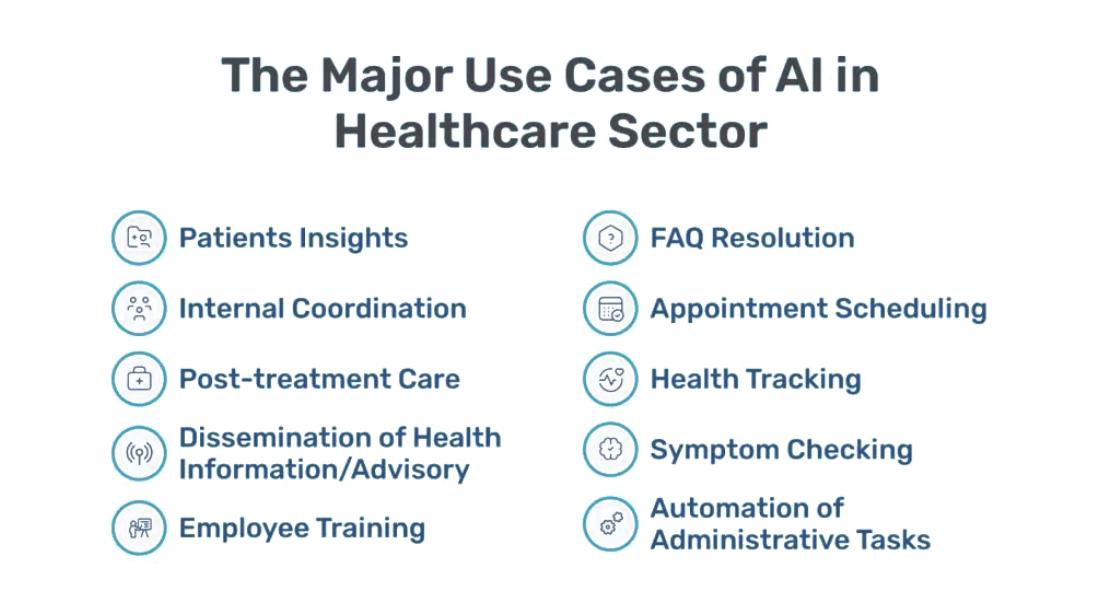
For example, Infervision uses Deep Learning techniques to identify lung cancer based on X-Ray, CT, MRI, and text descriptions of symptoms and diagnostic reports. The company has worked with multiple top-notch hospitals in China to identify lung cancer in its early stage.
Finance:
Fraud Detection: AI algorithms analyze transaction data in real-time to detect fraudulent activities and prevent financial losses.
Algorithmic Trading: AI-powered trading algorithms execute trades based on complex market data analysis, optimizing investment strategies and maximizing returns.
Customer Service: Chatbots and virtual assistants powered by AI handle customer inquiries, provide account information, and assist with basic financial transactions.
Risk Management: AI models assess credit risk, market risk, and operational risk, helping financial institutions make informed decisions and mitigate potential losses.
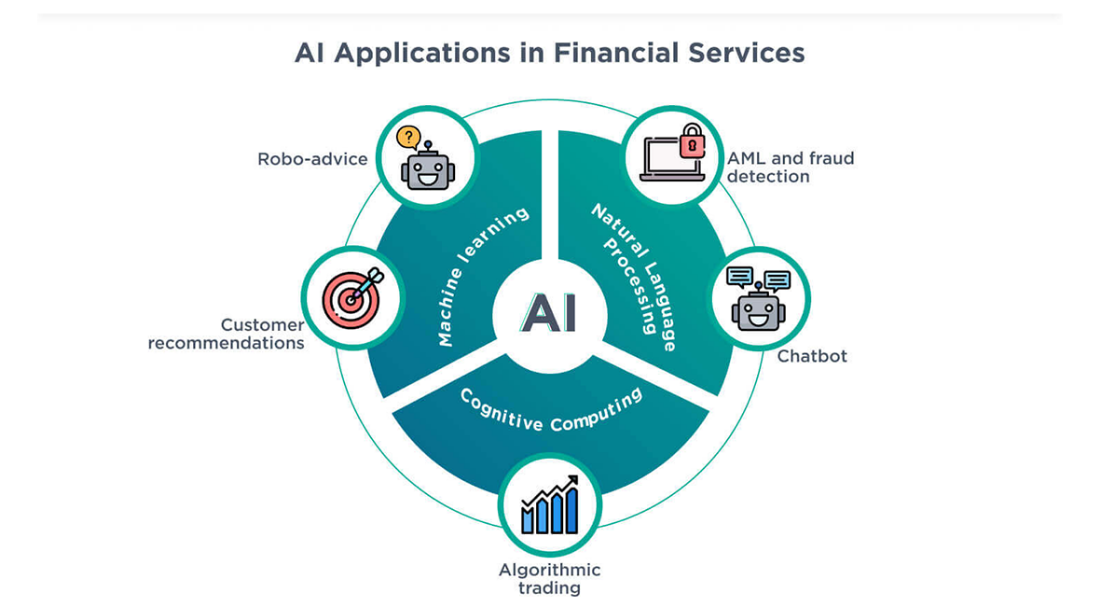
For example, GiniMachine is a credit-scoring platform that analyzes historical loan data and creates a report using artificial intelligence. GiniMachine then uses a deep-learning neural network to calculate credit scores from the report.
Retail:
Personalized Recommendations: AI algorithms analyze customer purchase history and behavior to provide personalized product recommendations, increasing sales and customer satisfaction.
Inventory Management: AI predicts demand trends and optimizes inventory levels to prevent stockouts and minimize excess inventory costs.
Supply Chain Optimization: AI-powered systems optimize supply chain operations by forecasting demand, managing logistics, and identifying areas for efficiency improvement.
Visual Search: AI-powered visual search engines enable customers to search for products using images, improving the shopping experience and driving sales.
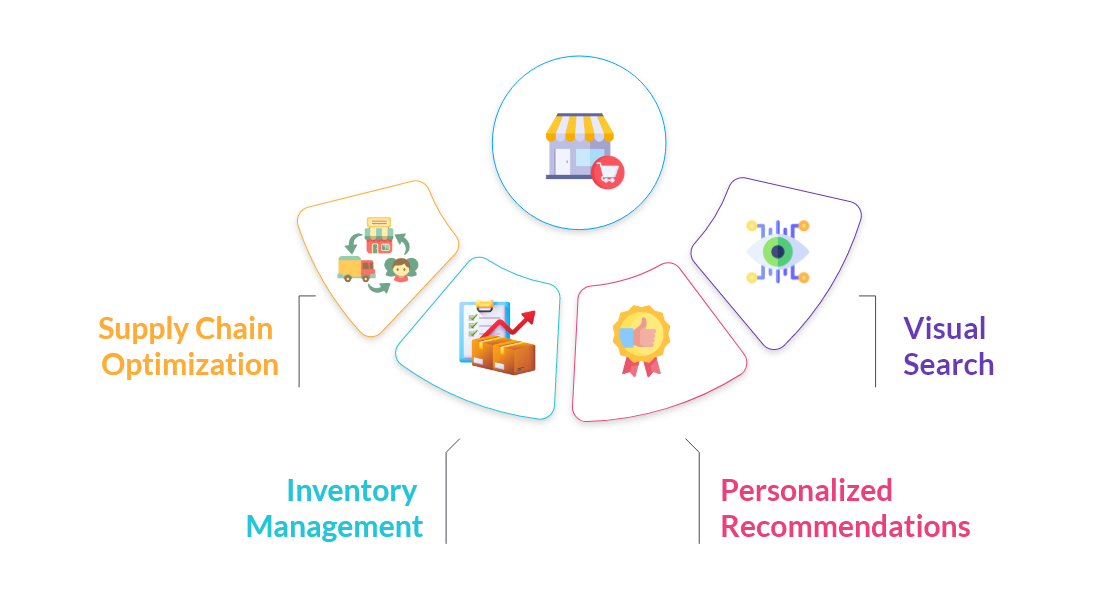
For example, Zalando is a famous online retailer of shoes, fashion, and beauty products from Berlin. It uses an image recognition app that simplifies the users’ buying’ journey in many ways. It allows users to scan barcodes on individual items to find and buy similar products.
Manufacturing:
Predictive Maintenance: AI analyzes sensor data from machinery to predict equipment failures before they occur, minimizing downtime and reducing maintenance costs.
Quality Control: AI-powered image recognition systems inspect products for defects and deviations from quality standards, ensuring product quality and reducing waste.
Supply Chain Management: AI optimizes supply chain processes by forecasting demand, scheduling production, and managing inventory levels to minimize costs and improve efficiency.
Autonomous Vehicles: AI-controlled robots and drones automate repetitive tasks such as material handling and inventory management, increasing productivity and safety in manufacturing facilities.
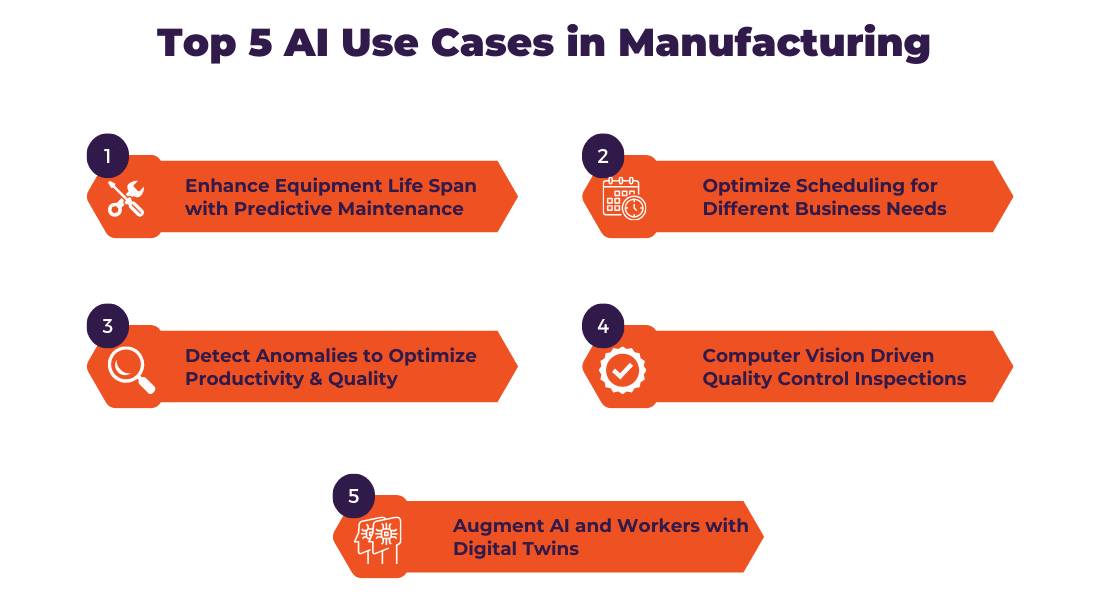
For example, The AVEVA Predictive Analytics solution helps asset-intensive organizations discover equipment issues early and schedule repairs before failures occur, thereby increasing reliability and reducing downtime.
Media and Entertainment:
Content Recommendation: AI algorithms analyze user preferences and behavior to recommend personalized content such as movies, music, articles, and advertisements.
Content Creation: AI tools generate content such as articles, music, and videos based on user input, templates, and predefined criteria, enabling faster content production and distribution.
Audience Insights: AI analyzes audience engagement data to identify trends, preferences, and demographics, helping media companies tailor their content and marketing strategies.
Content Moderation: AI-powered systems automatically detect and filter out inappropriate or harmful content such as hate speech, spam, and fake news, ensuring a safe and enjoyable user experience.
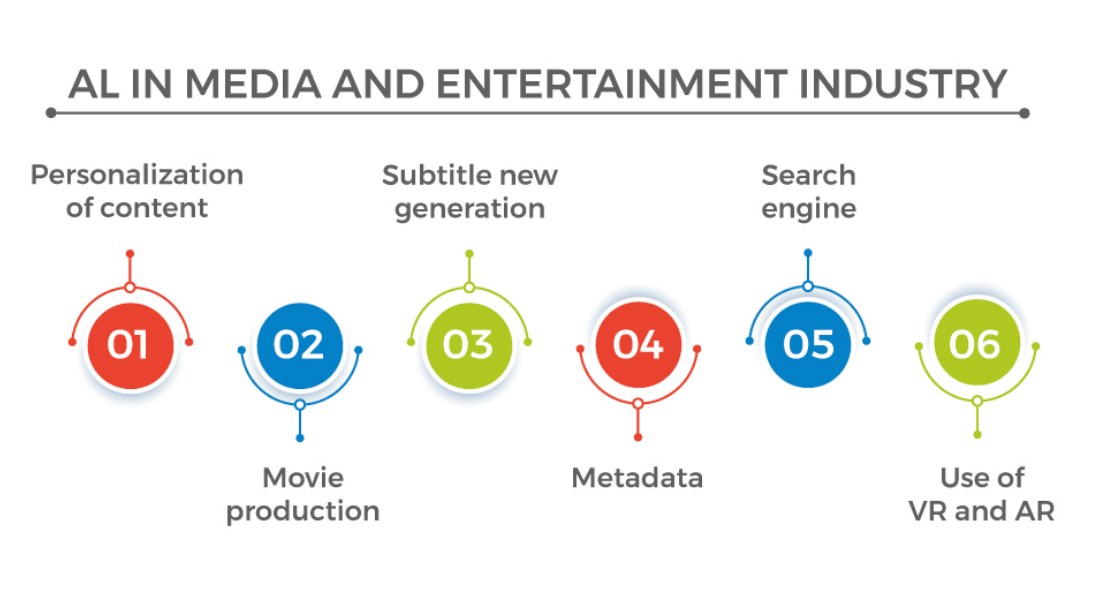
For example, AIVA (Artificial Intelligence Virtual Artist) is an AI-powered music composition tool that can create original music tracks based on user preferences. The tool analyzes data points such as genre, tempo, and mood to create unique compositions.
Let’s get in touch and discuss your industry requirements. Get AI-powered solutions designed especially for your industry.
Contact UsTill now, you must be convinced that Artificial intelligence (AI) and machine learning (ML) aren’t the buzzwords in business anymore.
When adopted the right way, both technologies benefit businesses in millions of ways. From enhancing efficiency and workflow to offering user convenience and accessibility—everything seems like a piece of cake.
AI/ML is undoubtedly the present and the future of this digital landscape. If your company’s system is still not integrated with AI, there's a chance you might lag behind your competitors.
However successfully implementing AI can be a challenging task that requires strategic planning, adequate resources, and a commitment to innovation. So. here’s the step-by-step process to make it easier for you!
To successfully integrate AI into your business activities, ensure you have clear objectives, necessary resources, a qualified team, and the right data for training purposes.
Keep reading to learn more about how you can implement AI into your business.
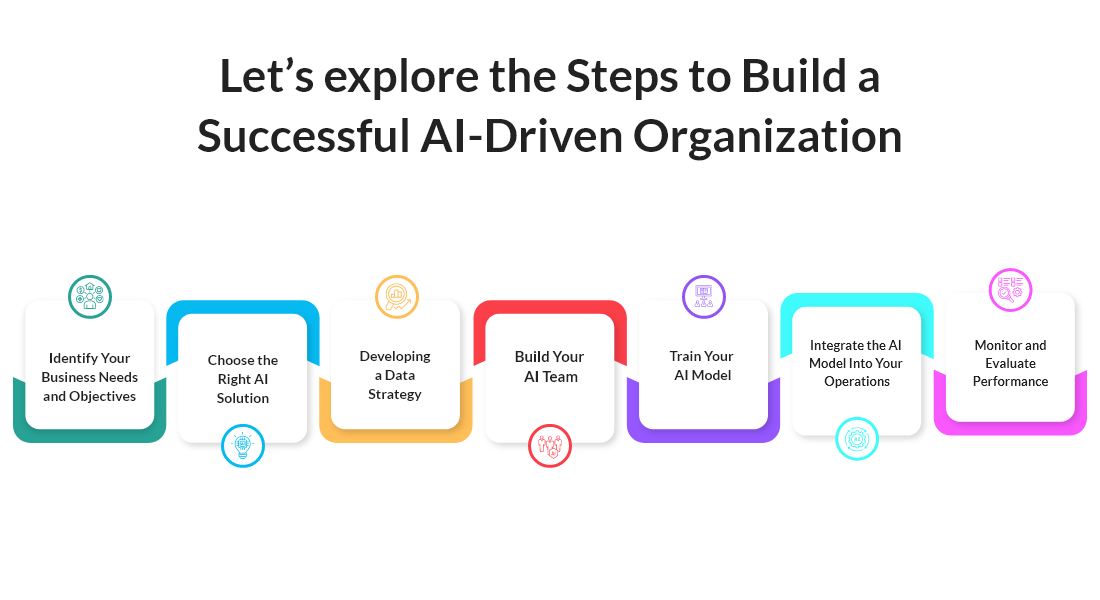
1. Identify Your Business Needs and Objectives
Before diving into the world of AI, identify your organization's specific needs and objectives.
Consider using AI to automate repetitive or time-consuming tasks, improve decision-making, increase accuracy, or enhance customer experiences. Once you have a clear understanding of your business goals, you can align them with the potential benefits of AI so you can have a successful implementation.
2. Choose the Right AI Solution
There are a wide variety of AI solutions on the market — including chatbots, natural language processes, machine learning, and deep learning — so choosing the right one for your organization is essential.
Start by researching different AI technologies and platforms, and evaluate each one based on factors like scalability, flexibility, and ease of integration. Assess each vendor’s reputation and support offerings, and find out if the solution is compatible with your existing infrastructure. Then select the best AI vendor that best suits your business needs.
3. Developing a Data Strategy
AI requires large amounts of data to learn and make predictions, so it's essential that you have a clear data strategy in place before implementing AI. Your data strategy should include the following:
4. Build Your AI Team
Assembling a skilled and diverse AI team is essential for successful AI implementation. Depending on the scope and complexity of your AI projects, your team may include data scientists, machine learning engineers, data engineers, and domain experts.
When building your AI team, consider both internal and external talent sources. This may involve upskilling or reskilling existing employees, hiring AI developers, or partnering with AI consultancies or service providers.
5. Train Your AI Model
Once you have chosen the right AI solution and collected the data, it's time to train your AI model. This involves providing the model with a large, comprehensive dataset so the model can learn patterns and make informed predictions.
Be prepared to work with data scientists and AI experts to develop and fine-tune your model so it can deliver accurate and reliable results that align with your business objectives.
6. Integrate the AI Model Into Your Operations
Once your AI model is trained and tested, you can integrate it into your business operations. You may need to make changes to your existing systems and processes to incorporate the AI.
During the rollout, make your best effort to minimize disruptions to existing workflows. Engage with key stakeholders, provide training, and offer ongoing support to ensure a successful transition to AI-driven operations.
7. Monitor and Evaluate Performance
Once you’ve integrated the AI model, you’ll need to regularly monitor its performance to ensure it is working correctly and delivering expected outcomes.
Establish key performance indicators (KPIs) that align with your business objectives, so you can measure the impact of AI on your organization. Regularly analyze the results, identifying challenges and areas for potential improvement.
Regularly reassess your data strategy and make adjustments to your AI solution so you can continue to deliver value and drive growth.
Wrapping-Up: Implementing AI in Your Business and Why It Matters
As technology continues to improve, the idea of implementing AI in your business is no longer something straight out of Hollywood.
There is no second opinion that AI is transforming businesses in this modern landscape. It offers convenience, accessibility, automation, and efficiency—all directly related to achieving more productivity and enhancing user experience.
AI allows you to reach a larger audience and establish long-term customer relationships. This, in turn, creates customer loyalty, leading to a continuous revenue flow for the company.
With time, AI is getting more sophisticated and powerful. So it’s high time you ditch your legacy systems and integrate AI into your business operations.
Partner with us to Integrate AI into Your Business Operations
Talk to Our Experts Now India (HQ)
Corporate House
15-16, Times Corporate Park,Thaltej, Ahmedabad, Gujarat 380059
 USA
USA
33 South ave, Suit 600 Iselin, NJ 08830
 Canada
71 Dawes Road, Brampton, On L6X 5N9, Toronto
 Australia
351A Hampstead Rd, Northfield SA 5085
 UAE
UAE
1608 Clover Bay, Business Bay, Dubai, UAE. PO Box 62049
 Sweden
Junkergatan 4, 126 53 Hagersten
 4.7
4.7
 4.8
4.8


ISO 27001:2013
Copyright © 2026 BACANCY SERVICES PRIVATE LIMITED. All Rights Reserved. An ISO 27001:2013. Certified Company