How to Plan EMR Data Migration in 2026: Strategies for Integrity, Continuity, and Compliance
Plan secure EMR data migration in 2026 with HIPAA, FHIR R4, and USCDI v3 compliance, data integrity, zero downtime, and clinical continuity.
Read MoreTelehealth vs telemedicine can seem similar but have quite different purposes in digital healthcare. Let’s understand that in this blog, where we explain the primary differences, their use cases, and when each approach is more appropriate.
Healthcare providers will discover how these models support remote care, where telemedicine fits into clinical services, and when virtual care should work alongside in-person visits.
Telehealth and telemedicine sound like two things with the same purpose. But it is quite different. Yes, both involve technology, remote healthcare, and patients connecting with providers without being physically present. However, there is an important difference between these two.
Telemedicine signifies remote clinical services, such as virtual consultations, diagnosis, and treatment. On the other hand, telehealth is the broader umbrella concept, including remote patient monitoring, healthcare education, support, and other digital health services.
As adoption increases, the global market for telehealth and telemedicine is projected to reach over $180 billion by 2030. Understand these distinct approaches for navigating the evolving care landscape.
In this blog, we will compare telehealth vs telemedicine in detail, explain how each works, and explore where both fit into modern healthcare.
While telehealth and telemedicine are often used interchangeably, they serve different purposes in digital healthcare. The table below breaks down their key differences across scope, services, and use cases.
| Aspect | Telehealth | Telemedicine |
|---|---|---|
| Scope | Covers clinical and non-clinical services: education, training, admin, monitoring | Limited to clinical services: diagnosis, treatment, consultation |
| Main Purpose | Improve overall healthcare access, education, and | Deliver direct medical care without an in-person visit |
| Services | Remote patient monitoring, provider training, health education, admin coordination, virtual consultations | Video consultations, e-prescriptions, diagnosis, follow-up visits |
| Patient Use Cases | Chronic condition tracking, wellness coaching, medication reminders, health literacy resources | Virtual doctor visits, prescription renewals, urgent care consults, specialist follow-ups |
| Provider Use Cases | Staff training, care coordination across teams, population health management | Diagnosing patients, prescribing treatment, reviewing test results remotely |
| Regulation | Varies more by state/policy since it spans non-clinical services | Follows stricter clinical practice laws (licensing, prescribing rules) |
| Insurance | Coverage is inconsistent, depends on service type | Increasingly covered by insurers as equivalent to in-person visits |
| Technology | Apps, wearables, patient portals, remote monitoring devices, messaging platforms | Primarily video conferencing and secure clinical communication tools |
Understanding the definition of both terms in telehealth vs telemedicine helps healthcare providers identify which remote care model applies to a particular service, patient interaction, or clinical workflow.
Telehealth is a service that uses telecommunications and digital technologies to provide healthcare solutions, health information, education, and support when patients and healthcare professionals are in different locations.
It lets your healthcare organization offer and coordinate care through technologies such as video consultations, telephone calls, secure messaging, mobile apps, and remote monitoring devices.
For healthcare providers, telehealth can support more than direct patient consultations. It can facilitate remote patient monitoring, health education, care coordination, provider-to-provider communication, medication management, and follow-up support.
Nevertheless, it depends on the healthcare organization and its care model; telehealth may involve both clinical and non-clinical interactions.
Example: A healthcare provider may use a telehealth platform to monitor a patient’s blood pressure remotely, send health education materials, coordinate care between specialists, or communicate with a patient through a secure messaging system.
Telemedicine is the use of telecommunications and digital technologies to provide medical services remotely, including clinical consultation, diagnosis, treatment, and follow-up care. It allows physicians and other qualified healthcare professionals to evaluate and manage patients without requiring them to be physically present in the same location.
Telemedicine commonly includes virtual doctor appointments, remote clinical consultations, diagnosis of certain conditions, treatment discussions, prescription management, and follow-up visits. Depending on the condition and applicable regulations, a provider may use video, telephone, or secure digital communication to interact with a patient.
Example: A patient with a recurring health concern may schedule a video appointment with a physician, discuss their symptoms, receive a clinical assessment, and get treatment recommendations without visiting the clinic.
Have a Telemedicine App Idea Ready to Take Off?
Take it from concept to launch with our telemedicine app development company and deliver seamless virtual care through a feature-rich platform.
No, telemedicine and telehealth are not the same thing, but both offer different services. They use digital technology to connect patients and healthcare professionals without requiring them to be in the same physical location.
Telemedicine refers specifically to the remote delivery of clinical medical care, while telehealth includes a wider range of healthcare services and activities delivered through digital or telecommunications technology.
For instance, a virtual appointment with a physician to evaluate symptoms and discuss treatment is telemedicine. Remote monitoring of a patient’s blood pressure, virtual health education, or communication between healthcare professionals can fall under telehealth without necessarily being a telemedicine service.
For healthcare providers, the telehealth vs telemedicine distinction matters because the technology, workflows, clinical responsibilities, and patient interactions can differ depending on the service being delivered.

The key difference in telemedicine vs telehealth comes down to the type of healthcare interaction being delivered remotely.
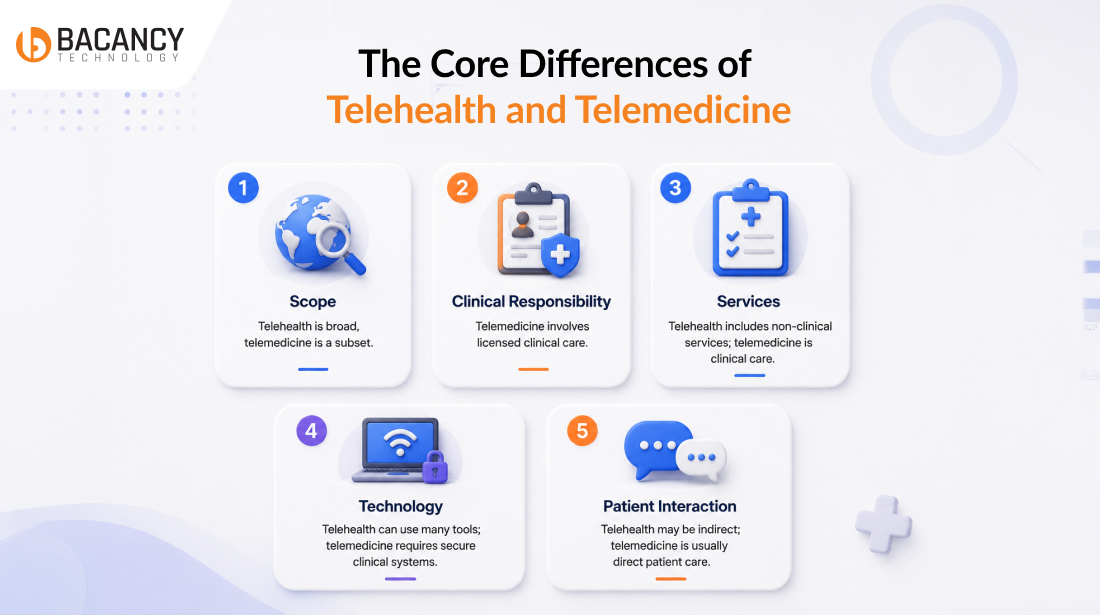
The scope is one of the clearest differences in telehealth vs telemedicine. Telemedicine specifically addresses remote clinical services provided by physicians and other healthcare professionals. Telehealth covers these services while also including other digital healthcare activities that may not involve direct medical treatment.
For example, a virtual appointment with a physician falls under telemedicine. Remote blood pressure monitoring, digital health education, or provider-to-provider communication can also fall under telehealth.
Telemedicine generally involves direct clinical responsibility. A healthcare professional may evaluate a patient’s symptoms, review medical information, make a clinical assessment, recommend treatment, or conduct a follow-up consultation.
Telehealth does not always involve a clinical decision. Some telehealth services support patients or healthcare teams without requiring a provider to diagnose or treat a condition. This distinction is important when healthcare organizations define workflows, responsibilities, and care delivery models.
Telemedicine services commonly include virtual doctor consultations, specialist appointments, remote clinical assessments, treatment discussions, medication reviews, and follow-up visits.
Telehealth services can include these clinical interactions along with remote patient monitoring, health education, chronic care support, care coordination, provider communication, and other digital healthcare services.
This is why telemedicine and telehealth should not always be treated as interchangeable terms when defining a healthcare organization’s digital care strategy.
Among telemedicine vs telehealth, both models rely on digital communication technologies, but the technology used can vary based on the service. Telemedicine commonly uses video conferencing, telephone consultations, secure messaging, electronic health records, and virtual care platforms to facilitate clinical interactions.
Telehealth can use the same technologies while also incorporating remote patient monitoring devices, mobile health applications, connected medical devices, patient portals, and digital health platforms.
Telemedicine generally involves a direct patient-provider interaction for a specific medical purpose. The patient may consult a physician about symptoms, receive a diagnosis, discuss treatment, or attend a follow-up appointment remotely.
Telehealth can involve direct patient interaction as well as ongoing or indirect support. A patient may submit health data through a connected device, receive educational resources through a patient portal, or communicate with a care team without having a traditional medical consultation.
The right approach in telehealth vs telemedicine depends on the type of healthcare service you need to deliver. A virtual clinical consultation may require a telemedicine solution, while ongoing monitoring or digital health education may fit within a broader telehealth model.
Telehealth can be relevant when the healthcare service extends beyond a direct doctor-patient consultation. Healthcare organizations may use telehealth to:
Telemedicine is suitable when the primary purpose is to provide clinical medical care remotely. Healthcare providers can use telemedicine for:
The key question to ask is: Is the service primarily providing clinical medical care, or is it supporting a broader healthcare activity? That distinction can help determine whether telemedicine or another telehealth approach is appropriate.
Telemedicine can replace some in-person doctor visits, but it cannot replace every type of medical appointment. Whether a virtual consultation is appropriate depends on the patient’s condition, the purpose of the appointment, the information the provider needs, and whether a physical examination or diagnostic test is necessary.
This is where the telehealth vs telemedicine distinction matters most for care pathway planning.
Telemedicine can work well when a provider can make an appropriate clinical assessment using the patient’s medical history, symptoms, available records, images, or information shared during a virtual consultation. It can also be useful for routine follow-ups, medication discussions, certain chronic care interactions, and other situations where an in-person examination is not essential.
However, some medical situations require physical assessment or diagnostic procedures that cannot be completed remotely. A provider may need to examine the patient directly, collect a blood sample, perform imaging, monitor vital signs with clinical equipment, or conduct another diagnostic test before making a clinical decision.
For example, a patient experiencing a new symptom may begin with a telemedicine consultation. After reviewing the symptoms, the physician may determine that an in-person examination or diagnostic test is necessary. In this situation, telemedicine does not replace in-person care. It becomes the first step in a connected care pathway.
Important: Telemedicine should not be treated as a substitute for emergency medical care. Patients experiencing a medical emergency should seek immediate in-person emergency assistance.

Patients can easily misunderstand virtual healthcare when the terms telehealth and telemedicine are used interchangeably. These misconceptions can lead to unrealistic expectations about what remote care can provide.
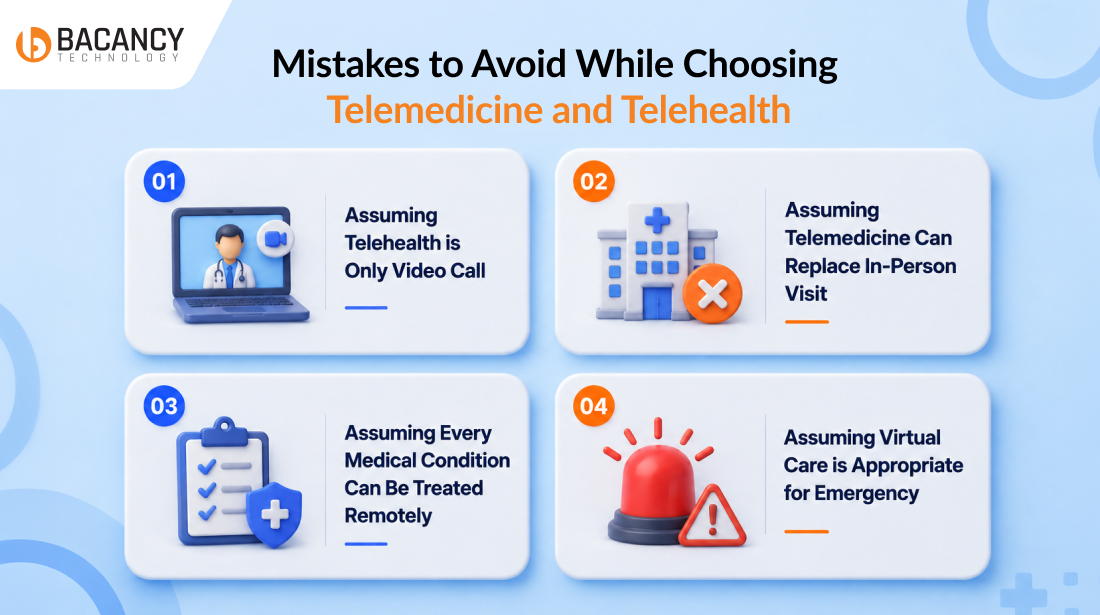
Telehealth is not limited to video appointments. It can include telephone consultations, secure messaging, remote patient monitoring, mobile health applications, digital health education, and communication between healthcare professionals.
A video consultation is just one way technology can support remote healthcare.
Telemedicine is useful for many types of clinical interactions, but some conditions require a physical examination, diagnostic testing, procedures, or hands-on treatment.
A virtual consultation may help a provider determine what happens next, but it does not eliminate the need for in-person care when physical assessment is clinically necessary
Not every condition can be safely assessed or managed through a virtual appointment. The suitability of telemedicine depends on the condition, symptoms, clinical requirements, available technology, and the healthcare provider’s judgment.
If a provider cannot obtain enough information remotely to make an appropriate clinical decision, an in-person assessment may be required.
Telemedicine should not be used as a substitute for emergency medical services. Serious symptoms that require immediate medical attention should be handled through appropriate emergency care.
Virtual healthcare is designed to improve access to appropriate care, not delay urgent treatment.
In the end, telehealth vs telemedicine differences come down to their scope and purpose. Telemedicine focuses on remote clinical care, whereas telehealth is a bigger bucket of digital healthcare services. This difference helps healthcare providers choose the right virtual care model and decide where digital care fits into their overall patient care approach.
With our doctor on-demand app development expertise, you can launch a secure platform for virtual consultations, appointment booking, digital prescriptions, patient records, and real-time doctor-patient communication. Bacancy Technology develops custom healthcare solutions that align with provider workflows and patient needs.
Our healthcare technology team helps you to transform your virtual care model into a reliable digital solution designed to support future expansion and better patient experiences.
No, they are different. Telemedicine is for remote clinical care, such as virtual consultations, diagnosis, treatment, and follow-ups. Telehealth has a wider scope with remote patient monitoring, health education, and care coordination.
The main difference between telehealth and telemedicine is their scope. Telemedicine focuses on the remote delivery of medical care, while telehealth includes a broader range of healthcare services delivered through digital technologies.
Yes, telemedicine is part of telehealth. Telemedicine covers remote clinical services provided by healthcare professionals, while telehealth also includes non-clinical and supportive healthcare activities, such as remote care.
Neither is universally better. Telemedicine is suitable for remote clinical care, while telehealth is better for a wider range of digital healthcare needs. The right choice depends on the service, patient needs, clinical requirements, and healthcare provider’s care model.
Examples of telehealth services include remote patient monitoring, virtual consultations, health education, care coordination, secure patient messaging, provider-to-provider communication, and digital follow-up support.
Examples of telemedicine services include virtual doctor consultations, remote clinical assessments, diagnosis, treatment discussions, medication reviews, prescription management, specialist consultations, and follow-up appointments.
Telehealth is a healthcare delivery model that uses digital and telecommunications technologies to provide healthcare services remotely. Virtual care refers to healthcare interactions that take place without an in-person visit and is often used as a broader, patient-facing term for remote care.
Yes, and it is one of the most practical reasons the distinction matters. Reimbursement for telemedicine consultations is generally more established, since many payers treat a virtual clinical visit as equivalent to an in-person visit. Coverage across the wider telemedicine vs telehealth landscape is less consistent, because non-clinical services such as health education, care coordination, and provider-to-provider communication are not always billable in the same way.

Plan secure EMR data migration in 2026 with HIPAA, FHIR R4, and USCDI v3 compliance, data integrity, zero downtime, and clinical continuity.
Read More
Discover how AI and big data are transforming healthcare through better diagnosis, personalized care, improved patient outcomes, and smarter operations.
Read More
Explore how to use generative AI in healthcare to enhance patient care. Discover generative AI healthcare use cases, benefits, and real-life examples.
Read More