 Bacancy Global






November 4, 2026
Hidden Costs of Healthcare AI Agents You Must Know
Explore the 7 hidden costs of healthcare AI agents, including EHR integration, compliance, security, and maintenance, plus TCO and ROI.
Read More Pratik Panchal
The ONC Certification Program started in 2010, but does your EHR/EMR system still meet the requirements that matter today? Let’s find out in this blog, where we will discuss the certification requirements, what changes happened in 2026, and how it differs from HIPAA compliance and CMS requirements. We will also discuss what healthcare providers and CTOs should check in ONC certification for EHR and EMR before implementing it.
If your EHR is not certified, you cannot report the Promoting Interoperability category in MIPS, and that can cut your Medicare payments. Hospitals face a similar hit under the Medicare Promoting Interoperability Program.
ONC certification for EHR and EMR software is the federal check that decides whether your system counts. The ONC Health IT Certification Program tests products on functionality, security, and data exchange.
This guide covers what certification requires today, what changed in 2026, and how to verify a product. First, let’s clear the biggest doubt about this certification.
No, it is not mandatory for EHR or EMR systems. The ONC certification is voluntary for health IT developers. Certified EHR technology is required to participate in certain federal healthcare programs; it depends on the program’s rules and the provider’s eligibility.
For instance, let’s take the Merit-based Incentive Payment System (MIPS). If you report under the Promoting Interoperability category, you need Certified EHR Technology (CEHRT). You also have to meet the reporting measures and submit a CMS EHR Certification ID.
Certification rules do not apply the same way to every organization. Check these 3 questions:
When an organization is not part of the CEHRT program, it will not need certified software for that reason. However, it may still choose certified technology to support interoperability, purchasing assurance, and other operational needs.
Also, there are different obligations for ONC certification, HIPAA compliance, and CMS programs. ONC certification evaluates a health IT product against specific certification criteria. HIPAA establishes privacy, security, and breach notification obligations for covered entities and business associates, where applicable. CMS programs determine eligibility, performance measures, reporting rules, and other participation requirements.
A certified product does not automatically make a healthcare organization HIPAA compliant. Similarly, meeting HIPAA requirements does not mean an EHR satisfies every CEHRT criterion needed for a particular CMS program.
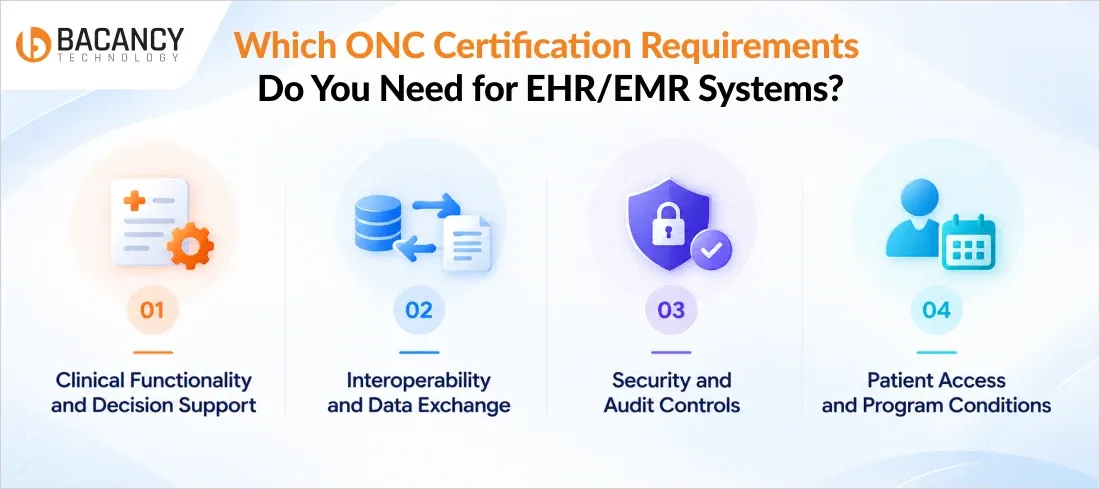
ONC certification for EMR and EHR criteria is defined in federal regulations, including 45 CFR Section 170.315. The criteria determine what a product is certified to do and what its status demonstrates.
The following areas are relevant when you are implementing it into EHR and EMR software.
The clinician-facing criteria address the daily tasks clinicians perform in a chart. It includes computerized provider order entry (CPOE) for medications and imaging, drug interaction checks, patient demographics, and implantable device lists.
The clinical decision support interventions criterion, 170.315(b)(11), covers predictive and AI tools inside the EHR. Today, a certified module must make source attributes available to users, such as how a model was developed, what data it used, and what it is meant to do. HTI-5 proposes to drop these source attribute requirements. If that happens, checking AI features becomes part of your own procurement, so ask vendors for this information either way.
A CHPL listing confirms which criteria a module has passed. Your implementation and clinical informatics teams should compare the CHPL listing with your specialty workflows, order sets, and documentation habits.
This group usually takes the most engineering effort. 3 standards shape it:
Criterion (b)(10) adds a data export requirement. The system must be able to export a patient’s full electronic health information, or the records of a whole patient population, in a usable format. It matters most when the healthcare provider decides to migrate to vendors.
Start by mapping your data model to USCDI v3. Gaps tend to appear there first, especially in newer data elements that older schemas never captured.
Teams that need help with FHIR APIs or C-CDA exchange can work with Bacancy's healthcare interoperability services team to simplify the process and map out the best.
The 170.315(d) criteria define the security features a certified module must include. The main ones are:
Note: HTI-5 proposes to remove all 13 privacy and security criteria. Your HIPAA Security Rule duties would stay the same.
Certified systems must give patients a simple way to view and share their records. Criterion 170.315(e)(1) includes view, download, and transmit. The (g)(10) API lets patients pull their data into the app they prefer.
Certification also carries yearly duties for the developer. These are called the Conditions and Maintenance of Certification:
Before contracting with an EHR/EMR vendor, read the published API documentation and fee terms. Ask for proof that real third-party apps connect to the API today.
4 federal rules shape certified EHR and EMR products this year, and each one is at a different stage.
HTI-1: Deadlines have passed. Health IT developers had to update certified modules by January 1, 2026. The 43-day federal shutdown in late 2025 cut off access to testing tools, so ASTP/ONC gave developers until the end of February 2026. Providers should now confirm that their vendor finished the updates and holds a current CHPL listing.
HTI-4: Final. Issued July 31, 2025 with the FY 2026 IPPS final rule and effective October 1, 2025. It adds 6 new criteria and updates electronic prescribing. The new criteria cover real-time prescription benefit checks, 3 provider prior authorization APIs, and 2 supporting API criteria. Real-time prescription benefit joins the Base EHR definition on January 1, 2028, and Promoting Interoperability participants must report an electronic prior authorization measure in 2027.
HTI-5: HTI-5: Proposed, not final. Published December 29, 2025, it would remove 34 of the 60 current criteria, revise 7 more, and shift the program toward FHIR-based APIs. Comments closed February 27, 2026. The 2026 Unified Agenda targeted a final rule for August 2026, but no final rule had been published as of October 2026. Until one takes effect, the current criteria stay in force.
HTI-6: Expected next. The federal regulatory agenda lists a proposed rule for November 2026. It is expected to cover API standards and information blocking.
HIPAA compliance checklist duties stay in place even if the criteria go. Your organization must still run risk assessments, control access to patient data, keep audit trails, and encrypt protected health information.
Is your EHR ready for the next rule change?
Our EHR software development services build FHIR-first platforms on the criteria in force today, designed to adapt if HTI-5 is finalized and when HTI-6 arrives.
ONC certification for EHR and EMR systems affects you in 2 ways. First, it helps you compare EHR vendors on a common federal standard. Second, it decides whether your EHR counts as certified technology, which CMS programs like MIPS and Medicare Promoting Interoperability require.
ONC certification helps you compare EHR vendors because every certified product appears on the Certified Health IT Product List (CHPL). Check that the version you plan to buy matches the certified version. Then ask the healthcare vendor which features come with the quoted price and which need extra licenses or setup.
ONC certification for EMR and EHR shows which data exchange functions a provider has been tested on, such as transition-of-care summaries, FHIR APIs, and patient record export. You can use these functions as your demo script. Ask the vendor to show a specialist referral, a medication check after a hospital discharge, and a patient viewing records in a third-party app.
Medicare Promoting Interoperability, MIPS, and many state Medicaid programs require providers to use CEHRT. Before you sign, confirm that the vendor’s certified modules include every function your program requires for the current reporting year.
ONC certification does not guarantee clinical fit for your specialty, easy-to-use screens, working connections to your local labs and pharmacies, or a smooth go-live. It also leaves your HIPAA and information blocking duties with you. You must test the system with your clinical staff, front office team, and exchange partners before you sign the contract.
You can verify ONC certification in 5 steps using the Certified Health IT Product List (CHPL), the official federal database of certified products.
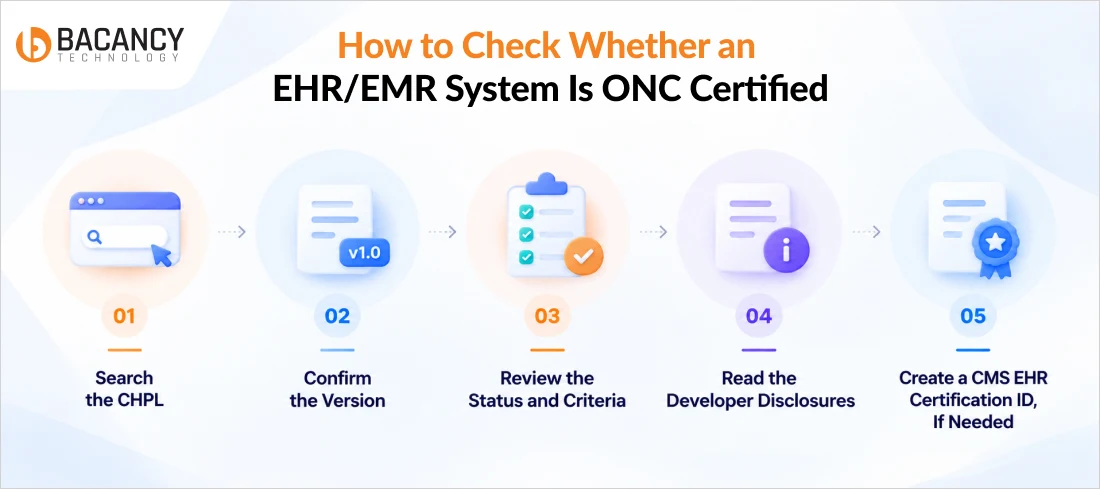
Go to chpl.healthit.gov and search by healthcare IT developer or product name.
Certification applies to each version separately. You can verify that the exact version you plan to use has a listing on the CHPL.
An active status means the certification is current. A retired, suspended, terminated, or withdrawn status means it is not. Review the certified criteria and compare them with your clinical and CMS reporting needs.
Check the disclosures for costs, limitations, dependencies, and API fees.
CMS programs require this ID. Create it with the CMS EHR Certification ID Creator on the CHPL, and add every certified product and version used during the performance period. The tool issues an ID only when your products together meet all Base EHR criteria. Create a new ID if your product mix changes.
Want an EMR that passes the CHPL check?
Our EMR software development team builds EMR systems with the certified criteria your CMS program needs.
CTOs and healthcare IT providers should start with the certification. Look at which modules the product includes, the version holding the listing, and which exact criteria it meets. You need to match that list to your clinical and reporting needs. A product can carry the certified label and still miss the one function your program requires.
Then look at how the system fits your technology. Ask how it connects to your labs, pharmacies, and partner hospitals. Review the APIs and FHIR support where they apply. Later, plan the data migration early, and list which legacy systems must stay connected and interfaces your team must build.
Security needs its own review. Certification shows that identity management and audit trails exist in the product. Your team still has to check how they fit your access policies and run its own risk analysis.
Finally, ask what happens after go-live. Find out how the vendor handles testing, updates, and support, and how fast it implements changes when federal rules shift. Read the disclosures on limits, dependencies, and extra fees. Ask whether your own customizations could change how certified functions behave, since a heavily modified system may no longer match the version that passed testing.
ONC certification tests the software, HIPAA compliance tests how your organization protects patient data, and CMS requirements decide whether you qualify for payment programs. A certified EHR supports all of them, but still each one of them needs its own proof from the team.
| Factors | ONC Certification | HIPAA Compliance | CMS Requirements |
|---|---|---|---|
| Questions | Can this product perform the functions federal criteria define? | Does your organization safeguard protected health information (PHI)? | Do you qualify for incentives and avoid payment penalties? |
| Who carries it | EHR developer | Your practice or hospital, plus every business associate | The provider or hospital that reports |
| Oversight | ASTP/ONC and authorized certification bodies | HHS Office for Civil Rights (OCR) | CMS |
| How you prove it | CHPL listing for the exact product version | Documented risk analysis, policies, training records, signed business associate agreements | Attestation and measure reporting, with CEHRT identified by your CMS EHR Certification ID |
| Typical failure | Vendor loses certification, or you run an uncertified version | Missing risk analysis, unencrypted devices, no business associate agreement | Failed measure, missing attestation, or product that does not meet CEHRT rules |
| Consequence | Product loses its listing | OCR investigation, settlement, corrective action plan | Negative MIPS payment adjustment for clinicians, or a reduced annual payment update for hospitals |
A certified EHR includes access controls, audit logs, and encryption support. These help you meet HIPAA technical safeguards. CMS programs such as MIPS and Medicare Promoting Interoperability require certified technology and also ask you to attest to a security risk analysis. The three overlap, yet each has its own rules and its own proof.
Most HIPAA risk is implemented outside the EHR. Certification does not involve shared workstations, staff phones, email phishing, or your billing and cloud vendors, which each need a business associate agreement. It also does not produce your organization-wide risk analysis, which OCR cites most often in settlements.
Confirm the CHPL listing, then run a risk analysis that includes the EHR in your own environment. Sign a business associate agreement with the vendor and turn on its security features. Assign someone to review audit logs, and repeat the analysis after any major update or new integration.
Wrap up the post hereONC certification for EHR and EMR software is an important consideration when selecting or developing health IT systems for the US healthcare market. Your decision should account for certification requirements, clinical workflows, interoperability goals, and long-term technology needs to help avoid costly changes and support regulatory readiness.
Planning to develop or upgrade your healthcare software? Bacancy Technology helps healthcare organizations build EHR/EMR platforms that align with their operational needs and integration requirements. Through our healthcare IT services, we support custom healthcare software development, legacy system modernization, and healthcare system integration to help your team provide reliable digital care experiences.
Your system stops counting as CEHRT once the listing is withdrawn or terminated. MIPS clinicians can apply for a Promoting Interoperability hardship exception for decertified EHR technology, and if approved, that category's weight moves to the Quality category. Ask vendors upfront how they would notify you and support a move.
ONC certification verifies that health IT products meet specific certification criteria. CEHRT refers to technology that meets the certification requirements applicable to certain CMS programs. Before selecting an EHR, confirm which CEHRT capabilities your organization needs for its intended program and reporting year.
Yes. In 2024, HHS reorganized ONC under the Assistant Secretary for Technology Policy, so the agency now appears as ASTP/ONC. The certification program, the CHPL, and the criteria were not changed by the new name.
ONC-certified EHR systems may need to support standards such as HL7 or FHIR for data exchange, USCDI for standardized health data, and terminology standards such as SNOMED CT and LOINC. The required standards depend on the certification criteria and applicable versions. Check the current ONC requirements when selecting or developing an EHR platform.
Because certification works module by module, teams can certify only the modules their program needs, or build on components that already hold a certification.
Certifications do not carry a fixed expiration date. A listing stays active while the developer meets the Conditions and Maintenance of Certification, including semiannual attestations and annual real world testing, and updates the product when criteria change by their deadlines. Retired, withdrawn, suspended, or terminated listings no longer count.
Explore the 7 hidden costs of healthcare AI agents, including EHR integration, compliance, security, and maintenance, plus TCO and ROI.
Read More
This guide covers 12 EMR security best practices that help healthcare organizations reduce the risk of data breaches, ransomware, and unauthorized access to patient records. It also explains key regulatory obligations and gives CIOs a practical 30-60-90 day plan for closing security gaps and improving incident readiness.
Read More

Understand EHR implementation costs with a detailed budget breakdown by organization size, implementation phase, hidden expenses, and TCO.
Read More
AI-First Engineers
Our engineers use AI agents and tools to build faster, then spend their time where it matters: reviewing code, closing technical gaps, catching security and performance risks, and testing every release. You work with AI engineers, AI product engineers and tech architects who own the quality of everything that delivers.

Embedded in Your Business
Our engineers work within your systems, data and security requirements, with overlapping hours for teams in the US, UK and Australia. Hire an individual Forward Deployed Engineer (FDE) or a dedicated FDE pod led by a named lead. We stay accountable for measurable outcomes until your solution runs reliably in production.

Built for Regulated AI
We build AI agents and agentic workflows primarily for healthcare and finance, integrating with EHRs, payer portals, banking systems and loan platforms. Our expertise spans data engineering, data warehousing and analytics, with human oversight, audit trails and HIPAA- and PCI DSS-aware controls. We also deliver solutions across other industries, backed by 1,050+ engineers and ISO/IEC 27001:2022 certification.