 Bacancy Global





October 29, 2026
ONC Certified EHR and EMR: A Guide for Healthcare Providers and CTOs
Understand ONC Certified EHR and EMR requirements, certification status checks, 2026 changes, and how they affect healthcare providers and CTOs.
Read More
A healthcare AI agent can look affordable during the initial planning phase and turn into a very different investment the moment it meets your EHR. Once you add integration, data preparation, security controls, clinician oversight, and ongoing compliance work, the total runs well beyond the first budget estimate.
The pattern is common enough that Gartner predicts over 40% of agentic AI projects will be canceled by the end of 2027. The reasons it names are escalating costs, unclear business value, and inadequate risk controls.
This blog breaks down the 7 hidden costs of healthcare AI agents to help healthcare decision-maker plan their budget more efficiently and accurately.
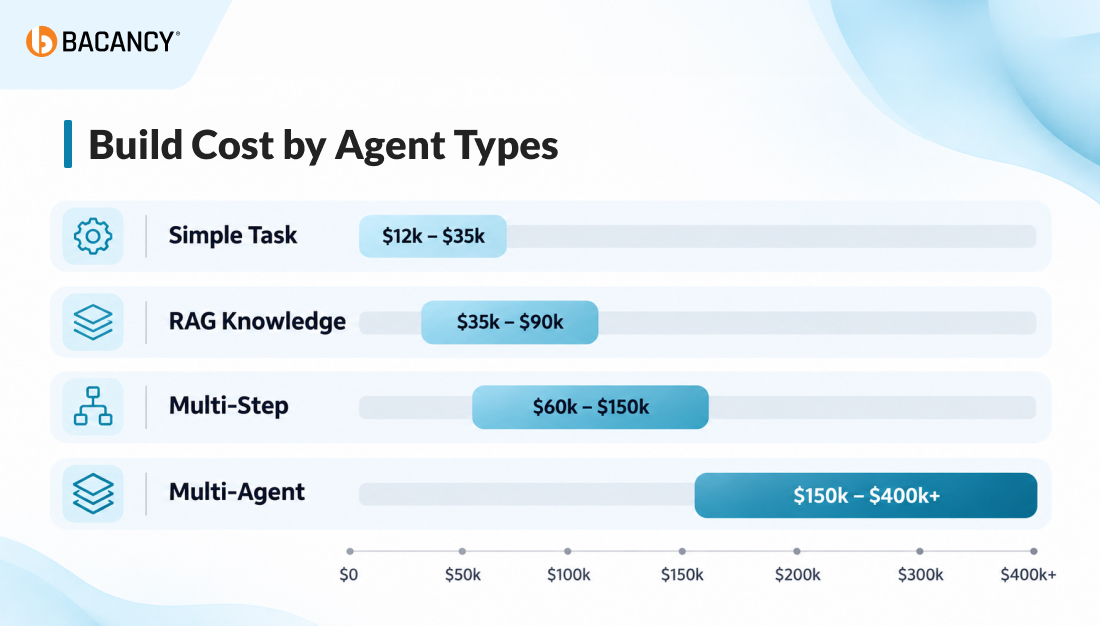
Build cost depends on the agent type. A single-task assistant and a multi-agent orchestration system differ by about 25x in both effort and price. The table below shows the typical build cost ranges by agent type in a healthcare setting.
Build cost depends on the agent type. A single-task assistant and a multi-agent orchestration system differ by about 25x in both effort and price. The table below shows the typical build cost ranges by agent type in a healthcare setting.
| Agent type | Healthcare example | Build cost | Timeline |
|---|---|---|---|
| Simple task agent | FAQ bot for patient portal, insurance lookup | $12,000 to $35,000 | 3 to 6 weeks |
| RAG knowledge agent | Clinical policy Q&A, formulary lookup, SOP assistant | $35,000 to $90,000 | 6 to 10 weeks |
| Multi-step workflow agent | Prior auth, intake, scheduling, discharge follow-up | $60,000 to $150,000 | 8 to 14 weeks |
| Multi-agent system | Full RCM chain, orchestrated clinical workflows | $150,000 to $400,000+ | 12 to 24 weeks |
Healthcare AI agents may seem cost-effective during the pilot, but during deployment reveal how expensive it becomes that teams often overlook. From EHR integration to ongoing compliance, these costs push your budget far beyond initial estimates.
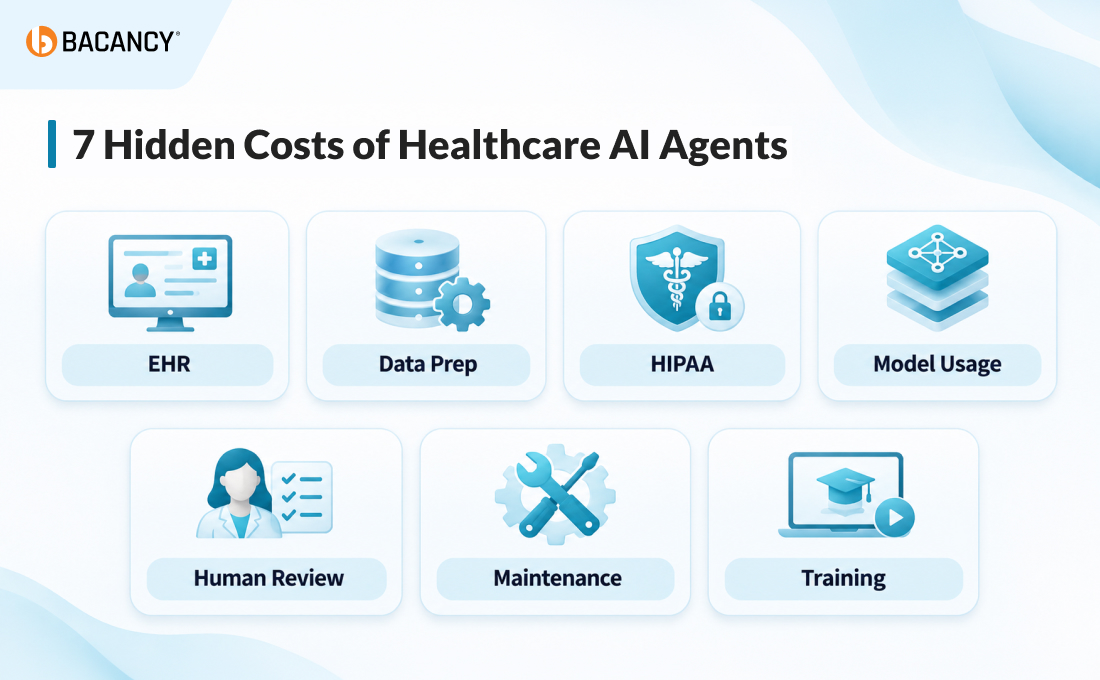
The following are the 7 hidden costs that you must assess before investing in healthcare AI agents.
Integrating EHRs into AI agents becomes more costly when systems use different data formats, outdated interfaces, and custom workflows. Development teams may need to work with HL7 and FHIR standards, resolve API limitations, and build custom connectors to support reliable data exchange.
Integration costs also continue after deployment because changes to EHR platforms, APIs, and clinical workflows can require updates and additional testing. Some legacy systems only support batch files or screen-level access, which adds middleware and testing.
Treat integration as a yearly budget line. Each EHR upgrade cycle needs regression tests for every agent that touches the record. Teams running revenue cycle agents on Epic can see where those touchpoints are in this Epic integration for revenue cycle management guide.
Healthcare AI agents depend on accurate, consistent, and accessible data to produce reliable outputs. However, duplicate patient records, outdated problem lists, free-text fields, and inconsistent codes all produce outputs that can turn out wrong and eventually increase cost.
It is crucial to prepare data with clean records, map fields, resolve inconsistencies, and establish data quality checks. If these issues remain unresolved, your AI agents may generate inaccurate outputs or require repeated corrections, higher development costs, and operational rework.
Expect to spend $8,000 to $60,000 on ingestion, OCR, embeddings, and sync jobs for a mid-sized clinical knowledge base.
AI agents that handle Protected Health Information (PHI) require appropriate privacy, security, and governance controls. These safeguards add costs through development and operation, especially when agents interact with patient records or third-party AI services.
Every health organization must account for access controls, audit logs, security testing, data retention policies, vendor assessments, and applicable contractual requirements. After January 2026, inflation adjustment published in the Federal Register, HIPAA civil penalties for uncorrected willful neglect reach $2,190,294 per calendar year. For context on how violations are structured, see our guide on HIPAA violations, fines, and penalties.
The operating cost of AI agents in healthcare depends on how often they run, which models they use, and how many steps they take to complete each task. The expense can include model API calls and token consumption, cloud hosting, data storage, and supporting infrastructure.
Higher usage, complex workflows, and continuous monitoring increase monthly operating costs. Your team should estimate usage based on expected workloads rather than calculating based on the initial pilot volumes alone.
| Scale (requests per day) | Typical monthly run cos | What is in it |
|---|---|---|
| Under 1,000 | $250 to $1,200 | Model tokens, small vector DB, basic logging |
| 10,000 to 50,000 | $2,200 to $7,500 | Add caching, routing, scaled vector DB, observability |
| Over 100,000 | $8,500 to $35,000+ | GPU hosting, prompt maintenance, dedicated SRE |
For pricing across agent types, you refer to the AI agent development cost to understand what kind of development cost an AI agent has.
A healthcare AI agent would not function without human intervention. Due to outputs, sensitive decisions, failed workflows, and incorrect actions, review by qualified staff is required. Here, the costs increase because of staff review time, approval mechanisms, exception handling, incident response, and manual corrections.
Human review is the highest cost, which most budgets overlook. In fact, without clear escalation rules, your organization will spend more time resolving AI-generated errors than it saves through automation. Choosing an AI scribe or human scribe can determine your hidden costs of healthcare AI agents.
Healthcare AI agents incur ongoing costs after deployment because of connected systems, workflow, and performance requirements changes. Your team may be required to monitor output quality, investigate errors, update EHR integrations, and test changes to keep the agent working.
Retraining is not mandatory. It depends on your solution, maintenance, prompt adjustments, configuration changes, model evaluations, or upgrades from the model provider. For AI systems used in clinical decision-making, additional validation or regulatory review adds more cost because it would not be treated as one-time development costs.
One often overlooked hidden cost of healthcare AI agents is the time and resources utilized to help staff adapt to new workflows. In healthcare organizations, clinical, administrative teams, and IT staff require training to use AI agents to review outputs, manage workflow, and understand when to include humans in it.
Additional expenses can arise from workflow redesign, updating standard operating procedures, and changes to existing handoffs. During the transition, staff are likely to take longer to complete tasks as they learn new processes, temporarily reducing productivity. These indirect costs can increase the overall implementation budget if they are not accounted for early.
The IBM Cost of a Data Breach Report 2026 claimed that the average healthcare breach costs $6.64 million. Healthcare has been one of the most expensive industries, which explains how crucial it is not to overlook security gaps. Let’s understand how security breaches and shadow AI can increase your healthcare AI Agent costs.
AI agents need broad access to be useful, and that access is a risk. A weak access control, exposed PHI in prompts or logs, and missing audit trails each widen the damage when something goes wrong.
Whenever a security gap is found, costs can include investigating the incident, notifying affected patients, legal reviews, possible OCR investigations, and system fixes. Missing audit logs make things harder because, without a clear record of what the AI agent accessed, you may need to treat every record it could access as potentially exposed.
Shadow AI is staff using AI tools the organization never approved. In healthcare, that often means pasting patient details into a consumer chatbot because the approved tool is slower or missing.
As per the reports, shadow AI was involved in 43% of breaches in 2026. The average cost of a shadow AI breach rose to $5.39 million from $4.63 million. Shadow AI also creates untracked spending, since individual subscriptions show up on expense reports instead of the IT budget.
Cost consideration: It includes ongoing security and compliance expenses in your healthcare AI agent budget. If you plan for these costs early can help you avoid expensive fixes and reduce the risk of disruptions after deployment.
Close PHI and Security Gaps Before Your AI Agent Goes Live
Map PHI flows, BAAs, access controls, and audit logs for every vendor in your agent stack. Our HIPAA compliance services help you find gaps before an auditor or attacker does.
Build cost is the loudest number in any AI agent proposal, and it is almost always the smallest line in the 3-year total. Run costs, oversight, maintenance, and compliance together pass the build line by Year 2 on most mid-market healthcare deployments.
The illustrative table below uses a $90,000 Multi-Step Workflow Agent as the baseline, running at the mid tier (around 25,000 requests per day).
| Line item | Year 1 | Year 2 | Year 3 | 3-year total |
|---|---|---|---|---|
| Build (one-time) | $90,000 | — | — | $90,000 |
| Model usage + hosting | $42,000 | $50,400 | $58,800 | $151,200 |
| Human oversight + review | $18,000 | $22,000 | $25,000 | $65,000 |
| Compliance + security | $12,000 | $14,000 | $16,000 | $42,000 |
| Maintenance + retraining | $10,000 | $13,000 | $15,000 | $38,000 |
| Yearly total | $172,000 | $99,400 | $114,80 | $386,200 |
Takeaway: Cumulative run cost ($99,400 in Year 2 alone) passes the initial build cost by Year 2. By Year 3, run and oversight make up roughly 77% of the three-year spend. Budget accordingly.
Healthcare leaders should include 8 categories: implementation, integration, data preparation, security, model usage, maintenance, human oversight, and training to calculate the total cost of ownership of a healthcare AI agent. A simple formula keeps them in one place:
Total Cost of Ownership = Initial Investment + Recurring Operating Costs + Maintenance and Oversight + Risk and Remediation Costs
Calculate these costs over a defined period, such as 3 years, to compare experts, evaluate deployment options, and plan your budget. You need to include the costs of ongoing operations rather than relying solely on the initial project estimate.
To measure the return on investment (ROI) of healthcare AI agents, compare the financial benefits with the full cost of ownership. However, time savings alone do not guarantee a financial return. The savings must translate into lower expenses, greater capacity, or improved revenue.
To track these metrics before and after deployment:
Use this formula to calculate ROI:
| ROI = | Financial Benefits − Total Cost of Ownership | × 100 |
| Total Cost of Ownership |
For instance, if a healthcare AI agent generates $150,000 in verified financial benefits over one year and costs $100,000 to operate during the same period, the ROI is 50%.
Three real options sit in front of a healthcare buyer. Each has a different cost shape and a different fit.
| Option | Typical cost shape | Fits when | Trade-off |
|---|---|---|---|
| Buy (off-the-shelf vendor) | $4,000 to $15,000 / month | Standard workflow, English-first, vendor template matches your EHR | Fast to deploy, locked to vendor's catalog and framework |
| Hybrid (buy platform + custom specialists) | $20,000 to $60,000 upfront + monthly | Mixed workflows, some fit vendor template, others need custom | Still some vendor dependency, two systems to maintain |
| Build custom (services engagement) | $40,000 to $150,000+ upfront, your run cost | Specialty workflow, multilingual, embedded in your product, specific EHR, compliance beyond vendor coverage | Longer to pilot (10 to 12 weeks), you own the code and the roadmap |
Bacancy Technology is a custom build partner. Every engagement is a custom build scoped to your workflow, your EMR, and your compliance posture, with full source code handoff at the end. No per-call fees, no vendor lock-in, no retained IP on our side.
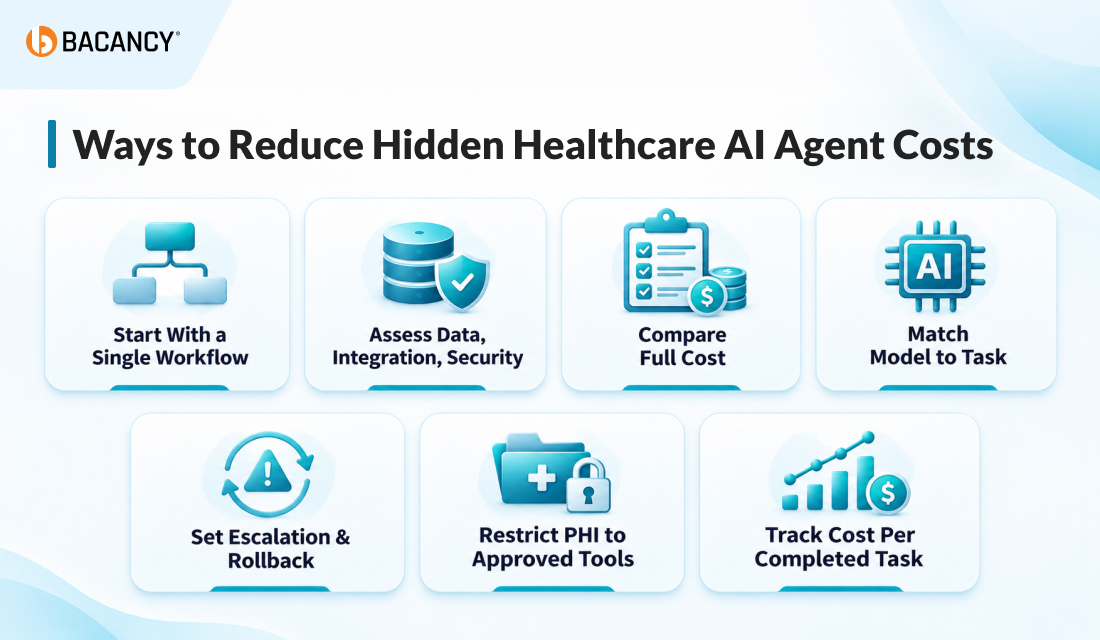
A healthcare organization can decrease the hidden cost of AI agents by planning technical operations and security requirements before deployment. The below steps will help you to prevent budget overruns and keep spending aligned with measurable results.
The compliance costs of healthcare AI agents continue after launch due to vendor agreement reviews, state AI law compliance, audit log management, and security updates.
| Compliance Area | What Healthcare Leader Must Manage | Potential Ongoing Healthcare AI Agent Costs |
|---|---|---|
| Business Associate Agreements (BAAs) | Review vendors that handle protected health information (PHI), including model, cloud, vector database, and logging providers. | Legal reviews, vendor assessments, and contract updates. |
| tate AI Laws | Assess applicable requirements under Texas TRAIGA, California AB 3030, and California AB 489. Monitor relevant Illinois legislation. | Legal assessments, patient disclosures, workflow changes, and software updates. |
| Audit Trails and Log Retention | Maintain required security documentation, monitor access, and retain records according to applicable requirements. | Secure storage, monitoring tools, audit reviews, and documentation. |
| HIPAA Security Rule Updates | Meet current requirements and assess proposed changes before they take effect. | Security assessments, policy updates, technical changes, and employee training. |
Key Takeaway: Healthcare AI compliance is an ongoing operating cost, not a one-time launch expense, so plan your budget accordingly.
Keep Healthcare AI Compliance Costs Under Control
Our Healthcare IT services help you build custom AI agents with compliance, security, and audit requirements from the beginning.
The hidden costs of healthcare AI agents often emerge after deployment, when new workflows require custom development, model usage grows beyond expectations, or routine updates disrupt existing integrations. Without a clear plan for these demands, operating costs can rise well beyond the initial budget.
Bacancy Technology has built healthcare enterprise software since 2011. With 1,050+ engineers supporting 500+ enterprises across 30+ countries and ISO/IEC 27001:2022 certification, we bring software engineering experience and security-focused practices to complex technology projects.
As a healthcare AI agent development company, we help healthcare organizations make informed decisions about agent design, model selection, workflow requirements, and ongoing monitoring. By assessing how an agent will be used in practice, we help teams account for the work involved in maintaining integrations, tracking model usage, and managing performance after deployment.
The hidden costs of healthcare AI agents include EHR integration, model usage, clinician review, HIPAA compliance, staff training, and ongoing maintenance. These expenses often arise during implementation or after deployment and increase the total cost of ownership.
Healthcare AI agent maintenance costs vary by usage volume, model pricing, integration complexity, and human review requirements. Organizations can estimate these costs by tracking monitoring, updates, model usage, and staff time during the first 90 days.
Yes, HIPAA compliance increases healthcare AI implementation costs through security assessments, access controls, audit logs, vendor reviews, and applicable Business Associate Agreements (BAAs). These safeguards also contribute to ongoing operating expenses.
Shadow AI exposes healthcare organizations to privacy breaches, compliance penalties, and untracked spending when employees use unapproved AI tools. Sharing protected health information (PHI) without appropriate safeguards may trigger breach assessments and patient notification requirements.
Healthcare organizations can calculate AI agent ROI by subtracting total costs from realized financial benefits, dividing the result by total costs, and multiplying by 100. It includes development, integration, maintenance, compliance, and human review costs alongside measurable savings.
Buying is generally more affordable upfront for standard workflows, while custom development may suit specialized healthcare requirements. You should compare licensing, integration, customization, compliance, and maintenance costs over the expected lifespan to determine the more cost-effective option.
Understand ONC Certified EHR and EMR requirements, certification status checks, 2026 changes, and how they affect healthcare providers and CTOs.
Read More

This guide covers 12 EMR security best practices that help healthcare organizations reduce the risk of data breaches, ransomware, and unauthorized access to patient records. It also explains key regulatory obligations and gives CIOs a practical 30-60-90 day plan for closing security gaps and improving incident readiness.
Read More

Understand EHR implementation costs with a detailed budget breakdown by organization size, implementation phase, hidden expenses, and TCO.
Read More
AI-First Engineers
Our engineers use AI agents and tools to build faster, then spend their time where it matters: reviewing code, closing technical gaps, catching security and performance risks, and testing every release. You work with AI engineers, AI product engineers and tech architects who own the quality of everything that delivers.

Embedded in Your Business
Our engineers work within your systems, data and security requirements, with overlapping hours for teams in the US, UK and Australia. Hire an individual Forward Deployed Engineer (FDE) or a dedicated FDE pod led by a named lead. We stay accountable for measurable outcomes until your solution runs reliably in production.

Built for Regulated AI
We build AI agents and agentic workflows primarily for healthcare and finance, integrating with EHRs, payer portals, banking systems and loan platforms. Our expertise spans data engineering, data warehousing and analytics, with human oversight, audit trails and HIPAA- and PCI DSS-aware controls. We also deliver solutions across other industries, backed by 1,050+ engineers and ISO/IEC 27001:2022 certification.