The Ultimate HIPAA Compliance Checklist For Software Development in 2026
Get the HIPAA Compliance Checklist for software development. Explore key steps and more to ensure your healthcare app meets HIPAA standards and stays compliant.
Read MoreIn this blog, we break down healthcare data warehouse architecture, from healthcare data sources and ingestion to transformation, storage, analytics, security, and governance. We also compare architecture models, explain the components to evaluate, and cover the key factors that influence architecture selection, cost, and build vs buy decisions.
Healthcare organizations collect data from EHRs, laboratories, imaging systems, medical devices, claims platforms, and operational applications. The challenge is integrating, standardizing, governing, and securing this information across disconnected systems.
In 2025, 76% of U.S. non-federal acute-care hospitals engaged in all four major interoperability activities: sending, receiving, finding, and integrating health information. A healthcare data warehouse helps convert this fragmented data into structured, trusted information for reporting, analytics, research, and AI.
This blog explains the core layers of healthcare data warehouse architecture, compares common approaches, and highlights the key factors organizations should consider when selecting a platform or technology partner.
A healthcare data warehouse is a centralized system that collects, integrates, and stores healthcare data from multiple sources, such as electronic health records (EHRs), claims, laboratory systems, medical devices, and patient management platforms.
Healthcare data warehouse architecture is the design behind that system – how data gets in, how it is transformed, where it goes, and who gets to query it. With this data, the healthcare organization can use it for reporting, analytics, clinical decision-making, financial analysis, and operational planning.
For example, let’s take a mid-size hospital running EPIC for EHR, a separate LIS for lab results, and a standalone billing system. For them, they need a warehouse, and without it they won’t be able to answer which service lines lost money on patients readmitted within 30 days or maybe more.
Let’s dive into the difference between a data warehouse, lake, clinical data repository, and lakehouse to understand how a data warehouse in healthcare is different from others.
| Platform | Primary Role | Best Suited for |
|---|---|---|
| Data Warehouse | Consolidates cleaned, structured, and historical healthcare data. | Reporting, BI, analytics, and performance monitoring. |
| Clinical Data Repository | Centralizes current clinical and patient information. | Real-time patient care and clinical decision-making. |
| Data Lake | Stores raw data in its original format across multiple sources. | AI/ML, research, big data, and advanced analytics. |
| Data Lakehouse | Combines data lake flexibility with warehouse-style analytics. | Unified analytics, AI/ML, BI, and large-scale data workloads. |
A CDR is primarily built for current clinical data and patient care, while an Enterprise Data Warehouse (EDW) brings together historical, structured data for organization-wide reporting and analytics. A data lake can store large volumes of raw and diverse data, whereas a data lakehouse combines this flexibility with capabilities for structured analytics.

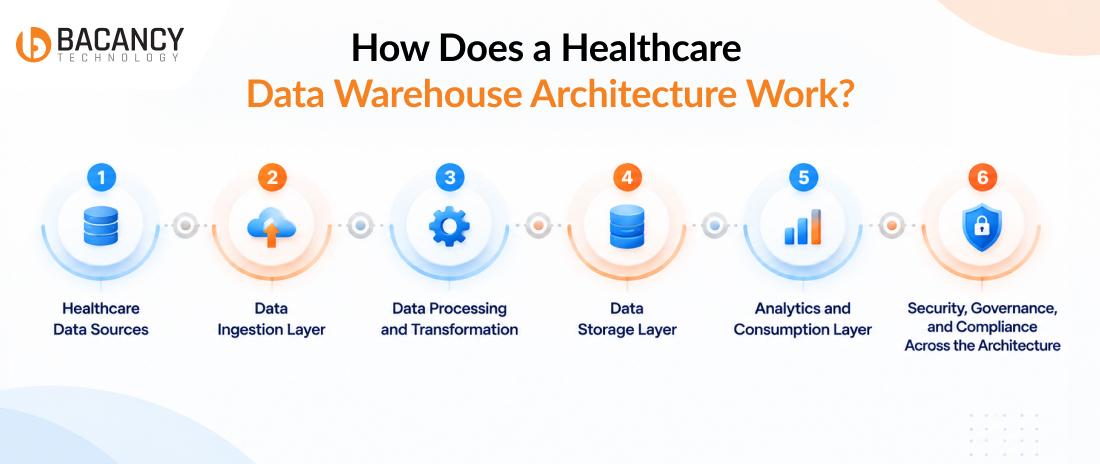
A data warehouse in healthcare architecture connects clinical, financial, administrative, and patient-generated data. It lets you create a consistent view of your information for reporting, analytics, and decision-making.
Healthcare organizations generate numerous data across multiple clinical and business systems. These systems store information in different formats and serve different purposes, so the architecture must bring their data together before enterprise-wide analysis.
Common healthcare data sources include:
The data ingestion layer moves information from source systems to the healthcare data platform. The ingestion method depends on how frequently the data changes, the source systems, data volume, and the intended use case.
Batch ingestion moves your data at scheduled intervals, such as hourly, daily, and weekly. It is commonly used for large historical datasets, financial reporting, claims processing, and workloads where immediate updates are not required.
Real-time or near-real-time ingestion continuously or frequently transfers data as it is generated. This approach can support use cases such as patient monitoring, clinical alerts, and time-sensitive analytics.
Healthcare data can enter the platform through several technologies and standards:
Healthcare data collected from different systems rarely has a consistent structure. The same patient, diagnosis, provider, or medical procedure may be represented differently across source systems. The processing and transformation layer prepares this data for reliable storage and analysis.
Key activities include:
After processing, the data is stored in an environment designed to support the organization’s analytical requirements. The storage architecture can include one or more platforms rather than relying on a single technology.
The analytics and consumption layer is where healthcare organizations use the prepared data to generate insights, monitor performance, and support operational and clinical decisions.
Common applications include:
This should not be treated as a final step after data has passed through the architecture. They operate across every layer, from the moment healthcare data enters the platform to the point where it is analyzed or accessed.
Here, security controls can include identity and access management, role-based permissions, encryption, network security, and monitoring. Governance establishes rules for data ownership, quality, classification, lineage, retention, and access. Compliance controls help organizations meet applicable healthcare privacy and security requirements.
Together, these controls help ensure that healthcare data is protected, traceable, accurate, and accessed only for authorized purposes throughout its lifecycle.
Struggling with Your Data Across Disconnected Healthcare Systems?
Get in touch with our data warehouse development services to integrate data sources efficiently and prepare your data for reporting, BI, and advanced analytics.

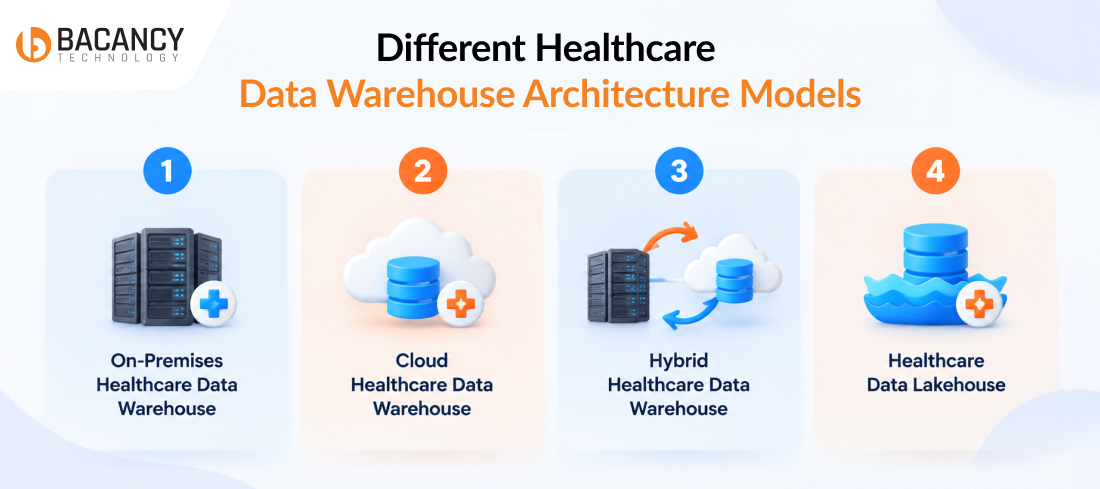
All different data warehouse healthcare architecture models have varying data volumes, security requirements, existing infrastructure, and analytics needs. Here are 4 models:
An on-premises data warehouse in healthcare stores and processes data within a healthcare organization’s own data center. It gives you direct control over infrastructure, security configurations, and data access.
Best suited for: Businesses with strict data governance requirements, existing data center investments, or legacy healthcare systems that are difficult to migrate.
A cloud healthcare data warehouse stores healthcare data and runs analytics workloads on cloud platforms, such as AWS, Microsoft Azure, or Google Cloud. It supports elastic storage and computing resources without requiring organizations to maintain physical infrastructure.
Best suited for: Healthcare organizations that need flexible capacity, faster deployment, and integration with modern analytics and AI services.
A hybrid architecture combines on-premises and cloud environments. Sensitive or legacy healthcare data can remain within existing infrastructure while selected workloads, analytics, or data pipelines run in the cloud.
Best suited for: Businesses transitioning from legacy infrastructure to the cloud while maintaining control over specific datasets or systems.
A healthcare data lakehouse combines the flexible storage capabilities of a data lake with the structured analytics capabilities of a data warehouse. It can support structured, semi-structured, and unstructured healthcare data from sources such as EHRs, medical devices, claims, imaging systems, and patient applications.
Best suited for: Healthcare organizations handling diverse data types and building advanced analytics, machine learning, and AI use cases.
| Architecture | Data Storage | Scalability | Infrastructure Control |
|---|---|---|---|
| On-Premises | Organization-owned servers | Limited by Infrastructure | High |
| Cloud | Cloud-based storage | High | Moderate |
| Hybrid | On-premises + cloud | High | High |
| Lakehouse | Unified lake-based storage | High | Moderate |
To evaluate healthcare data warehouse architecture in your organization, you need data ingestion, integration, storage, processing, governance, security, and analytics components.
ETL/ELT pipelines extract healthcare data from EHR/EMR systems, claims platforms, laboratories, pharmacies, medical devices, and other sources. You can review pipelines that support batch and real-time ingestion, data validation, transformation, error handling, and reliable data movement.
The data modeling layer organizes healthcare data into structures that support reporting, analytics, and downstream applications. Common approaches include star schemas for analytical workloads and FHIR/HL7 mapping for healthcare interoperability.
FHIR mapping deserves particular attention when the warehouse supports data exchange and interoperability requirements tied to CMS-0057-F. The rule establishes implementation timelines that include requirements beginning in January 2026, with additional requirements taking effect in January 2027, which makes the underlying data model and interoperability strategy an important architectural consideration.
The storage layer determines how structured, semi-structured, and unstructured healthcare data is retained and accessed. You can assess storage capacity, performance, encryption, retention policies, backup, disaster recovery, and support for growing healthcare datasets.
A semantic layer creates consistent definitions for healthcare metrics, dimensions, and business terms across analytics tools. It helps ensure that measures such as readmission rates, claims costs, patient volumes, and clinical outcomes are calculated consistently.
The analytics layer enables users to turn warehouse data into operational reports, dashboards, clinical insights, and predictive analytics. Analyze supports self-service BI, regulatory reporting, real-time dashboards, and integration with AI/ML workloads.

The right approach should support current analytics needs while accommodating data growth, interoperability, security requirements, and future use cases such as AI.
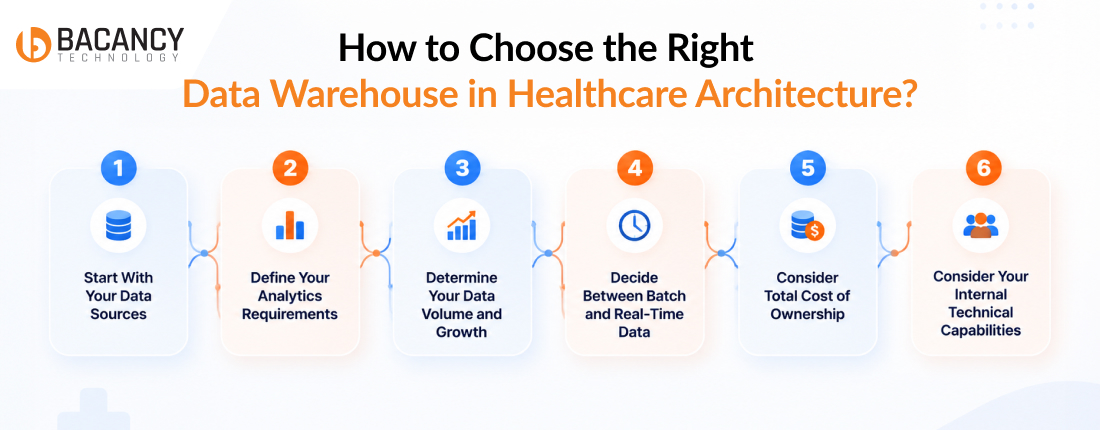
Begin by identifying all the systems that will feed data into your warehouse. Healthcare organizations often work with EHR or EMR systems, claims platforms, laboratory systems, pharmacy applications, medical devices, CRM platforms, and patient-facing applications.
Consider:
The more varied your data sources are, the more important it becomes to have an architecture that can handle different formats, integration methods, and data frequencies without creating unnecessary complexity.
Your analytics goals should directly influence the architecture you choose. A warehouse designed primarily for historical reporting may have different processing requirements than one supporting clinical analytics or AI applications.
Determine whether you need:
For instance, scheduled reporting can generally work with batch processing, while use cases that depend on frequently updated information may require real-time or near-real-time data pipelines.
Don’t evaluate an architecture based only on the amount of data you have today. Healthcare data can grow rapidly as organizations add patients, clinical systems, medical devices, claims records, and new data sources.
Look at your:
It helps you determine whether the architecture can maintain performance as your data environment expands without requiring frequent redesigns.
The choice between batch and real-time processing depends on how quickly users and applications need access to updated data.
Batch processing is suitable when data can be collected and processed at scheduled intervals. It is commonly used for historical reporting, claims analysis, periodic data synchronization, and routine business intelligence.
Real-time processing is more appropriate when recent data can influence clinical or operational decisions. Patient monitoring, care coordination, fraud detection, and time-sensitive dashboards are examples where frequent data updates may be valuable.
Several healthcare organizations use a combination of both approaches, applying real-time processing where timing matters and batch processing for workloads that do not require immediate updates.
The initial infrastructure cost does not tell you how much a healthcare data warehouse will cost to operate over time. A more accurate comparison includes the technology, implementation, and ongoing operational expenses.
Factor in:
Also account for future data growth and the additional infrastructure or expertise required as analytics workloads become more complex.
Finally, consider whether your internal team can operate the architecture you are planning to implement. A highly complex environment may provide extensive capabilities, but it can also require specialized skills across data engineering, cloud infrastructure, security, DevOps, and analytics.
Concerned about HIPAA Requirements Across Your Data Systems?
Our HIPAA compliance services help identify compliance gaps, strengthen security controls, and establish safeguards for protected health information.
As a healthcare organization, you can either build a data warehouse platform internally or adopt an existing platform that meets your data and analytics requirements.
The right approach depends on how much customization you need, your implementation timeline, existing infrastructure, and the technical resources available to maintain the environment.
To build your own platform gives you greater control over the architecture, data models, integrations, and analytics workflows. It can be a suitable option when your requirements do not fit standard warehouse capabilities.
Building makes sense when you have:
However, building also means taking responsibility for development, security, interoperability, maintenance, upgrades, and infrastructure management.
You can buy an existing platform and reduce development effort. It also helps your organization start using data warehouse capabilities sooner. Here, the commercial platform can provide pre-built infrastructure, integrations, security features, and insight capabilities.
Buying makes sense when you have:
The key is to evaluate how well the platform integrates with your existing healthcare systems and whether it can support future data and interoperability.
A third approach is to work with a healthcare technology partner like Bacancy Technology can design, build, modernize, and support the data warehouse environment based on your specific requirements.
This approach can be relevant when you have:
Bacancy Technology can support healthcare organizations across architecture design, data integration, cloud migration, data engineering, analytics, and ongoing platform development, allowing internal teams to retain focus on their core healthcare operations while technical requirements are managed by a dedicated engineering team.
A healthcare data warehouse typically costs $10,000 to $50,000+ to build from scratch, while buying a commercial healthcare data warehouse platform can cost $50,000 to $250,000+ per year. The actual cost depends on data volume, integrations, architecture, security, compliance, customization, and analytics requirements.
For a custom healthcare data warehouse, costs increase with complex EHR/EMR, claims, laboratory, FHIR/HL7, and medical-device integrations. Commercial platforms can reduce development effort, but licensing, storage, compute, implementation, and support add to the total cost of ownership.
A well-designed healthcare data warehouse gives organizations a reliable way to bring clinical, operational, and financial data together for reporting, analytics, and AI-driven use cases. The right architecture depends on your data sources, interoperability needs, security requirements, analytics goals, and long-term growth.
Bacancy Technology helps healthcare organizations design, build, modernize, and integrate data warehouse environments around their specific requirements. Our healthcare analytics consulting services can help you select the right architecture, connect fragmented healthcare data, modernize legacy systems, and build analytics capabilities that support better data-driven decisions.
An integrated healthcare enterprise data warehouse can cost you from $10,000 to $250,000+ per year. It depends on your data volume, number of systems, complexity, security requirements, and customization. It can also vary based on cloud infrastructure, data migration, and ongoing maintenance needs.
To build a HIPAA-compliant healthcare data warehouse, you need to implement data encryption, role-based access control, audit logging, secure data transmission, access monitoring, and proper data governance. The architecture should also support HIPAA requirements for protected health information (PHI), data access, and storage.
Common data warehouse healthcare architecture challenges include integrating fragmented data sources, maintaining data quality, supporting healthcare interoperability standards, protecting PHI, and managing large data volumes. Legacy systems and inconsistent data formats can further complicate integration.
A healthcare data warehouse usually takes 3 to 12 months to implement; it depends on the number of data sources, integration requirements, and compliance needs. A basic implementation may take a few months, while an enterprise-scale warehouse with multiple integrations can require a year or longer.
A healthcare data warehouse should support standards such as HL7, FHIR, DICOM, and ICD-10, depending on the organization’s data and interoperability requirements. FHIR and HL7 support clinical data exchange, DICOM supports medical imaging data, and ICD-10 provides standardized diagnostic classification.

Get the HIPAA Compliance Checklist for software development. Explore key steps and more to ensure your healthcare app meets HIPAA standards and stays compliant.
Read More
Explore telehealth vs telemedicine, their key differences, services, use cases, and when healthcare providers should choose each for remote care
Read More
Discover how EMR optimization strategies in 2026 improve healthcare delivery, boost efficiency, enhance patient care and support data-driven clinical decisions.
Read More