 Bacancy Global






November 4, 2026
Hidden Costs of Healthcare AI Agents You Must Know
Explore the 7 hidden costs of healthcare AI agents, including EHR integration, compliance, security, and maintenance, plus TCO and ROI.
Read More
EMR security best practices help reduce exposure to data breaches, ransomware, and unauthorized access to patient records. This guide explains 12 security controls, key regulatory obligations, and practical steps to identify vulnerabilities and improve incident readiness within 90 days.
Patient records are being accessed from an unfamiliar location, and the hospital’s IT team cannot immediately decide whether the activity is legitimate or not. For the CIOs, every minute of uncertainty raises difficult questions: has sensitive data been exposed? Can clinical teams continue to work without disruption? Are existing security controls sufficient to prevent further access?
These are the risks that make EMR security best practices a priority for healthcare IT leaders. A single vulnerability in access management, system configuration, or threat monitoring can expose patient data and create regulatory and operational consequences.
The U.S. Department of Health and Human Services (HHS) security guidance outlines safeguards for protecting electronic protected health information. This blog examines the measures CIOs and IT directors can implement to improve EMR security, reduce exposure, and maintain reliable access to patient records.
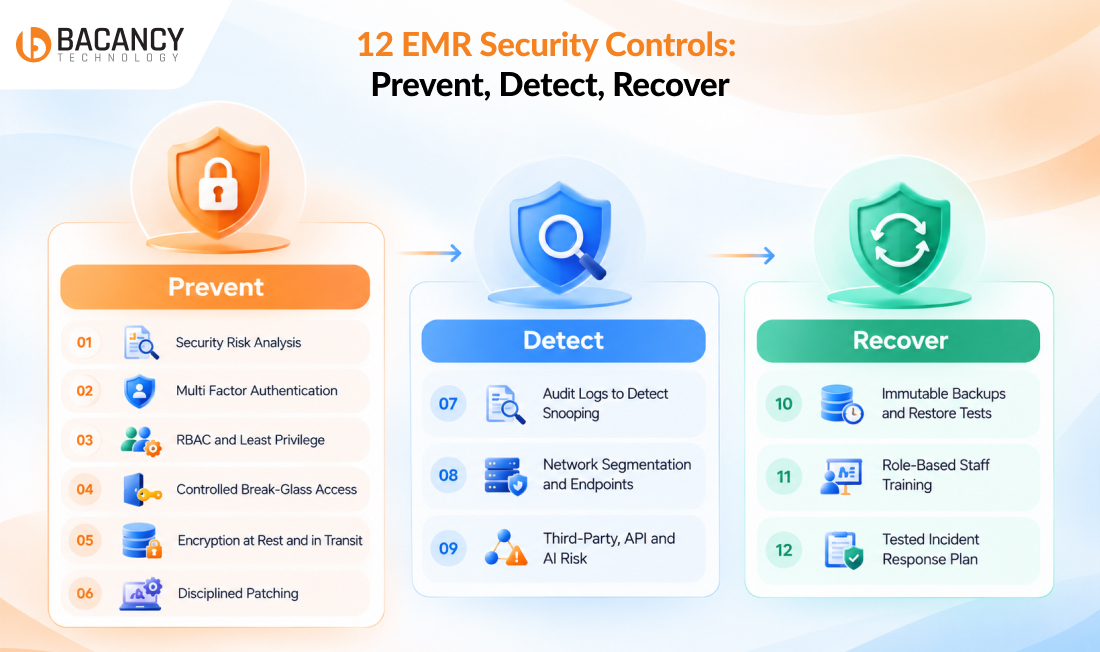
The most effective approach combines preventive controls, continuous monitoring, and tested recovery procedures. As a healthcare organization, you should prioritize these 12 practices according to their risk exposure and operational needs.
A security risk analysis identifies where electronic protected health information (ePHI) resides, who can access it, and what could compromise its confidentiality, integrity, or availability.
Under the HIPAA Security Rule, covered entities and business associates must conduct an accurate and thorough assessment of risks to ePHI.
Start by inventorying EMR databases, document repositories, backups, test environments, connected applications, and third-party integrations. Review user permissions, unsupported software, exposed services, and existing recovery procedures.
Document each risk, its potential impact, existing safeguards, remediation steps, and accountable owner. Reassess risks when major changes occur, such as an EMR migration, new integration, acquisition, or introduction of AI tools.
Best practice: Use the risk assessment to prioritize security investments rather than treating every vulnerability as equally urgent.
Passwords alone cannot adequately protect EMR systems. Attackers can steal credentials through phishing, password reuse, and compromised devices. Multi Factor authentication (MFA) adds another verification step before access is granted.
Require MFA for EMR users wherever technically feasible, particularly for remote access, administrators, cloud consoles, and provider accounts. Prefer phishing-resistant methods, such as passkeys or FIDO2 security keys, where supported.
Secure account recovery processes, monitor repeated login failures, and remove access promptly when employees or contractors leave.
Best practice: Review every access route, including VPNs, remote support tools, and administrative portals, so attackers cannot bypass MFA through a weaker entry point.
Role-based access control (RBAC) assigns permissions according to job responsibilities. Least privilege limits users to the access required for their work.
For instance, physicians may need clinical histories and medication records, while billing staff may require insurance and encounter information. Neither role should automatically receive unrestricted access to every record or administrative function.
Define permissions for clinicians, billing teams, researchers, IT administrators, and external vendors. Review them when responsibilities change, remove inactive accounts, and separate administrative accounts from everyday user accounts.
For sensitive records, apply additional restrictions where appropriate. Access policies must also account for legitimate treatment needs and applicable legal exceptions.
Best practice: Review actual permissions regularly and remove access that no longer matches a user's responsibilities.
Clinicians sometimes need immediate access to restricted records during emergencies. Break-glass access allows authorized users to override selected restrictions when normal permissions could delay essential care.
A secure process should require individual authentication, capture the reason for access, log the records accessed, and notify designated reviewers. Access should be limited to what the emergency requires.
For instance, a physician treating an unconscious patient may need to review a restricted medication history. The system grants emergency access and records the event for later review.
Best practice: Monitor break-glass activity and investigate repeated or unexplained use instead of allowing emergency access to become a routine workaround.
Encryption helps prevent unauthorized parties from reading exposed patient information. Protect data in production databases, document stores, backups, endpoints, and integrations.
AES-256 is a common standard for stored data. For data in transit, use securely configured TLS 1.2 or higher for patient portals, APIs, remote sessions, and supported clinical interfaces.
Encryption keys require separate protection. Restrict key administration, log access, establish rotation procedures, and test recovery options. Review legacy interfaces that cannot support modern encryption and document compensating safeguards.
Under the current HIPAA Security Rule, encryption is an addressable implementation specification. Your organization must assess whether it is reasonable and appropriate, implement it when appropriate, or document the rationale for an alternative measure.
Best practice: Verify encryption coverage across the complete data lifecycle, including exported reports, test environments, and backup copies.
Audit logs help identify inappropriate access and reconstruct security incidents. They are especially important when an employee has legitimate credentials but views records without a work-related reason.
Configure logging for patient-record views, edits, exports, deletions, authentication events, permission changes, break-glass access, and privileged actions.
Capture the user or service identity, timestamp, affected record, and action performed. Centralize logs where practical, restrict modification, synchronize system clocks, and establish retention requirements.
Monitor unusual activity, such as bulk downloads, repeated access to unrelated patients, or privileged actions at unexpected times. Investigations should consider clinical context before concluding that an event represents misuse.
Best practice: Define who reviews alerts, when incidents are escalated, and how evidence is preserved and documented.
Unpatched applications, operating systems, databases, and network devices can expose EMR environments to known attacks.
Maintain an accurate asset inventory, scan systems for vulnerabilities, and prioritize remediation according to exploitability, exposure, and potential impact on patient information or clinical operations.
Apply security updates promptly, with expedited handling for critical vulnerabilities and known exploited flaws. Test updates before deployment when necessary to protect clinical workflows, but document any delay and apply compensating controls.
Unsupported software requires particular attention. You need to upgrade, replace, isolate, or protect it through documented safeguards when security updates are no longer available.
Best practice: Verify that remediation succeeded through rescans or other evidence rather than relying solely on patch installation records.
EMRs depend on workstations, servers, identity systems, medical devices, email, and remote access services. If attackers compromise one component, poor network separation can let them reach other systems.
Separate EMR databases, application servers, administrative systems, general workstations, and medical devices according to their functions and risks. Restrict communication between segments and use controlled paths for administrative access.
Protect supported endpoints with endpoint detection and response (EDR), anti-malware controls, secure configurations, and limited administrator privileges. Strengthen email security against phishing and spoofing, and protect remote access with MFA.
Older medical devices may not support modern security tools. For that, you need to use vendor-approved protections, network isolation, and monitoring that does not interfere with patient care.
Best practice: Test network boundaries to confirm that a compromised workstation cannot automatically reach every EMR server or backup repository.
Backups support recovery from ransomware, accidental deletion, corruption, and infrastructure failures. However, a completed backup job does not prove that an EMR can be restored successfully.
Maintain immutable or offline copies that ordinary production credentials cannot modify or delete. Encrypt backups, restrict administrative access, and include the databases, documents, configurations, and dependencies required to restore clinical operations.
Define recovery time objectives (RTOs) and recovery point objectives (RPOs) for critical systems. Test restoration in an isolated environment and verify that records are complete, consistent, and accessible.
Recovery exercises should also test dependent interfaces and clinical downtime procedures.
Best practice: Measure backup readiness through successful restoration tests and not simply through the number of completed backup jobs.
Cloud providers, billing services, transcription platforms, and other vendors may access or process ePHI. Their security weaknesses can expose healthcare organizations to additional risk.
Assess providers before onboarding and throughout the relationship. Execute business associate agreements when required, restrict remote access, review subcontractors, and define incident notification and data-handling responsibilities.
Secure APIs and integrations with appropriate authentication, narrowly scoped permissions, protected credentials, and monitoring for unusual data transfers. Apply these controls to HL7 interfaces, FHIR endpoints, patient portals, and custom applications.
AI tools introduce additional concerns. Before connecting an AI assistant or clinical documentation tool to an EMR, determine what data it receives, where the data is processed, whether the provider retains it, and whether it is used for model training.
Require appropriate privacy and security reviews, limit data access, test for unintended disclosure, and establish human review for high-impact clinical outputs where appropriate.
Best practice: Treat every healthcare associate, API, and AI integration as part of the EMR security boundary.
Security training should reflect how employees actually use EMR systems. Clinicians need guidance on appropriate record access and shared workstations, while administrators need training on privileged accounts, secure configurations, and incident response.
Train staff to recognize phishing, protect credentials, handle patient information appropriately, and report suspicious activity promptly. It includes payers and contractors in relevant security procedures.
Use practical scenarios, phishing simulations, and short refreshers to reinforce secure behavior. Track training completion, reporting rates, and recurring mistakes to identify areas that need attention.
Best practice: Make security procedures practical for clinical teams and provide clear reporting channels for mistakes and suspected incidents.
A response plan defines how the organization detects, contains, investigates, and recovers from security incidents while protecting patient care.
Include procedures for compromised accounts, ransomware, unauthorized disclosures, and provider-related incidents. Assign responsibilities across security, IT operations, clinical leadership, privacy, legal, and communications teams.
The plan should cover containment, evidence preservation, clinical downtime, system restoration, breach assessment, and required notifications. After an incident, document the cause and assign corrective actions.
Conduct tabletop exercises using realistic scenarios, such as ransomware that makes the EMR unavailable or a compromised administrator account. Test whether teams can maintain essential clinical workflows, make timely decisions, and restore systems within approved recovery objectives.
Best practice: Evaluate incident readiness through exercises and documented improvements rather than relying on a written plan alone.
Unsure Which EMR Security Best Practices Your System Needs?
Get expert support from our EMR software development company to assess security gaps, prioritize critical risks, and implement safeguards that align with your healthcare organization's requirements.
EMRs combine sensitive personal information with access to critical healthcare operations. Below are the 4 common risk areas that deserve particular attention.
Healthcare organizations should assess these risks together because a single incident may involve several attack paths.
HIPAA remains a central U.S. framework for protecting ePHI. Healthcare organizations may also need to comply with state privacy laws, contractual requirements, and additional rules that apply to specific types of records.
| Requirements | Status and Relevance |
|---|---|
| HIPAA Security Rule | Requires administrative, physical, and technical safeguards for ePHI |
| HIPAA Breach Notification Rule | Establishes notification obligations for qualifying breaches of unsecured PHI |
| 42 CFR Part 2 | Updated requirements became subject to compliance for covered substance use disorder records |
| HIPAA Security Rule Modernization Proposal | Proposed changes should not be treated as current law. Verify the latest rulemaking status before publication. |
| HHS Cybersecurity Performance Goals | Voluntary guidance with 10 essential and 10 enhanced goals to help healthcare organizations prioritize safeguards. |
Note : The HHS official has proposed more prescriptive HIPAA Security Rule requirements. The latest regulatory agenda is available as the target for final action, so check the proposal before finalizing it.
HIPAA violations may lead to civil monetary penalties, corrective action plans, and increased oversight. Financial exposure depends on the violation and applicable circumstances. For details, you can read our HIPAA violations fines and penalties.
Our Takeaway: Maintain documented risk assessments, access reviews, remediation records, training evidence, backup test results, provider assessments, and incident response exercises.
A phased 30-60-90 day plan helps your healthcare organizations address immediate risks while building lasting security practices.
| Timeline | Priority Actions |
|---|---|
| Day 1-30 | Assess risks, inventory systems and integrations, review privileged access, identify crucial vulnerabilities, and verify backup readiness. |
| Day 31-60 | Address high-priority gaps, enforce MFA, validate audit logging, review providers, and test backup restoration. |
| Day 61-90 | Conduct targeted security testing, run an incident response exercise, validate clinical downtime procedures, and establish ongoing metrics. |
Track MFA coverage, overdue critical vulnerabilities, access review completion, suspicious access investigation time, backup restoration success, and provider review coverage.
Assign an owner to each improvement and review progress with IT, security, privacy, and clinical leadership. It keeps security work measurable without losing sight of patient care.
Effective EMR security depends on coordinated safeguards that protect patient information and keep clinical systems available. MFA, least-privilege access, encryption, audit logging, vulnerability management, network segmentation, tested backups, and incident response each address a different part of the risk.
Healthcare CIOs should begin with a clear risk assessment, address the most significant gaps, and validate that controls work in clinical environments. A 30-60-90 day plan helps your teams establish ownership, measure progress, and prepare for future security requirements.
If your organization is modernizing an EMR or integrating new healthcare applications, Bacancy’s healthcare IT services can help you assess technical requirements and build secure healthcare software around your operational needs.
The most crucial best practices of EMR systems include risk assessments, MFA, least-privilege access, encryption, audit logging, timely patching, network segmentation, tested backups, staff training, and incident response planning.
HIPAA does not prescribe one universal assessment schedule. Organizations should establish a risk-based review cadence and reassess when major changes occur, such as an EMR migration, new integration, acquisition, or security incident.
Encryption is an addressable implementation specification under the current HIPAA Security Rule. Your organization must assess whether it is reasonable and appropriate, implement it when appropriate, or document the rationale for an alternative measure.
Use MFA, role-based permissions, least privilege, session timeouts, prompt account deactivation, and audit monitoring. Review suspicious activity and provide controlled emergency access for legitimate clinical needs.
Apply security updates, secure privileged accounts, segment networks, monitor endpoints, and maintain immutable backups. Test restoration procedures and prepare clinical downtime plans.
It should define recovery objectives, backup locations, restoration procedures, system dependencies, assigned responsibilities, clinical downtime workflows, and data integrity checks. Regular exercises should validate recovery readiness.
Assess vendors, execute required business associate agreements, restrict access, protect API credentials, monitor data transfers, and review integrations regularly. Revoke unnecessary access when contracts or responsibilities change.
EMRs generally focus on electronic medical records within an individual practice or organization, while EHRs are designed to support a broader longitudinal patient record across care settings. Their security requirements overlap significantly.
Explore the 7 hidden costs of healthcare AI agents, including EHR integration, compliance, security, and maintenance, plus TCO and ROI.
Read More

Understand ONC Certified EHR and EMR requirements, certification status checks, 2026 changes, and how they affect healthcare providers and CTOs.
Read More

Understand EHR implementation costs with a detailed budget breakdown by organization size, implementation phase, hidden expenses, and TCO.
Read More
AI-First Engineers
Our engineers use AI agents and tools to build faster, then spend their time where it matters: reviewing code, closing technical gaps, catching security and performance risks, and testing every release. You work with AI engineers, AI product engineers and tech architects who own the quality of everything that delivers.

Embedded in Your Business
Our engineers work within your systems, data and security requirements, with overlapping hours for teams in the US, UK and Australia. Hire an individual Forward Deployed Engineer (FDE) or a dedicated FDE pod led by a named lead. We stay accountable for measurable outcomes until your solution runs reliably in production.

Built for Regulated AI
We build AI agents and agentic workflows primarily for healthcare and finance, integrating with EHRs, payer portals, banking systems and loan platforms. Our expertise spans data engineering, data warehousing and analytics, with human oversight, audit trails and HIPAA- and PCI DSS-aware controls. We also deliver solutions across other industries, backed by 1,050+ engineers and ISO/IEC 27001:2022 certification.