 Bacancy Global




August 7, 2026
10 Best LLM in Healthcare (2026): Benchmarks, HIPAA & Deployment Guide
Compare top LLM in healthcare for 2026 using HealthBench benchmarks, HIPAA/BAA deployment options, FDA guidance, and real-world implementation insights.
Read More
Learn what digital twin technology in healthcare is, how it works, and how hospitals use it in patient care today. Explore the five types, real clinical examples, and which solutions are ready to use in 2026.
We also explain FDA, EMA, and EU AI Act requirements, data and FHIR needs, common challenges, build vs. buy options, costs, and ROI. You will also learn how to start with a 90-day pilot and when to stop one.
Research on digital twin technology in healthcare is growing quickly, but most of it has not yet become tools doctors use every day. This gap between research and real-world use is the first thing to understand.
Take the TWIN-VT trial, published as a research letter in the New England Journal of Medicine on April 1, 2026. Johns Hopkins doctors built a digital copy of each patient’s heart from an MRI scan, tested the ablation on it first, then used that plan on the real patient.
All ten patients had already had a heart attack and had ventricular tachycardia, a dangerous heart rhythm problem. After ablation, doctors could not trigger the abnormal rhythm in any patient tested.
After an average follow-up of 13 months, eight patients stayed free of the problem without rhythm medicines. Science News reported the procedure time dropped from about three hours to around 30 minutes.
The FDA allowed the trial under an investigational device exemption and limited it to one hospital and ten patients. This shows the current situation clearly. Digital twin technology in healthcare is starting to be used with real patients, but it is still being tested in small and controlled studies.
Another reason this topic can be confusing is that people use the term “digital twin” in different ways. Sometimes it means a simple model that is still being tested.
Other times, it means software that hospitals can already use. Both may be called a “digital twin,” even though they are at different stages of development.
Here is a quick look at digital twin technology in healthcare:
| Question | Quick Answer |
|---|---|
| What is it? | A digital copy of a patient, organ, disease, medical device, or healthcare process that uses real-world information. |
| What's being used today? | Digital models that help with treatment planning, patient care, hospital work, and medical decisions. |
| What's still being tested? | Patient-specific treatment twins in clinical trials, plus whole-body, immune system, and brain twins still in research. |
| How does it work? | Real patient or healthcare data is added to the digital model. It can then be used to predict what might happen or compare different options. |
| Is it FDA approved? | There is no single FDA approval that covers digital twins as a category. Some are cleared as medical devices; some are not regulated at all. It depends on what the software does and how it is used. |
| What does it cost? | Operational twins cost less; clinical twins cost more due to validation and regulation. |
| What's the biggest project risk? | Creating a complicated digital twin without a clear goal or a way to measure whether it is actually useful. |
Digital twin technology in healthcare is a virtual model of a specific patient, organ, disease, device, or hospital process, built from its real data and updated as new data arrives. Doctors and hospital teams use it to test decisions before acting in the real world.
For example, a digital copy of a patient’s heart, built from scans and test results, lets doctors try different treatments without risk to the real patient.
Digital twin technology in healthcare works by taking real health data and turning it into a digital model. This model can then show what may happen next and help guide better choices.
1. Gather real data: The system collects information such as medical records, scan results, lab reports, wearable device data, and hospital records.
2. Build the digital model: This data is used to build a digital copy of something in healthcare. It could stand in for a patient, an organ, a disease, a medical device, or even a hospital process.
3. Test what could happen: The digital model can be used to test different situations and make guesses about outcomes. For example, doctors can use it to see how a patient might react to different treatments.
4. Update: As new data comes in, it gets added to the model. This keeps the digital twin close to the real, current state of the patient or system.
5. Put the results to use: The information from the digital twin can help doctors decide on treatment. It can also help with fixing medical equipment or making hospital work run better.
The digital twin does not always need updates at the same speed. A twin used to plan surgery may only need new data when the patient gets a new scan. A twin used to watch a patient closely may need updates much more often.
These terms are often used together, but they are not the same thing when discussing a digital twin in healthcare.
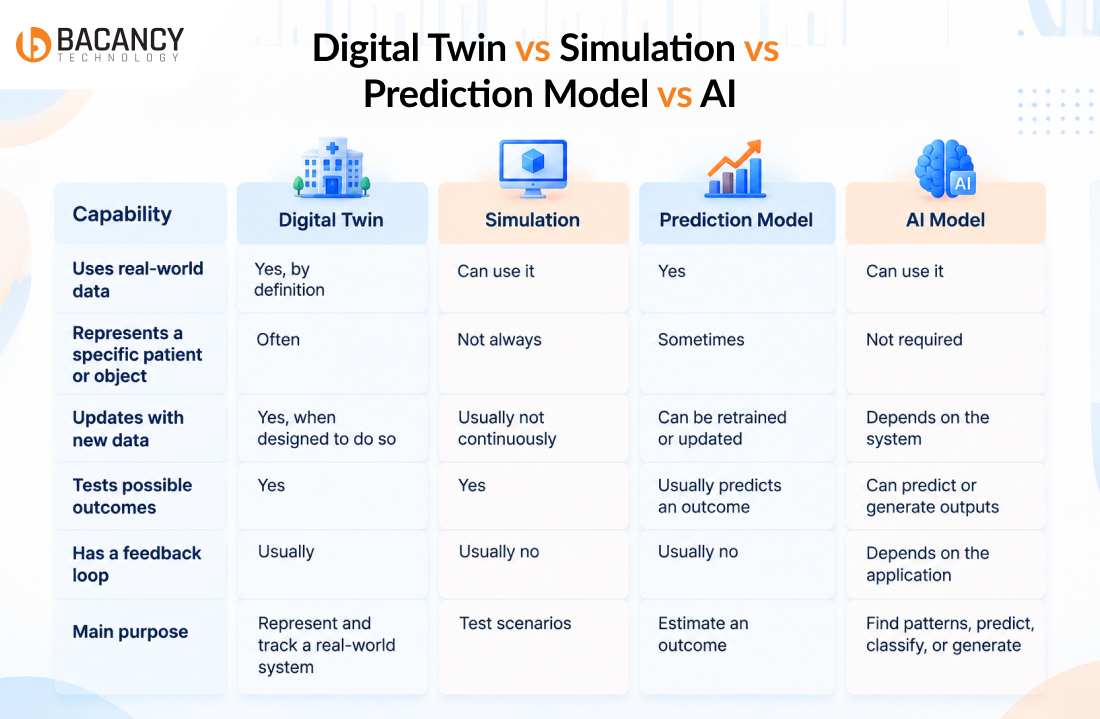
A simulation can test what might happen without being connected to one specific real-world patient or system.
A prediction model takes data and estimates an outcome, such as the risk of readmission. It does not necessarily maintain a changing digital representation of that patient.
AI is a method that can be used inside a Digital twin in the healthcare category. For example, an AI model could predict disease progression, while the digital twin combines that prediction with the patient’s changing clinical data.
This distinction matters because calling an AI prediction model a digital twin does not automatically make it one. A healthcare digital twin needs a meaningful connection between the digital model and the real-world patient, device, disease, or process it represents.
Digital twin in healthcare generally fall into five groups based on what the model represents:
1. Patient digital twins: Create a digital model of an individual patient using clinical and physiological data to support personalized care.
2. Organ and physiological twins: Create a digital model of an organ or body system, such as the heart, lungs, brain, or kidneys.
3. Disease and treatment twins: Model disease progression or test how a patient may respond to different treatments.
4. Medical device twins: Represent an implant, imaging system, surgical device, or other medical equipment to monitor performance or test changes.
5. Hospital and operational twins: Model patient flow, beds, staffing, operating rooms, and other hospital processes to improve resource planning and operations.
Digital twin technology in healthcare is more than a patient model. It needs the right data, a model that can process that data, and a way to turn the output into a useful decision.
| Component | What it does | What it needs |
|---|---|---|
| Real-world data | Brings in EHR, imaging, lab, device, or sensor data. | Data access, integration work, and ongoing data quality checks. |
| Digital representation | Creates the digital version of the patient, organ, device, or process. | Modeling and patient-specific data preparation |
| Simulation model | Tests what could happen under different conditions or treatments. | Modeling expertise and testing against known outcomes |
| Prediction layer | Estimates outcomes using physics, machine learning, or both. | Training data, validation across patient groups, and clinical sign-off |
| Feedback loop | Uses new data to keep the twin updated over time. | Automated pipelines, drift monitoring, revalidation |
Of these parts, the prediction layer matters most, because it decides what the digital twin actually tells you.
The prediction model drives much of the value of digital twin technology in healthcare. There are three common approaches:
There is no single model that works best for every situation. A physics-based model can be a good choice when we already understand how the biological process works.
Machine learning can be useful when there is a lot of data, and we want to find patterns that are hard to model directly. Hybrid models bring both approaches together.
The main question is not which model is more advanced. What matters is whether the model can give reliable results for the specific medical or healthcare decision it is being used for.
Picking the right model is only half the job, though. The other half is deciding how often that model needs new data to stay useful. That is where refresh rate comes in.
Digital twin technology in healthcare does not always need real-time data. Its refresh rate should match the decision it supports.
| Use case | Typical refresh need | Why |
|---|---|---|
| Surgical planning | One-time or when new scans are available | The model supports a specific procedure |
| Disease modeling | Daily or weekly | Changes happen over a longer period |
| Patient monitoring | Near real time | The patient's condition can change quickly |
| ICU monitoring | Every few minutes or faster | Decisions may depend on rapid changes |
The goal is not to refresh the twin as often as possible. Refresh it as often as the clinical or operational decision requires.
The term digital twin can mean different things when looking at digital twin technology in healthcare. Some digital twins are already being used for specific medical or hospital decisions. Others are still being tested and researched.
Here is a simple view of where things stand in 2026:
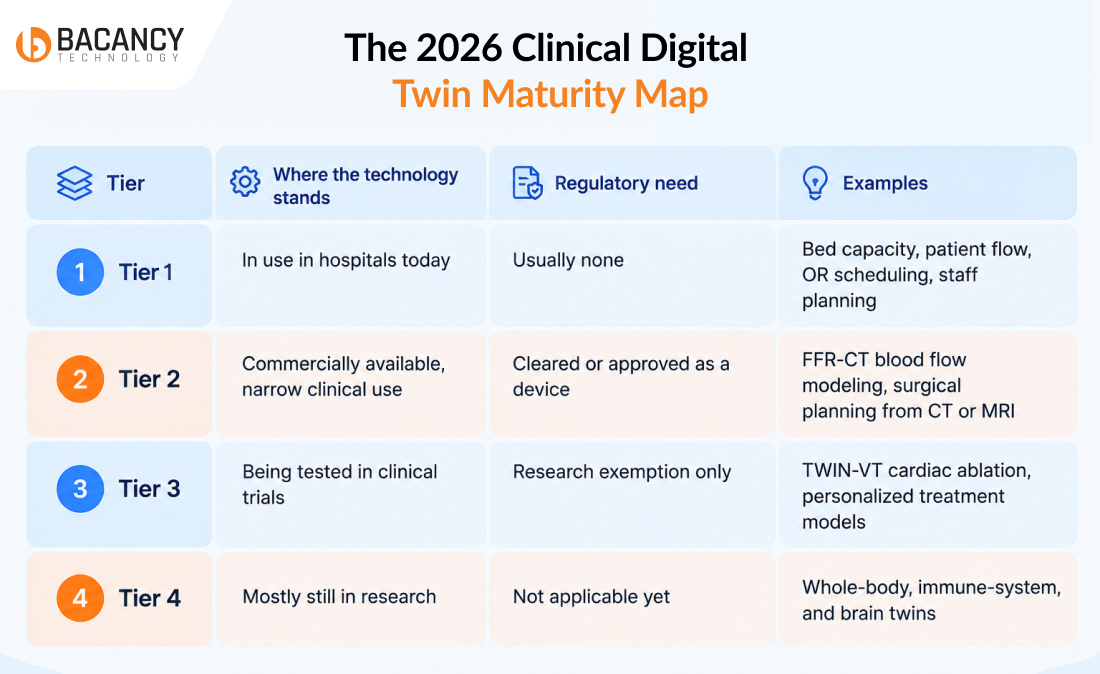
Digital twins in healthcare built for hospital operations are easier to build. They do not need to copy how the human body works.
Hospitals use these models to test things like:
The benefit is simple. A hospital can test a change on a computer first, before making that change for real.
Most of these models never touch a clinical decision, so they usually stay outside medical device rules.
Clinical models are harder. Only a few can be bought and used on real patients today. That is Tier 2.
The clinical digital twins available today usually focus on one specific job. They do not try to create a digital copy of the whole patient.
Heartflow’s FFRCT analysis is the clearest example. It builds a patient-specific blood flow model from a CT scan to assess coronary artery disease, and Heartflow says it is used at more than 1,800 institutions worldwide.
FFRCT has billed under a Category I CPT code since January 2024. Surgical planning models built from CT or MRI scans are another example.
These are regulated as medical devices because their output guides a clinical decision.
One thing to remember: not every patient model counts as a real “digital twin” or a medical device. It depends on what the model is used for.
Some digital twins are now being tested in real clinical trials. TWIN-VT is one example. It tested patient-specific heart models to help plan treatment for a dangerous heart rhythm problem.
The results look promising. But there are still questions to answer.
Does the model work for many different patients, not just a few?
Does it really help doctors make better choices? Is it safe to use?
Until those questions are answered, doctors should treat this as research, not everyday care.
The hardest digital twins to build try to copy the entire human body. That work is still far from finished. That is Tier 4.
Whole-body digital twins try to copy many parts of the body at once, like several organs, the immune system, or the brain.
This is hard to do. There is not enough patient data yet. The models are not accurate enough. They also need much more testing before they can be trusted.
For now, this stays research. It is not ready for everyday hospital or patient use.
Knowing where a digital twin sits on this map is only useful if it changes how you plan a pilot.
Here is how to put the map to work before spending any money.
Before putting money into a digital twin pilot, ask these five questions:
1. Is there enough evidence?
Look for clinical studies, real-world results, or examples of the technology already in use. A research demo alone is not enough.
2. What are the regulatory requirements?
Understand what the digital twin will be used for. Will it support clinical decisions, treatment planning, patient monitoring, or only hospital operations? Its intended use decides the regulatory requirements.
3. Can we use it with our data?
Check if you have the EHR, imaging, lab, device, or hospital data the model needs. The data must be reliable, easy to update, and fit how your teams already work.
4. Who will pay for the result?
For clinical use, check reimbursement first. Heartflow shows a working path: its separate AI plaque analysis gained a Category I CPT code in January 2026 and is covered by UnitedHealthcare, Cigna, Humana, and Aetna. Most digital twins have nothing like that yet.
For hospital operations, look for clear savings instead, like fewer admissions, shorter stays, or better use of staff.
5. How will we know the pilot worked?
Set clear goals before building. This could mean faster treatment planning, fewer complications, better patient flow, or lower costs.
Start with one small use case and decide how you will measure results. If you are unsure about the data, evidence, regulations, or business value, do more testing before investing further.
Patient digital twins are slowly moving from research into real healthcare use. They can use patient data to help doctors understand a health problem, plan treatment, and compare different treatment options.
Cardiology is one area where a digital twin in healthcare is showing good progress with patient-specific models.
A digital model of the heart can use information such as heart scans, electrical signals, and other patient data. Doctors can use this model to see how the heart may respond to different treatments.
For example, during cardiac ablation, the model can help doctors find areas that may be causing an abnormal heart rhythm before the procedure. It can also help with valve planning by showing how a patient’s heart may respond to a specific valve or device.
Heart failure is another area being studied. Researchers can use patient data to see how the heart may change over time and how different treatments may affect the patient.
Cancer can change over time, so doctors need a way to understand how a tumor may react to treatment.
A model built with digital twin technology in healthcare can use medical scans, health records, and treatment details to estimate how a tumor may respond.
Doctors and researchers can use the model to compare different treatment options before trying them on the patient. This can help them understand what might happen with each option.
Digital models can also help plan radiation treatment. They can show how the tumor and nearby healthy tissue may react to different radiation plans.
The goal is not to replace the oncologist. The model simply gives the care team more information to help them compare treatment options.
Brain conditions can be hard to predict because every patient can have different symptoms, and the condition may change in different ways.
Researchers are looking at how brain scans, medical records, body data, and other patient information can be used to create a digital model for each patient.
These models could help doctors see how a brain condition changes over time and understand how a patient may respond to different treatments.
Mental health is a newer area for digital twin research. Researchers are looking at whether these models can help with conditions where symptoms can change over time.
However, this work is still in the early stages. More testing is needed before these models can be used in everyday mental healthcare.
A surgical digital twin creates a digital copy of a patient’s body part using medical images such as CT or MRI scans.
Before surgery, doctors can look at this model to understand the patient’s body better and plan how they want to perform the procedure.
This can be especially helpful for complex surgeries. The surgical team can see where important parts of the body are and plan the procedure before the actual surgery.
In simple words, the team can practice and plan the surgery on a computer before doing it on the patient.
Patients in the ICU can become sick in a short time. So, it is important for doctors to notice early signs that a patient’s condition is getting worse.
A digital twin can bring together information such as vital signs, lab results, medicines, and other patient data. The model can then help show how the patient’s condition may change.
In the future, these systems could help doctors look at different situations and spot signs that a patient may be getting worse.
This area still needs a lot of testing. A wrong prediction in the ICU can have serious effects, so these models need to be tested carefully before doctors can use them to make important medical decisions.
Beyond treating individual patients, digital twins are also being explored for a different problem: making clinical trials faster and cheaper to run.
Want to explore where digital twins can fit into your healthcare workflow?
Our healthcare Digital transformation services help turn patient data and emerging technologies into practical, connected care solutions.
Clinical trials take years, and digital twin technology in healthcare could help researchers address some of the delays involved in finding and enrolling the right patients. Digital twins can help by giving researchers a virtual way to test treatments and design trials.
How a Digital Twin Works Inside a Clinical Trial
A patient digital twin is built from medical records, imaging, lab results, and treatment history. Researchers use it to estimate how a patient might respond to treatment. It can also strengthen comparison groups using existing data instead of more real participants, reducing the number of people needed and easing recruitment.
How Much Do Sponsors Actually Save?
Savings vary by disease, trial design, data quality, and model validation. No fixed percentage applies to every trial.
Why Validation Could Erase Those Savings
The savings only work if regulators and researchers trust the digital twin. In September 2022, the EMA qualified Unlearn.AI’s PROCOVA method, which uses digital twins to reduce trial sample sizes. The FDA later concurred that it follows current guidance. (Source)
But this does not mean all digital twins are approved. The opinion only applies to this specific method. If the digital twin gives wrong results, sponsors may still need more participants or a traditional trial. This can remove the expected savings.
The main question is not whether digital twins can make trials smaller. It is whether they can do this without reducing the quality of the results. Until this is proven, digital twins should help with trial design, not replace traditional trials.
But before digital twins can be trusted in clinical trials or patient care, healthcare organizations also need to understand the regulatory rules they must follow.
Digital twin technology in healthcare does not automatically become a medical device just because it uses patient data. Its intended use is what matters. A model used to plan hospital capacity faces different requirements from software that recommends a treatment.
Ask what the software actually does. If it only displays data or supports hospital operations, medical device rules may not apply. If it analyzes patient data and its output is used to diagnose, monitor, or guide treatment, the regulatory requirements can become much stricter.
Once a digital twin falls under medical device rules, the next question is which specific approval path applies in the United States.
The FDA does not have one separate approval category called a “digital twin.” The pathway depends on the software’s intended use and risk. Depending on the product, developers may need to consider pathways such as 510(k), De Novo, or PMA.
Outside the US, the rules follow a different structure, but the same basic idea: intended use decides everything.
In Europe, software with a medical purpose may fall under the Medical Device Regulation (MDR). Its risk class depends on the harm an incorrect output could cause.
The EU AI Act adds another layer. AI in devices needing notified-body review (Class IIa and above) counts as high-risk, with obligations applying from 2 August 2028 under the Digital Omnibus. EMA authorization is not a general approval route for healthcare digital twins.
Regulators need more than a high accuracy score. They may look at the data used to train and test the model, validation methods, performance across patient groups, safety controls, monitoring, and how the software behaves after deployment.
Trust in the model starts with trust in the data behind it. That brings up a separate, practical problem: getting healthcare data into a usable shape in the first place.
Digital twin technology in healthcare is only as useful as the data feeding the digital twin. FHIR can make that data easier to exchange between healthcare systems, but FHIR alone does not solve the data problem.
FHIR can bring together information from EHRs, labs, medications, observations, and other systems. The next step is converting those records into clean inputs that the twin’s model can actually use.
Different clinical data uses different standards. SNOMED CT can represent clinical conditions, LOINC can identify lab tests and measurements, and RxNorm can standardize medication information.
Mapping these correctly helps the twin understand that data consistently across systems.
Missing values, outdated records, duplicate entries, incorrect codes, and different measurement methods can all affect the model.
A sophisticated twin cannot fix poor source data. If the input is wrong, the prediction can be wrong too.
Is disconnected healthcare data making it harder to build a reliable digital twin?
Our healthcare interoperability services help connect data from different healthcare systems and make it easier to use.
Here are 5 top reasons why your digital twin in healthcare might fail:
Failure 1: Building the Model Before Deciding What It Should Do
Failure 2: The Data System Stops Working After the Pilot
Failure 3: No Clear Use Case, So the Model Cannot Be Validated
Failure 4: Doctors Don’t Want to Change How They Work
Failure 5: No One Owns the Budget or Knows How to Get Paid
The right choice for digital twin technology in healthcare depends on how specific your use case is.
What Kind of Vendors Should You Look At?
How to Decide Between Buying and Building
What It Costs and How Long It Takes
Write these down before you start, because deciding afterwards never works.
Kill it if the data pipeline needs manual intervention more than once a week. Kill it if the model doesn’t beat your baseline metric by a margin you defined in advance. Kill it if clinicians don’t open the output without being prompted. Kill it if you still can’t name who pays for the result at day 90.
A pilot that ends in a documented no is a success. A pilot that gets extended twice because nobody set a stopping rule is the failure mode.
Digital twin technology in healthcare is growing, but not every use is ready. The best opportunities today solve clear clinical or hospital problems with measurable results. Start with one goal, check your data and regulations, set stop rules, and scale only when the pilot beats its baseline.
With the right healthcare IT services and solutions, organizations can also build the data, integration, and technology foundation needed to move promising digital twin use cases from pilot to practical implementation.
No. Refresh rate should match the decision. Surgical planning twins update only with new scans, while ICU twins need minute-level data and cost significantly more.
No. The EMA qualified Unlearn.AI’s PROCOVA method (2022) for reducing sample size in Phase 2 and 3 trials, but twins support trial design, not replacement.
Sometimes. AI twins in devices needing notified-body review (Class IIa and above) count as high-risk, adding oversight and documentation duties from 2 August 2028.
Patients retain rights over their health data, but hospitals or vendors usually own the resulting model. Settle ownership, reuse, and retraining rights in the contract.
Operational twins deploy fastest. Patient-specific clinical twins take much longer, since validation, regulatory review, and clinician sign-off usually consume more time than building the model.
Compare top LLM in healthcare for 2026 using HealthBench benchmarks, HIPAA/BAA deployment options, FDA guidance, and real-world implementation insights.
Read More

EMR vs EHR key differences, ideal use cases and which system best fits your healthcare organization. Make informed decisions for patient care.
Read More
Explore telehealth vs telemedicine, their key differences, services, use cases, and when healthcare providers should choose each for remote care
Read More
Top-Tier IT Geniuses
Bacancy Technology is an exclusive hub of top dedicated software developers, UI/UX designers, QA experts, and product managers with incredibly rare and hidden talents you will ever come across. We let you access the exceptional IT talent globally, from independent software developers to fully managed teams.

Time Zone Aligned
Timezone is never a constraint when you are working with Bacancy Technology. We follow a simple procedure- our developers and your time zone. Hire dedicated software developers from us and collaborate from far away to work according to your time zone, deadline, and milestone.

Experienced Team
Whether you are looking for skilled developers in emerging technologies or looking for an extended arm to augment your existing team, we can lend a helping hand in both situations. We are a full-stack software development company with 1050+ skilled and experienced software developers whom you can hire at your convenience to address ongoing business challenges.