Confidential client, name withheld under NDA

How an Offline-First ePCR Cut EMS Charting Time by 50%

Quick answer: An offline-first EMS ePCR (Electronic Patient Care Record) lets paramedic crews record patient details, vitals, treatments and EKG readings with no signal. It saves on the device, syncs when the connection returns and sends patient information to the receiving hospital before the ambulance arrives. Bacancy Technology built it for an emergency medical services technology provider.

Outcomes deliveredDelivered over 4 months, 340 crews live after deployment
50%

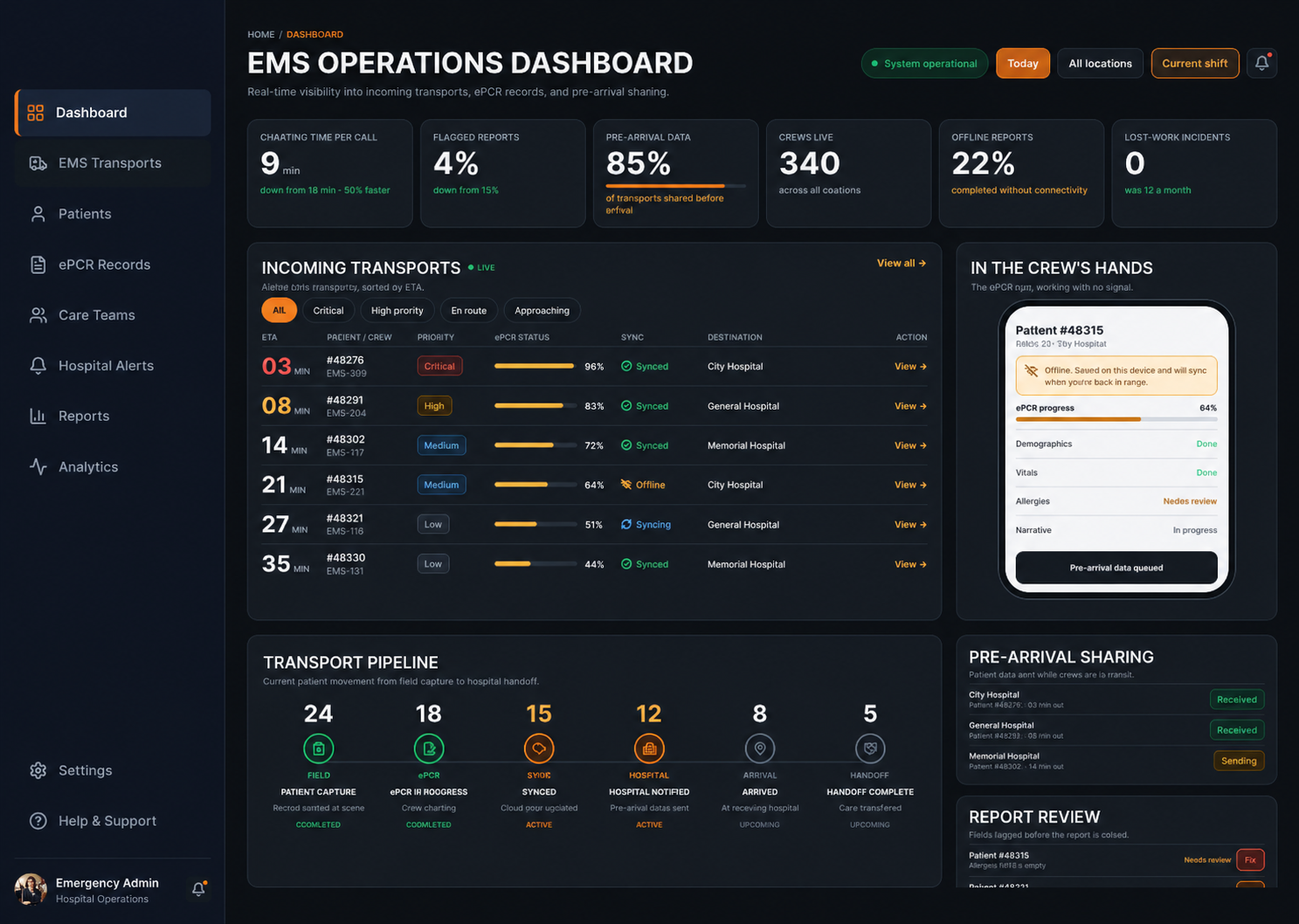
Faster charting per call

Down from 18 minutes to 9 minutes

85%

Transports shared before arrival

Patient data available to hospital staff ahead of the ambulance

0

Lost-work incidents after app close

Down from 12 a month with session recovery

Client name withheld under NDA. To honour our non-disclosure agreement and compliance obligations, we describe this client by industry and region only. The project scope, technology and outcomes are shared without details that could identify them.

About the Client

The client provides electronic patient care technology for emergency medical services. Paramedic and ambulance crews across 340 vehicles recorded patient details, vital signs, treatments, transport data and EKG readings on paper. Paper was slow, error-prone and difficult to share with a receiving hospital before the crew arrived.

Bacancy Technology built an electronic patient care record that crews use on a phone, tablet or computer. It works with no internet, saves locally and syncs when the connection returns. It also sends patient information to the receiving hospital before the ambulance arrives.

Client type
EMS technology provider
Industry
Healthcare (Emergency Medical Services)
Location
United States
Team
6 developers
Timeline
4 months
Project size
Non-disclosable
Engagement
Custom ePCR development

Four gaps in paper-based EMS charting

Crews relied on paper throughout the call, and the gaps showed up at every stage from the scene to the hospital.

Paper records were slow and error-prone

What was happening

Crews wrote by hand while treating patients, and reports were often incomplete or inconsistent.

Business Impact: 15% of reports were flagged as incomplete after the call.

Connections dropped during emergencies

What was happening

Crews needed to keep charting with no signal, but any connectivity-dependent tool left gaps in documentation.

Business Impact: No existing digital tool worked reliably offline during ambulance transit.

Hospitals lacked patient data before arrival

What was happening

Receiving staff learned the details when the crew walked in, leaving no time to prepare resources or specialists.

Business Impact: Emergency departments could not triage or prepare ahead of the patient's arrival.

Report errors and lost work surfaced late

What was happening

Missing or inconsistent fields were found after the call, and unexpected app closes resulted in lost work.

Business Impact: 12 lost-work incidents a month from unexpected app closes.

Challenges & Solutions

Each challenge addressed a specific gap between paper charting and what crews and hospitals needed.

Challenge 1: Crews needed to chart without a connection

Standard cloud-based tools failed when ambulances lost signal in rural areas or during transit. Crews either stopped charting or switched to paper mid-call.

Solution: Our team built an offline-first capture system with automatic save and sync, as in our EMR software development work. Every entry saves on the device and syncs when the connection returns. 22% of reports were completed entirely offline, with no data loss.

Challenge 2: Charting took too long during active treatment

Writing freeform notes while stabilizing a patient slowed both documentation and care. Injuries and burns required detailed location descriptions that took time to type.

Solution: Our engineers built an interactive body diagram that lets paramedics tap a figure to mark injuries or burns on a visual model. Combined with structured input fields for vitals, medications and transport data, charting time fell from 18 to 9 minutes per call.

Challenge 3: Hospitals received patient data only on arrival

Emergency departments learned about incoming patients when the crew walked through the door, leaving no time to prepare specialists, equipment or triage resources.

Solution: Patient information is sent to the receiving hospital automatically while the crew is in transit, through our EHR integration services. 85% of transports had data available to the hospital before arrival, giving staff time to prepare.

Challenge 4: Incomplete reports and lost work after app closes

Paper left gaps, and early digital attempts lost data on unexpected app closes. 15% of reports were flagged as incomplete after the call.

Solution: Our team added a built-in review that flags fields needing fixes before submission, and session recovery that resumes the record where it stopped if the app closes. Flagged or incomplete reports fell from 15% to 4%, and lost-work incidents dropped from 12 a month to zero.

How the Platform Works

The ePCR charting interface showing patient vitals, injury body diagram and offline mode

Core Features

  • Offline-first capture with automatic syncEvery entry saves on the device and syncs when the connection returns, so crews chart with no signal.
  • Interactive body diagramParamedics tap a figure to mark injury and burn locations during the call.
  • Patient vitals, treatments and transport dataStructured fields for all standard ePCR data, including medications administered and transport details.
  • EKG readings and document attachmentsCrews attach EKG recordings and supporting documents directly to the patient record.
  • Pre-arrival hospital sharingPatient information is sent to the receiving hospital before the ambulance arrives.
  • Review flags and session recoveryThe record flags incomplete fields and resumes where it stopped on an unexpected app close.

EMR Command Center

EMR Command Center

The stack behind the ePCR

Frontend
React
Offline mode
On-device storage | Automatic sync
Platform
Integration with the client's existing platform
Device access
Phone | Tablet | Computer

Ready to start?

2500+ projects delivered by Bacancy Technology

Get access to an experienced team of developers and engineers from Bacancy Technology, handpicked to ace your goals. Kickstart within 48 hours, no-risk trial.

Book A 30 Min Call
14+Years of business experience
1458+Happy customers
30+Countries with happy customers
1050+Agile-enabled employees

More Case Studies

View All Case Studies