
Confidential client, name withheld under NDA

Built a Healthcare Demand Forecasting Model on Databricks and Snowflake for a US Hospital Chain

Quick answer: A demand forecasting model on Databricks and Snowflake joins EHR and workforce data and trains thousands of facility forecasts daily, served under role-based access. Bacancy Technology built this for a US hospital chain.

Outcomes deliveredDelivered October 2025 to May 2026 by a team of 4
61%

Higher demand forecast accuracy

Compared with historical averages

47%

Lower overtime and agency staffing spend

Fewer shifts needed emergency cover

Daily

Forecasts for every facility and unit

Replacing monthly manual averaging

50%

Less manual forecasting effort

Automated daily forecasting pipeline

Client name withheld under NDA. To honour our non-disclosure agreement and compliance obligations, we describe this client by industry and region only. The project scope, technology and outcomes are shared without details that could identify them.

About the Client

The client is a US-based hospital chain. It planned beds, staffing and supplies on historical averages of patient demand, and it needed forecasts that matched real demand at each facility.

Those averages missed seasonal surges and differences between facilities, so resources often fell short. Patient data sat in the EHR and staff data in a separate workforce system. Thousands of forecast series exceeded the old reporting tools, and protected health information carried compliance risk.

Bacancy Technology joined Epic and workforce data in Snowflake and built XGBoost demand models that train daily on Databricks, managed through MLflow. Forecasts are served under role-based access and masking. Forecast accuracy improved by 61%, and overtime and agency staffing spend fell by 47%.

Client type
Hospital chain
Industry
Healthcare
Location
USA
Team
4 resources
Timeline
October 2025 to May 2026
Project size
Non-disclosable
Engagement
Data engineering and ML forecasting

Four problems behind mismatched hospital capacity

Split data, average-based planning and tools that could not scale left each facility planning beds and staff without real demand signals.

No combined patient record

What was happening

Visits and admissions sat in the EHR, and staff schedules sat in the workforce system.

Business Impact: There was no single history to build a forecast on.

Planning on averages

What was happening

Historical averages missed seasonal changes and differences between facilities.

Business Impact: Beds, staff and supplies often did not match the patients who arrived.

Thousands of forecast series

What was happening

Each facility, unit and service line needed its own forecast, beyond what reporting tools could handle.

Business Impact: Teams planned at a broad level without unit-level detail.

Protected data in reports

What was happening

Forecast inputs held protected health information that reached dashboards and reports.

Business Impact: Wrong exposure carried compliance risk across every facility.

Challenges & Solutions

Our data and ML engineers solved each problem as one step in a single forecasting pipeline.

Challenge 1: Joining EHR and workforce data into one source

Patient activity lived in the EHR and staff schedules in the workforce system, with no combined record.

Solution: Bacancy Technology's healthcare data analytics team built Fivetran pipelines into Snowflake. Visit, admission and appointment data from Epic was joined with UKG staff schedules and hours, giving the chain one history to forecast from.

Challenge 2: Replacing historical averages with ML forecasts

Average-based plans did not reflect seasonal surges or differences between facilities.

Solution: Our Databricks developers built XGBoost models that learn from weekly patterns, holidays, seasonal surges and each facility's recent history. Planned beds, staff and supplies now match real demand.

Challenge 3: Scaling to thousands of forecasts a day

Forecasts were needed for every facility, unit and service line, beyond what existing tools could process.

Solution: Our team ran model training on Databricks with Spark, training the series in parallel across the cluster. Lakeflow Jobs runs the forecasts daily, and MLflow manages the models and promotes approved ones to production.

Challenge 4: Governing protected health information in forecasts

Forecast outputs carried protected health information, and access rules had to hold across every facility.

Solution: Our Snowflake developers served the forecasts through Snowflake with row access policies, dynamic data masking and role-based access. Each user sees only the data their role allows, under the same rules at every facility.

How the Platform Works

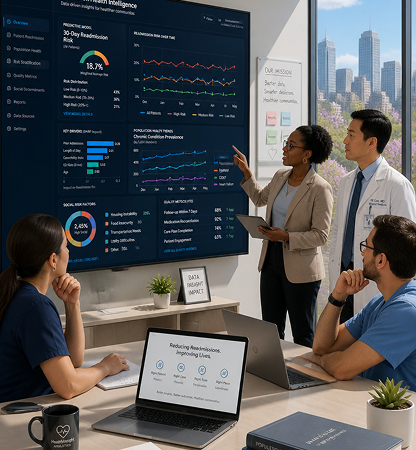
The client demand forecasting dashboard

Core Features

  • Automated Epic and workforce ingestionEpic and UKG data loaded into Snowflake with change data capture.
  • Forecasts per facility and service lineDedicated demand forecasts for every facility, unit and service line.
  • Distributed daily model trainingSpark on Databricks trains thousands of series in parallel every day.
  • Managed model lifecycleMLflow handles retraining and moves approved models into production.
  • Role-based access and maskingRow access policies and dynamic masking protect patient data in reports.

The stack behind the forecasting model

Source systems
Epic (Clarity, Caboodle) | UKG
Ingestion
Fivetran (change data capture)
Cloud data warehouse
Snowflake | Snowflake Connector for Spark
Processing and orchestration
Databricks | Lakeflow Jobs | dbt
AI and ML
XGBoost | MLflow | Python
BI and reporting
Power BI
Security and governance
Snowflake RBAC | Dynamic data masking | Row access policies
Version control and CI/CD
Git | GitHub Actions

Ready to start?

2500+ projects delivered by Bacancy Technology

Get access to an experienced team of developers and engineers from Bacancy Technology, handpicked to ace your goals. Kickstart within 48 hours, no-risk trial.

Book A 30 Min Call
14+Years of business experience
1458+Happy customers
30+Countries with happy customers
1050+Agile-enabled employees

More Case Studies

View All Case Studies