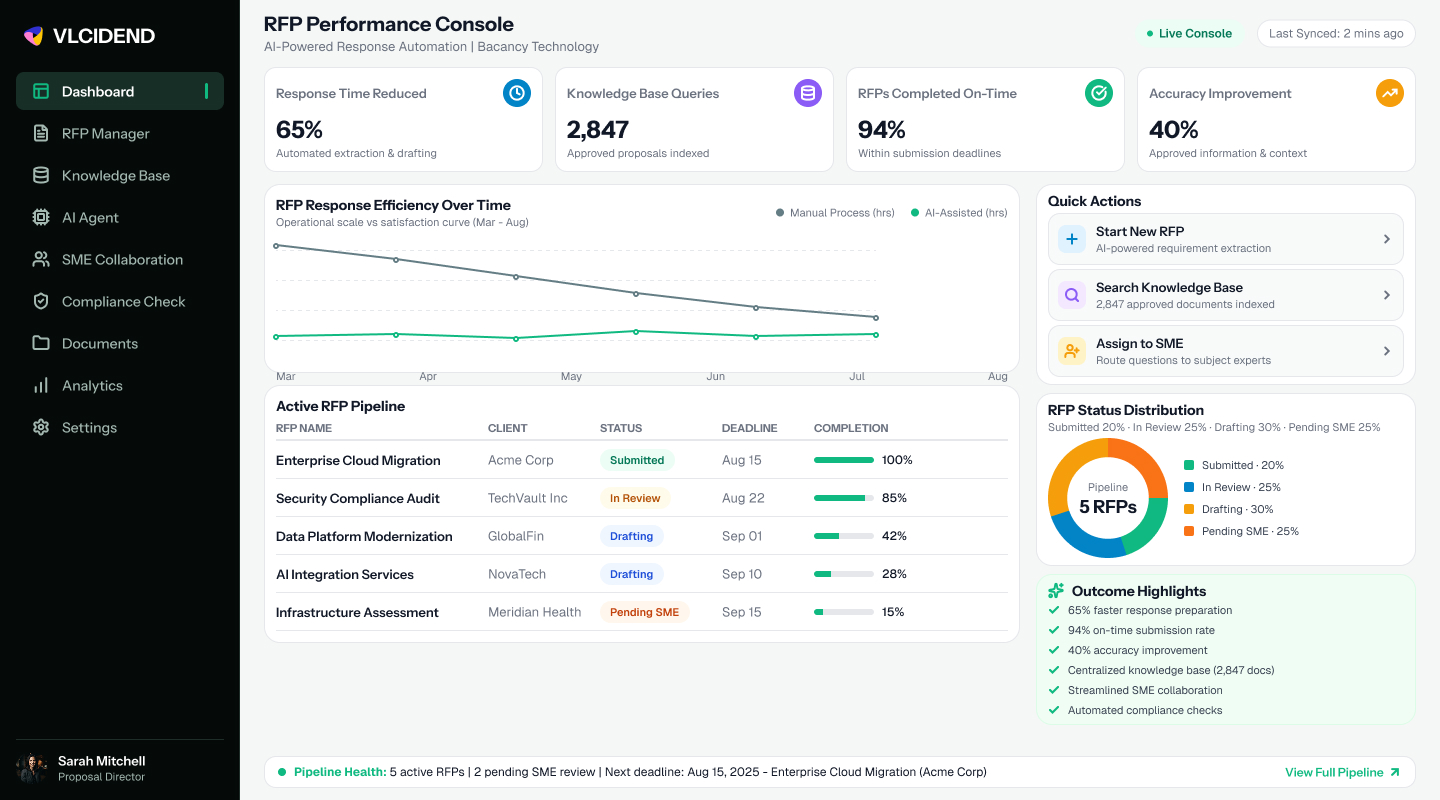
Vlcidend, a technology and consulting company, was handling multiple RFP responses for enterprise customers. Preparing each response required the proposal team to review lengthy RFP documents, understand individual requirements, find relevant information from previous proposals and internal documents, and coordinate with subject matter experts across technical, security, legal, and finance teams. Although Vlcidend had years of proposal content available, there was no centralized way to find and reuse the right information for a new RFP. Teams also spent considerable time writing similar responses, checking whether every requirement was addressed, and reviewing content for accuracy and consistency. With growing RFP volumes and strict submission deadlines, the manual process made response preparation slower and increased the risk of missed requirements and outdated information. Vlcidend needed AI-powered RFP response software that could understand RFP requirements, retrieve relevant knowledge, generate response drafts, streamline SME collaboration, and validate the final response before submission, so they turned to Bacancy Technology to design and build it.
Automated extraction of RFP requirements, deadlines, evaluation criteria, and submission instructions from lengthy documents
A centralized knowledge base that retrieves relevant content from approved past proposals and internal sources for every new question
AI-generated response drafts built from retrieved company knowledge, with SME input and review built into the same workflow
Automated validation that checks a completed response against the original RFP requirements before submission
The proposal team manually reviewed lengthy RFP documents to identify requirements, questions, deadlines, evaluation criteria, and submission instructions. Extracting and organizing this information for every new RFP consumed valuable time and delayed the start of response preparation.
Vlcidend had useful information spread across previous RFP responses, proposals, case studies, product documents, and internal knowledge bases, yet the team had to search these sources manually to find relevant answers, often rewriting information that had already been approved and used in earlier proposals.
Many RFP questions required input from technical, security, legal, finance, and other subject matter experts. Proposal managers had to identify the right expert, share the question, track pending responses, and follow up manually, which made collaboration difficult whenever submission deadlines were tight.
Before submission, every response needed to be checked for unanswered requirements, inconsistent information, outdated content, missing attachments, and compliance with customer instructions. Reviewing these details manually across a large proposal increased the risk of errors reaching the final submission.
Our developers with generative AI development expertise built software that automatically analyzes an incoming RFP and extracts its questions, requirements, deadlines, evaluation criteria, and submission instructions, organizing all of it into a structured response workspace. This gives the proposal team a clear view of what needs to be addressed, what information is required, and which requirements need to be tracked from the very first read.
Our RAG development team connected Vlcidend’s approved previous proposals, RFP responses, case studies, product documents, and internal knowledge sources into a centralized knowledge base, so the system retrieves relevant information for each RFP question and lets teams reuse approved content instead of searching through multiple documents by hand, while keeping relevant information organized and accessible throughout the proposal process.
We built an AI response generation layer that drafts each RFP answer from the relevant retrieved company knowledge and the specific customer’s requirements. Our AI agent developers then built the routing layer that sends individual questions to the right subject matter expert automatically, so proposal managers can collect SME input, edit AI-generated responses, and manage reviews from one centralized workspace.
Before submission, the platform evaluates the completed response against the original RFP requirements and submission instructions, identifying unanswered questions, missing information, outdated content, inconsistencies, and required attachments. It also gives the proposal team a structured way to review flagged issues, make final updates, and move the completed response through the required approval workflow before submission.
Intelligent RFP parsing that extracts requirements, questions, deadlines, evaluation criteria, and submission instructions from lengthy documents
AI knowledge retrieval that searches approved past proposals, RFP responses, case studies, and internal knowledge bases for relevant content
AI-powered response generation that creates customer-specific drafts while proposal teams review and edit every response
SME collaboration and approval tools that assign questions, track expert input, manage revisions, and support centralized approvals
03
Jan-May 2026
40% faster RFP response preparation
2x faster SME response coordination
60% less manual content searching
30% less repetitive response writing
2 hours saved per RFP through automated extraction
100% centralized response review and validation
| Programming Language | Python |
| Workflow Orchestration | LangGraph |
| Language Model | GPT-4 |
| Vector Database | Pinecone |
| Relational Database | PostgreSQL |
| Deployment | AWS |
Get access to an experienced team of developers and engineers from Bacancy, handpicked to ace your goals. Kickstart within 48 hours, no-risk trial.
Years of Business Experience
Happy Customers
Countries with Happy Customers
Agile Enabled Employees