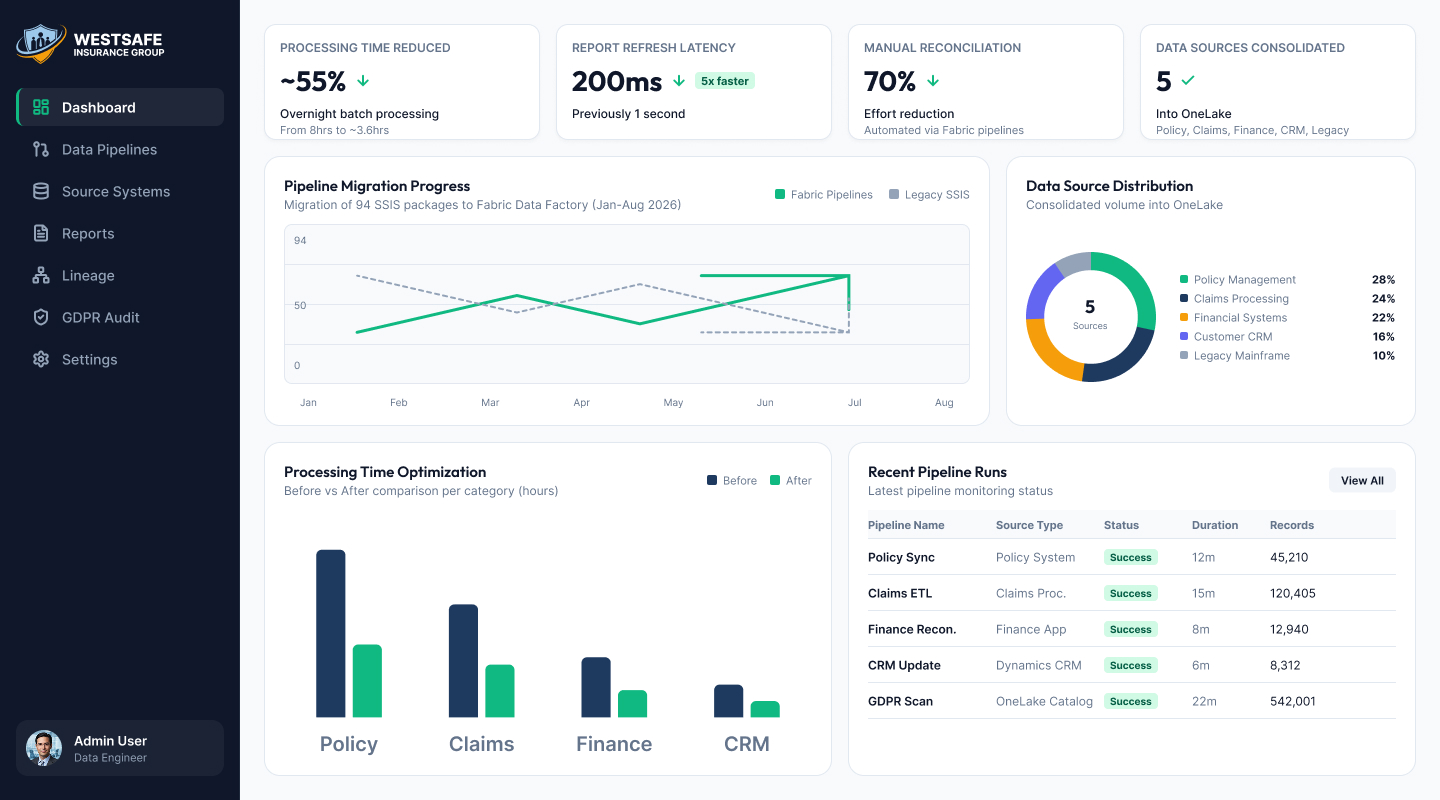
WestSafe Insurance Group is an EU-based insurer running policy, claims, finance, and customer operations on separate systems. An on-premises SQL Server ran SSIS packages overnight that pulled data from those systems for reporting. Growing data volumes made the batch run even longer, and reports arrived a day late. Bacancy Technology modernized the client’s data management environment with Microsoft Fabric and Azure, replacing 94 legacy SSIS packages with Fabric Data Factory pipelines and bringing data from five source types into OneLake. We also implemented governed data layers, centralized lineage, and Power BI reporting to give teams faster access to trusted data. The modernization reduced nightly processing time by approximately 55%, cut manual reconciliation effort by 70%, and made reporting data available at the start of the business day.
Legacy SSIS workflows redesigned for Microsoft Fabric
Five source types connected through Fabric Data Factory
Data processing and transformation implemented across OneLake
Azure-native governance for identity, secrets, lineage, & EU residency
SSIS packages processed policy, claims, finance, and customer data overnight. The packages ran on a fixed nightly schedule. They loaded sources turn by turn, then built the reporting tables from the combined data. Data volumes grew, new sources were added, and the load was still running in morning, holding up the reports analysts needed to start work.
The data came from five kinds of sources. Policy and claims records lived in SQL Server, finance data in a SAP-based ERP, and customer and broker data in Salesforce. Third-party feeds came over REST APIs, and external providers sent CSV and Excel files. SSIS handled the database sources, but the API and file-based sources required custom components.
Reporting numbers could not be traced back to source. The client held contractual GDPR and data residency obligations, and SSIS produced no lineage, so answering a question about a figure meant working back through the transformation manually. Classification of personal data depended on dev knowledge rather than anything recorded in platform.
The on-premises platform had reached its capacity limit. SQL Server could not scale further, so every new source competed for the same fixed compute. The developers who wrote the SSIS packages had left, and 94 packages held logic nobody had documented, so a change to one package could break the loads that depended on it.
Bacancy Technology’s data engineers assessed all 94 SSIS packages, identified the workloads that were still in active use, and redesigned them as Fabric Data Factory pipelines rather than lifting the packages onto an integration runtime. We scheduled each pipeline against the reports it fed, so the loads ran separately instead of in one single queue for overnight load.
Our Microsoft Fabric experts connected each source with its matching Fabric connector, using database connectors for SQL Server and the SAP-based ERP, the Salesforce connector for CRM data, REST connectors for third-party feeds, and file connectors for the CSV and Excel datasets. Our Insurance IT experts ensured that policy, claims, finance, customer, and broker data retained its business context.
We built the governance layer on Microsoft Purview. Our data governance team catalogued the integrated data, classified personal data at column level, and mapped lineage from each Power BI report back to its source system. We configured access through Microsoft Entra ID, moved the connection credentials into Azure Key Vault, and deployed the platform in an Azure EU region to meet the residency requirement.
Our data migration team moved processing to Fabric capacity and structured the data in Bronze, Silver, and Gold layers in OneLake. We cleaned, standardized, deduplicated, and validated the data in Silver before applying the required transformations in Gold. We then served the Gold datasets through Fabric Warehouse and connected Power BI through Direct Lake for reporting.
Column-level classification of personal data across all integrated sources
Native Fabric connectors for database, API, and file-based sources
Report-level lineage from Power BI back to source system
Fabric capacity monitoring for pipeline scheduling & query performance
04
June 2025 – January 2026
Overnight data processing time reduced by approximately 55%
Reporting data made available at the start of the business day
5 Data source types consolidated into OneLake
Report refresh latency down from 1s to 200 ms
Manual reconciliation effort brought down by 70%
Lineage traceable from report to source system for GDPR audit
| Source systems | SAP-based ERPSalesforceREST APIsCSV/Excel |
| Legacy platforms | SQL ServerSSIS |
| Cloud platforms | Microsoft FabricMicrosoft Azure |
| Data ingestion & orchestration | Fabric Data Factory |
| Storage | OneLake |
| Data architecture | Medallion (Bronze, Silver, Gold) |
| Serving layer | Fabric Warehouse |
| BI/reporting | Power BI |
| Data governance | Microsoft Purview |
| IAM | Microsoft Entra ID |
| Secrets management | Azure Key Vault |
| Capacity | Fabric Capacity |
Get access to an experienced team of developers and engineers from Bacancy, handpicked to ace your goals. Kickstart within 48 hours, no-risk trial.
Years of Business Experience
Happy Customers
Countries with Happy Customers
Agile Enabled Employees