
AI-Powered Cardiac Remote Monitoring System for CardiacData Analytics

Quick answer: An AI cardiac remote patient monitoring system ingests wearable data in real time, predicts cardiovascular risk and alerts care teams to abnormal vitals. Bacancy Technology built this for CardiacData Analytics, a US healthcare client.

Outcomes deliveredDelivered November 2025 to February 2026 by a team of 6
45%

Faster emergency response

Real-time alerts on abnormal vitals

60%

Faster clinical decision-making

Real-time AI insights for clinicians

50%

Higher patient engagement

Including monitoring adherence

1,000+

Active patients supported at once

Cloud-native AWS architecture

About the Client

CardiacData Analytics is a US healthcare client focused on cardiovascular care. It needed a remote patient monitoring system that combines data from many wearables. The system had to track patient health in real time and flag risk early. Patient data privacy and growing data volumes had to be handled from day 1.

Bacancy Technology built an AI-based monitoring platform with standardized wearable data pipelines and an event-driven architecture. Emergency response time fell by 45%, and the system supports 1,000+ active patients at once.

Industry
Healthcare
Location
United States
Team
6 team members
Timeline
November 2025 to February 2026
Project size
Non-disclosable

Challenges & Solutions

Our AI and AWS engineers built each layer of the monitoring platform around real-time patient data.

Challenge 1: Integrating wearables with inconsistent data formats

Multiple wearable devices sent data in inconsistent formats.

Solution: Our engineers built standardized ingestion pipelines for each wearable device. Data now arrives in one consistent, reliable format.

Challenge 2: Protecting patient data across systems

The platform had to meet strict healthcare data privacy requirements across patient systems.

Solution: Our AI developers deployed a compliance engine that detects policy violations, classifies sensitive data and enforces access controls automatically.

Challenge 3: Processing vitals in real time without lag

Critical healthcare scenarios needed real-time data processing without latency.

Solution: Our team built the monitoring system on an event-driven architecture with WebSockets. Abnormal vitals trigger alerts with minimal delay.

Challenge 4: Scaling for more patients and more data

The architecture had to scale with growing data volumes and user numbers.

Solution: Our AWS experts built a cloud-native microservices architecture on AWS. It supports 1,000+ active patients at the same time.

How the Platform Works

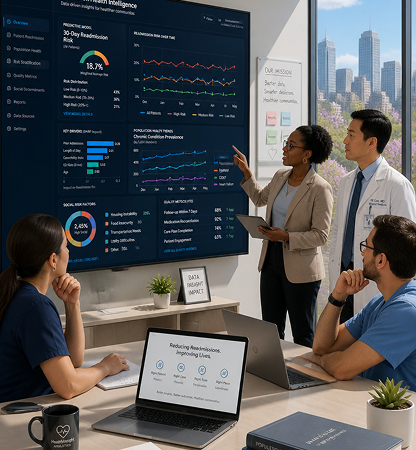
CardiacData Analytics cardiac remote monitoring dashboard

Core Features

  • Real-time patient monitoring dashboardCare teams see live cardiovascular data for every patient.
  • AI cardiovascular risk predictionPredictive models flag patients at higher risk.
  • Automated abnormal vitals alertsClinicians are alerted as soon as vitals go out of range.
  • Secure wearable data integrationStandardized pipelines bring in data from multiple devices.
  • Automated privacy controlsSensitive data classified and access enforced by a compliance engine.

The stack behind the platform

Frontend
React | React Native
Backend
Node.js | Express.js
AI and ML
OpenAI | LangChain
Database
PostgreSQL | MongoDB
In-memory data store
Redis | Memcached
Cloud and DevOps
AWS S3 | AWS EC2
Architecture
Microservices | Event-driven
API communication
REST APIs | WebSockets

Ready to start?

2500+ projects delivered by Bacancy Technology

Get access to an experienced team of developers and engineers from Bacancy Technology, handpicked to ace your goals. Kickstart within 48 hours, no-risk trial.

Book A 30 Min Call
14+Years of business experience
1458+Happy customers
30+Countries with happy customers
1050+Agile-enabled employees

More Case Studies

View All Case Studies