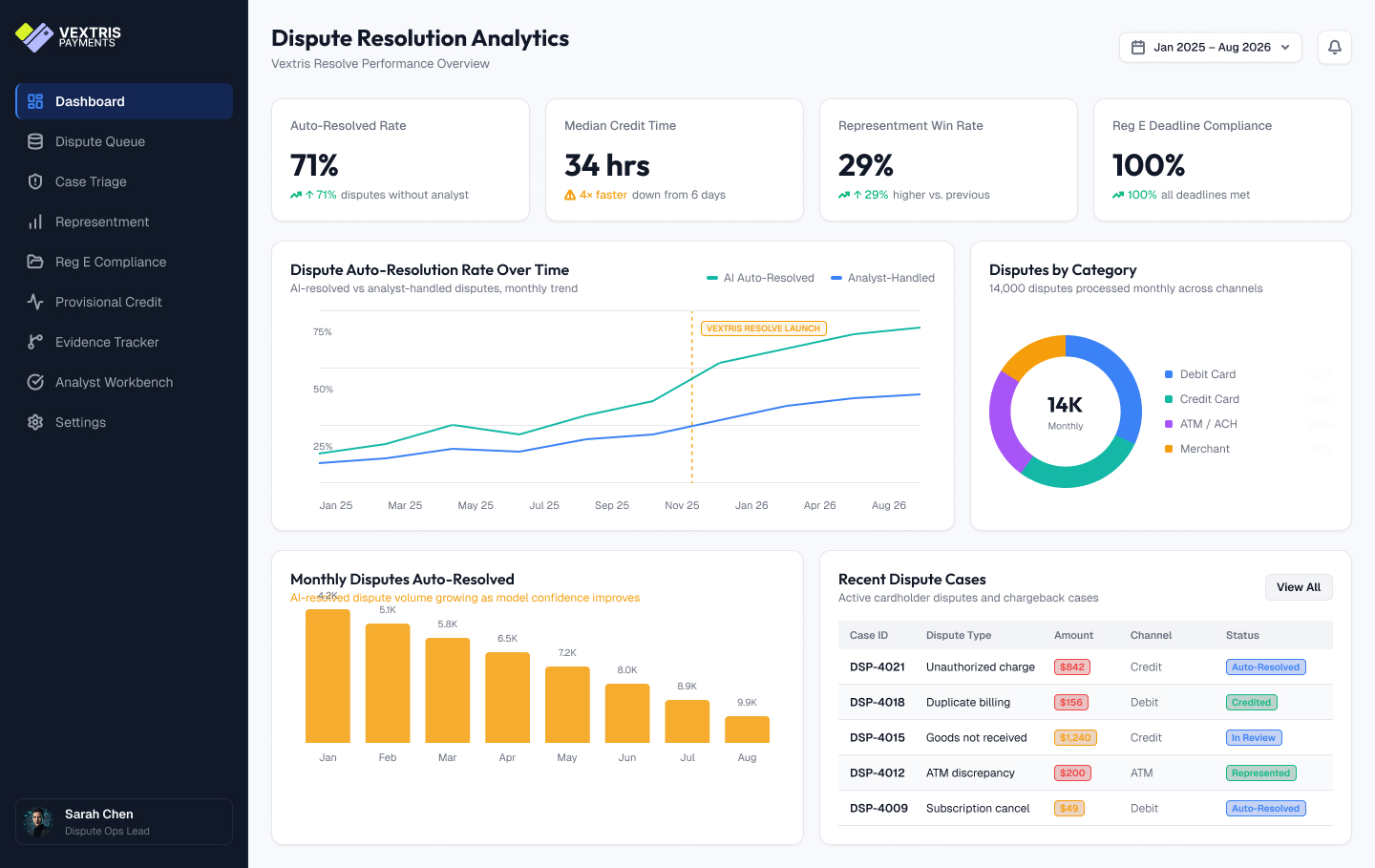
Vextris Payments issues debit and credit products to 1.9 million US cardholders and processes roughly 2.8 million transactions a month. That volume generated about 14,000 disputes a month, and every one of them landed with a team of 26 analysts working spreadsheets, processor portals, and email threads. Provisional credit took a median of 6 days against a regulatory clock of 10, analysts missed network representation deadlines often enough to write off recoverable losses, and the dispute team grew in direct proportion to the cardholder base. Vextris had a dispute operation and a compliance function, but no product and no AI engineering team. They came to Bacancy Technology with a cost line and a deadline risk, not a specification. We ran the product discovery with their dispute and compliance leads, defined the decision rules and evidence standards, built the system, tested it in shadow mode against a year of closed disputes, and launched it across the full dispute flow. The result is Vextris Resolve, a dispute and chargeback resolution product Vextris owns outright, with no per-dispute vendor fee attached to growth.
Full product ownership from discovery through launch, covering product definition, dispute workflow design, architecture, engineering, QA, and phased release.
A working MVP in 11 weeks, validated in shadow mode against a year of closed disputes before touching a live cardholder.
An evidence assembly engine that builds a network-ready representation packet automatically from transaction, device, session, and merchant data.
A deadline orchestration layer built on Temporal that holds every regulatory and network clock per dispute and escalates before a deadline passes.
Analysts handled every dispute by hand, from copying details into spreadsheets to searching four systems for evidence. The only way to take on more volume was to hire more people.
Regulation E gives banks 10 business days to put the money back in a customer's account. Vextris averaged 6, and missing that deadline means eating the loss and explaining it to an examiner.
One representation packet took an analyst 40 minutes to put together. Plenty of cases were worth fighting, but the deadline passed before anyone got to them.
Someone disputing a charge they actually made looks the same as a real fraud victim on day one. Vextris credited both, and the avoidable losses landed on its own books.
We ran product discovery with dispute operations and compliance before writing code. Our AI product development team observed 90 live dispute cases end to end, mapped every decision an analyst made, and worked with compliance to define which of them the product could make alone and under what evidence standard. That work produced the specification Vextris did not have and set the auto-resolve thresholds that later survived their regulatory examination.
We built an intake that turns a customer narrative into a structured case. A LangGraph agent reads the cardholder’s own description from chat or the mobile app, classifies it against Visa and Mastercard reason codes, asks only the follow-up questions that specific code requires, and opens a structured case file. Cardholders now finish intake in about two minutes instead of a phone queue, and analysts stop rekeying.
We automated evidence assembly and representation. The product pulls transaction detail, device fingerprints, session and geolocation history, prior merchant relationship, and delivery confirmation through direct integrations, then assembles a network-ready representation packet. What consumed 40 analyst minutes now completes in seconds, so cases get challenged on merit rather than on whoever had time.
We scored first-party fraud and put every clock under orchestration. An XGBoost model scores first-party fraud risk from behavioral history, prior dispute patterns, device consistency, and merchant relationship, with SHAP factors attached so an analyst sees the reasoning. Temporal workflows hold each Regulation E and network deadline per dispute and escalate ahead of expiry. Every automated decision stores its evidence, scores, and reasoning as an examiner-ready record.
Conversational intake that picks the reason code from the cardholder's own words and asks only what that code needs.
Automated evidence assembly that builds a network-ready representation packet in seconds.
First-party fraud scoring with ranked risk factors and configurable credit rules.
Deadline tracking that holds every Regulation E and network clock, with a full decision record per case.
07
January 2026 to August 2026
71% of disputes resolved without an analyst
4X faster provisional credit, 6 days to 34 hours
29% higher representment win rate
100% of Regulation E deadlines met
11 weeks from kickoff to working MVP
0 per-dispute fees on a client-owned product
| Frontend | Next.js, TypeScript |
| Backend | Python, FastAPI, Apache Kafka |
| AI Orchestration | LangGraph, GPT-4o |
| Fraud Modeling | XGBoost, SHAP |
| Workflow & Deadlines | Temporal |
| Database | PostgreSQL, Redis |
| Cloud & Deployment | AWS, Docker, Kubernetes |
Get access to an experienced team of developers and engineers from Bacancy, handpicked to ace your goals. Kickstart within 48 hours, no-risk trial.
Years of Business Experience
Happy Customers
Countries with Happy Customers
Agile Enabled Employees