Overview

Corvane Specialty Care is a US multi-specialty healthcare group that provides orthopedic, cardiology, and pain management care. The group operates 14 clinics and serves more than 120,000 patients every year. Prior authorizations had become a costly bottleneck, as coordinators copied patient data from Epic into payer portals by hand, and missing documents led to frequent denials. Corvane first worked with a third-party vendor that built a tool from a requirements document, handed it over, and moved on. The tool never matched real clinic workflows, and staff abandoned it within three months. Corvane contacted Bacancy Technology and hired forward-deployed engineers who embedded with its coordinators, billing leads, and compliance team and took full ownership of the outcome. They rebuilt the solution around how the clinics actually work, integrated it deeply with Epic, and stayed on site until every clinic adopted it. The system went live across all 14 clinics in 12 weeks and cut average turnaround from five days to a day and a half.

Technologies Used

Python
Node.js
Anthropic Claude
Epic FHIR APIs
PostgreSQL
React.js

Project Highlights

checkmark

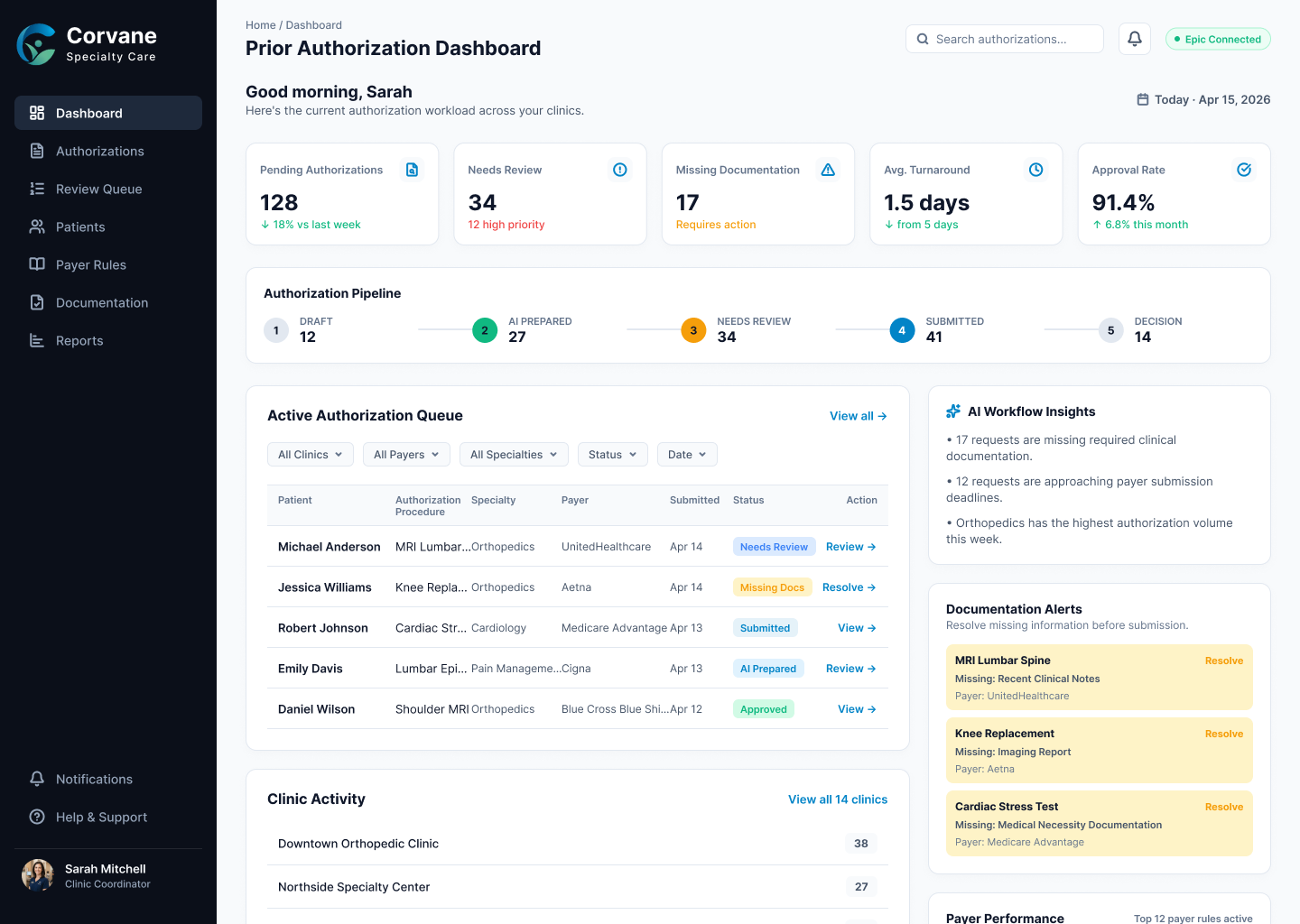
Built an AI agent that gathers patient chart data from Epic and drafts payer-ready prior authorization requests

checkmark

Developed a payer rules layer that covers requirements for the top 12 insurance payers

checkmark

Created a missing documentation check that automatically flags gaps before submission

checkmark

Designed a coordinator review workspace with clinic staff for quick approval, edits, and status tracking

The Challenges

1

Coordinators spent 25 to 40 minutes on each prior authorization. They copied diagnosis codes, clinical notes, and imaging reports from Epic into separate payer portals, and the growing backlog stretched average turnaround to five days.

2

Missing clinical documentation caused a large share of denials. Coordinators often learned about the gap only after a payer rejected the request, which meant resubmissions, delays, and rescheduled procedures.

3

The previous AI team worked remotely from a requirements document, never setting foot in the clinics. They missed payer rules buried in coordinator notes, and their rigid tool didn't match daily clinic routines.

4

The previous team delivered the tool and exited the project, leaving no one accountable for adoption. With manual Epic exports and no staff training, usage dropped to almost zero within three months.

Solutions by Bacancy

1

Our Forward Deployed Engineers started inside the clinics instead of a requirements document. They spent two weeks with front-desk staff, coordinators, and billing leads at two locations and mapped every step from the provider’s order to the payer’s decision. They also documented the rules for the top 12 payers, such as Medicare Advantage plans, Medicaid managed care, and major commercial insurers, and turned them into a rules layer that billing leads can update on their own.

2

The AI agent now pulls ICD-10 codes, CPT codes, clinical notes, lab results, and imaging reports from Epic in real time, through a FHIR API connection our FDEs built and owned end-to-end. With that data in hand, it drafts a payer-ready request with a clear medical necessity statement and checks it against payer criteria before submission. If a document is missing, the care team gets an alert right inside Epic, so gaps are fixed before the payer ever sees the request.

3

Corvane’s compliance team approved the system before rollout, something the previous project never achieved. That approval came from working side by side with Corvane’s compliance and IT teams from week one onward, catching concerns early rather than surfacing them after launch. The agent follows HIPAA’s minimum necessary standard and accesses only the PHI each request requires, runs on BAA-covered Azure hosting, and logs every data access event for audit, giving the compliance team a clear trail to review at any time.

4

Rollout started small, with a pilot at one orthopedic clinic, so the workflow could be tested on real prior authorization cases before reaching other locations. Coordinators helped co-design the review workspace, and their daily feedback shaped how it evolved. As the system expanded, our FDEs trained staff on-site at every location, then stayed on after go-live with weekly reviews to update payer rules and resolve issues fast.

Core Features

checkmark

Real-time chart data retrieval from Epic through FHIR APIs

checkmark

Payer-specific rule checks with missing documentation alerts

checkmark

AI-drafted prior authorization requests ready for coordinator review

checkmark

Status tracking across all pending authorizations

No. of Resource

03

No. of Resource

Time Frame

February 2026 – April 2026

Time Frame

Project Snapshot

Corvane Specialty Care-dashboard

Outcomes

70% less manual prior authorization work

1.5 Day average turnaround, down from 5

40% fewer documentation-related denials

95% coordinator adoption in first month

Live across all 14 clinics in 12 weeks

100% HIPAA-aligned data handling

Technical Stack

Frontend React.js, TypeScript
Backend Python 3.11, Node.js
Integration Epic FHIR APIs, HL7, Payer Portal Automation
Database PostgreSQL, Redis
Cloud Microsoft Azure (HIPAA-eligible services)
Containerization Docker, Azure Kubernetes Service
Security BAA-Covered Hosting, PHI Encryption, Role-Based Access, Audit Logging

Experience With Bacancy

2500+ Projects Experienced Innovation with Bacancy!

Get access to an experienced team of developers and engineers from Bacancy, handpicked to ace your goals. Kickstart within 48 hours, no-risk trial.

Book a 30 min call

14+

Years of Business Experience

1458+

Happy Customers

12+

Countries with Happy Customers

1050+

Agile Enabled Employees