Quick Summary
This blog explains what RegTech is, how it works, and how fintech companies use it to manage regulatory compliance. It covers key use cases such as AML, KYC, transaction monitoring, fraud detection, risk management, and regulatory reporting. You will also learn how AI, automation, analytics, and system integrations power RegTech solutions and help reduce manual compliance work.
Table of Contents
Introduction
It becomes difficult for fintech businesses to keep up with regulatory requirements, especially after it expands across products, customers, and markets. For more transactions mean more data to review, compliance checks to manage, and regulatory changes to track.
As a fintech founder and CTO, the challenge is not simply meeting compliance requirements. It is building compliance processes that can keep pace with the business without adding unnecessary manual work.
This is where a RegTech can make a difference. RegTech offers technology solutions that can make your compliance workflow easier and better, which include automated compliance checks, regulatory monitoring, risk detection, and reporting.
According to FortuneBusinessInsight, the global RegTech market was valued at $19.06 billion in 2025 and will reach $105.23 billion by 2034, with a CAGR of 20.00% during the forecast period.
So, what is RegTech, how does it work, and where does it fit into fintech? This guide breaks it down.
What is RegTech?
RegTech (Regulatory Technology) is a technology used to help financial companies manage compliance, monitor risk, and meet regulatory requirements more efficiently. It replaces manual compliance work with automated tools built on data analytics, AI, and other digital technologies.
Its common use cases include identity verification, KYC, AML and transaction monitoring, fraud detection, and regulatory reporting. These tools process large volumes of data, flag potential risks, maintain audit trails, and adapt as regulations change.
RegTech is generally considered a subset of FinTech focused on regulatory compliance and risk management.
How Does RegTech Work in 2026?
RegTech works by connecting regulatory requirements with a company’s data, compliance processes, and systems. It collects relevant information, checks the information against regulatory rules, identifies potential compliance risks, and automates the next steps.
In 2026, RegTech platforms can combine AI, machine learning, analytics, APIs, and automation to manage large volumes of compliance activities with less manual effort. For instance, when customer and transaction data are checked against rules, detect unusual activity, create an alert, and send it to the compliance team for review.
The process usually involves 6 steps:
1. Collect Regulatory and Business Data
First, RegTech gathers the information required to perform compliance checks. It can include customer profiles, transaction data, identity information, risk profiles, sanctions lists, regulatory documents, risk information, and internal policies.
The system can also connect with your existing banking, payment, CRM, KYC, and other business systems through APIs and integration. Hence, you do not need to collect data manually from different systems.
2. Monitor Regulatory Requirements
Next, RegTech helps you keep track of the rules that apply to your business. It changes frequently, especially for fintech companies operating across multiple markets. As regulatory requirements change, the system can monitor relevant updates and connect them with your existing policies, controls, and compliance processes.
For instance, if a new requirement changes how customer information must be collected or reported, the system can help map that change to the relevant compliance workflow.
3. Analyze and Identify Compliance Risks
Once the relevant data is available, RegTech analyzes it to identify potential compliance risks.
It can use predefined rules, risk indicators, analytics, and AI or machine learning models to spot unusual activity. For instance, if a customer’s transaction behavior suddenly changes, the system can flag it for further review.
4. Automate Compliance Tasks
After identifying a compliance requirement or potential risk, RegTech can automate the related task. It can include KYC verification, sanctions screening, risk scoring, document checks, case creation, and data validation.
For instance, instead of sending every case through the same manual process, the system can handle routine checks automatically and send exceptions to the compliance team.
5. Generate Reports and Alerts
When the system detects a potential issue, it can generate an alert and route it to the appropriate team for investigation. RegTech can also collect and organize information required for regulatory reports.
It helps compliance teams spend less time gathering information and more time reviewing cases that require human attention.
6. Maintain an Audit Trail
RegTech keeps a record of compliance activities throughout the process. It can capture alerts, investigations, approvals, reports, decisions, and workflow changes.
It creates a clear history of what was checked, what action was taken, and when it happened, giving compliance teams the records they need for audits and regulatory reviews.
What are the Core Categories of RegTech Solutions?
RegTech is a range of technologies that help financial companies handle regulatory compliance, financial risk, cybersecurity, and financial crime. To understand what RegTech solutions do, it helps to group them by the type of problem they solve.
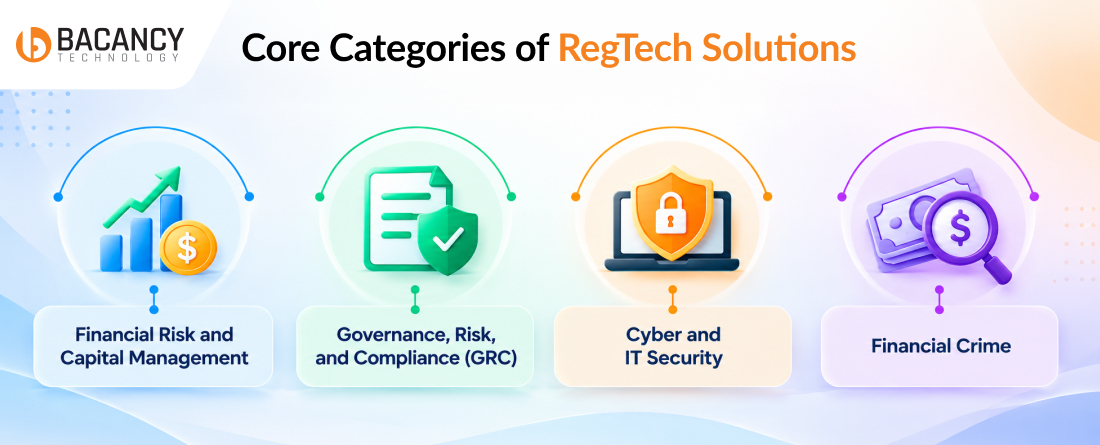
Financial Risk and Capital Management
This category focuses on helping financial companies understand and manage financial risk and capital requirements.
For instance, a bank may need to monitor its capital position, assess credit or market risk, or calculate information required for regulatory reporting. RegTech can bring the relevant data together, perform calculations, monitor risk indicators, and help teams prepare required reports.
In simple terms, these solutions help answer: “Are we meeting our financial risk and capital requirements?”
Governance, Risk, and Compliance (GRC)
GRC solutions focus on the broader question of whether a business is following the rules and managing its risks properly.
They can help teams manage regulations, internal policies, compliance controls, risk assessments, approvals, and supporting evidence from one place. For instance, when a regulatory requirement changes, a GRC platform can help identify the affected policy or control and assign the required action.
In other words, GRC RegTech helps answer: “What requirements apply to us, how are we meeting them, and can we prove it?”
Cyber and IT Security
This category focuses on the security of the technology, systems, and data that financial companies rely on.
RegTech solutions can help monitor security controls, access permissions, vulnerabilities, incidents, and technology-related compliance requirements. They can also collect evidence that security controls are operating as required.
The goal is to help answer: “Are our systems and data protected, and are we meeting the required security standards?”
Secure your financial technology with stronger controls
Our financial services cybersecurity helps you manage access permissions, monitor vulnerabilities, track security incidents, and maintain compliance across critical financial systems.
Financial Crime
Financial crime RegTech focuses on detecting and preventing activities, such as money laundering, fraud, sanctions violations, and other suspicious financial activity.
These solutions can monitor transactions, screen customers against sanctions lists, perform KYC checks, assess customer risk, and flag unusual activity for investigation.
In simple terms, financial crime RegTech helps answer: “Is there anything in our customer or transaction activity that could indicate financial crime?”
7 Must-Know Use Cases of RegTech
RegTech can support compliance across almost every stage of a financial business, from onboarding a customer to monitoring transactions and preparing regulatory reports. The exact use case depends on the company’s products, markets, and regulatory requirements. Here are seven common ways financial companies use RegTech.
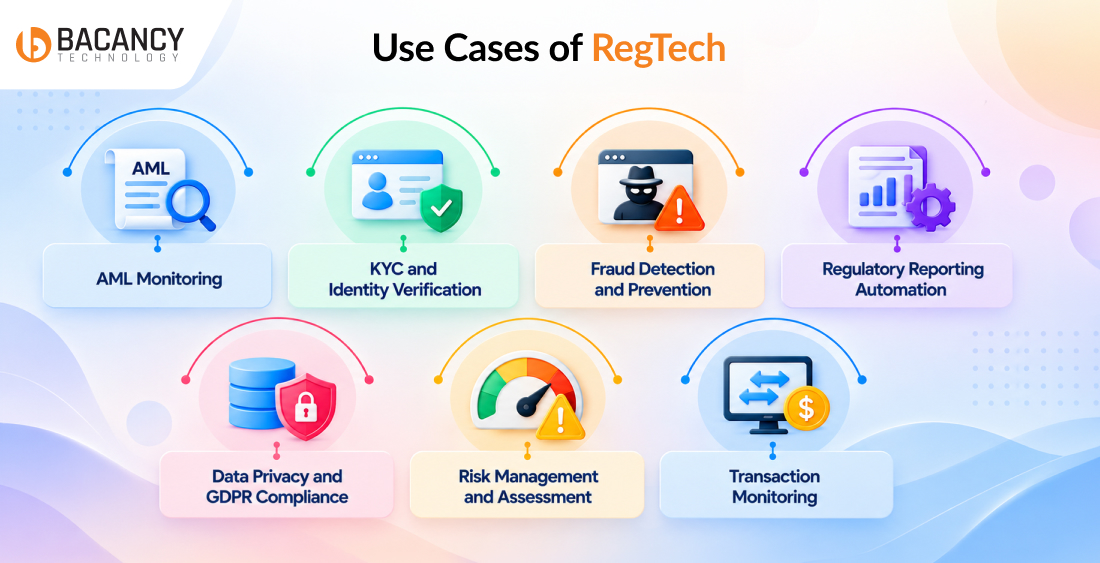
🡲 Anti-Money Laundering (AML) Monitoring
RegTech helps financial companies identify activities that may indicate money laundering. It can combine customer information, transaction history, risk profiles, and other data to detect suspicious patterns.
For instance, an AML transaction monitoring system can flag unusual activity based on predefined rules or risk indicators and send the case to a compliance team for investigation.
🡲 Know Your Customer (KYC) and Identity Verification
KYC requires financial companies to verify who their customers are before and during the business relationship. RegTech can automate much of this process.
It can verify identity documents, validate customer information, perform sanctions or watchlist checks, and assign customer risk levels. It helps to make your customer onboarding more consistent while reducing manual verification work.
🡲 Fraud Detection and Prevention
RegTech can analyze customer and transaction behavior to identify activity that may indicate fraud.
For instance, a system can look at transaction patterns, account behavior, device information, location, and other signals. If the activity differs significantly from expected behavior, it can trigger an alert for further review.
🡲 Regulatory Reporting Automation
Financial companies often need to submit reports containing large amounts of structured data to regulators. Collecting and validating this information manually can take considerable time.
RegTech can connect to business systems, collect the required data, validate it, apply reporting rules, and prepare reports in the required format. It makes your reporting process more structured and reduces repetitive manual work.
🡲 Data Privacy and GDPR Compliance
RegTech can help organizations manage requirements related to customer and personal data.
For instance, it can help identify sensitive data, monitor access, manage consent records, track data-related requests, and maintain evidence of privacy controls. This is particularly useful for fintech companies that handle customer information across different systems and jurisdictions.
🡲 Risk Management and Assessment
RegTech can bring together data from different parts of a financial business to help teams identify and assess risks.
It can monitor risk indicators, assign risk scores, compare current activity with predefined thresholds, and alert teams when risk levels change. This gives compliance and risk teams a more structured way to monitor operational, financial, and regulatory risks.
🡲 Transaction Monitoring
Transaction monitoring involves continuously reviewing financial transactions to identify activity that may require investigation.
RegTech lets you analyze transaction amount, frequency, location, customer behavior, and other factors to identify unusual patterns. Its rule-based systems can flag predefined scenarios, while analytics and machine learning can help identify more complex patterns across large transaction datasets.
What Technologies Power RegTech?
RegTech is not built around one technology. It is a combination of data, automation, AI, and system integrations to make compliance processes easier to manage. The exact technology stack depends on whether the goal is AML monitoring, KYC, fraud detection, reporting, or risk management.
1. Artificial Intelligence and Machine Learning
AI and ML help RegTech systems spot patterns across large amounts of customer and transaction data. They can support risk scoring, anomaly detection, fraud detection, and AML monitoring.
2. Natural Language Processing
NLP helps RegTech systems work with regulatory documents, policies, and compliance updates. It can identify relevant information and help teams track changes without reviewing every document manually.
3. Big Data and Analytics
Financial companies deal with large volumes of customer and transaction data. Big data tools process this information, while analytics helps teams identify risk patterns, unusual activity, and compliance gaps.
4. Cloud Computing
Cloud infrastructure provides the storage and computing power RegTech needs to process compliance data. It also makes it easier to connect systems and support compliance workflows across teams.
5. APIs and System Integration
APIs connect RegTech with existing systems such as banking platforms, payment systems, KYC tools, CRM, and data warehouses. This allows your compliance checks to use existing business data instead of relying on manual transfers.
6. Robotic Process Automation
RPA handles repetitive compliance tasks such as data entry, record validation, document processing, and report preparation. It is useful for routine processes that follow clear, predefined steps.
Need to build a smarter RegTech technology stack?
Combine AI, machine learning, NLP, analytics, cloud, and automation by opting for our fintech AI development services to build connected compliance solutions.
What is RegTech in Fintech?
RegTech in fintech signifies technology that helps you manage regulatory compliance as part of everyday financial operations. Instead of treating compliance as a separate manual process, fintech companies can build tools for KYC, AML, fraud detection, transaction monitoring, risk assessment, and reporting directly into their technology environment.
RegTech's Role in Fintech
Fintech companies handle large amounts of customer and transaction data while dealing with regulatory requirements that can vary by product and market. RegTech helps connect these requirements with the systems already used to run the business.
For instance, a digital payments company can use RegTech to verify customers, screen transactions, identify unusual activity, and maintain compliance records within its existing workflow.
Key Compliance Applications
RegTech can support several areas of fintech compliance, including:
- KYC and identity verification during customer onboarding
- AML and transaction monitoring to identify suspicious activity
- Fraud detection across customer and payment activity
- Sanctions screening against relevant watchlists
- Regulatory reporting and compliance documentation
- Risk assessment based on customer and transaction data
- Data privacy and related compliance requirements
Why Do Fintech Companies Use RegTech?
As fintech operations grow, manually managing every compliance check becomes harder. RegTech helps automate repetitive tasks, process large volumes of data, identify potential risks, and keep compliance records organized.
For fintech founders and CTOs, it means your compliance can become part of the product and technology workflow, rather than a process that teams have to manage separately after transactions and customer activity have already taken place.
What are the Benefits of RegTech for Fintech Companies?
RegTech helps fintech companies manage compliance across customer onboarding, transactions, reporting, risk management, and regulatory processes. It can also improve how teams monitor requirements, detect risks, manage data, and demonstrate compliance.
🡲 Compliance Automation
RegTech can handle routine compliance activities, such as KYC checks, sanctions screening, customer risk assessments, and document verification. These tasks can run within existing workflows, which reduces the amount of repetitive work handled manually by compliance teams.
🡲 Regulatory Monitoring
RegTech tools can track regulatory requirements and changes that may affect a fintech company’s products, markets, or internal processes. Instead of manually reviewing multiple regulatory sources, teams can use technology to identify relevant updates and determine which policies or controls may need attention.
🡲 Reporting Efficiency
Regulatory reports often require information from different systems and teams. RegTech can bring this information together, validate required fields, and organize data according to reporting requirements. It makes the reporting process easier to manage and reduces the effort involved in preparing recurring submissions.
🡲 Risk Detection
RegTech can continuously examine customer and transaction activity for indicators of fraud, money laundering, sanctions violations, or other compliance risks. By identifying unusual patterns and generating alerts, it helps compliance teams focus their attention on activity that requires investigation.
🡲 Data Accuracy
Compliance decisions are only as reliable as the data behind them. RegTech can validate information, identify inconsistencies, and maintain standardized records across connected systems. This helps reduce problems caused by duplicate, incomplete, or outdated compliance data.
🡲 Auditability
RegTech can keep a record of compliance activities, including checks performed, alerts generated, investigations conducted, approvals given, and reports submitted. These records provide an audit trail that helps demonstrate how compliance processes were carried out.
🡲 Adaptability to Regulatory Changes
When regulations change, fintech companies may need to update their compliance rules, workflows, or reporting processes. RegTech provides a structured environment for making these updates, helping teams adjust existing controls without redesigning their entire compliance operation.
Conclusion
By connecting compliance requirements with data, software, and business processes, RegTech can simplify how fintech companies handle regulatory monitoring, customer verification, risk management, transaction monitoring, and reporting. Its role continues to grow as financial businesses deal with more complex regulations and larger volumes of data.
At Bacancy Technology, we bring fintech and technology expertise together to help businesses turn their compliance requirements into workable technology strategies. Our fintech consulting services help define the right approach, evaluate technology requirements, design suitable solutions, and connect them with the systems already used across your business.
Frequently Asked Questions (FAQs)
RegTech in banking refers to using technology to manage regulatory compliance, risk, reporting, KYC, AML, transaction monitoring, and financial crime requirements. At Bacancy Technology, we build fintech solutions that can integrate compliance workflows with banking systems, financial data, and existing enterprise platforms.
RegTech can be used in any industry with strict regulations and heavy data flows. It includes insurance, healthcare, fintech and crypto, energy and manufacturing, e-commerce, and telecom.
RegTech is generally considered a specialized area of FinTech. While FinTech covers technology-enabled financial products and services, RegTech focuses specifically on regulatory compliance and risk management.
RegTech is used for AML monitoring, KYC and identity verification, transaction monitoring, fraud detection, sanctions screening, regulatory reporting, risk assessment, data privacy, and compliance management. Bacancy Technology can develop and integrate these capabilities based on your business and regulatory requirements.
RegTech helps financial institutions manage compliance and regulatory requirements, while SupTech refers to technology used by regulators and supervisory authorities for monitoring and oversight. RegTech works from the perspective of the regulated organization, whereas SupTech supports the regulator.
AI can analyze customer, transaction, and regulatory data to identify patterns, detect anomalies, support risk scoring, and automate compliance workflows. Bacancy Technology can integrate AI and machine learning into RegTech solutions for use cases such as AML monitoring, fraud detection, and financial risk analysis.
Yes, RegTech platforms can connect with banking platforms, payment systems, CRM applications, KYC providers, data warehouses, and other enterprise systems through APIs and integrations. Bacancy Technology can help design and develop these integrations so compliance workflows can work with existing financial data.
RegTech can automate repetitive activities such as customer verification, sanctions screening, data validation, risk scoring, report preparation, and case management. This allows compliance teams to focus more on reviewing exceptions and higher-risk cases.
Yes, we develop custom fintech and RegTech solutions based on specific compliance workflows, business requirements, data sources, and technology environments. Our team offers AI-powered monitoring, KYC and AML platforms, regulatory reporting systems, risk management tools, and integrations with existing financial systems.
The main challenges are legacy systems integration, poor data quality, frequently changing regulations, high upfront costs, vendor lock-in, AI explainability, and a shortage of skilled compliance professionals.