Quick Summary
This guide explains what is embedded finance, how it differs from BaaS and open banking, common use cases, how the technology works, what platforms can earn, how to choose a provider, and what implementation costs and timelines look like in 2026.
Table of Contents
Introduction
Software platforms are no longer just helping businesses run their operations. Many are also helping them move, manage, and access money.
Toast is a good example. About 82% of its FY2025 revenue came from financial technology solutions rather than software subscriptions. Shopify saw a similar shift, with 76% of its revenue coming from merchant solutions.
Both companies started as software platforms, but financial services now make up a large part of their business. This shift is also shaping how SaaS in banking is evolving, as software platforms increasingly add financial services to their products.
The opportunity is growing. Bain & Company estimated in 2022 that embedded finance transaction value in the US could reach $7 trillion by the end of 2026, equal to about 10% of all US financial transactions.
But adding financial services to a software platform is not as simple as connecting an API. Businesses also need to consider compliance, security, data, financial infrastructure, provider relationships, and who is responsible when something goes wrong.
This guide explains how embedded finance works, where it is being used, what it can offer businesses, how to choose the right provider, what implementation can cost, and what to consider before getting started.
What is Embedded Finance?
In simple terms, embedded finance means adding financial services to a product or platform that people already use. Users do not have to leave the platform to make payments, get a loan, manage money, or use other financial services.
For example, a marketplace can let sellers receive payments directly. A business platform can offer loans or working capital. A SaaS product can provide business accounts or cards. A payroll platform can manage payments and taxes.
The idea is simple: the financial service becomes part of the product instead of being a separate service.
Embedded finance can include payments, banking, lending, insurance, and investing. The right option depends on what the platform offers and what its customers need.
Why Embedded Finance Is Accelerating in 2026
Understanding what is embedded finance also means looking at why more businesses are adding financial services to the platforms their customers already use.
Adyen and BCG studied around 30 platforms and 2,000 SMBs and estimated that the opportunity for embedded payments and finance in SaaS platforms is $185 billion. That is 25% higher than in 2022, and less than 20% of the opportunity had been served when the study was published. (Source)
However, this number comes from a 2024 study, not 2026. Adyen also provides embedded payment services, so the figure should be treated as an estimate, not an exact market size.
Four changes are pushing this growth:
- APIs Make Financial Services Easier to Add
Platforms can add payments, cards, accounts, or lending through ready-made services instead of building everything themselves.
- Businesses Want More Services in One Place
SMBs are looking for payments, banking, and lending within the software they already use. In the same Adyen and BCG survey, 50% of SMBs said they were highly likely to buy more embedded finance products from their software provider.
- Embedded Finance Use Cases Are Expanding
Embedded finance is no longer limited to payments. Platforms are adding banking, cards, lending, and other financial services to make their products more useful and create new revenue.
- AI Is Becoming Part of Embedded Finance
Platforms are starting to layer AI on top of payments, lending, and banking to personalize financing offers, catch fraud in real time, and automate parts of KYC and AML review that used to need a manual compliance team.
A fintech AI development services provider can help businesses build these capabilities into their financial products, turning AI from an add-on into a core part of the customer experience. This can be the difference between a platform that simply plugs in a provider and one that competes through a smarter, more personalized experience.
Top Embedded Finance Use Cases
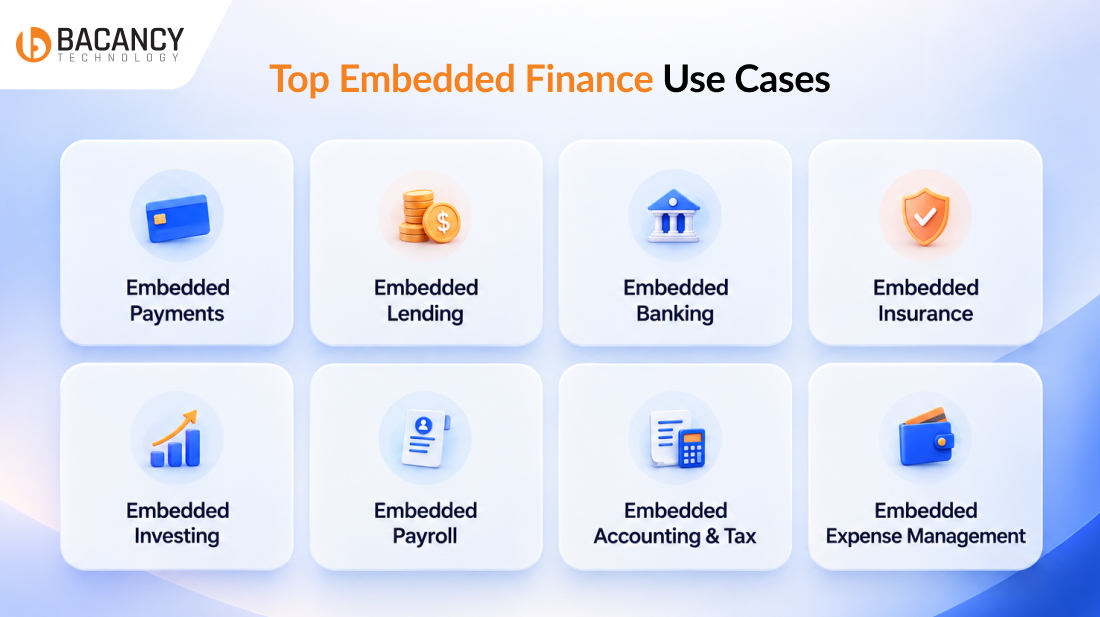
Once you understand what is embedded finance, these eight use cases show how businesses are putting it into practice, from payments and lending to banking, payroll, and expense management:
Embedded payments let customers make or receive payments directly inside a platform instead of being sent to a separate payment service.
For example, a marketplace can collect money from a buyer and send the seller their share without making either user leave the platform. A SaaS platform can also let customers pay invoices or subscriptions directly through its software.
Shopify is a good example. Merchants can manage payment collection as part of their online store. BNPL providers such as Klarna, Affirm, and Afterpay take this a step further by letting customers choose installment payments during checkout.
The same model is also growing in B2B. Procurement and ERP platforms can build accounts payable and receivable into their existing workflows.
Bain’s 2022 forecast estimated that embedded B2B payments could reach $2.6 trillion in transaction value by 2026, roughly three times the level at the time. (Source)
The main benefit is that payment data stays connected to orders, customers, refunds, and payouts. Payments become part of the platform’s core workflow instead of a separate service.
Embedded lending lets customers apply for financing directly through a platform they already use. Instead of filling out a separate loan application, customers can receive an offer based on the financial data the platform already has.
For example, a platform may already know a business’s sales volume, transaction history, repayment activity, and account balances. With the right setup and customer consent, a lending partner can use this information to assess the customer’s eligibility.
Shopify Capital is a clear example. Eligible merchants can receive financing offers based on their Shopify sales. The program originated $4.2 billion in 2025.
Block uses a similar model across Cash App Borrow, Afterpay, and Square Loans. In January 2026, it announced that it had provided access to more than $200 billion in credit. It also said that loss rates had remained stable since 2013 despite the growth in lending.
The main benefit is convenience. The financing offer appears where the customer’s business activity and financial data already exist, making it easier to discover and apply for credit than through a traditional loan application.
3. Embedded Banking: Add Accounts and Cards to Existing Software
Embedded banking lets non-bank platforms offer financial services such as business accounts, debit cards, money transfers, and account management directly inside their software.
The platform does not become a bank. Instead, a licensed banking partner provides the regulated banking infrastructure, while the platform manages the customer experience.
For example, Shopify Balance gives eligible merchants access to financial tools directly inside Shopify. Stripe Treasury allows platforms to build account and money-movement features into their own products. Uber’s Instant Pay and Lyft’s Express Pay let drivers access their earnings quickly instead of waiting for a standard bank transfer.
This model works especially well for vertical SaaS platforms. It is also relevant to SaaS in banking, where software platforms integrate financial services into the workflows their customers already use.
The main benefit is convenience. Customers can manage their business and financial needs in one place instead of switching between different financial products and platforms.
4. Embedded Insurance: Offer Coverage During the Purchase
Embedded insurance lets businesses offer insurance directly inside the product or purchase where customers are most likely to need it.
For example, a travel platform can offer trip protection while a customer books a flight or hotel. An electronics retailer can offer device protection during checkout instead of asking the customer to find an insurance provider separately.
Cover Genius provides infrastructure that businesses can use to add protection products to digital customer journeys, operating across 60-plus countries. BIMA takes a different approach, using mobile channels to make insurance more accessible in markets where traditional insurance can be harder to access.
The main benefit is timing. Customers see the insurance offer at the moment they understand what they are buying and what risks they may want to protect against. This makes insurance easier to discover and purchase.
5. Embedded Investing: Add Investment Features Through a Partner
Embedded investing lets non-financial platforms offer investment features directly inside their products without building brokerage infrastructure from scratch.
The platform manages the customer experience, while a brokerage partner handles tasks such as opening investment accounts, executing trades, and holding assets.
DriveWealth is a good example. It provides the brokerage infrastructure businesses can use to offer features such as fractional trading. Embedded investing is also expanding beyond stocks into areas such as retirement accounts and fractional real estate.
This model works well for financial apps, wealth platforms, and employee-benefit products. Customers can access and manage investments within a platform they already use instead of moving to a separate brokerage app.
The main benefit is convenience. Platforms can add investment features without building the complex brokerage infrastructure needed to support them.
6. Embedded Payroll: Put Payroll Inside Business Software
Embedded payroll lets a software company add payroll directly to its product instead of sending customers to a separate payroll service.
For example, the software can connect employee details, working hours, wages, tax calculations, and payroll reports in one place. The payroll provider handles the complex tax and payment processes in the background.
Gusto Embedded and Check provide payroll infrastructure that platforms can build into their products. Rollfi goes further by handling payroll and tax for W-2 and 1099 workers across all 50 states, including federal, state, and local tax filing.
This model works especially well for vertical SaaS platforms. A platform can add payroll to the tools its customers already use, creating another source of recurring revenue while keeping payroll data connected to the rest of the business.
7. Embedded Accounting & Tax: Keep Financial Data Connected
Embedded accounting connects financial activity with accounting tools directly inside a platform. Instead of downloading transactions and uploading them into another system, the platform can automatically send invoices, payments, and expense data to the customer’s accounting software.
For example, Apideck provides a unified API that connects platforms with more than 30 accounting platforms and ERPs through a single integration.
The main challenge is keeping financial records accurate across all systems. The platform, financial provider, and accounting software may each track the same transaction. If a payment appears in one system but not another, it can lead to reconciliation problems.
By keeping financial data connected, platforms can reduce manual data entry and make it easier for customers to keep their accounts up to date.
8. Embedded Expense Management: Control Spending at the Transaction
Embedded expense management lets businesses manage company spending directly inside the software they already use. This can include corporate cards, spending limits, approval rules, and expense reports.
For example, instead of checking every purchase at the end of the month, a business can set rules that check spending as soon as a transaction happens. A purchase can be approved, flagged, or blocked based on those rules.
Pleo Embedded provides card and expense management features that platforms can build into their products. Cardlay takes a similar approach by adding expense controls to existing card programs.
The main benefit is better spending control. Businesses can check transactions against company rules in real time instead of waiting until the end of the month to find problems.
Want to Build Embedded Expense Management?
Opt for fintech consulting to evaluate providers, spending controls, compliance needs, and integration options.
Benefits of Embedded Finance
Knowing what is embedded finance helps explain why these services can benefit both platforms and their customers. Here are the key benefits for each:
- Increase revenue: Platforms can earn additional revenue by offering financial services alongside their core products.
- Create new revenue streams: Payments, lending, banking, and other financial services can become new sources of income.
- Improve customer retention: Offering more services in one platform can give customers more reasons to stay.
- Increase customer engagement: Financial features can encourage customers to use the platform more frequently.
- Use existing customer data: Platforms can use relevant customer and transaction data to offer more suitable financial services.
Benefits for End Users
- Save time: Customers can access financial services without switching between different platforms.
- Get faster access: Customers can apply for or use financial services directly within the platform they already use.
- Enjoy a simpler experience: Customers can manage payments, financing, accounts, and other financial tasks from one place.
- Get relevant financial services: Platforms can offer financial products based on the customer’s needs and activity.
- Reduce manual work: Embedded finance can automate tasks such as payments, expense tracking, and financial reporting.
How Embedded Finance Works
To understand what is embedded finance beyond the customer experience, it helps to look at the three layers that make these products work.
Layer 1: The platform. Your software. You own the interface, the customer relationship, the support queue, and the decision about when a financial offer appears. You do not hold a banking license, and you do not hold customer funds.
Layer 2: The infrastructure provider. Unit, Stripe, Adyen, Synctera, Treasury Prime, and similar companies. They supply the API, the ledger that tracks balances, the KYC tooling, card issuing, and the compliance program that sits between you and the bank.
Some of them are middleware, meaning they connect you to a bank they don’t own. That distinction matters more than any feature comparison, and it’s the first question to ask a provider.
Layer 3: The sponsor bank. A licensed, insured institution. It holds the deposits, it carries the regulatory obligation, and its regulator ultimately decides whether your program is allowed to keep operating. You may never speak to this bank directly, but its risk appetite governs your roadmap.
How Money and Data Actually Move
A typical flow looks like this:
Customer → Platform UI → API/SDK → Financial Provider → Sponsor Bank
When a customer opens an account inside your product, you collect the required identity information and pass it to the provider.
The provider runs KYC, the bank approves or declines, and an account gets created in the bank’s system. Your platform then displays the balance and transaction history it reads back through the API.
Here’s the part most articles skip. That balance you’re displaying is usually not a bank account per customer. It’s a position on a ledger.
Customer funds frequently sit pooled in a single custodial account at the bank, often called an FBO account, and the record of who owns what within that pool is maintained by the provider or by you.
That ledger is the whole point. If it’s accurate and reconciled daily, the system works. If it drifts, nobody can prove who owns which dollar. That is precisely what happened at Synapse in 2024, and it’s why regulators have spent the time since focused on this exact mechanic.
Three Questions to Answer Before You Write Code
- Where does the ledger live?
If the provider owns it and the provider disappears, can you reconstruct customer balances from your own records? If the answer is no, you have a single point of failure, not an integration.
- Who runs KYC, and who is accountable when it fails?
These are two different questions. A provider can perform the checks while your platform still carries reputational and sometimes contractual liability for the outcome.
- How many banks sit behind the program?
One sponsor bank means one regulator’s opinion can end your product. Providers with multiple bank partners cost more and take longer to onboard, and for regulated products that’s usually money well spent.
Get clear answers to these three questions before development starts. Changing them later can mean moving real customer money, which can be very costly.
Build, Buy, or Partner: Choosing Your Embedded Finance Model
Once you understand what is embedded finance and how the infrastructure works, the next question is how you should add it to your product. Compare Build, Buy, and Partner to find the option that best fits your product and business needs.
| Build | Buy | Partner |
|---|
| You own | Ledger, compliance program, bank relationships, ops | The integration only | Product experience, UX, support, customer data |
| Provider owns | Nothing | Everything behind the API, including the customer flow | Ledger, KYC tooling, bank relationship |
| Realistic timeline | 12+ months before first customer | 2 to 6 weeks for payments | 6 to 12 weeks for payments; 4 to 9 months for accounts, cards, or lending |
| Ongoing headcount | Dedicated compliance and risk function | Effectively none | Part-time compliance owner, plus a reconciliation process |
| Biggest hidden cost | Bank charter or sponsor negotiations, plus audit | Losing control of the experience at the moment it matters | Provider onboarding and underwriting, which routinely takes longer than the build |
| You should pick this if | Financial services is your product, not a feature | You need a standard capability live this quarter | Your platform data gives you an underwriting or timing edge worth building around |
For most companies entering embedded finance, partnering is the practical starting point. Building internally means owning a compliance function before you own a customer. Buying is fast, but you inherit someone else’s checkout, and at the exact moment a customer decides whether to trust your product, they’re looking at a screen you don’t control.
The timelines above assume the provider onboarding runs in parallel with the build. It usually doesn’t. Due diligence, contract negotiation, and sponsor bank approval routinely take longer than the engineering work, and they can’t be compressed by adding developers.
What Determines the Implementation Time?
There is no fixed timeline for fintech software development when building embedded finance solutions. A basic payment integration can take a few weeks, while banking, lending, or other regulated products can take several months.
The biggest factors are:
- Financial product: Payments are generally simpler to integrate than accounts, cards, lending, or insurance.
- KYC and compliance: Customer verification, transaction monitoring, reporting, and other requirements can add significant work.
- Provider onboarding: Due diligence, contracts, underwriting, and bank-partner approval can take longer than the API integration itself.
- Customization: A standard provider workflow is faster than building custom account, payment, or lending experiences.
- Existing infrastructure: Platforms with strong identity, payments, ledger, and security systems can usually integrate faster.
What Developers Need to Plan For
The API integration is only one part of the project. Before development starts, the team should clearly define:
- Who owns KYC and AML: The contract should specify which checks the provider handles and which responsibilities remain with the platform.
- Who provides the banking relationship: If banking services are involved, identify the sponsor bank or licensed financial institution behind the product.
- Where financial data is stored: Define how account, transaction, identity, and payment data is encrypted, accessed, logged, and retained.
- How money is reconciled: The platform needs a reliable way to match its internal records with provider and bank transactions.
- What happens if the provider changes: Have a migration and exit plan so the product is not completely dependent on one provider or banking partner.
The goal is not simply to connect an API. The architecture needs to make financial responsibility, compliance ownership, data flow, and money movement clear before the feature goes live.
Planning an embedded finance integration?
Our fintech integration services help you choose the right provider, design the integration, and avoid costly vendor lock-in.
Comparing Embedded Finance Providers
If you know what is embedded finance but are not sure which provider to use, the right choice depends on the financial product, geography, regulatory requirements, existing payment stack, and how much control the platform needs.
Expert Note: Plaid connects apps to users’ bank accounts and helps them access financial data. It is not a BaaS provider. BaaS providers offer the banking infrastructure needed to build products such as accounts and cards.
How to Evaluate an Embedded Finance Provider
Instead of choosing the provider with the largest feature list, compare them against the actual product you are building:
1. Financial product: Does the provider support the exact service you need, such as payments, accounts, cards, lending, or financial data?
2. Geography: Can it support the countries, currencies, and financial institutions your product needs?
3. Compliance ownership: Which KYC, AML, reporting, and regulatory responsibilities does the provider take on?
4. Banking partners: If the product requires banking services, which banks support the program and what happens if that relationship changes?
5. API and developer experience: Check documentation, SDKs, sandbox quality, webhooks, error handling, and testing tools.
6. Pricing: Look beyond the API fee. Include transaction fees, account fees, compliance costs, minimums, and operational costs.
7. Exit options: Make sure customer data, transaction records, and financial relationships can be migrated if you eventually change providers.
Common Mistakes To Avoid When Implementing Embedded Finance
Before implementing embedded finance, it’s important to understand the common mistakes that can lead to delays, higher costs, and compliance problems. Here are seven to watch out for:
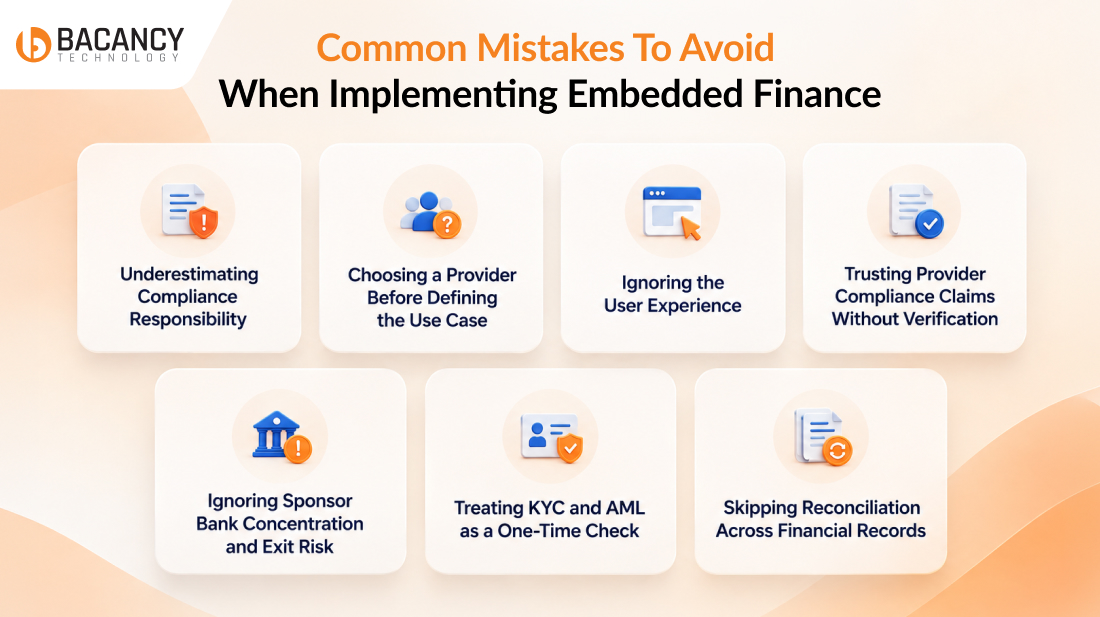
1. Underestimating Compliance Responsibility
Platforms must define which compliance tasks they own and which their financial partners handle. Unclear ownership can create regulatory gaps, delays, and unexpected costs.
2. Choosing a Provider Before Defining the Use Case
Start with the financial product and customer workflow you need. Then compare providers based on capabilities, compliance support, integration effort, pricing, and scalability.
3. Ignoring the User Experience
Financial features should fit naturally into your existing product. Extra redirects, unfamiliar screens, or separate logins can add friction and reduce adoption.
4. Trusting Provider Compliance Claims Without Verification
Do not rely on a provider’s compliance claims alone. Check relevant licenses, certifications, security controls, regulatory responsibilities, and contractual obligations before signing.
5. Ignoring Sponsor Bank Concentration and Exit Risk
If your product depends on one sponsor bank or one middleware layer, a relationship change or failure can freeze operations overnight. Define backup options and an exit plan before launch.
6. Treating KYC and AML as a One-Time Check
KYC and AML are ongoing processes, not just onboarding steps. Monitor customer activity and risk changes throughout the relationship to meet applicable requirements.
7. Skipping Reconciliation Across Financial Records
Reconcile transactions across your platform, financial provider, and bank regularly. This helps identify missing payments, duplicate transactions, settlement differences, and ledger errors early.
Conclusion
Understanding what is embedded finance is only the starting point. It is becoming a practical way for platforms to offer more value without building every financial service themselves. Payments, lending, banking, and other financial products can now fit directly into existing customer workflows.
At Bacancy Technology, we offer fintech IT solutions and services to help businesses plan, build, and integrate embedded finance into their platforms. We help choose the right use case, financial partner, and technology approach while keeping compliance, data security, payment reconciliation, and future growth in mind.
Frequently Asked Questions (FAQs)
Not exactly. BaaS provides the banking tools and infrastructure, while embedded finance adds financial services directly into a non-financial platform. A platform can use BaaS to offer embedded finance.
It depends on the product, provider, and level of customization. A simple payment feature may take a few weeks, while lending or banking features can take several months.
Usually, no. Many businesses work with licensed banks or financial providers that handle regulated activities. However, the requirements can vary based on the product, service, and country.
There is no fixed cost for embedded finance. The total cost depends on the financial product, provider fees, transaction volume, development work, compliance requirements, and ongoing maintenance. Share your requirements with us, and we can give you a tailored cost estimate.
Yes. A platform can use providers and licensed banks for payments, accounts, cards, or lending. The platform owns the customer experience while the financial partners handle the infrastructure and regulated activities.
Responsibility depends on the setup and contracts. Your provider may handle KYC, payments, or fraud checks, but your platform may still be responsible for customer support and certain compliance requirements.
Customer funds are generally held through a regulated bank, while a ledger tracks who owns what. Before choosing a provider, check where funds are held and how balances can be recovered.
Yes. One provider is easier to launch and manage, while multiple providers can reduce dependency and provide backup options. The trade-off is more integration, testing, compliance work, and ongoing maintenance.
Build it yourself when financial services are central to your product and provider limits could hold you back. For example, a fintech building its own banking product may need full control over its infrastructure.