Quick Summary
- A neobank is a digital-only financial provider that runs on its own banking license or a partner bank’s license.
- It earns from interchange, subscriptions, credit, partnerships, and foreign exchange.
- Profit depends on low acquisition cost, a mixed revenue base, and tight risk control.
This blog covers what is a neobank, the licensing options, and how it is different from traditional banking.
Table of Contents
Introduction
What is a neobank, and how did a branchless app win millions of customers away from banks that spent a century earning trust? The answer lies in advanced technology, lower operating costs, and digital-first customer experiences.
Fortune Business Insights values the global neobanking market at about $210 billion in 2025 and projects it to reach roughly $7.66 trillion by 2034. For fintech founders, this growth raises important questions about how neobanks operate, what makes their business models commercially viable, and which technologies support their growth.
This blog explains how neobanks work, compares neobanks with digital and traditional banks, and the licensing options and revenue models founders need to understand.
What Is a Neobank?
A neobank is a financial provider that delivers banking services through a mobile app or website, with no physical branches. A customer can open an account, get a card, send money, and apply for a credit card or loan, all from a phone.
Without a branch network to run, neobanks can focus their budget on the digital experience. Their most common products are checking and savings accounts, payments, loans, and investments.
Many neobanks do not hold a banking license of their own. They partner with licensed banks that hold customer deposits and carry the core regulatory obligations. This keeps their costs low and their operations agile.
What are the Benefits of Neobanks?
- Neobanks help customers protect their money with instant card freezing and customizable spending limits.
- Neobanks simplify saving by automatically setting aside money based on income, spending, and savings goals.
- Multi-currency accounts let customers manage different currencies and make international payments more easily.
- Neobanks help small businesses manage cash flow, track invoices, and monitor expenses in one place.
- Open banking integrations connect multiple financial accounts, which give customers a clearer view of their overall finances.
Neobank vs Digital Bank vs Challenger Bank
These 3 terms neobank vs digital bank vs challenger bank overlap, which often causes confusion. Here is a quick way to tell a neobank, a digital bank, and a challenger bank apart.
- Neobank: A digital-only brand built around an app. Some hold their own banking license. Many run on a partner bank’s license.
- Digital bank: A licensed bank that delivers its services online. An established bank can run one as a channel or as a separate brand.
- Challenger bank: A term common in the UK and Europe for newer licensed banks that compete with large incumbent banks. Most are digital-first.
Real-Life Neobank Examples:
These 5 examples show the range of neobank models: Chime shows the partner bank path. Varo, Monzo, and N26 show the license path. Nubank shows how one product can grow into a full platform.
- Chime (US): An app-based provider that offers accounts through partner banks, such as The Bancorp Bank and Stride Bank.
- Varo Bank (US): Holds a national bank charter, so it operates under its own license.
- Monzo (UK): A licensed UK bank with no branch network.
- N26 (Europe): A digital bank licensed in Germany that serves customers across Europe.
- Nubank (Brazil): Grew from a no-annual-fee credit card into a broad financial platform across Latin America.
How Is a Neobank Different From a Traditional Bank?
A neobank trades physical branches for digital services, while a digital bank may operate independently or as part of an established banking institution. Understanding the neobank vs digital bank distinction helps explain differences in operating costs, licensing, and product delivery. The table below compares neobanks with traditional banks.
| Factor
| Neobank | Traditional Bank
|
|---|
| Channel | App and web only
| Branches, ATMs, app, and web
|
| Account Opening
| Minutes and fully digital
| Longer, and some accounts need a branch visit
|
| Licensing
| Own license or a partner bank’s license
| Holds its own banking license
|
| Cost | Affordable; no branch network and smaller teams
| Heavy with branches, legacy systems, and large staff
|
| Technology | Cloud-native and API-first
| Core systems often decades old
|
| Product Range
| Narrow at launch, expands in steps
| Broad: mortgages, wealth, corporate, branch services
|
| Revenue
| Interchange, subscriptions, lending, partnerships, FX
| Net interest margin, account and service fees, lending
|
| Release speed
| Frequent releases, tested on small user groups
| Slower cycles tied to core system limits
|
| Target Customer
| Digital-first users and niche segments
| Broad base across all segments
|
| Deposit protection
| It is covered through the bank that holds the funds
| It covers directly
|
What These Differences Mean Briefly
Cost: A traditional bank carries high fixed costs from branches, staff, and legacy systems. A neobank spends its budget on engineering, compliance, and customer acquisition. The fixed cost lets it waive fees that traditional banks still charge.
Speed: Cloud infrastructure and APIs let a neobank test a feature with a small user group and release it within weeks. A traditional bank often has to wait for a core system upgrade.
Product depth: Traditional banks lead on breadth, with mortgages, wealth management, and corporate services at their core. Neobanks start narrow and add products as their customer base grows.
Trust: Traditional banks carry decades of brand trust. Neobanks earn it through clear pricing, quick support, and strong security.
Planning to Build a Neobank?
Hire fintech developers to build a neobank around your target customers, with the banking features, integrations, and workflows your business needs.
How Does a Neobank Work? Banking Licenses, BaaS, and Deposits
Every neobank runs on 1 or 2 operating models. The model decides who holds the license, who holds the deposits, and who answers to the regulator.
Model 1: Own Banking License
The neobank applies for a charter and becomes a regulated bank. It takes deposits onto its own balance sheet, lends directly, and reports to its regulator. Monzo and N26 follow this path in Europe, and Varo is the best-known US example with its national bank charter.
This model gives high control, and the costs match. Approval can take years, and the capital and compliance demands are heavy.
Model 2: Partner Bank Through BaaS
The neobank teams up with a licensed bank. Banking-as-a-Service (BaaS) platforms connect the two through APIs for accounts, cards, payments, and identity checks.
The partner bank holds the charter and the deposits. The neobank owns the brand, the app, and the customer relationship.
Launch is faster, and the capital requirement is lower. The trade-off is less control over product rules and a reliance on the partner bank’s risk appetite. Regulators have also raised their expectations for how partner banks oversee fintech programs, so founders should expect closer review.
Where Deposits Sit and How FDIC Coverage Works
In the US, FDIC insurance protects deposits up to $250,000 per depositor, per insured bank, per ownership category. Under the BaaS model, the partner bank holds the funds, so coverage applies at that bank. Pass-through coverage can extend to each customer when the records are accurate, and the account is set up correctly.
Here are the 3 points every founder should keep in mind:
- Federal Deposit Insurance Corporation (FDIC) coverage applies only when an insured bank fails. If the fintech app itself fails, coverage does not apply.
- Coverage applies only to deposits. Investments and crypto held through an app have no FDIC protection.
- Recordkeeping decides how fast customers get their money back. When the BaaS middleware provider lost access to their fund, FDIC proposed recordkeeping and daily reconciliation rules for the accounts.
You need to choose a fintech software development company partner with clean ledger reconciliation and design for it from the beginning.
Is a Neobank a Real Bank?
The short answer depends on the license. A neobank with its own charter is a real bank. A neobank on the partner model is a fintech brand, and the partner bank is the real bank that holds the money. Customers should check the app’s fine print for that bank’s name. Founders should state it plainly in their own marketing, because regulators watch how fintechs describe themselves.
Neobank Business Model: How Do Neobanks Make Money?
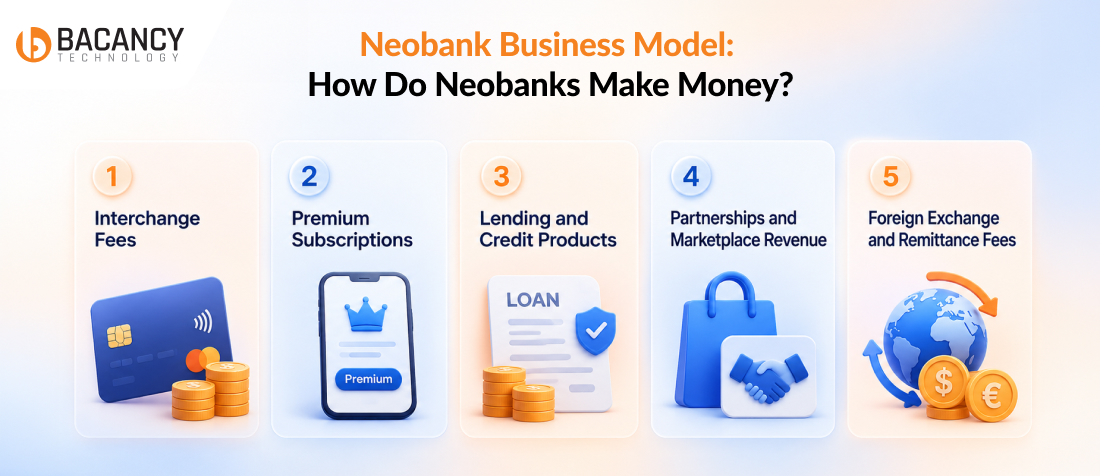
Most neobanks skip account fees and earn from the way customers use the product. Among them, 5 revenue streams carry the model.
1. Interchange Fees
Every time a customer pays by debit or credit card, the merchant pays a fee. The card network and the issuer split it, and the issuer’s share is interchange revenue. It is the core income line for most neobanks because it grows with card spend.
One detail shapes strategy. In the US, the Durbin Amendment caps debit interchange for banks with more than $10 billion in assets. Smaller banks are exempt, so they earn more per swipe. That is one of the reasons several neobanks partner with banks below the threshold.
2. Premium Subscriptions
A free tier brings customers in. Paid tiers add perks such as higher cash-back, travel cover, metal cards, higher ATM limits, and priority support. Revolut, Monzo, and N26 all sell tiered plans. Subscription income is steady and predictable, which helps when card spend dips.
3. Lending and Credit Products
Credit is the largest profit pool, and the one with the most risk. Common products include credit cards, personal loans, overdraft, early wage access, buy now pay later, and small business loans. A neobank on its own license earns the spread between deposit cost and loan yield. A neobank on a partner model usually earns origination fees, a revenue share, or a share of interest.
Strong underwriting separates profit from loss here. Alternative data and AI-based credit models help, and so does tight fraud control.
4. Partnerships and Marketplace Revenue
The app is a distribution channel. Neobanks earn referral fees and revenue shares by offering partner products in their marketplace, such as insurance, investments, crypto, tax tools, and merchant cash-back offers. Each partner product adds income without adding balance sheet risk.
5. Foreign Exchange and Remittance Fees
Cross-border customers pay for currency exchange and international transfers. Neobanks earn through a small markup on exchange rates, flat transfer fees, and surcharges on out-of-hours or large conversions. The line works well for neobanks that serve travelers, freelancers, migrants, and small exporters.
What Makes a Neobank Business Model Profitable?
Revenue streams are only half the story. Profit comes from how well the neobank manages cost, risk, and customer value. The following 6 factors decide the outcome.
1. Low Customer Acquisition Cost: Paid ads get expensive fast. Referral programs, embedded distribution, and community channels keep the cost per customer down.
2. Primary Account Status: A customer who receives a salary in the account spends more on the card, holds higher balances, and buys more products. Design onboarding and rewards around direct deposit.
3. A Mixed Revenue Base: Interchange alone is fragile. Aim for at least 3 of the 5 streams so a drop in one does not sink the business.
4. Healthy Unit Economics: Track average revenue per user against acquisition and servicing cost. A lifetime value of about 3 times acquisition cost is a common rule of thumb.
5. Credit and Fraud Control: Loan losses and card fraud erase margin quickly. Real-time monitoring, strong underwriting, and clean collections protect it.
6. A Focused Niche: Neobanks that serve a defined group, such as freelancers, gig workers, small businesses, or cross-border families, win loyalty faster than those that try to serve everyone.
Compliance and technology costs also shape the margin. Automated KYC, AML monitoring, and reporting cut manual effort as the customer base grows. You now know how the model works and where the profit comes from. The next question is how to build it.
How Bacancy Technology Helps You Build a Neobank
Since 2011, Bacancy Technology has helped fintech businesses build secure digital banking platforms around what their customers actually need. Our fintech integration services connect your neobank with banking APIs, payment gateways, KYC providers, and third-party financial systems, so your team spends less time on planning and more time on the product.
- We help you compare a banking license with a BaaS launch and map the compliance load for each.
- Design onboarding, account, card, and payment flows around your target segment, so more users finish signup.
- Build mobile and web apps, ledgers, KYC and AML workflows, card management, and payment rails.
- Connect partner banks, card issuers, identity providers, and payment networks through secure APIs.
- Add AI-powered fraud real-time fraud detection, risk scoring, and smart support to protect your margin.
- Develop personalized dashboards and spending insights that keep customers engaged.
- Design the platform so you can add lending, savings, and payment products later without rebuilding the core.
- Build in encryption, access control, audit trails, and regulatory reporting from the first sprint.
- Handle testing, release, and support, then extend the platform as your product range grows.
Frequently Asked Questions (FAQs)
An MVP built on a BaaS partner usually starts in the low six figures, and a full-featured platform can run well past that. Lending, multi-currency accounts, and advanced fraud tools raise the cost further. Licensing, partner bank fees, and compliance programs also add to the total. The final figure depends on your scope, operating model, and target markets, so the best way to get a real number is a scoping session with our team.
A neobank is a bank-like app with no branches. You open an account, spend with a card, and manage your money from your phone.
A neobank is safe when two things hold. Your deposits sit at an insured bank, and the provider follows strong security standards. In the US, look for the name of the FDIC-insured bank that holds your funds. Check for multi-factor login, encryption, and clear fraud policies.
Some are, and some are not. A neobank with its own banking license is a real bank. A neobank on a BaaS model is a fintech brand, and a licensed partner bank holds the deposits.
Through 5 main sources: interchange fees on card spend, premium subscriptions, lending and credit products, partnership and marketplace revenue, and foreign exchange and remittance fees.
No, you can launch under a partner bank’s license through a BaaS provider. Your product may still need registrations, such as money transmitter licenses, depending on the features and markets you pick. A full banking license gives you more control, though it takes longer and needs more capital.
Rules vary by country and by model. In the US, a neobank typically deals with:
- KYC and customer due diligence
- AML and Bank Secrecy Act requirements, plus OFAC sanctions screening
- Regulation E for electronic fund transfers
- Truth in Savings rules and UDAAP consumer protection standards
- Gramm-Leach-Bliley Act privacy and data security requirements
- PCI DSS for card data
- Partner bank oversight and third-party risk requirements
Outside the US, expect PSD2 and GDPR in Europe and FCA rules in the UK. Build compliance into the product from the start.
Pick BaaS if you want speed, lower upfront capital, and a chance to test the market. Pick a banking license if you have deep funding, a long-term plan to hold deposits and lend on your own balance sheet, and the patience for a long approval process. Many founders launch on BaaS and move to a charter once the customer base and revenue justify it.
A typical stack has these layers:
- Front end: Swift and Kotlin, or cross-platform tools such as React Native and Flutter
- Back end: Node.js, Java, Python, or Go, built as microservices
- Cloud: AWS, Azure, or Google Cloud
- Core and ledger: A BaaS provider or a core banking platform
- KYC and identity: Providers such as Alloy, Persona, or Onfido
- Card issuing and processing: Providers such as Marqeta or Lithic
- Payment rails: ACH, RTP, FedNow, and card networks
- Data and AI: Fraud models, credit scoring, and analytics
- Security: Encryption, tokenization, and role-based access