Quick Summary
This guide explains where LLM hallucination costs arise across enterprise workflows, how to estimate their financial impact with a practical example, and which controls can reduce the risk. It also covers remediation, human review, compliance, monitoring, and downstream errors, helping enterprises understand the business impact of incorrect AI outputs in production.
Table of Contents
Introduction
A support bot might promise a refund that your company’s policies never allow. A coding assistant may suggest a package that doesn’t even exist. These may seem like simple AI accuracy issues, but in an enterprise environment, the consequences can extend far beyond an incorrect answer. Once AI becomes part of an enterprise workflow, a wrong answer can lead to rework, security risks, compliance exposure, operational delays, and lost customer faith.
Organizations generally budget for model usage, infrastructure, integration, and development. What often gets overlooked is the cost of LLM hallucinations after deployment, such as the time and resources spent verifying incorrect outputs, correcting automated actions, and managing customer impact while investigating what went wrong. According to the Forbes Technology Council, AI hallucinations are estimated to cost businesses $67 billion globally, while the average single AI error costs $4.4 million.
What Counts as an LLM Hallucination
LLM hallucinations occur when a model generates information that is presented as a fact but is incorrect, unsupported by its source data, or not grounded in the available evidence. It could be a fabricated citation, a nonexistent API, or a refund policy the company never published. Hallucinations in LLMs are a consequence of how LLMs generate responses, how they predict the likely sequence of words based on learned patterns rather than independently verifying whether each claim is true.
Where Does LLM Hallucination Cost Actually Show Up?
Before estimating LLM hallucination cost, it helps to separate the different ways hallucinations can affect an enterprise. Such costs rarely appear on the same budget line or reach the same team. Some costs are easy to measure, while others, such as reduced adoption or compliance exposure, may only become visible after a major incident.
| Cost category
| What drives it
| How to measure
| Typical Cost Range
|
|---|
| Direct remediation
| Manual correction, refunds, and redone work per bad output
| Cost per incident, remediation hours, or value of rework
| $50,000+ per incident (regulated industries); ~$180,000/year at moderate scale
|
| Compliance and legal exposure
| False claims, fabricated citations, misstated policy terms
| Review costs, legal fees, penalties, or incident-related costs
| $50,000-$500,000/year in compliance spend; individual penalties $2,000-$110,000+ per case
|
| Downstream automation errors
| A bad output feeding the next step in an agent or pipeline
| Cost of each affected step, transaction, or failed action
| Compounds per step: a 2% first-step error rate can affect ~8% of outcomes across a 4-step chain with no checkpoints
|
| Human-in-the-loop staffing
| Review layer added after launch, once trust breaks
| Review hours, headcount, or monthly staffing cost
| $150,000-$500,000+/year for a dedicated review or governance function
|
| Monitoring and evaluation tooling
| Bought reactively after a public or costly failure
| Tooling and implementation costs
| $50,000-$300,000+/year, trending higher when purchased reactively
|
| Trust and adoption
| Internal teams quietly stop using the tool
| Usage decline, additional review time, or lost expected productivity gains
| Avg. loss $4.4M among affected orgs; 64% report losses over $1M
|
This is the easiest cost to identify. A support employee may need to correct an incorrect answer, issue a refund that should never have been promised, or redo work generated from an inaccurate source. As these costs are easy to track, they are the first to be included in an AI risk estimate. Remediation costs have been reported to exceed $50,000 per incident in regulated industries once legal, clinical, or financial review is involved.
Compliance and legal exposure
These costs are harder to predict because their impact depends heavily on the use case and industry. Enterprises can spend $50,000 to $500,000 annually on AI compliance, legal, and consulting costs alone. Under the EU AI Act, fines for certain high-risk non-compliance can reach €15 million or 3% of global annual turnover before a single hallucination incident occurs.
Downstream automation errors
These errors become more significant as AI moves from generating content to taking actions. In a four-step agent chain with no checkpoints between steps, a 2% error rate at the first step does not remain isolated. Each subsequent step that relies on the previous output can compound the error, turning a single hallucination into a chain of connected failures.
Human-in-the-loop staffing
It is another cost that emerges right after deployment. Dedicated AI review and governance teams can add $150,000 to $500,000+ annually to enterprise operating costs, in addition to the per-incident hours required for reviewing and remediating incorrect outputs.
Monitoring and evaluation
Such tooling can also become a post-launch expense. Teams may initially deploy an AI system without comprehensive evaluation, observability, or production monitoring. After encountering unreliable outputs, they may need to add these controls quickly. The resulting cost includes both the tooling itself and the engineering effort required to integrate and maintain it. Continuous monitoring and drift-detection tools for enterprise AI deployments can cost $50,000 to $300,000+ annually.
Trust and adoption
Trust and adoption costs are harder to quantify but can still be significant. EY’s 2025 Responsible AI Pulse survey of 975 C-suite leaders found that 99% of organizations reported financial losses from AI-related risks, while 64% reported losses exceeding $1 million. The average loss among affected organizations was estimated at $4.4 million.
Reduce LLM Hallucination Risk Before It Becomes a Business Cost
Hire LLM Engineers from Bacancy Technology to build reliable, production-ready AI systems with strong grounding, evaluation, monitoring, and validation controls.
What Does LLM Hallucination Really Cost? A Worked Example
To see how quickly LLM hallucination costs can add up, consider a simple support workflow. The following example is illustrative, not based on a specific client, and uses assumptions that organizations can replace with their own production data.
Assume an LLM-powered support system handles 50,000 customer interactions per month. Based on research, open-ended LLM generation has been reported to have substantially higher hallucination rates in some settings, particularly without grounding and other mitigation measures. For this example, assume a 2% effective hallucination rate after retrieval, evaluation, and other safeguards are in place. That would result in 1,000 potentially hallucinated responses each month.
Now consider the remediation effort. If a support agent spends an average of 20 minutes identifying, correcting, and following up on each affected response, those 1,000 incidents would require approximately 333 hours of work per month. At a blended support cost of $45 per hour, that represents roughly $15,000 per month, or $180,000 per year, in direct remediation costs alone.
This is only the starting point. The calculation does not account for compliance reviews, legal support, additional human oversight, downstream workflow failures, monitoring, and evaluation costs. The same formula can be applied to your own environment.
Monthly hallucination cost = Monthly interactions × Effective hallucination rate × Remediation time per incident × Hourly cost
The important point is not that every enterprise will incur $180,000 in annual remediation costs. It is that even a relatively small effective hallucination rate can create a meaningful recurring cost at scale.
Additional LLM Hallucination Costs Enterprises Often Miss
The impact of hallucinations extends beyond correcting wrong answers. It needs to account for recurring costs for review, monitoring, infrastructure, and slower AI adoption.
Human Review Becomes an Ongoing Operating Cost
Many AI deployments start with the assumption that outputs can be trusted with occasional spot checks. Once an incorrect response reaches a customer, employee, or decision-maker, that assumption can change quickly. The organization may introduce a formal human-review layer, adding recurring staffing costs that were not part of the original AI business case. Even a lean AI review function can add $150,000 to $500,000+ in recurring annual staffing costs, an expense that may not be included in the original AI business case.
Evaluation and monitoring are easier to build into an AI system from the start than to retrofit after a failure. When teams discover gaps only after a costly or public incident, they may need to purchase monitoring tools, build evaluation pipelines, and allocate engineering resources under time pressure. The reactive purchases can push annual evaluation and monitoring costs toward the upper end of the $50,000-$300,000+ range, whereas planning these capabilities into the deployment from the outset can help control costs.
These controls also need to be supported by a broader governance framework covering evaluation, monitoring, human oversight, incident management, and ongoing AI risk management. Bacancy Technology’s guide to AI governance best practices provides a broader framework for managing these risks across the AI lifecycle.
Model or Vendor Changes Can Add Unplanned Costs
When confidence in a model or provider declines, switching is rarely as simple as changing an API configuration. Teams may need to redesign prompts, rebuild evaluation baselines, retest workflows, update integrations, and validate the new system before production. The re-platforming after losing confidence in a model can require 6 to 12 weeks of engineering effort. At a blended rate of $100 per hour, that can translate to roughly $60,000 to $120,000 in engineering costs simply to restore the capabilities the team already had.
Additional Review Gates Can Slow AI Rollouts
After a significant hallucination incident, organizations often add approval and review steps to reduce the risk of recurrence. These controls may be necessary, but they can also increase the time required to launch new features, expand use cases, or automate additional workflows. Over time, these additional checks can make it more expensive to launch new features, expand use cases, or automate additional workflows.
Where LLM Hallucination Cost Concentrates: Chatbots, RAG, Agents, and Code
LLM hallucinations’ costs are not evenly distributed across enterprise AI use cases. It becomes more significant when an incorrect output can reach a customer, trigger an automated action, enter a production system, or influence business decisions before a human can intervene.
| Use case
| Typical failure mode
| Who catches it
| Cost tier
| Illustrative Cost Data
|
|---|
| Customer-facing chat
| Incorrect information reaches the customer directly
| Often, no one until a complaint or escalation
| High
| Avg. single AI error costs $4.4M; feeds into the $67.4B global hallucination-loss estimate
|
| RAG systems
| Poor retrieval or weak grounding leads to confident but unsupported answers
| Depends on the evaluation and review coverage
| Medium to high
| Well-implemented RAG can cut search hallucinations from ~27% to ~11%, but does not eliminate remediation cost
|
| Agentic multi-step workflows
| One incorrect step propagates through subsequent actions
| Often difficult to detect mid-workflow
| High
| A 2% first-step error rate can compound to affect ~8% of outcomes across a 4-step chain with no checkpoints
|
| Coding and development agents
| Fabricated APIs, packages, dependencies, or configuration
| Build, runtime, security, or code review processes
| Medium to high
| Hallucinated-package rates of 4.6%-6.1% on 2026 frontier models; one confirmed malicious package has drawn 233+ weekly downloads
|
The key pattern is how far a hallucinated output can travel before it is detected. A wrong answer in a low-risk, tightly grounded workflow may require little more than a correction. The same error becomes more expensive when it reaches a customer, triggers an automated action, or is passed from one agent or system to another. That’s the reason why workflows with multiple autonomous steps generally require stronger evaluation, monitoring, and review controls than simple retrieval or extractive use cases.
Does the Model You Choose Change Your LLM Hallucination Cost
Your LLM hallucination cost can be influenced before you add a single grounding or review control. It begins with the model you choose. Different LLM models can produce different levels of factual errors when they are used with the same data, prompt, and safeguards. A model with a higher hallucination rate can create more responses that require human review, correction, escalation, or remediation. At enterprise scale, even a small difference in hallucination rates can therefore translate into a meaningful difference in operating costs.
That’s the reason why model selection needs to be considered as part of hallucination risk and cost assessment, not just a performance or infrastructure decision. While evaluating models, consider them not only because of their accuracy and capabilities but also because of how their error patterns could affect your specific workflows. The choice between retrieval-based grounding and model customization can also affect how you manage hallucination risk.
For a practical framework, follow our guide on how to choose the right LLM model for your business and evaluate models based on performance, reliability, risk, and total cost.
How Can You Reduce LLM Hallucination Cost in Production
The reduction in LLM hallucination cost is not about eliminating every incorrect output. It is about designing production systems so that hallucinations are less likely to occur, easier to detect, and less likely to propagate into costly downstream actions. The most effective controls are built into the architecture and workflow before deployment rather than added after an incident.
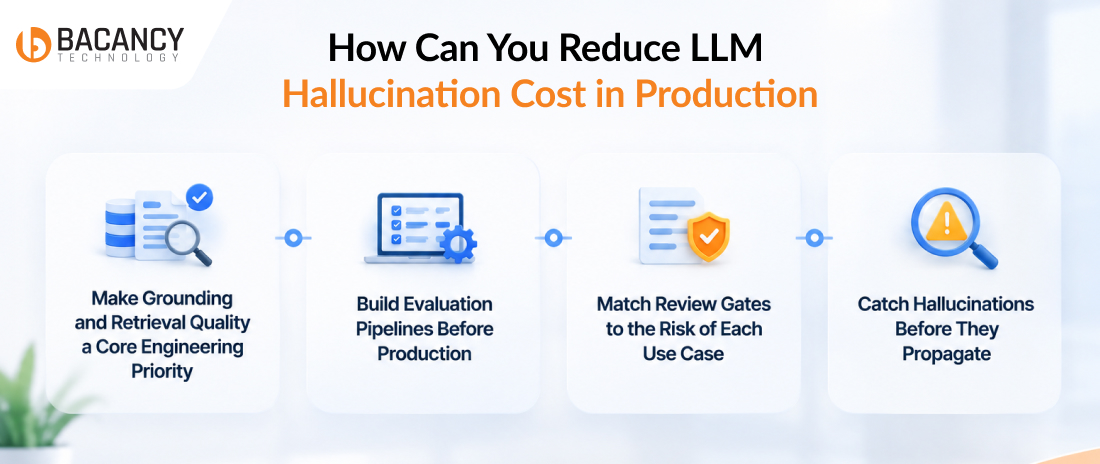
Make Grounding and Retrieval Quality a Core Engineering Priority
For enterprises connecting LLMs with existing applications, APIs, data sources, and business workflows, LLM integration services help incorporate these grounding and validation controls into the production architecture. This ensures that LLMs can access relevant, up-to-date information while reducing the risk of unsupported responses reaching users or downstream systems.
Build Evaluation Pipelines Before Production
Evaluation should begin before an AI workflow reaches users, not after a bad output exposes a gap. The pre-production evaluations can test factual accuracy, retrieval quality, instruction following, edge cases, and failure behavior against representative datasets. When these evaluations are built only after an incident, teams are forced to respond under pressure and may end up adding controls reactively rather than designing them into the system from the start.
Match Review Gates to the Risk of Each Use Case
Not every AI workflow requires the same level of human oversight. A customer-facing chatbot, an internal summarization tool, and an agent that can execute financial or operational actions have very different consequences when something goes wrong. The requirements need to be reviewed based on the maximum impact of an incorrect output. Over-reviewing low-risk workflows adds unnecessary operating costs, while under-reviewing high-risk workflows can leave the organization exposed to much larger remediation, compliance, or security costs.
Catch Hallucinations Before They Propagate
Notice that when an incorrect output influences another agent, triggers automated action, or reaches a customer, the cost of correcting it increases. The production workflows should include validation checkpoints, confidence or grounding checks, approval gates, and other controls at the points where errors could otherwise cross into downstream systems.
How Does Bacancy Technology Help You Control LLM Hallucination Cost
LLM hallucinations become costly when incorrect outputs lead to rework, manual review, downstream errors, or compliance issues. Bacancy Technology helps enterprises build AI systems with controls that make unreliable outputs easier to detect, validate, and contain before they reach customers or downstream systems.
Our approach focuses on the areas that have the greatest influence on hallucination risk, such as grounding, evaluation, validation, monitoring, and controlled execution. For example, RAG architectures can connect LLMs to trusted enterprise data, while evaluation pipelines can test responses against real business scenarios before deployment. For agentic workflows, validation checkpoints and approval gates can help prevent an incorrect output from triggering a costly downstream action.
We incorporate these controls across different stages of the AI lifecycle through LLM development services and RAG development services. When specialized model behaviour is needed, we use LLM fine-tuning services to improve domain alignment and adapt model responses to specific business requirements.
Conclusion
LLM hallucination is not an AI accuracy issue; for enterprises, it can become a recurring business cost when incorrect outputs require human review, trigger downstream errors, create compliance or security risks, or reduce trust in AI systems. The actual impact depends on how often hallucinations occur, how quickly they are detected, and how far an incorrect output can travel before someone intervenes. Instead of assuming hallucinations can be eliminated completely, enterprises should focus on reducing their likelihood, detecting errors early, and preventing unsupported outputs from reaching high-impact systems or actions.
Grounded retrieval, pre-production evaluation, risk-based human review, validation checkpoints, and continuous monitoring help control both the operational impact and financial cost of hallucinations. For organizations scaling LLMs, the more useful question is not simply, “How accurate is the model?” but “What happens when the model is wrong? By answering this question, enterprises can estimate the real cost of hallucination risk, prioritize the right safeguards, and build AI systems that are reliable enough for production.
Frequently Asked Questions (FAQs)
The LLM hallucination cost varies significantly by use case, deployment size, and remediation effort. For a mid-sized deployment, direct remediation alone can reach six figures annually, and regulated-industry incidents have been reported to exceed $50,000 per incident, before accounting for compliance exposure, human review, monitoring, and lost customer trust.
No. Retrieval-augmented generation (RAG) can significantly reduce LLM hallucination by grounding responses in retrieved information, but it cannot eliminate the risk entirely. The poor retrieval, incomplete source data, or a model that ignores retrieved context can still result in confident, unsupported responses.
There is no single hallucination rate that applies to every agentic workflow. Multi-step agents can introduce and compound errors across successive actions, making their risk profile different from single-turn applications.
Yes. Coding agents that autonomously resolve and install dependencies can potentially reference hallucinated package names. The attackers may register those names with malicious code, creating a software supply chain risk that goes beyond a simple build failure.