Quick Summary
This blog explores real estate tokenization from a fintech perspective, detailing how property assets become digital financial instruments and how investors, institutions, and owners can transact through tokenized models. We discuss smart contracts, payment rails, KYC and AML, regulatory challenges, how it works, its use cases, and the infrastructure required to build these platforms.
Table of Contents
Introduction
Real estate is valuable, but investing in it comes with steep barriers. High capital requirements, limited liquidity, and complex ownership structures shut out smaller investors and create operational headaches for asset owners and fund managers.
Real estate tokenization offers a different approach. It represents property ownership or investment interests as digital tokens on a blockchain. This supports fractional ownership, simplifies transactions, and opens new ways to manage and transfer real estate interests. The Deloitte Center for Financial Services predicts that $4 trillion of real estate will be tokenized by 2035.
So how does real estate tokenization actually work, and what does it take to build a tokenized property ecosystem? This blog breaks down the process, benefits, use cases, challenges, and technology behind it.
What Is Real Estate Tokenization?
Real estate tokenization is the process of converting ownership rights or financial interests in a real estate asset into digital tokens recorded on a blockchain. Each token can represent a fraction of the underlying property or an economic interest in it, depending on how the investment is structured.
For instance, instead of one investor purchasing an entire $1 million property, the asset could be divided into 100,000 digital tokens. Multiple investors could then hold tokens that represent a portion of the investment, subject to the legal and regulatory structure.
How Is Real Estate Tokenization Different From REITs and Crowdfunding?
While all three models can give investors exposure to real estate, the structure is different:
| Real Estate Tokenization | REITs | Real Estate Crowdfunding
|
|---|
| What Investors Hold
| Digital tokens representing ownership or economic interests
| Shares in REIT
| An investment interest in a specific project or property
|
| Underlying technology
| Blockchain | Traditional financial infrastructure
| Usually a centralized online platform
|
| Ownership structure
| It can represent fractional property interests
| Ownership of shares in a real estate company or trust
| Depends on the platform and legal structure
|
| Trading | May support blockchain-based transfers or secondary markets where permitted
| Often traded on public exchanges for listed REITs
| Usually less liquid and platform-dependent
|
| Investment access
| It can enable fractional participation
| Investors buy REIT shares
| Investors contribute through a crowdfunding platform
|
How Does Tokenized Real Estate Work?
To tokenize real estate, you need to represent a real estate asset or the economic rights tied to it as digital tokens. But behind that digital representation is a structured process that connects the physical property, legal ownership, blockchain infrastructure, and investors.
For instance, consider a commercial property valued at $5 million. Instead of requiring one investor to purchase the entire asset, the property could be structured into 500,000 tokens, with each token representing a defined interest in the investment. Investors can then purchase tokens according to the terms of the offering.
The exact structure varies based on the property, jurisdiction, and rights attached to the tokens. So, how does this process work in practice?
Step-by-Step Process of Real Estate Tokenization
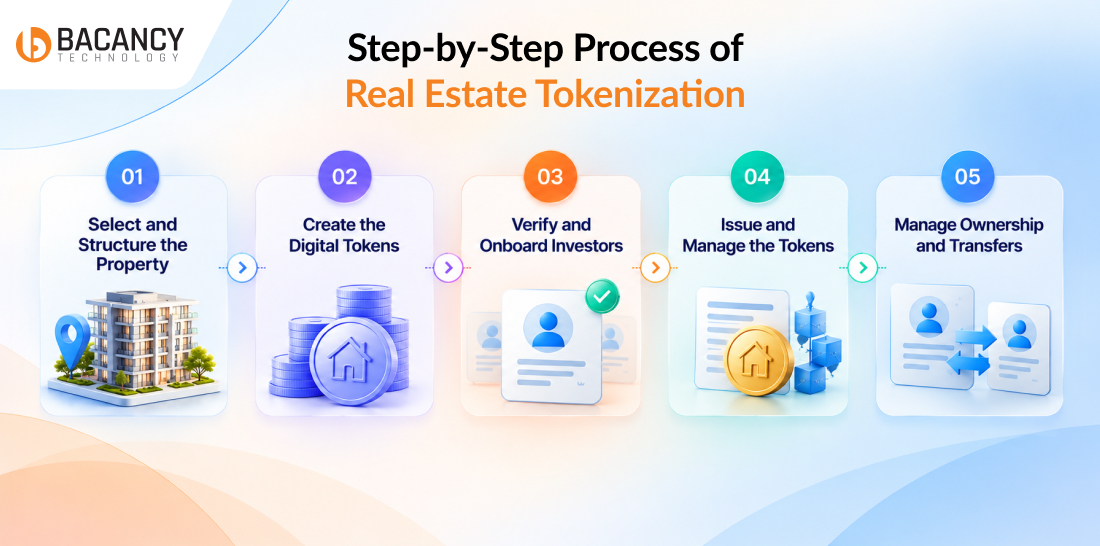
While the exact process can vary by property and jurisdiction, real estate tokenization generally follows 5 key steps:
Step 1: Select and Structure the Property
The property is identified, valued, and placed under an appropriate legal structure. The issuer also defines what the tokens will represent, such as fractional ownership or an economic interest in the asset.
Step 2: Create the Digital Tokens
The defined property interests are converted into digital tokens and issued on a blockchain. The token structure specifies ownership rights, transfer conditions, and other relevant terms.
Step 3: Verify and Onboard Investors
Potential investors complete required checks, such as KYC and AML verification, before they can participate in the offering.
Step 4: Issue and Manage the Tokens
Approved investors purchase the tokens, with their holdings recorded on the blockchain. Smart contracts can support transactions, income distributions, and other predefined processes.
Step 5: Manage Ownership and Transfers
After issuance, investors can manage their token holdings through digital wallets. Where permitted, tokens may also be transferred or traded through an approved secondary marketplace, subject to applicable regulations.
Where Digital Wallets and Custody Fit In
After purchasing tokens, investors need a way to hold and manage them. Digital wallets provide this functionality by allowing investors to store their tokenized assets and authorize transactions. Platforms that want a built-in wallet experience can hire blockchain developers to integrate wallets directly with the token contracts.
A platform may also use custody services, where a regulated or specialized provider holds the digital assets on behalf of investors. This can be particularly relevant for institutional investors that require additional controls around asset security, access, and compliance.
Planning to build a real estate tokenization platform?
Our fintech software development services help you build integrated workflows for token creation, investor verification, smart contracts, wallet management, custody, and digital asset transfers.
Types of Real Estate Tokens
The rights attached to a token depend on how the underlying property or investment is structured. Some tokens can represent ownership in an asset, while others can represent debt, fund interests, or a share in the income generated by a real estate portfolio.
Equity Tokens vs Debt Tokens
Equity tokens represent an ownership interest in a real estate asset or entity that owns the asset. Investors may receive a share of rental income, property appreciation, or proceeds from a future sale that depends on the structure.
On the other hand, debt tokens represent a loan or debt claim linked to a real estate project. Instead of holding an ownership interest, investors typically provide capital to the property owner or developer in exchange for interest payments and repayment of the principal under defined terms.
The key difference is what the investor receives: equity tokens are linked to ownership or economic participation, while debt tokens represent a claim for repayment.
Fund Tokens and REIT-Style Structures
Real estate tokenization can also be applied to investment funds or structures that hold multiple properties. In this model, tokens can represent an interest in the fund rather than direct ownership of a particular property.
A REIT-style structure follows a similar portfolio-based concept, where investors gain exposure to a pool of real estate assets through an investment vehicle. The difference is that tokenization uses blockchain-based tokens to represent the investor’s interest and can introduce digital ownership records and automated transaction processes.
The exact rights, income distribution, transferability, and regulatory treatment depend on the legal structure behind the token.
What are the Benefits of Tokenizing Real Estate?
If you are looking at real estate tokenization, the biggest question is simple: what does it actually change for your business and investors? By putting property interests on the blockchain, you can simplify certain processes, improve visibility, and create more flexible ways to structure real estate investments.
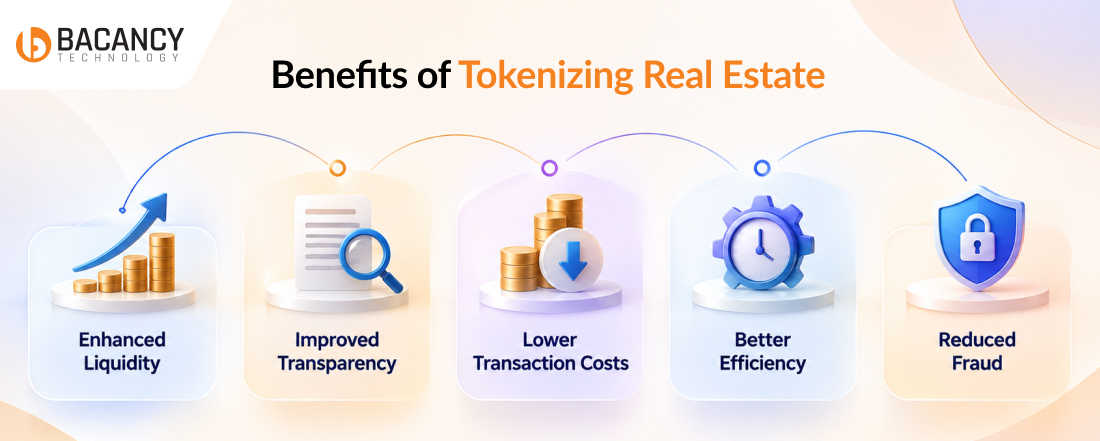
Enhanced Liquidity
If you own or manage a high-value property, selling the entire asset can take time. Tokenization can divide the property into smaller investment interests, giving investors more flexibility to buy or transfer their share. Where a compliant secondary market exists, these tokenized interests may also be easier to trade than traditional property interests.
Improved Transparency
When multiple parties are involved in a property investment, keeping track of ownership and transactions can become complicated. Blockchain gives you a shared digital record of token ownership and transfers, which makes it easier to track activity and provide greater visibility to authorized participants.
Lower Transaction Costs
Traditional property transactions can involve paperwork, intermediaries, and several administrative steps. Tokenization can digitize parts of these processes and use smart contracts to automate predefined transactions that help you reduce certain administrative and operational costs.
Better Efficiency
From investor onboarding to ownership records and income distributions, you can manage several activities through a digital platform. Smart contracts can also automate routine actions based on predefined rules, which reduces manual intervention and streamlines day-to-day processes.
Reduced Fraud
A blockchain creates a traceable record of token ownership and transactions that is difficult to alter retrospectively. When combined with KYC, access controls, and other security measures, tokenization can help you strengthen transaction tracking and reduce the risk of certain types of fraudulent activity.
Integrating fintech cybersecurity services into the platform can add further protection for investor data, digital assets, and transaction workflows.
Real Estate Tokenization and Fintech Infrastructure
Real estate tokenization needs more than blockchain to function effectively. The fintech infrastructure behind it helps manage investor verification, payments, transactions, and regulatory requirements. Together, these systems connect the tokenized asset with the financial processes required to issue, purchase, hold, and transfer real estate tokens.
Role of KYC and AML Compliance
KYC and AML are crucial parts of any platform that handles real estate investments. KYC verifies an investor’s identity and eligibility, while AML checks help detect suspicious transactions and potential financial crime.
For tokenized real estate, these checks can be integrated into the investor onboarding process. Once an investor completes the required verification, the platform can determine whether they are eligible to purchase or transfer specific tokens based on applicable rules.
Payment Rails for Token Transactions
Tokenized real estate also needs reliable payment infrastructure to move money between investors, platforms, and asset owners. Payment rails can support token purchases, rental income distributions, redemptions, and other financial transactions.
Depending on the platform and market, this infrastructure may connect bank transfers, payment processors, digital assets, or stablecoins with the tokenization system. This creates a link between the movement of funds and the corresponding token transactions.
RegTech and Regulatory Automation
Regulatory requirements can become more complex when tokenized real estate involves multiple investors, assets, or jurisdictions. RegTech helps automate parts of the compliance process through transaction monitoring, reporting, identity checks, and rule-based controls.
For instance, regulatory automation can restrict transfers to verified investors, flag transactions for review, and maintain compliance records. This allows compliance requirements to be built directly into the platform rather than handled separately after each transaction.
Are your payment and compliance systems ready for tokenized financial transactions?
Choose our fintech IT solutions and services to integrate payment rails, KYC and AML checks, transaction monitoring, and regulatory controls into your platform.
What are the Challenges of Real Estate Tokenization?
Tokenization in real estate can create new ways to structure and manage property investments, but it also introduces challenges that businesses need to address.
Regulatory Uncertainty Across Markets
Real estate tokens can fall under different regulatory frameworks depending on what the token represents and where the offering takes place. Securities laws, property regulations, KYC/AML requirements, and digital asset rules can vary significantly between jurisdictions, especially in cross-border blockchain transactions.
It means a tokenization model that works in one market may require changes before it can be offered in another. Businesses need to establish the regulatory classification of their tokens and understand the requirements that apply to issuance, investor participation, transfers, and reporting.
Legal Frameworks Tying Tokens to Property Rights
A digital token does not automatically give its holder legal ownership of a physical property. The legal structure must clearly establish the relationship between the token and the underlying asset.
It can involve entities such as special purpose vehicles (SPVs), contracts, shareholder agreements, or other ownership arrangements. The rights attached to the token, including income, voting, redemption, or sale proceeds, also need to be clearly defined and enforceable.
Liquidity Gaps in Secondary Trading
Tokenization can make fractional ownership easier to structure, but that does not guarantee a liquid market. Investors still need a suitable marketplace and enough buyers and sellers to trade their tokens.
Secondary trading can also be subject to investor eligibility rules, transfer restrictions, securities regulations, and jurisdiction-specific requirements. As a result, the ability to trade a token depends not only on blockchain technology but also on the legal framework and market infrastructure supporting it.
Who’s Adopting Tokenized Real Estate: Use Cases
Real Estate Tokenization is moving beyond experimentation as businesses look for new ways to structure property investments, raise capital, and serve investors digitally. Banks, wealth platforms, developers, and funds can use tokenization to create investment products, simplify asset management, and build new revenue opportunities.
1. Banks and Financial Institutions
Banks can tokenize eligible real estate assets to create fractional investment products for their customers. This allows them to offer digital property investment opportunities while connecting tokenized assets with existing banking infrastructure, including KYC, AML, payments, and custody.
Tokenization can also help financial institutions develop new fee-based services around asset issuance, custody, settlement, and digital investment management.
Wealth management platforms can add tokenized real estate to their investment offerings and give eligible clients access to fractional property interests. It creates an opportunity to expand alternative investment portfolios without requiring clients to purchase an entire property.
With the right infrastructure, platforms can manage token purchases, portfolio visibility, distributions, and compliant transfers through a single digital experience.
3. Real Estate Developers and Funds
Developers and funds can use tokenization to structure fractional investment opportunities and reach a broader pool of eligible investors. Instead of relying solely on traditional capital-raising structures, they can represent defined property interests through digital tokens.
Tokenization can support automated distributions, digital investor records, and streamlined ownership management that help your developers and fund managers create a more efficient investment lifecycle.
How Bacancy Technology Builds Real Estate Tokenization Platforms
Bacancy Technology approaches real estate tokenization through our customized real estate software development for property owners, financial institutions, and CTOs. Our team begins by understanding your property model, tokenization goals, investor requirements, and compliance needs. We then design and develop the platform with blockchain integration, smart contracts, token issuance, investor onboarding, KYC/AML, payment gateways, digital wallets, ownership management, and investor dashboards. Where required, we also develop secondary marketplace capabilities for compliant token transfers. This approach gives you a purpose-built platform that brings property assets, digital investments, and financial workflows together.
Frequently Asked Questions (FAQs)
To tokenize real estate, legally structure the property, define token rights, choose a blockchain, develop smart contracts, complete KYC and AML checks, and set up token issuance, wallets, custody, and transfers. Bacancy Technology can build the software infrastructure that connects these workflows.
Yes, real estate tokenization can be legal, but the applicable rules depend on the property structure, token type, investor rights, and jurisdiction. Tokenized real estate may fall under securities, property, KYC, AML, and financial regulations. Legal and regulatory requirements should be assessed before issuing or transferring tokens.
Real estate tokenization can cost $10,000 to $500,000+, depending on the project scope. A basic or white-label solution may start around $10,000, while a custom enterprise platform can exceed $25,000 to $500,000.
Tokenized real estate uses blockchain-based tokens to represent ownership or economic rights, while REITs are regulated investment vehicles that own or finance real estate. Tokenized models can enable fractional ownership and digital transfers, whereas REITs operate through established corporate and regulatory structures.
To invest in tokenized real estate, an investor typically selects a property offering, completes KYC and AML verification, reviews the token’s ownership or economic rights, funds the investment, and purchases the tokens. Depending on the platform and jurisdiction, the tokens can then be held in a digital wallet and transferred or traded through an approved marketplace.