Looking to implement Python for fraud detection? This blog explains how to choose the right Python libraries for fraud detection, machine learning models, and detection techniques for your needs. Learn how to build a real-time fraud detection system, tackle implementation challenges, and identify suspicious transactions while keeping false alerts under control.
Table of Contents
Introduction
A fraudulent transaction costs more than the transaction value. Missed fraud can lead to chargebacks, investigation costs, and reputational damage. But overly aggressive fraud controls create another problem: blocking legitimate payments frustrates customers and erodes trust.
The Federal Reserve’s 2026 Risk Officer Report highlights the growing fraud challenges facing financial institutions. For CTOs and VPs of Engineering, Python for fraud detection offers an effective way to build systems that identify suspicious activity early while minimizing disruption to legitimate transactions.
In this blog, you will see why Python is a preferred choice, which libraries and machine learning techniques help you identify suspicious transactions, and how to run fraud detection using Python in real time.
Why Use Python for Fraud Detection?
Python is a strong fit for fraud detection because this language provides the full path from raw transaction data to a live risk score. Your team can explore data, train models, test them, and deploy them without switching stacks. That matters when fraud tactics shift every few weeks, and your system has to keep pace.
Here is how Python helps at each stage.
1. Extensive Libraries for Machine Learning and Statistical Analysis
Python with Machine Learning as one of the richest ecosystems for fraud analytics. Scikit-learn, XGBoost, LightGBM, and PyTorch give your team tested tools for classification, anomaly detection, and risk scoring. SciPy and statsmodels help you study spending behavior and flag outliers. Your data scientists put their time into fraud signals instead of rebuilding algorithms from scratch.
2. Support for Large-Scale Transaction Data Processing
Fraud detection runs on volume. Pandas handles day-to-day analysis. PySpark and Dask scale the same logic across millions of transactions on distributed systems. You can create features like transaction velocity, device history, and spend patterns from months of payment data. You also catch coordinated fraud rings that manual review would miss.
3. Integration With Banking APIs, Databases, and Data Pipelines
A fraud model only helps if it sees the data in time. Python connects to core banking systems, payment gateways, SQL and NoSQL databases, and data pipelines built on Kafka or Airflow. Your detection layer plugs into the stack you already run, so you skip the costly rewrite.
4. Flexibility to Develop and Test Different Detection Models
No single model catches every type of fraud. With Python, you can run rule engines, logistic regression, gradient boosting, and neural networks on the same dataset. Compare precision, recall, and false positive rates, then keep the model that performs best. When a new fraud pattern shows up, retrain and redeploy fast.
5. Support for Batch Processing and Real-time Inference
Batch jobs review past activity, tune thresholds, and retrain models on fresh data. Real-time inference scores a payment in milliseconds, before it clears. Frameworks like FastAPI and Kafka consumers serve live predictions at scale. This is a big reason teams choose Python for fraud detection: one language handles both workloads, so your team maintains a single codebase.
Which Python Libraries for Fraud Detection Should You Use?
The right Python libraries for fraud detection depend on the job at hand: cleaning data, training a model, fixing class imbalance, or catching drift. No single package has all of it. Most teams pair a few core tools with a few specialists. Here is what each one is best at.
1. Scikit-learn
Use it for your first model. Logistic regression and random forest set the bar that anything fancier has to beat. Isolation Forest flags unusual payments with zero fraud labels. Confusion matrices, ROC-AUC, and cross-validation keep your results honest.
2. Pandas
Raw payment logs are messy. Pandas parses timestamps and time zones, standardizes currencies, and removes duplicate events. Joins attach device and merchant history to each transaction, so every row carries the context a model needs.
3. NumPy
Compute the gap between consecutive payments, the ratio of an amount to a customer’s average, or a z-score across a million rows with no loops. Every other library here runs on NumPy arrays, so it acts as the shared language between them.
4. TensorFlow
Sequence models read a customer’s recent history as an ordered series. LSTM and GRU layers pick up slow shifts in behavior, like small test charges before a large theft. Autoencoders train on normal payments only, then flag anything they struggle to rebuild.
5. XGBoost
Boosted trees tend to win on tabular data, and most fraud data is tabular. XGBoost handles missing values and mixed feature types out of the box. Built-in feature importance shows which signals drive your scores.
6. Imbalanced-learn
Fraud can be a fraction of a percent of your data, and a model may learn to ignore it. SMOTE builds synthetic fraud examples. Borderline-SMOTE and ADASYN focus on the hard cases near the decision boundary. Resample only the training folds, inside a pipeline to avoid data leakage.
7. PyCaret
A single compare_models() call trains and ranks a dozen algorithms. Its setup step handles encoding and train-test splits for you. It is a fast way to shortlist candidates before you commit engineering time.
8. River
River updates a model one event at a time. Built-in drift detectors such as ADWIN signal when fraud patterns shift. As chargeback labels arrive, the model learns from them without a full retrain.
Python Fraud Detection Libraries by Pipeline Stage
Library
Use Case
Stage in Pipeline
Pandas
Merge sources into one feature table
Data Preparation
Scikit-learn
Reusable pipelines and cross-validation
Modeling and evaluation
XGBoost
Main classifier for tabular scoring
Modeling
LightGBM
Faster training on wide, high-cardinality data
Modeling
imbalanced-learn
Rebalance classes before training
Training data prep
PyOD
Unsupervised outlier scoring when labels are scarce
Anomaly detection
NetworkX
Link analysis across shared cards, devices, and addresses
Feature engineering
SHAP
Per-decision reason codes for analysts and auditors
Explainability
FastAPI
Scoring endpoint that other systems can call
Deployment
MLflow
Experiment tracking and model registry
Monitoring and MLOps
If you are just starting fraud detection using Python, begin with pandas, scikit-learn, and XGBoost.
How Machine Learning Supports Python in Fraud Detection
Machine learning lets Python fraud systems learn from past behavior and score new payments in real time. Rules catch the fraud you already know. ML catches patterns you have not seen yet, which is the core idea behind AI fraud detection. Most Python libraries for Machine Learning combine the 4 approaches below.
1. Supervised Models
Supervised models learn from labeled history, where every past transaction is tagged as fraud or legitimate. They study features like amount, merchant category, device, location, and time since the last purchase. Each new payment gets a fraud probability between 0 and 1. It is the same scoring logic used across predictive analytics in finance, applied to one payment at a time.
Labels arrive late. Chargebacks can take 30 to 90 days, so plan for that delay when you train and validate. Set your score threshold based on cost. A blocked good customer costs a sale and some trust. A missed fraud costs the transaction value plus fees.
Best for: Known fraud types such as card-not-present fraud and account takeover.
2. Unsupervised and Anomaly Detection
These models need no labels. They learn what normal looks like for a customer or a peer group, then flag anything far outside it. Clustering methods like DBSCAN and HDBSCAN group similar behavior, and payments that fit no group get a closer look.
This helps most with new attack types and cold starts, where no fraud history exists. Unusual does not always mean fraud, so most teams send anomaly scores to an analyst queue or feed them into a supervised model.
Best for: Emerging threats, new customers, and data with few fraud labels.
3. Graph Analysis for Fraud Rings
Single payments often look clean. The links between them give fraud away. A graph maps customers, cards, devices, IP addresses, and phone numbers as nodes, with shared details as edges.
Patterns show up fast. 20 accounts share 1 device. A group of cards cashes out at the same merchant. Mule accounts forward funds within minutes. Community detection methods like Louvain find tight clusters, and graph neural networks learn from the structure itself.
NetworkX handles this analysis natively, which makes graph features one of the clearest wins of Python for fraud detection.
Best for: Synthetic identity fraud, money mule networks, and organized fraud rings.
4. Deep Learning for Sequences
Some fraud only shows in the order of events. A new device login, a password reset, an address change, and a large transfer form a classic takeover chain. Each step looks harmless alone.
Sequence models such as LSTMs and transformers read a customer’s recent activity as one story. They need more data and computation than tree-based methods, and they pay off when your history is deep and timing matters.
Best for: Account takeover and behavioral shifts in large datasets.
How the 4 approaches work together
No single method wins everywhere. A common setup uses a supervised model as the main scorer, anomaly detection for new threats, graph features for rings, and a sequence model for behavior over time. Python holds all four in one codebase and feeds them into a single decision engine.
Which Python Techniques Are Used for Fraud Detection?
Fraud detection using Python usually relies on 4 techniques, often in layers. Each one catches a different kind of risk, and each has a clear limit.
Rule-Based Fraud Detection
Rules are fixed checks written in plain logic. Examples include more than five payments in ten minutes, a shipping country that differs from the card country, or an amount above a set limit. Python runs them with pandas filters or a rules engine.
Rules are fast, easy to explain, and ready on day one. They also go stale. Fraudsters learn the limits and stay just under them.
Supervised Machine Learning for Known Fraud Patterns
Supervised models learn from past cases that carry a fraud or legitimate label. Random forest and gradient boosting are the usual picks. Two settings matter most in fraud work. Class weights tell the model that a missed fraud costs more than a false alert. Probability calibration makes a score of 0.8 mean roughly an 80% chance of fraud, which helps when you set decision bands.
This technique works well when you have plenty of labeled history. It struggles with attack types it has never seen.
Anomaly Detection for Unusual Transactions
Anomaly detection looks for payments that break a customer’s normal pattern. Isolation Forest and autoencoders are common choices. A simpler option is a rolling z-score on each customer’s spend, which flags a payment far above their usual range.
It needs few or no labels, so it suits new products and new markets. Expect some noise, since a rare but genuine purchase can look odd.
Hybrid Models for Layered Fraud Detection
Hybrid systems stack the three techniques. Rules run first and block clear violations in milliseconds. A supervised model scores the rest. An anomaly score adds a second opinion on new behavior. The combined result sends each payment to approve, review, or decline.
Layers cover each other’s gaps. Rules handle the obvious cases cheaply, so ML time goes to the gray area. This layered design is where Python for fraud detection earns its place, because rules, models, and anomaly scores all live in one codebase
Looking to improve fraud detection accuracy?
Hire Python developers to build Python-based systems that identify suspicious transactions.
How to Build Fraud Detection Using Python: Step by Step
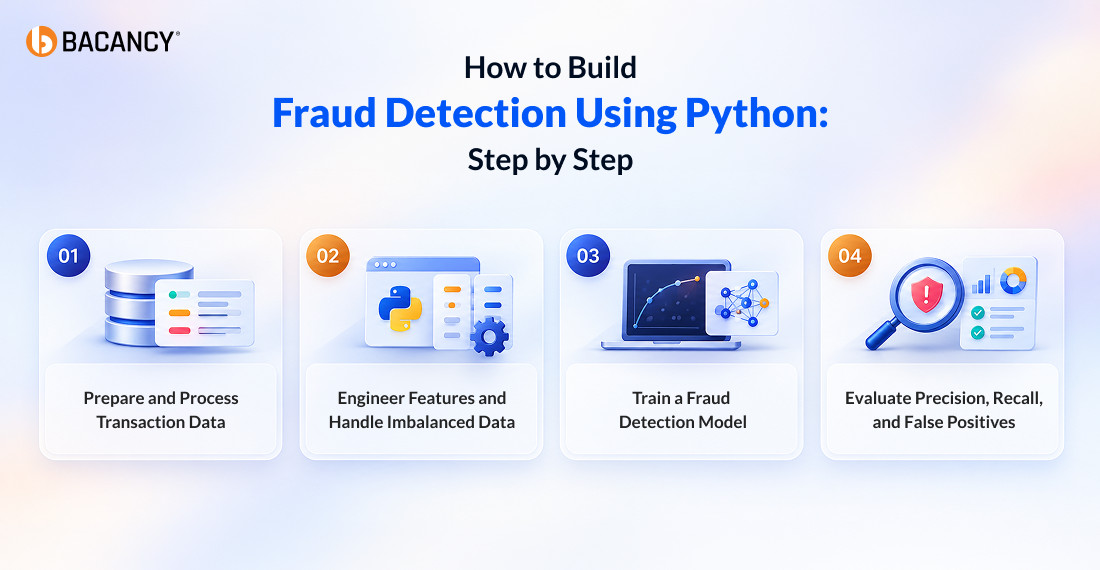
Step 1: Prepare and Process Transaction Data
Load transactions, labels, and customer data into pandas. Remove duplicates, fix timestamps, and fill or flag missing values. Split by time. Train on older months and test on recent ones, so the test mirrors real use.
Step 2: Engineer Features and Handle Imbalanced Data
Raw fields say little. Build behavior features, such as payment count in the last hour, average amount over 30 days, and number of new devices this week. Fraud is rare, so rebalance the training set with SMOTE or class weights.
Step 3: Train a Fraud Detection Model
Start with logistic regression as a baseline. Then train XGBoost and compare.
from xgboost import XGBClassifier

model = XGBClassifier(scale_pos_weight=ratio, eval_metric="aucpr")
model.fit(X_train, y_train)
scores = model.predict_proba(X_test)[:, 1]
Here, ratio is the count of legitimate transactions divided by the count of fraud cases.
Step 4: Evaluate Precision, Recall, and False Positives
A model that approves everything scores 99% on accuracy and catches nothing. Track precision, recall, and the precision-recall curve. Count false positives in dollars and in lost customers. Pick a threshold that matches your risk appetite, then retest on fresh data before launch.
How Does a Python Fraud Detection System Work in Real Time?
With Python for fraud detection, a real-time system scores each payment while the customer waits. Most teams aim for a response in under 100 milliseconds. Here is the flow.
1. Receive a Transaction Through an Existing Financial System
The payment gateway or core banking platform sends the request to a Python service, usually through a REST or streaming endpoint.
2. Process Relevant Transaction Features
The service pulls the customer’s recent history from a fast store like Redis and builds the same features used in training.
3. Generate a Fraud Risk Score Using a Trained Model
The model returns a probability from 0 to 1.
4. Apply Decision Rules to Approve, Flag, Decline, or Route the Transaction for Review.
Low scores pass. Mid-range scores go to an analyst or trigger step-up checks like OTP. High scores decline.
5. Monitor System Latency and Model Performance
Log every score and outcome. Track response time, alert volume, and chargeback rates, so you spot slowdowns and drift early.
What Are the Main Challenges of Python-Based Fraud Detection?
Most problems teams hit with Python for fraud detection come from the data and the systems around the model. Here are the 5 that come up most.
False Positives and Missed Fraud
Every threshold trades one error for the other. Tune it against real dollar costs, and review declined good customers each month.
Imbalanced and Shifting Transaction Data
Fraud may be well under 1% of volume, and the mix changes as attackers adapt. Use class weights, resampling, and fresh training data.
Model Drift and Changing Fraud Patterns
A model that worked in spring can slip by autumn. You can watch score distributions and recall each week, and retrain on a schedule or when drift alerts fire.
Data Security, Explainability, and Regulatory Requirements
Payment data falls under rules like PCI DSS and GDPR. Mask sensitive fields, control access, and keep audit logs; the same controls covered in Python for cybersecurity. Tools like SHAP give reason codes, so you can explain a decline to a regulator or a customer.
Integration with Legacy Banking Systems
Older core systems may run on batch files or unusual message formats. Wrap them with API layers or message queues, so the Python service gets clean data without a core rewrite.
This kind of wrapping work is routine in fintech software development, so plan for it early rather than treating it as an afterthought.
What Are the Best Practices for Production-Ready Fraud Detection?
A model that scores well in a notebook can still fail in production. These 5 practices close that gap for fraud detection using Python.
1. Use Time-Based Validation to Reduce Data Leakage
Fraud labels arrive late, often weeks after the payment. A random split lets your model learn from information it would never have in real life, so test scores look great and live results disappoint. Train on older data, test on newer data, and leave out transactions with immature labels. Scikit-learn’s TimeSeriesSplit helps.
2. Choose Decision Thresholds Based on Fraud Risk and Business Costs
A $20 digital purchase and a $5,000 wire carry different risks, so one cutoff will fail one of them. Set thresholds by segment and use three bands: approve, review, and decline. Size the review band to match your analysts’ daily capacity.
3. Monitor Precision, Recall, Drift, and Inference Latency
Track all 4 on 1 dashboard. You can use Plotly and Dash, famous for Python data visualization, to check drift with the Population Stability Index (PSI) and watch p95 and p99 latency to catch checkout timeouts. Recall lags because it needs confirmed labels, so use drift and alert rates as early warnings.
4. Maintain Audit Trails and Model Version Control
Customers, dispute teams, and regulators may ask why a payment was declined months later. Log the model version, input features, score, and decision for every transaction. Use MLflow for model versions and DVC for datasets, and keep a rollback path.
5. Incorporate Feedback from Fraud Investigation Teams
Analysts spot new tactics before the data does. Let them tag each alert as confirmed fraud, false alarm, or unclear, and feed those tags into your next training run. Their labels arrive faster than chargebacks, which shortens your retraining cycle.
Conclusion
Python for fraud detection gives your team one language for the full cycle: data prep, model training, real-time scoring, and monitoring. Start with a strong baseline, then add anomaly detection, graph features, and sequence models as your data grows. Fraud tactics keep shifting, so plan for regular retraining and review.
Before you build, check a few basics. How clean is your transaction data? What response time can your payment flow allow? Which legacy systems will feed the model? What audit and compliance rules apply? Clear answers shape the right model, threshold, and deployment path, and they save months of rework later.
We build Python fraud detection systems for banks, fintechs, and payment platforms. As a Python development company, we work with your engineers on data pipelines, model development, real-time scoring, and compliance-ready deployment. Share your current setup and fraud goals with Bacancy Technology, and we will map out where to start.
Frequently Asked Questions (FAQs)
No single library covers every need. Among the Python libraries for fraud detection, XGBoost is the most common choice for scoring transactions. Fraud data is mostly tabular, and gradient boosting handles it well. Pair it with pandas for data prep and scikit-learn for baselines and evaluation. Add PyOD when you have few fraud labels and need unsupervised outlier detection.
Gradient boosting (XGBoost or LightGBM) usually performs best on labeled transaction data. Random forest is a solid second option. For unlabeled data, Isolation Forest is a reliable starting point. The right pick depends on your data, so compare a few models on a time-based test set and judge them on precision and recall, not accuracy.
Yes. Real-time fraud detection using Python puts a trained model behind an API built with FastAPI or a similar framework. The payment system sends each transaction, the service builds features from recent customer history, and the model returns a risk score. Many teams target a response under 100 milliseconds. Fast feature stores like Redis and lightweight models keep latency low.
Start with better features. Behavior signals such as a customer’s usual spend, devices, and locations help the model tell odd from risky. Next, tune your thresholds by payment type and add a review band between approve and decline. Calibrate your probability scores, track false positives in dollars, and feed analyst decisions back into each retraining cycle.
Rajiv Mehta
AI/ML Developer at Bacancy
Versatile tech leader driving innovation across cloud, AI, and full-stack development.