Quick Summary
This blog covers predictive analytics in finance: where it works best, like fraud detection, credit risk, and cash flow forecasting. It also explains why so many projects fail before launch, what the 2026 rules mean for your team, and the key steps to get your first model live.
Table of Contents
Introduction
Banks make decisions every day that depend on what happens next.
- Will this payment turn out to be fraud?
- Will this borrower repay the loan?
- Will there be enough cash next month?
Predictive analytics in finance helps answer these questions by using past and current data to estimate what might happen. This gives banks and finance teams a chance to act early, reduce losses, and make better decisions before problems arise.
Many firms have started using predictive analytics, but getting a model to work in real business operations is harder. It needs regular checks, reliable data, and clear explanations that an auditor can review.
The cost of getting it wrong is real. US consumers reported a record $15.9 billion in fraud losses in 2025. Fixed rules also struggle to catch new scams that look like normal payments.
Usually the model isn’t what goes wrong. Projects get stuck on messy data, unclear ownership, and no plan for monitoring. The rules are changing as well. In the US, SR 26-2 now replaces SR 11-7, and the EU’s credit scoring rules apply from December 2, 2027.
This guide shows where predictive analytics pays off first, why projects stall, and the five steps to take a model into production. It’s written for CTOs, data heads, and finance leaders deciding what to build first.
What Is Predictive Analytics in Finance?
Predictive analytics in finance means using past and current data to predict what may happen in the future.
For example, banks use it to estimate whether a borrower will repay a loan, or to flag a payment that looks like fraud.
Predictive Analytics vs Traditional Financial Forecasting
Traditional forecasting starts by looking backward. A company pulls last year’s sales numbers, projects them forward to estimate future revenue, and typically revisits those figures once a month.
Predictive analytics for financial forecasting casts a wider net. It draws on how customers spend, how quickly they pay invoices, and what the market is doing. And when fresh data comes in, the model can fold it in and update its forecast almost immediately, instead of waiting for the next monthly review.
Of course, it comes at a price. Predictive analytics for financial forecasting takes more effort to set up, plus it needs enough quality data and ongoing review to work well. If your numbers are stable and predictable, though, a spreadsheet will probably do.
Data Sources Used in Financial Predictive Analytics
A model can only use the data it is given, so you need to know where yours comes from. Most firms rely on these sources:
- Bank and payment records: every transaction, balance, and payment a customer makes.
- Credit and open banking data: credit scores, loan history, and account details that customers have agreed to share.
- ERP and accounting systems: sales, expenses, invoices, and cash flow. Predictive analytics for financial forecasting mostly draws on these, especially in FP&A.
- Customer behavior: when people log in, which device they use, and any sudden change in their spending. Fraud often shows up here first.
- Outside data: stock prices, economic trends, company reports, and earnings calls.
Why Predictive Analytics in Financial Services Matters in 2026
AI use is now widespread across banks and lenders. But using AI is one thing, and making it work in daily operations is another. Predictive analytics in finance matters for two main reasons: many firms can’t measure what their AI delivers, and older fraud systems often miss new types of scams.
Most Firms Use AI, but Many Can’t Measure Its Value
The Cambridge Centre for Alternative Finance’s 2026 report found that 81% of the financial firms it surveyed use AI in some way. Yet 55% find it hard to measure the value of their AI, rising to 76% at large institutions.
So using AI is just the start. To get real results, you also need good data, someone who owns the project, and regular checks on how it’s doing.
Fraud Detection Needs More Than Rules
Old fraud systems run on fixed rules, like flagging an unusually large payment. That means they miss new kinds of fraud, and sometimes they block a customer who did nothing wrong.
A predictive model looks at several things at once: the customer’s payment history, the device they’re using, and whether they’re paying someone new. Put together, those clues can show fraud that no single rule would catch.
In a 2026 Mastercard industry survey, 83% of respondents said false positives dropped a lot after they started using AI tools. Mastercard sells fraud prevention tools, so test these results on your own data before you expect the same.
That’s why more banks are adopting predictive analytics in finance.
Common Predictive Analytics Models Used in Finance
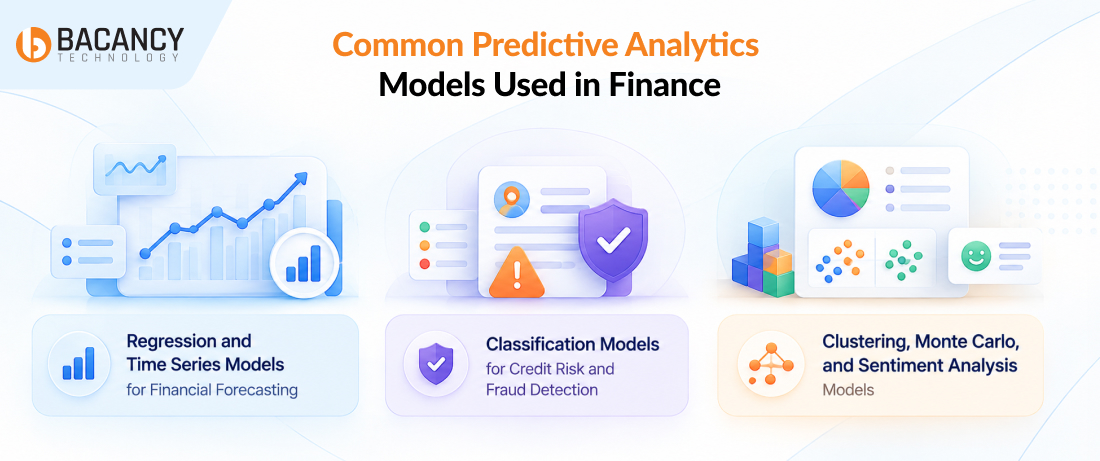
Predictive modeling in finance has no one-size-fits-all model. Some models forecast income and cash flow. Others catch fraud or judge how risky a loan is. Take a look below:
Regression and Time Series Models for Financial Forecasting
In predictive analytics for financial forecasting, regression shows how one thing affects another. Let’s say you raise your prices. Regression can tell you how much your revenue is likely to change because of it.
Time series models, like ARIMA and Prophet, learn from what has already happened. If your sales jump every December, the model notices that and expects it to happen again. Predictive analytics for financial forecasting often uses these for revenue, cash flow, and bank deposits.
Classification Models for Credit Risk and Fraud Detection
A classification model gives a yes or no answer. Will this borrower miss a payment? Is this transaction fraud?
Most lenders use logistic regression for credit scoring. XGBoost and LightGBM are popular too, since they can look at many factors at once, whether they’re scoring credit risk or looking for fraud.
Accuracy alone can’t tell you whether a fraud model is any good, because fraud is so rare.
If only 1 in 100 payments is fraudulent, a model that approves everything is right 99% of the time and still catches nothing. So look at two other things: how much of the real fraud it catches, and how many legitimate payments it blocks by mistake.
Clustering, Monte Carlo, and Sentiment Analysis Models
These three models help teams understand customers, plan for what might happen, and get a read on the market.
- Clustering: Sorts customers or accounts into groups that behave alike. Banks use it to understand their customer types and to find accounts that act strangely.
- Monte Carlo simulation: Runs thousands of “what if” scenarios. Teams use it to prepare for market losses, cash shortages, or changes in investment risk.
- Sentiment analysis: Reads news, company reports, and earnings calls to see how people feel about a company or the market. It’s a noisy signal, so treat it as one input and never rely on it alone.
Model Accuracy vs. Explainability: Which Should You Choose?
With predictive analytics in finance, the right model depends on what you need to predict and whether you must explain the result.
| Model | Accuracy | Ease of explanation
| Best use
|
|---|
| Logistic regression/scorecard | Good | Easy to explain | Credit scoring and lending decisions |
| Gradient boosting (XGBoost, LightGBM) | Very good for many types of financial data | Needs extra tools, such as SHAP | Fraud detection, credit risk, and customer churn |
| Neural networks (PyTorch, TensorFlow) | Very good for large or complex data | Harder to explain | Transaction patterns, text, and complex fraud cases |
| Time series (ARIMA, Prophet) | Good when past patterns continue | Easy to explain
| Predictive analytics for financial forecasting |
Before you pick a model, ask yourself two things. How much does a wrong prediction cost you? And will anyone have to explain the decision later?
If you’re lending, begin with logistic regression or a scorecard. It’s simple to tell a customer why their application was approved or turned down. Gradient boosting can work too, but you’ll need SHAP to show what pushed the decision one way or the other.
Fraud is a different problem. You want a model that stops suspicious payments without blocking too many genuine ones. Even then, keep a person on hand for the cases the model can’t decide.
That covers the models. Next are the predictive analytics use cases in finance that banks, fintechs, and insurers rely on.
Top Predictive Analytics Use Cases in Finance: Banking, Fintech, and Insurance
Predictive analytics can help banks, fintech companies, and insurers make better decisions and manage risks. Here are 7 common use cases and how businesses use them.
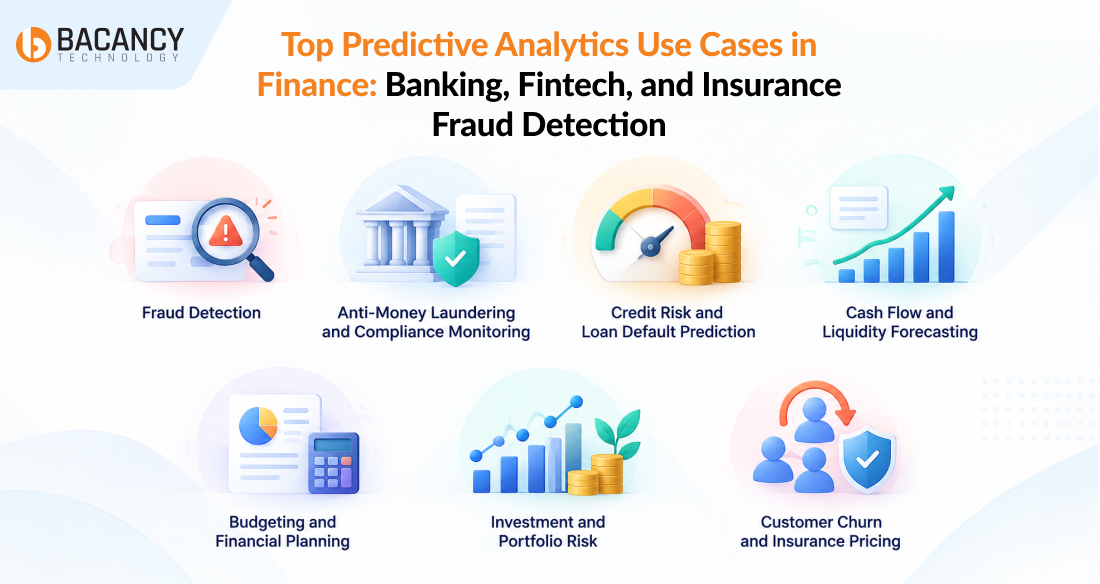
Fraud Detection
Predictive analytics for fraud detection checks every payment and flags the ones that look off. The model looks at the amount, how often the customer pays, which device they’re on, and what their account usually does.
Don’t try to fix every kind of fraud at once. Pick one, like card fraud or transfers to new payees. Then track two things: how much fraud the model catches, and how often it blocks a payment that was fine. Too many false alerts and your staff end up spending their day checking safe payments.
Anti-Money Laundering and Compliance Monitoring
Every bank has to look out for money laundering. Rule-based systems make that job harder, because they flag so many transactions that staff can barely get through the list, let alone spot the real cases.
A predictive model can rank those alerts by risk, so analysts look at the serious ones first. It can also connect accounts that seem unrelated. Don’t drop the checks your regulator requires, though. Use the model to decide what to review first, not to replace the basics.
If you’re a US bank, look at the Federal Reserve’s SR 26-2 guidance when you update your model risk policies. It replaced the 2021 interagency statement on model risk management for BSA/AML systems
Credit Risk and Loan Default Prediction
Lenders use predictive models to work out whether a borrower is likely to fall behind on payments. The model checks things like credit history, income, and how much debt the person already has. If the rules allow it, it can also look at their bank transactions.
Open banking data helps when a borrower has little or no credit history. Before you use any model, make sure it treats applicants fairly. Then keep tracking missed payments over time. Interest rates and people’s finances change, and the model’s predictions can slip along with them.
Cash Flow and Liquidity Forecasting
Finance teams need to know when money is coming in and when bills are due. Predictive analytics for financial forecasting looks at past payments, invoices, and spending to estimate how much cash you’ll need.
Many businesses plan their cash 13 weeks ahead. Predictive analytics in banking works the same way for customer withdrawals and daily payments. Show a likely range instead of one fixed number. That way, if cash runs short, you’ve already planned for it.
Budgeting and Financial Planning
Finance teams use predictive analytics for financial forecasting to build rolling, driver-based plans. The model tracks sales, headcount, prices, and costs. When one changes, the forecast updates too. Businesses can also use financial forecasting software to bring these projections together, compare different scenarios, and adjust financial plans as conditions change.
Say sales come in lower than planned. The model can show how that hits your revenue and spending. You can check the forecast every week instead of waiting for month-end. Your finance team still has to review the assumptions and decide what to do about it.
Investment and Portfolio Risk
Investment firms use predictive models to see how risky their portfolios are. A model can show how far prices might swing, how your holdings could react if the market moves, and what a bad downturn might do to you.
Predicting returns is a different story, and it’s much harder. A model can look brilliant on old data and then fall apart the moment it sees new numbers. So test it on data it has never seen, and see if it still holds up in the real market.
Customer Churn and Insurance Pricing
A customer rarely leaves without warning. Their balance drops, they log in less, they complain about a fee more than once. A churn model picks up on this early. Then someone can call them or offer a better deal before they close the account.
Insurers use predictive models too, mainly to price risk and set premiums. Most still rely on older statistical methods. Newer models are used alongside them to compare results.
If you sell life or health insurance in the EU, be careful. The AI Act treats AI used for pricing and risk assessment there as high-risk. Find out what that means for your model before it goes live.
Need help building predictive models for your financial business?
Explore our fintech AI development services to build predictive models that fit your business needs.
Business Benefits of Predictive Analytics in Finance
Take a look at what predictive analytics in finance can do for you in your enterprise. But do not take this at face value. Monitor the metrics that matter to your enterprise.
| Business benefit | What to measure |
|---|
| Fewer genuine payments flagged as fraud and lower fraud losses | False positive rate and fraud losses |
| More accurate cash flow and revenue forecasts | Forecast error (WAPE) |
| Better lending decisions | Default rate for each risk group |
| Less time spent preparing forecasts | Time taken to complete each forecast |
Save your current numbers before you start. After the model goes live, compare the new numbers with the old ones. That’s how you know if it helped.
Why Many Predictive Analytics in Finance Projects Fail Before Launch
Building a predictive model is the easy part. Getting it to work in the real world is where most projects fall apart. Here’s why predictive analytics in finance fails before launch: bad data, customer habits that keep changing, and too few people with the right skills.
Poor Data and Systems That Don’t Talk to Each Other
Most banks keep customer and payment data in different systems. Details go missing, records don’t match, and every team saves data in its own format. Predictive analytics for financial forecasting can’t work from data like that.
A model can also look great in testing and fall flat once live, often because of data leakage or differences between training and live data. So clean and check the data first. A financial services data analytics team can help you sort out your data before you build a model.
Models That Lose Accuracy Over Time
Predictive analytics for financial forecasting that works today may not work as well in a year. Fraudsters try new tricks, customers change how they spend, and interest rates keep moving. Over time, these changes make the model’s predictions less accurate. This is called model drift.
Keep an eye on your models and check regularly that they still work. Some results, like loan defaults, take months to show up, so you can’t just wait for them. Until they do, watch for early warning signs. And test any new model before it replaces the old one.
Talent Gaps: Hiring the Right Team
Data scientists alone can’t run a model. You also need people who can prepare the data, put the model into use, and keep it working.
Compliance, Explainable AI, and Model Risk Management in 2026
Getting a model to work is only part of the job. Firms using predictive analytics in financial services must explain decisions, protect customer data, and follow the rules that apply. Here are the main points to consider in 2026.
EU AI Act and Credit Scoring
The EU’s Digital Omnibus, which took effect on July 27, 2026, changed the timeline for some high-risk AI systems. The deadline for certain systems used to assess creditworthiness moved from August 2, 2026, to December 2, 2027. See the EU regulation.
The later deadline does not give predictive analytics in finance a free pass. If your credit scoring system falls under the high-risk category, use this time to prepare the required records, check your data, and decide who will review its decisions.
AI whose main intended use is detecting financial fraud is excluded from the credit-scoring category, but life and health insurance pricing gets no such exclusion.
US Model Risk Rules: SR 11-7 Has Been Replaced by SR 26-2
On April 17, 2026, US banking regulators issued new model risk management guidance called SR 26-2. It replaces the earlier SR 11-7 guidance and takes a more risk-based approach. This means banks can adjust their checks based on a model’s importance and the risks it creates. Read the Federal Reserve’s guidance.
The guidance is non-binding, excludes generative and agentic AI, and is most relevant to banks with more than $30 billion in assets. Banks should review their existing model risk policies and update references to SR 11-7 where needed. Lenders must also continue to follow applicable rules on explaining credit denials, including Regulation B.
Banks in other regions have their own requirements. UK banks with internal model approval must follow the PRA’s SS1/23. Others may find it a useful guide. In India, financial firms can refer to the RBI’s FREE-AI framework for guidance on responsible AI use.
How to Explain Model Decisions with SHAP and LIME
When a model rejects a loan application or flags a payment, your team may need to explain why. SHAP (SHapley Additive exPlanations) and LIME (Local Interpretable Model-agnostic Explanations) help show which factors influenced a model’s prediction.
SHAP shows how different factors affected a particular prediction. LIME creates a simpler explanation for one prediction. Both can help teams review model decisions, but neither proves that a factor caused the result. Teams should check these explanations before using them to support lending or other important decisions.
Keeping Customer Data Safe
Predictive analytics in finance often uses sensitive information, such as payment history, income, and account activity. Firms need to protect this data throughout the process.
Remove or replace personal details when possible, limit who can access the data, and keep records of access. Check where data can be stored and how it can be used under the rules that apply to your business, including GDPR, India’s DPDP Act, and PCI DSS for payment card data.
Tools and Tech Stack for Predictive Analytics in Finance
Predictive analytics in financial services doesn’t need every tool out there. Choose tools that fit your data, work with your existing systems, and are easy for your team to maintain and review.
Python, scikit-learn, XGBoost, TensorFlow, and PyTorch
Python is a common choice for predictive analytics in finance. Scikit-learn works well for basic models and credit scoring. XGBoost and LightGBM are useful when a model needs to find patterns across large sets of financial data.
TensorFlow and PyTorch are better suited to more complex tasks, such as studying transaction sequences, text, or links between accounts. For many financial datasets, start with a simpler model or boosted trees before moving to deep learning. Test both options to see which works better for your data.
Data Pipelines and Warehousing: Spark, Snowflake, Databricks
Predictive analytics in finance needs clean, up-to-date data. Apache Spark and Databricks help teams process large amounts of data. Kafka can send new transactions to a model for checks as they happen.
Snowflake and Databricks can store and manage data for analysis. A feature store keeps the data used to train a model consistent with the data it receives when making predictions. This helps prevent differences between test results and live results.
These platforms help teams train models, manage approved versions, put models into use, and track their performance.
Choose a platform that works well with your current data systems and meets your data storage requirements. Keep records of model changes, approvals, and performance checks so your team can review them during an audit.
BI and Reporting: Power BI and Tableau
Tools such as Power BI and Tableau turn model results into reports and charts that finance and risk teams can use.
In predictive analytics for financial forecasting, a cash flow report can show a range of outcomes, not one fixed figure. Users should also be able to see which factors affected a forecast. Store model results in a shared data warehouse so finance and risk teams work from the same figures.
How to Build Predictive Analytics in Finance: 5 Steps
Building a predictive model takes more than choosing the right tools. Here are 5 steps to help you build, test, and use predictive analytics in finance.
Step 1: Set One Clear Goal
Decide what you want to improve, how you will measure it, and who will be responsible. For example, aim to reduce false alerts on transfers to new payees by 25% without missing more fraud. If no one owns the final decision, settle that before building the model.
Step 2: Check and Clean Your Data
Predictive analytics for financial forecasting usually needs 2 years or more of past data to cover seasonal changes. Define what counts as fraud or loan default and when that information becomes available. Check for missing values, imbalanced data, and information that could give the model an unfair advantage during testing. Split the data by time, not at random.
Step 3: Train and Test the Model
Start with a simple model, then compare it with stronger options such as boosted trees. Test them on later data they have not seen before. Measure the cost of wrong predictions, not just overall accuracy. Check for unfair results and use SHAP to understand which factors affect predictions.
Step 4: Connect the Model to Your Systems
Use an API to connect the model to your banking or payment systems. Plan the integration work early, as connecting the model to existing systems can take time. First, run it in the background without affecting real decisions. Once the results look good, put it into use alongside the existing model and keep a way to switch back if problems occur.
Step 5: Monitor and Update the Model
Assign an owner to each model and track its performance on a dashboard. Check for changes in data, prediction accuracy, and cases where staff override its decisions. Retrain the model on a set schedule or when its performance drops. Check high-risk models more often, in line with the risk-based approach in SR 26-2.
Build In-House, Buy a Tool, or Hire a Partner?
Build in-house if you have the data systems and ML engineers you need, and the model gives your business an edge. Buy a tool when the task is common, and the vendor has data you cannot access. Hire a partner offering financial services data analytics when you know what you need but lack the team to build and launch it. You can also combine these options by buying a ready-made tool and hiring a partner to connect it to your systems and monitor it.
What to Look for in a Predictive Analytics Development Partner
- Finance experience: Has worked on real projects in banking, fintech, or insurance.
- Technical skills: Can handle data engineering, model development, and ongoing monitoring.
- Clear team and plan: Names the project lead, team members, and engagement model.
- Useful documentation: Provides records your team can review and use to check the model.
- Verified security: Holds certifications such as ISO/IEC 27001.
- Clear pricing: Explains the costs before work begins.
Bacancy Technology provides data science, ML development, data engineering, and predictive analytics in financial services for banks, NBFCs, fintech companies, and insurers. Since 2011, Bacancy has worked with 500+ enterprises across 30+ countries and has a 98% client retention rate. The team includes 1,050+ engineers, and the company holds ISO/IEC 27001:2022 certification.
Conclusion
Predictive analytics in finance can help your team spot fraud, assess credit risk, and plan cash flow with more confidence. But success depends on more than choosing the right model. You need good data, clear goals, regular checks, and people who know how to act on the results.
Start with one business problem, measure the results, and improve the model as you learn. If your team needs help with predictive analytics in finance, opt for our financial IT services and solutions, where we help you with ML development and data engineering. Talk to our team to discuss your project.
Frequently Asked Questions (FAQs)
Predictive analytics in finance helps banks and businesses estimate what may happen next by studying past and current data. They use it to make decisions about payments, loans, cash flow, and other financial activities.
Common predictive analytics use cases in finance include fraud detection, credit risk checks, loan default prediction, cash flow planning, investment risk, and customer churn. The best place to start depends on the problem your business needs to solve.
Logistic regression is a common choice for credit scoring because it is easier to explain. Models such as XGBoost and LightGBM can help detect more complex patterns in payment and loan data. Test different models with your own data before choosing one.
The accuracy depends on the quality of your data, the model, and how much your business patterns change. Compare predicted figures with actual results over time. This will help you see whether predictive analytics for financial forecasting gives better results than your current method.
Start with transaction records, account history, customer details, and past cases of confirmed fraud or loan defaults. The data you need will depend on what you want to predict. For cash flow forecasts, you will also need payment records, invoices, and accounting data.
The EU AI Act classifies credit scoring and AI used for life and health insurance risk assessment and pricing as high-risk. AI whose main purpose is fraud detection is excluded from the credit-scoring category. The revised deadline for these high-risk systems is December 2, 2027. Financial firms should check which rules apply to their systems and prepare the required records and review processes.
The cost depends on the use case and project scope. A basic cash flow forecasting model costs less to build than a fraud detection or credit risk system. Data preparation, system integration, testing, and maintenance also affect the budget. Defining your needs early helps you estimate the cost.
Building in-house makes sense if you already have the right data and engineering team. A development partner may be a better choice if you need help building the model, connecting it to your systems, or maintaining it after launch. You can also buy an existing tool and hire a partner to handle integration.