Quick Summary
This blog explains how US banks, lenders, and fintech firms use LLM in finance. You will learn the best LLM use cases in finance to start with, how to choose a model, and how to build a reliable system that keeps data safe. We have also covered SR 26-2, the risks to watch for, and a simple 90-day plan.
Table of Contents
Introduction
Large language models (LLMs) are AI systems that can read, understand, and write text. More specifically, LLMs in finance help banks, lenders, and fintech firms review documents, summarize research, answer customer questions, and prepare compliance reports.
Large language models in finance are already being used in everyday banking work. For example, JPMorgan Chase, the largest bank in the US, rolled out an internal AI assistant called LLM Suite to help employees write and summarize documents.
In February 2025, its chief data and analytics officer said 200,000 employees had access to it (Source). This shows how banks are putting AI tools to use beyond small pilot projects.
But choosing a model is only the first step. Financial firms also need to protect sensitive data, check answers for accuracy, and follow the rules that apply to their business.
In this blog, we’ll explain how LLMs in finance work, which use cases to start with, how to build a reliable system, and what US banking guidance, including SR 26-2, means for their use.
What Is an LLM in Finance, and Where Does It Fit?
Financial firms deal with documents such as company filings, loan agreements, credit memos, and policy manuals every day. Reading through them takes time. LLMs in finance can help teams find information, summarize documents, and review text faster.
Where LLMs Help Most
A financial LLM works well with text. It can summarize financial filings, pull key terms from loan agreements, compare policy versions, or sort customer messages by topic.
Financial documents often contain tickers, dates, and clauses where one wrong word can change the meaning. That is why an LLM in finance needs a person to check every output before anyone acts on it.
Where an LLM in Finance Should Not Work Alone
A financial LLM predicts words, so it can state a wrong number with full confidence. That is a problem for exact calculations, payment approvals, and credit decisions.
These jobs need systems with fixed rules and a person who signs off. But the good point is that using LLMs in finance can help by drafting the explanation afterward.
LLMs vs. Traditional ML and Smaller Models
Banks don’t replace the machine learning (ML) models they already use for risk scores, forecasts, and fraud alerts. They use both together. The fraud model flags a strange payment, and the LLM in finance writes a short report on it for the investigator.
A bigger model is not always better. A smaller model may work just as well for a specific task.
BERT is a smaller Google model that reads text but cannot write it. An LSEG paper reports that BERT, retrained on financial data, scored sentiment more accurately than ChatGPT.
The paper tested earlier ChatGPT versions, so test on your own documents. For narrow tasks like sentiment scoring, a smaller model can be the better fit.
High-ROI LLM Use Cases in Finance
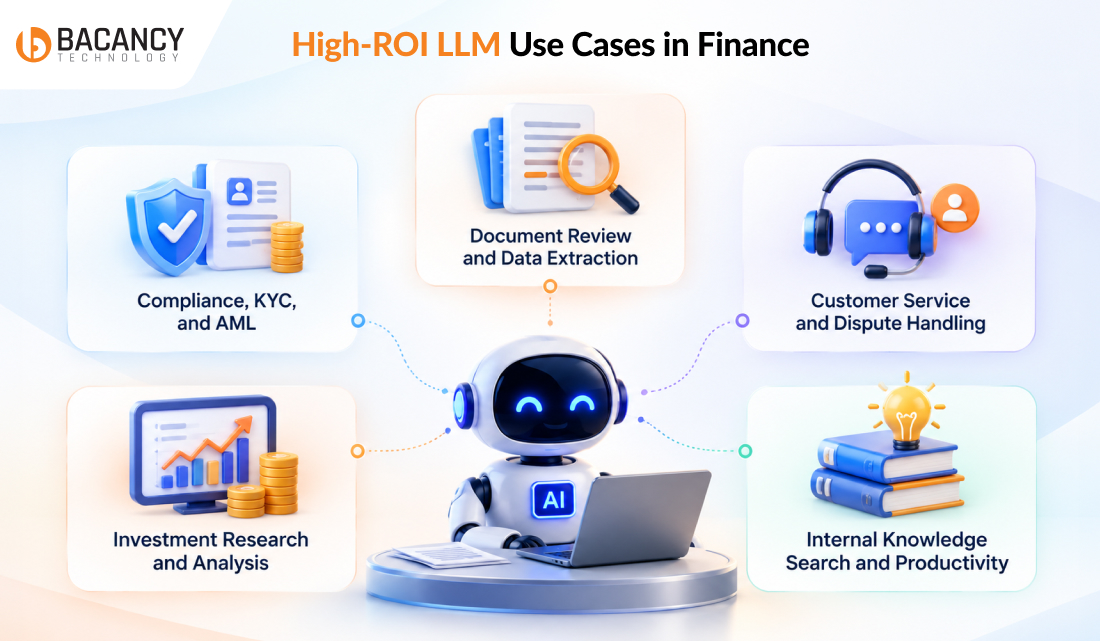
So where do you start using an LLM in finance? Pick a job that’s mostly reading, searching, or summarizing. These 5 are a good place to begin.
Document Review and Data Extraction
Teams usually spend hours just reading important documents like 10-K and 10-Q filings, credit memos, loan documents, and trade finance checks. A financial LLM can simply point out the key terms, dates, and amounts, and flag anything that looks odd. However, a reviewer might still need to check each detail against the source.
Compliance, KYC, and AML
Compliance teams can get real help from LLMs in finance. They can keep an eye on new rules, check customer details, and look up negative news about a customer. They can even put together a first draft of a suspicious activity report (SAR). But a compliance officer still has to go through the details and approve the report before sending it.
Customer Service and Dispute Handling
Customer questions about billing, disputes, and accounts follow familiar patterns. An LLM in finance can draft replies from approved policies and verified account data, so agents don’t write each one from scratch.
Investment Research and Analysis
Analysts spend hours reading earnings call transcripts, filings, and market research. A financial LLM can summarize them and answer questions across several documents. Here, analysts still need to verify important facts before using them in their research.
One thing to watch for when testing investment strategies is data leakage. An LLM may already have learned information about past market events during training. If that information is included in a back-test, the strategy may appear more successful than it would be in real trading.
Internal Knowledge Search and Productivity
Inside a firm, the hard part is often just finding the answer. Policies and procedures are scattered across so many systems. With LLMs in finance, employees can simply ask a question in plain words and get an answer, along with a link to the approved source.
Real Examples From US Firms
Large US banks are already using internal AI assistants to help employees with everyday tasks. The following 3 examples show large language models in finance at work.
1. JPMorgan Chase
JPMorgan Chase introduced LLM Suite to help employees write and summarize documents. Reports in 2024 put access at about 50,000 staff. By February 2025, the bank’s data chief said 200,000 employees had access to the tool.
Stage: Bank-wide rollout.
2. Morgan Stanley
Morgan Stanley launched its AI @ Morgan Stanley Assistant to help financial advisors and their support teams find answers across about 100,000 research reports and documents. According to OpenAI, more than 98% of advisor teams actively use the assistant.
Stage: In daily use.
3. Goldman Sachs
Goldman Sachs launched its GS AI Assistant across the firm in June 2025, after around 10,000 employees had already been using it. The tool helps employees summarize complex documents, draft content, and analyze data. Reuters reported the firm-wide launch, but did not confirm that all 46,000 employees were actively using the tool.
Stage: Firm-wide rollout after a pilot.
Once you have a use case, the next call is the model. The right one for an LLM in finance depends on your data, your security rules, and your budget.
How to Choose a Financial LLM: Finance-Tuned, General-Purpose, Open or Closed
Models differ in how much they know about finance, who controls them, and what they cost.
What Finance-Tuned Models Offer
A financial LLM trained on financial text may understand finance language better than a general model.
Here’s the catch: cost and data. An LSEG paper says building one from scratch can cost tens to hundreds of millions of dollars, and you’d still need good data. Before you trust any benchmark, test the model on your own documents.
Plenty of firms running an LLM in finance skip tuning altogether. They connect a general model to their own approved documents instead. That’s called retrieval-augmented generation (RAG), and the next section covers it.
Open-Source vs. Closed-Source Models
Open and closed models trade control for effort.
| Open-source
| Closed-source
|
|---|
| Where it runs
| Can run in your own environment; you get control over your data, depending on how it is deployed.
| Through the provider’s API, or a private endpoint in your cloud, depending on the vendor
|
| Customization | Full access to adjust the model
| Limited
|
| Skills needed
| A skilled ML team to maintain it
| Less technical skill
|
How to Choose
Start with your data. If sensitive information cannot leave your systems, consider a self-hosted model or a private deployment that meets your security requirements.
Next, consider the cost of a wrong answer. If an error could affect a credit decision or financial report, you will need stronger testing and human review.
Then work out the total cost. Include model usage, setup, infrastructure, maintenance, and any license fees.
Finally, check whether the model fits your team’s needs. How quickly must it respond? Can it process work in batches? Will it connect to your existing systems? And who will maintain it after launch?
Once you choose a model, you need to build the right system around it.
How to Build a Production-Grade LLM Stack for Finance
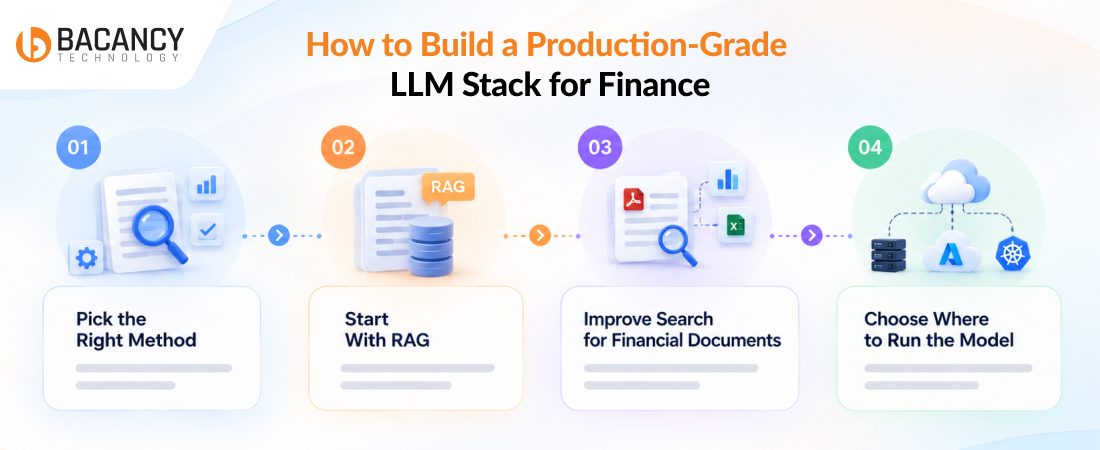
Building the system takes four steps. Each one depends on the one before it.
Step 1: Pick the Right Method
Prompting, RAG, and fine-tuning solve different problems for an LLM in finance. Start with the simplest method that meets your needs. For most finance use cases, that means RAG.
- Prompting: Give the model clear instructions and examples. Try this first.
- RAG: Let the model search approved, updated documents before answering. Use it when answers need to come from your own data.
- Fine-tuning: Train the model further on examples from your field. Consider it when prompting and RAG do not give you the results you need.
Most LLM projects in finance do not need fine-tuning. It takes high-quality training data and extra work to maintain.
Step 2: Start With RAG
RAG makes the financial LLM look up your approved documents before it answers. An LSEG paper compares it to an open-book exam. The model can refer to trusted information instead of relying only on what it learned during training.
This helps LLMs in finance answer questions using approved information. It also means you don’t retrain the model every time a document changes. You can tell the model to say “I don’t know” when the documents have no answer, so it doesn’t guess.
Step 3: Improve Search for Financial Documents
RAG is only useful when it finds the right information. Basic search often misses the exact tickers, dates, amounts, and clauses that an LLM in finance depends on. Three fixes help:
- Hybrid search: Combines keyword search with meaning-based search. For example, a search for “Q3 2025 covenant breach” can find exact matches and documents that discuss the same issue in different words.
- Metadata filters: Narrow results by document type, date, or business unit.
- Source citations: Show which documents support an answer so a reviewer can check the facts.
Step 4: Choose Where to Run the Model
Where the model runs decides who can touch your data. You have three options:
- Private cloud: A cloud environment used by your firm alone.
- Virtual private cloud (VPC): An isolated section of a public cloud, run under your network rules.
- On-premises: You own the servers. You get the most control and carry the most running effort.
Compare them on four points: who can access the data, where it is stored, what the vendor’s terms allow, and what it costs to run.
Once your LLMs in finance are running, you also need to understand the rules and controls that apply.
US Banking Rules for LLMs in Finance After SR 26-2
US banks need to manage the risks of the models and AI tools they use. On April 17, 2026, regulators updated their model risk management guidance through SR 26-2. However, the guidance does not cover generative AI or agentic AI models directly.
What Changed on April 17, 2026
On April 17, 2026, the Fed, OCC, and FDIC released SR 26-2. It tells banks how to check that their models are safe to use. It replaces two older documents, SR 11-7 and SR 21-8.
The idea is simple: the more a model matters to the bank, the more carefully it needs to be checked.
| SR 11-7 (2011) | SR 26-2 (2026) |
|---|
| Status | Replaced | Current |
| Approach | Detailed steps | Checks based on risk and bank size
|
| Generative AI | Issued before generative AI became widely used
| Outside its scope |
Does SR 26-2 Cover LLMs?
No. The guidance leaves generative AI and agentic AI out of scope because these technologies are still changing quickly. However, other laws, security obligations, and supervisory expectations may still apply. Banks need to assess the risks and put suitable controls in place.
SR 26-2 is supervisory guidance that does not set enforceable standards or prescriptive requirements. It is mainly relevant to banks with over $30 billion in assets.
Other Rules That Still Apply
Even though SR 26-2 does not directly cover LLMs, other laws and rules can still apply to how banks use them.
- GLBA (customer data): Treat customer data sent to an LLM, or to its vendor, as protected.
- ECOA and Regulation B (fair lending): If a lender denies credit, it must give specific reasons, even when a model made the call. The CFPB’s AI circulars on this were withdrawn in 2025, but the law still applies.
- Third-party risk: Hiring an LLM vendor does not move the risk to the vendor. The bank still owns it. Regulators proposed new guidance on this in September 2026.
- NYDFS Part 500 (New York cybersecurity): If New York regulates you, include AI risks in your security risk assessment. Its latest AI letter came in May 2026.
Controls to Put in Place
You can borrow SR 26-2’s ideas for your financial LLM:
- List every LLM use case and rank each by risk.
- Test before launch, then keep watching it.
- Keep a person in the loop for important outputs.
- Check outside vendors as carefully as your own team’s work.
This is general information, not legal advice. Confirm decisions with your own legal and compliance advisers.
Rules set the limits. Next, we look at what can go wrong inside the system.
Risks of Using an LLM in Finance and How to Reduce Them
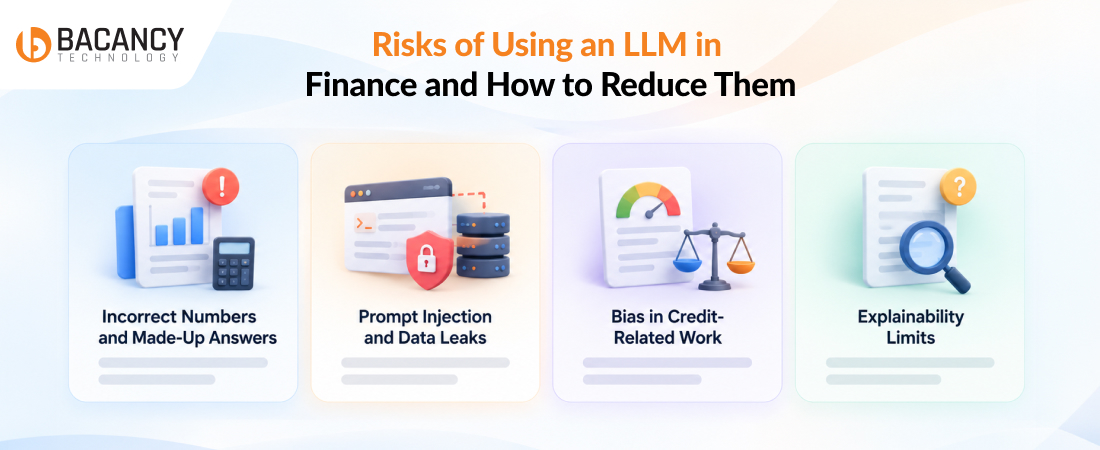
LLMs in finance can save time, but they can also give wrong answers, expose sensitive data, or repeat bias. Here are 4 common risks and how to reduce them.
Incorrect Numbers and Made-Up Answers
A financial LLM can write an answer that sounds correct but contains wrong information. This is called a hallucination. In finance, one wrong figure or contract clause can lead to a poor decision.
You can’t remove this risk, but you can shrink it:
- Use RAG, so answers come from approved documents.
- Add source citations, so a reviewer can check each claim.
- Tell the model to say “I don’t know” when the documents have no answer.
- Test on your own documents before launch, and keep testing after.
Prompt Injection and Data Leaks
Prompt injection happens when someone uses an input, such as a question or uploaded document, to make an LLM ignore its instructions. This can expose sensitive data. OWASP lists it as a major risk for LLM applications.
To reduce it:
- Give the model access only to the data it needs.
- Check inputs and outputs for signs of an attack.
- Run attack tests before launch.
LLMs in finance can repeat unfair patterns found in their training data. In lending, this could lead to unfair treatment of some customer groups.
To reduce it:
- Test outputs regularly for bias.
- For high-impact lending decisions, use the LLM to support staff rather than make the final decision on its own.
Explainability Limits
An LLM can give an answer without clearly showing why it gave that answer. The LSEG paper explains that tools such as SHAP and LIME are harder to apply to LLMs than to some traditional models.
To reduce it:
- Ask the LLM to show the documents behind its answers and keep records of its responses.
- For decisions that need a clear explanation, use models that are easier to understand and check.
When to Build, Buy, or Partner for a Financial LLM
You have three ways to get an LLM system. Build it with your own team, buy a ready-made product, or partner with an outside team that builds it with you.
How to Choose
Check each factor against your firm’s situation, then see which column most of your answers point to.
| Factor | Build
| Buy | Partner |
|---|
| Data sensitivity
| Most control. Data stays in your environment.
| Data goes to the vendor. Check their terms.
| Can run in your environment under your control.
|
| System integration
| Fits your systems, but your team does all the work.
| Works for common cases. Limited for custom systems.
| Built to fit your systems, with outside help.
|
| In-house AI skills
| Needs ML, data, and security engineers.
| Needs few AI skills.
| Fills your skill gaps.
|
| Time to production
| Slowest. Hiring and setup come first.
| Fastest to start.
| Faster than building from scratch.
|
| Ongoing support
| Your team tunes and monitors it.
| The vendor handles updates.
| Shared. Agree on who owns what.
|
What Affects LLM Costs?
The cost of using an LLM in finance depends on your setup and what you need it to do. These are the main factors:
- Model usage: How much text the model reads and writes, counted in tokens.
- Document processing: Preparing your files so the model can use them.
- Retrieval setup: Building the search system behind RAG.
- Integration: Connecting the model to your existing systems.
- Testing, security, and monitoring: Checking accuracy, protecting data, and monitoring the system after launch.
Include testing and maintenance in your budget from the start, not just the model fee.
When an LLM Development Partner Makes Sense
A partner helps when you lack the skills in-house or must connect LLMs in finance to your core platforms. They can also support RAG development, testing, security controls, and the move to production.
Bacancy Technology offers LLM development and fintech IT services, backed by 1,050+ engineers and ISO/IEC 27001:2022 certification. If you are unsure where to start, we can help you assess a suitable first use case for large language models in finance.
Once you have a use case and the right team, the next step is to plan the build.
Looking to Put LLMs to Work in Your Finance Operations?
Explore our LLM development services to find the right use case and build a solution that fits your business needs.
A 90-Day Roadmap to Your First Production Use Case
Here is a simple plan to take one of the LLM use cases in finance from idea to a limited rollout in about 90 days.
Days 1 to 30: Choose the Right Use Case
Pick a workflow for your first LLM in finance project that is heavy on documents and has risk you can manage. Document review and internal search are good fits. What’s next:
- Set success measures, such as time saved per document.
- Set an accuracy target.
- Decide who can access which data.
- Decide who reviews the output.
Days 31 to 60: Build and Test the Pilot
Set up RAG and test it on real documents. What’s next:
- Prepare a set of test documents.
- Check every answer and its source reference.
- Test common failure cases, such as questions the documents can’t answer.
Days 61 to 90: Prepare for Production
Get your LLM in finance ready for real users. What’s next:
- Finish security and governance reviews.
- Set up human approval for important outputs.
- Train your users.
- Decide how you will monitor the system.
- Roll out to a small group first, then widen it.
Treat 90 days as a planning target, not a promise. Regulatory approvals, vendor access, and system complexity can all add time.
Once the first group is live, you can decide what to scale next.
Conclusion
LLMs in finance can help financial firms review documents, find information, and handle routine tasks faster. However, they still need human review and clear rules to protect sensitive data and reduce errors.
To get started with LLMs in finance, choose one use case, such as document review or internal search. Test it with your existing data, measure the results, and expand its use when it proves valuable.
Bacancy Technology offers financial IT services and solutions to help you build and integrate LLM systems that fit your business needs.
Frequently Asked Questions (FAQs)
The best ones are document review, KYC and compliance support, customer reply drafts, investment research, and internal search. They all involve a lot of reading, and someone can quickly check the output.
It does not apply directly. SR 26-2 leaves generative AI out of its scope, so each bank sets its own controls. Many still borrow its risk-based thinking for testing and oversight.
Ground every answer in your approved documents with RAG, and show the source so reviewers can verify it. Let the model say “I don’t know,” and keep testing after launch.
Start with RAG. It keeps answers tied to your current documents without retraining anything. Fine-tuning only makes sense if prompting and RAG fall short, since it needs lots of quality data.