Quick Summary:
As per Bacancy Technology’s expertise in the insurance industry, here is what an insurance app costs in 2027:
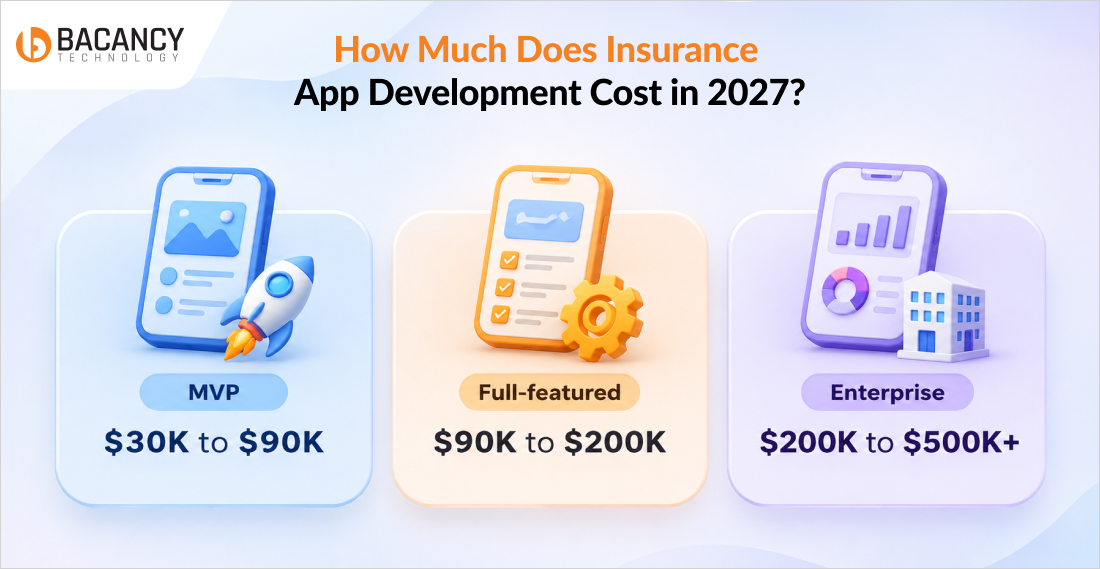
- An MVP insurance app costs $30K to $90K and takes 3 to 5 months.
- A full-featured app costs $90K to $200K and takes 5 to 9 months.
- An enterprise platform costs $200K to $500K+ and takes 9 to 18 months.
- Core system integration, compliance scope, and AI or telematics cause most of the variance in insurance app development cost.
- Plan 15% to 20% of the build cost each year for maintenance.
Table of Contents
Introduction
In 2027, an insurance app has to do more than show quotes, claims, and payments. It must connect to core systems, meet the rules of each state it sells in, and support AI features under new governance standards.
Customers are also moving online. A recent JD Power report found that 47% of new auto and home policies are bought digitally.
Getting all this right takes careful planning. At Bacancy Technology, we have delivered software for 15+ years and built insurance apps for policy, claims, and billing.
Backed by that hands-on experience, this guide walks you through insurance app development costs in 2027, what drives those numbers, how insurers keep costs down without hurting product quality, and how to plan each phase with a budget you can rely on.
How Much Does Insurance App Development Cost in 2027?
Insurance app development cost falls into three tiers: MVP, full-featured, and enterprise. Each step adds more quoting, integrations, and automation, so the cost and timeline rise with it. A typical app for an insurer, with quoting and claims, lands in the full-featured tier at $90K to $200K.
| Tier | What it includes
| Estimated range
| Typical timeline
|
|---|
| MVP | Policy view, ID cards, premium payments, basic claim filing
| $30K to $90K
| 3 to 5 months
|
| Full-featured
| Quoting, claims with photo upload, notifications, identity checks, core system links
| $90K to $200K
| 5 to 9 months
|
| Enterprise | Several products, deep core integration, automation, AI features, full audit trail
| $200K to $500K+
| 9 to 18 months
|
These insurance app development cost ranges assume a blended team of US leads and offshore engineers at about $45 an hour.
After scope, team location is one of the largest levers on insurance application development cost. US-only agencies usually quote higher because onshore hourly rates are greater.
| Team model
| Typical hourly rate (2026)
| Best fit
|
|---|
| US onshore
| $70 to $120
| Close time-zone overlap, on-site workshops
|
| Latin America and Eastern Europe
| $35 to $60
| Partial overlap, lower rates
|
| India and Southeast Asia
| $22 to $60
| Large builds, lowest hourly cost
|
| Blended (US leads, offshore engineers)
| Between onshore and offshore rates
| Regulated builds that need local accountability
|
What Does Each Part of Insurance Application Development Cost Include?
For a full-featured app, insurance application development cost splits into eight blocks of work: discovery, design, mobile and web builds, backend, core integration, quoting, payments and identity, and security testing. Together, they add up to roughly $96K to $197K.
| Component | What it covers
| Estimated range
|
|---|
| Discovery | Product mapping, state and compliance review, core system review
| $5K to $10K
|
| UI/UX design
| User flows, screens, accessibility checks
| $8K to $15K
|
| Mobile and web apps
| Customer app, agent portal, and admin screens
| $30K to $60K
|
| Backend and APIs
| Business rules, data storage, service layer
| $15K to $30K
|
| Core integration
| Connections to policy, billing, and claims systems
| $15K to $35K
|
| Quoting and rating
| Premium calculation, product rules, quote-to-bind flow
| $10K to $20K
|
| Payments and identity
| Card and bank payments, sign-in, identity checks
| $5K to $12K
|
| Security and QA
| Testing, penetration tests, security reviews
| $8K to $15K
|
Discovery sets the insurance app development cost estimate. A few weeks spent on products, states, core systems, and compliance scope prevents many later change requests, and those changes cost far more once building starts.
Platform choice also shapes insurance mobile app development cost. Separate native iOS and Android apps cost more than a single cross-platform codebase built with Flutter or React Native, although the savings depend on the features you need.
Native-only builds tend to land at the upper end of each insurance application development cost range. Common backend choices are Node.js, Java, or .NET on AWS or Azure.
Your line of insurance decides which components matter most.
Insurance App Development Cost by Line of Business
Insurance app development cost changes with the line you sell. An auto app, a home app, and a health app each handle different policies, rules, and customer needs, so each line needs different features and carries its own price range.
| Line of business
| Features that drive cost
| Estimated range for a first release
|
|---|
| Auto | Policy wallet, claims with photo upload, roadside assistance, telematics
| $50K to $120K
|
| Home and property
| Property photos, claims with inspection scheduling, weather alerts
| $40K to $90K
|
| Health | Member records, provider search, claims status, privacy controls
| $60K to $150K
|
| Life | Policy views, beneficiary updates, premium payments, document signing
| $40K to $100K
|
| Travel | Trip-based policies, quick purchase, claims with receipts
| $30K to $70K
|
| Commercial | Multi-user accounts, certificates of insurance, renewals
| $60K to $130K
|
| Agent or broker
| Book of business view, quoting tools, client management
| $30K to $80K
|
Usage-based auto insurance adds a separate layer to insurance application development cost. The app has to collect driving data, score it, and adjust premiums, and each step needs its own build, rate filing review, and testing.
Health products carry the highest insurance application development cost in the table because HIPAA controls reach data storage, access, and audit logs. Our medical insurance app cost guide covers that line in more detail.
Next, see which features push insurance app development cost up the most.
Which Features and Integrations Raise Insurance Application Development Cost?
Telematics, underwriting rules, and AI models raise insurance application development costs the most. Core system integration is the line item most likely to overrun, so it deserves close attention early in planning.
| Feature | Price band
| What it involves
|
|---|
| Policy wallet and ID cards
| Low | Policy details and digital ID cards
|
| Premium payments and autopay
| Medium | Saved payment methods, scheduled charges, payment history
|
| Claims with photo upload
| Medium | Guided claim filing, photo capture, status tracking
|
| Notifications | Low | Renewal reminders, claim updates, payment alerts
|
| Identity verification
| Medium | Document checks and secure sign-in
|
| Chatbot | Medium | Answers common questions, routes complex ones
|
| Roadside assistance
| Medium | Requests for help, provider matching, location sharing
|
| Telematics | High | Device data collection, driving scores, premium adjustments
|
| Billing and invoicing
| Medium | Installments, refunds, failed-payment handling, reconciliation
|
| Underwriting rules
| High | Risk scoring, eligibility rules, referral to underwriters
|
Not every feature gives the same return. JD Power found that only 11% of insurance shoppers have used chatbots. So, give an insurance AI chatbot a clear purpose before investing in one. Price comparison tools show better results. Shoppers were nearly twice as likely to consider a policy when they could compare prices (39% vs. 21%).
Telematics costs more to build because data differs across devices. The scoring model also needs testing and adjustment for each device before it can calculate premiums.
The higher cost often comes from connecting systems behind the app. Core integration links the app with platforms like Guidewire, Duck Creek, and Majesco. An API layer makes it easier and cheaper to add features later.
Older systems take more time to connect. So, estimate this part of insurance app development cost after reviewing your existing systems, not by using a fixed percentage.
Next, budget for compliance and governance work.
Which Compliance and AI Rules Affect Insurance App Development Cost?
US insurance apps must follow state data security rules, privacy laws, and e-signature requirements. AI features need governance records as well. Building these controls early keeps insurance application development costs far lower than adding them later.
Key rules to plan for:
- NAIC Insurance Data Security Model Law (#668): written security program and breach notification, in states that adopted it.
- New York DFS Cybersecurity Regulation (23 NYCRR 500): multi-factor authentication for all users and an asset inventory, both required since November 2025.
- GLBA and CCPA: privacy notices, consumer data rights, and limits on sharing.
- HIPAA: safeguards for protected health information in health products.
- E-SIGN Act and state UETA: consent and record rules for electronic signatures.
- WCAG 2.2: accessibility for customer-facing screens.
- PCI DSS v4.0.1: controls for any card data you store or process.
Rules differ by state and product. For example, insurers licensed in New York must follow Part 500. Insurers licensed only in Ohio follow Ohio’s data security law. Involve legal experts early to understand these rules. Each additional state adds more review, testing, and paperwork, which increases insurance application development cost.
AI features also need proper checks. Chatbots, claims triage, fraud detection, and underwriting models need 4 things:
- A list of all AI models and what they do.
- Testing before release.
- Regular checks after launch.
- Documents from AI vendors.
As a planning estimate, one AI feature, such as claims triage or a document-reading tool, can add $20K to $60K to the development cost.
As of October 2026, 27 states, along with DC and Puerto Rico, have adopted the NAIC AI Model Bulletin. California, Colorado, New York, and Texas have their own AI guidance for insurers. You also need to budget for monthly AI hosting, usage, and monitoring costs after launch.
What Does It Cost to Run, Launch, and Maintain the App?
Plan to spend around 15% to 20% of the build cost on yearly maintenance. Apps with many integrations or strict compliance needs may cost up to 25%.
Also budget for hosting, third-party tools, payment processing, and security testing. Include these expenses in your insurance app development cost from the start.
| Cost item
| What it covers
| Typical cost
|
|---|
| Maintenance | Bug fixes, updates, and changes
| 15% to 20% of build per year
|
| Cloud hosting
| Servers and data storage
| Grows with users
|
| Third-party services
| APIs for identity, payments, and other tools
| Grows with usage
|
| Payment processing
| Fees on card and bank payments
| Set by your provider
|
| Penetration testing
| Security checks, usually once a year
| Depends on scope
|
| Apple developer Program
| Publishing on the App Store
| $99 per year
|
| Google play registration
| Publishing on Google Play
| $25 one-time
|
Apple’s rules require other payment methods for services used outside the app. Google’s billing rules apply only to digital goods and services. Since insurance is a real-world service, app store commissions do not apply.
Longer timelines also increase insurance app development cost because each extra week adds to the bill. Set a clear timeline for each stage: discovery, design, development, testing, and launch.
| Phase | MVP | Full-featured
|
|---|
| Discovery | 2 to 3 weeks
| 3 to 4 weeks
|
| Design | 2 to 3 weeks
| 3 to 5 weeks
|
| Development | 7 to 11 weeks
| 12 to 22 weeks
|
| Testing and security
| 1 to 3 weeks
| 3 to 6 weeks
|
| Launch and store review
| 1 to 2 weeks
| 1 to 2 weeks
|
| Total | 3 to 5 months
| 5 to 9 months
|
Around launch, watch for slow legacy integrations, late compliance fixes, apps that solve no real problem, store rejection of health apps with incomplete privacy declarations, and feature requests after the budget is set.
How Can Bacancy Technology Help Control Insurance App Development Cost?
Our insurance IT services team settles scope, states, and integrations before any code is written, which keeps insurance application development costs predictable. Here is how that works in practice:
- Discovery first. Each project begins with a short review that turns your requirements into a feature-level estimate.
- A narrow first release. Launching one product in a few states, with policy views, payments, and claim status, returns real usage data sooner.
- An API layer over core systems. We build this layer in the first release, so later features plug into it, and insurance application development cost falls with each update.
- Proven services over custom code. Mature providers handle payments, e-signature, and identity checks, so budget goes to features that set your app apart.
- Compliance from the first sprint. Audit logs and state rules are planned early, while changes are still cheap.
Conclusion
Scope determines insurance app development cost more than any other factor. Before you talk to a developer, pin down which products, states, and core systems the first release must cover.
Plan for the costs that come after launch as well. Maintenance, hosting, and compliance work continue for years, so a budget that stops at the build will run short.
If you want a feature-level estimate for your product, talk to our insurance app development company, and we will map your scope to a budget.
Frequently Asked Questions (FAQs)
Insurance app development cost starts around $30,000 for an MVP with policy views, payments, and basic claims. A full-featured app runs $90,000 to $200,000, and an enterprise platform can reach $500,000 or more with several products, automation, and AI.
An MVP typically takes 3 to 5 months, a full-featured app 5 to 9 months, and an enterprise platform 9 to 18 months. Discovery, core integration, and compliance approvals cause most of the variation, and they also drive insurance application development cost.
For auto, a first release usually puts insurance app development cost at $50K to $120K. Telematics adds the most, because the scoring model must be built, tested, and filed with state regulators before it changes premiums.
Buy Guidewire or Duck Creek to replace core systems. A white-label app suits a quick, standard launch. Build custom for your own workflows on existing cores, which keeps insurance application development costs well below a core replacement.
Plan for about 15% to 20% of the build cost each year, or closer to 25% for apps with many integrations. Hosting, third-party services, and penetration testing come on top, so include them in your insurance application development cost plan from the start.
Yes. Data security, privacy, e-signature, and accessibility rules all add work, and they vary by state and product. Bringing counsel into discovery early costs far less than fixing gaps after launch.
A blended team usually does. Offshore engineers bill about $22 to $60 an hour against $70 to $120 onshore, while US-based leads keep compliance and product decisions close to the business.