Quick Summary
This blog explains how to build a payment gateway in 7 steps, from defining your business model and designing the architecture to integrating payment providers and securing transactions. It also breaks down development costs, regional compliance requirements, common mistakes to avoid, and when to build a custom gateway or use an existing provider.
Table of Contents
Introduction
A customer clicks Pay Now, and the payment goes through. Behind that click, the gateway authorizes the transaction, protects the card data, and records every payment correctly.
If you are a fintech founder or CTO working out how to build a payment gateway, you need to get every part of that process right. But where do you start? Should you build the transaction engine in-house or integrate existing payment services? Which security standards (PCI Data Security Standard) must your architecture meet, and how much will it cost?
If you have one of those questions, this blog is for you. We have curated 7 steps to build a payment gateway, which can help you move from initial requirements to launch-ready solutions with security, integrations, and costs.
7 Steps to Build a Payment Gateway
Here is how to build a payment gateway, step by step. Each step involves decisions that affect your budget, launch timeline, and long-term operating costs.
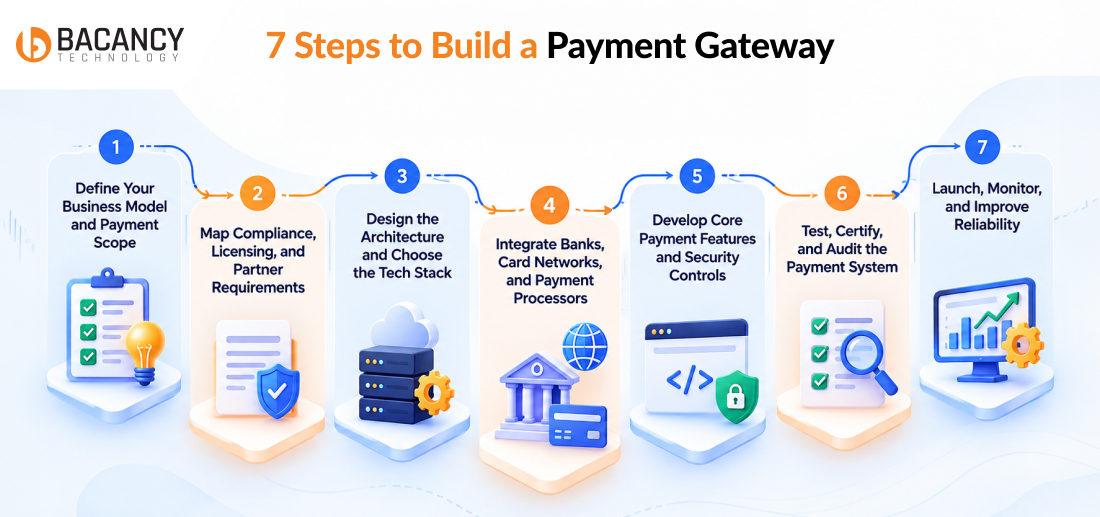
Step 1: Define Your Business Model and Payment Scope
You start with the money flow estimate. Determine who pays, who gets paid, and who holds funds in between. A gateway for a single merchant brand looks very different from a multi-merchant platform with split payouts.
Start by defining:
- Target customers: Will you serve a single business, multiple merchants, marketplaces, or financial institutions?
- Revenue model: Will you charge per transaction, apply subscription fees, or offer premium payment services?
- Payment methods: Which options will you support, such as cards, UPI, ACH, SEPA, and digital wallets?
- Target markets: Which countries, currencies, and regional payment networks will you support?
- Transaction volume: What are your expected daily transactions, average payment value, and peak processing requirements?
Next, decide whether you need a payment gateway that routes transaction data or a payment aggregation platform that handles merchant funds. This distinction affects your licensing requirements, banking partnerships, development costs, and operational responsibilities.
Step 2: Map Compliance, Licensing, and Partner Requirements
You need to ensure compliance supports the architecture, so plan it before design. Next, list every regime that applies by region: PCI DSS for card data, local licensing for fund handling, and data protection law for customer records.
Now, shortlist partners. You will need a sponsor or acquiring bank, access to card networks, and a Qualified Security Assessor (QSA) for PCI validation. Partner onboarding takes weeks, sometimes months. Start those conversations in parallel with design work. Document the outcome in a compliance matrix, and engineers then build against written requirements.
Step 3: Design the Architecture and Choose the Tech Stack
Your payment gateway architecture must protect sensitive data, maintain accurate financial records, and process transactions reliably under peak load. If you tokenize card data at the edge, systems that only handle tokens can stay out of PCI scope, provided they are segmented from the cardholder data environment.
A typical design includes:
- API layer: REST endpoints with idempotency keys and versioning
- Tokenization service: Replaces card data with tokens at the edge
- Payment orchestration: Routes transactions to processors based on cost, success rate, and region
- Ledger service: Double-entry records for every money movement
- Event layer: Queues and webhooks for async status updates
Common stack choices include Java or Go for transaction services, Node.js for API gateways, PostgreSQL for ledgers, Kafka for event streams, Redis for caching, and Kubernetes for orchestration. Hence, you must pick a tool that your team can implement and align with your project.
Step 4: Integrate Banks, Card Networks, and Payment Processors
A payment gateway integration connects your platform to the financial institutions and networks that authorize and process transactions. In this step, your timeline can stretch since every acquirer, processor, and local rail has its own message formats and certification steps.
You can use ISO 8583 card network messaging where required for card transaction messaging, alongside REST or SOAP APIs supported by your providers. After that, create an adapter layer so every provider has a consistent interface for APIs and message formats. This adapter layer is often where teams need expertise in fintech integration to connect different providers without changing the core system.
To streamline the process, you need to add new processor connections and avoid a core rewrite. Multiple processor connections can support routing flexibility and business continuity, subject to provider capabilities and contractual requirements.
Step 5: Develop Core Payment Features and Security Controls
Build the core flow first: authorization, capture, void, refund, and chargeback handling. You must add a merchant dashboard, reporting, and settlement files next.
Payment gateway security is a design input. Apply these controls from the first commit:
- Encryption in transit using TLS 1.2 or higher
- Tokenization and hardware security modules for key management
- 3-D Secure 2 for cardholder authentication
- Rule-based and machine learning fraud scoring
- Role-based access, audit logs, and secrets management
Keep your card verification values such as CVV out of stored records and logs. You must store secrets in a dedicated secrets manager, encrypt sensitive data in transit, and restrict access to production systems.
Step 6: Test, Certify, and Audit the Payment System
Testing is where a payment gateway earns trust. A successful sandbox payment only proves a standard transaction. It does not show how your gateway behaves during production failures, duplicate requests, settlement mismatches, or traffic spikes. Test complete transaction lifecycles, including the conditions that leave money movement unclear.
Then certify. Expect processor certification, card network testing, a penetration test, and a PCI DSS assessment. Under PCI DSS v4.0.1, 51 formerly future-dated requirements became mandatory on March 31, 2025, including controls for payment page scripts and stronger authentication.
Note that you need to run a test in which the processor approves a payment, but your gateway loses the response. Verify that the system can recover the actual payment status without creating another charge or incorrectly marking the transaction as failed.
Step 7: Launch, Monitor, and Improve Reliability
A payment gateway needs active monitoring after launch because processor performance, customer behavior, fraud patterns, and transaction volumes change over time. You can launch with a limited cohort for a small group of merchants or a controlled percentage of eligible traffic.
You can monitor key metrics to track authorization rates, payment failures, API latency, and reconciliation discrepancies. Also, must alert the responsible team when any error rate arises, payment confirmation queues grow, or settlement records fail to match.
Investigate decline patterns, optimize routing where supported, and add payment methods based on actual customer demand.
Want to Build a Payment Gateway?
Hire fintech developers from Bacancy Technology to build secure payment systems that scale with your transaction volume.
How Much Does It Cost To Build a Payment Gateway?
Most custom payment gateways cost between $50,000 and $500,000 to build, depending on scope. A basic single-region gateway starts around $50,000, a mid-scale platform typically runs $120,000 to $300,000, and enterprise-grade builds reach $300,000 to $500,000. Integrating an existing provider’s gateway costs ranges around $5,000 to $15,000.
Payment Gateway Development Cost by Project Scope
| Scope
| What It Includes
| Indicative Cost
|
|---|
| Basic gateway | Single region, cards only, one processor, basic dashboard
| $50,000 to $120,000
|
| Mid-scale gateway
| Multiple payment methods, two to three processors, fraud engine, merchant portal
| $120,000 to $300,000
|
| Enterprise Platform
| Multi-region, orchestration, advanced fraud, ledger, licensing support
| $300,000 to $500,000
|
Key Factors That Affect Development Cost
These are the main levers that push your payment gateway development cost up or down:
- Number of payment methods and currencies
- Count of processor and bank integrations
- Fraud detection depth, including machine learning models
- Compliance scope across regions
- Merchant tooling such as dashboards, APIs, and SDKs
- Team location and seniority
Some estimates place security and compliance work at 15% to 20% of the total budget. Plan for it up front.
How Long Does Payment Gateway Development Take?
A basic gateway typically takes 4-6 months. A mid-scale build runs 6-9 months. An enterprise platform can take 9-18 months. Bank onboarding and certification often set the critical path.
Development Cost vs. Long-Term Operating Cost
The build is the smaller line item over 5 years. Operating costs include PCI reassessment each year, infrastructure, monitoring, on-call engineering, processor fees, and fraud losses. A common planning rule sets annual maintenance at 15 to 25% of initial development cost. Model both numbers before you commit.
Payment Gateway Compliance by Region
Every region has different payment gateway compliance requirements. Before building your gateway, you must follow the security standards and regulations that apply to your target market.
1. United States: PCI DSS and State Money Transmitter Licenses
PCI DSS applies to anyone who stores, processes, or transmits card data. Service providers usually face the strictest validation level. State money transmitter licenses apply if you hold or move customer funds. The requirements will differ by state, and multi-state coverage takes time. A sponsor bank partnership or licensed partner can shorten that.
2. India: RBI Payment Aggregator Authorization and UPI
Non-bank entities that handle merchant funds need RBI authorization as a payment aggregator under the Payment and Settlement Systems Act, 2007. Applicants need a minimum net worth of Rs 15 crore at application and Rs 25 crore by the end of the third financial year after authorization. Escrow account rules apply to funds in transit. A technology-only gateway that never touches funds faces lighter rules. UPI access runs through NPCI and a sponsor bank. Confirm current RBI directions with counsel before filing.
3. Europe: PSD2 and Strong Customer Authentication
PSD2 and Strong Customer Authentication (SCA) remain key requirements for payment gateway security in Europe. PSD2 requires payment service providers to apply SCA to most electronic payments, using atleast 2 independent authentication flows. These may include something the customer knows, owns, or is. Design secure authentication flows, risk-based exemptions, and step-up verification to meet these requirements while minimizing friction for legitimate customers.
Common Mistakes To Avoid When You Build a Payment Gateway
Understanding these common mistakes early helps you avoid costly errors, reduce launch delays, and keep your gateway reliable.
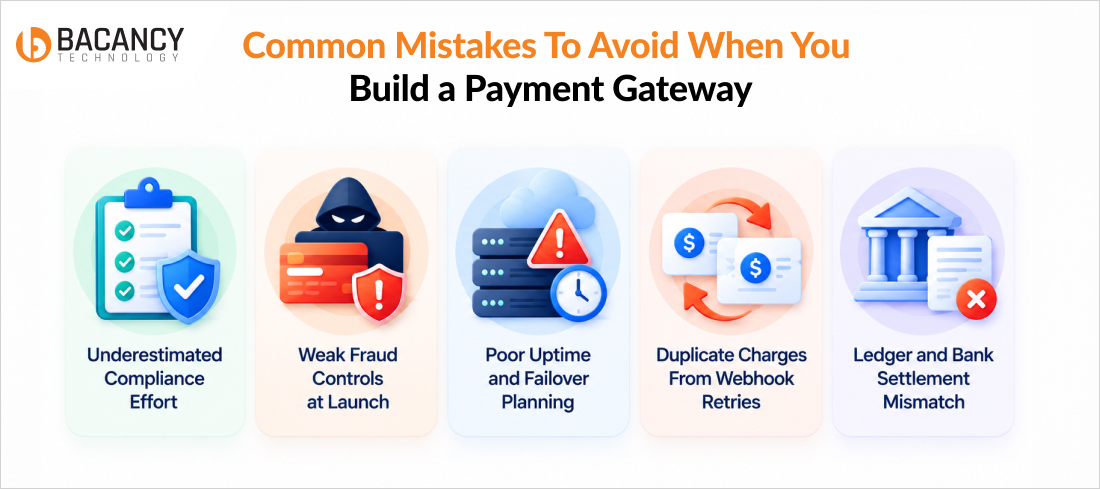
Underestimated Compliance Effort
Teams scope engineering carefully and treat compliance as paperwork. It is a workstream with its own owner, budget, and timeline. You can get in touch with a fintech consulting expert to detect issues early and run a gap assessment before development starts.
Weak Fraud Controls at Launch
New gateways attract card testing attacks within days. Launch with velocity limits, BIN and geolocation checks, 3-D Secure 2, and a manual review queue from the first release.
Poor Uptime and Failover Planning
A gateway that goes down stops your merchants’ revenue. Design for multi-zone deployment, processor failover, and graceful degradation. Test failover on a schedule and document what each drill reveals.
Duplicate Charges From Webhook Retries
Processors retry webhooks when your endpoint is slow. Without idempotency, your single payment can become two. Store a unique event ID, make every handler idempotent, and return a fast acknowledgment before heavy processing.
Ledger and Bank Settlement Mismatch
It could be possible that your ledger says one number, the processor says another, and the bank says a third. So it’s better to use double-entry accounting, automate daily reconciliation, and flag every break for review before it grows.
Build a Custom Payment Gateway or Use an Existing Provider?
When you build a payment gateway, you are required to decide whether to develop your own platform or use an existing provider. Both options have different costs, development timelines, and levels of control.
1. Control and Customization
A custom gateway gives you full control over routing logic, checkout experience, data, and product roadmap. Providers, such as Stripe, Adyen, or Razorpay give you a proven product but you work within their rules and feature set.
2. Upfront Investment and Ongoing Costs
Providers charge per transaction and need little upfront spend. A custom gateway needs six figures to build and carries fixed operating costs. At low volume, provider fees win. At high volume, owning the stack can cut cost per transaction.
3. Operational Responsibility and Time to Market
With a provider, a standard payment gateway integration can go live in weeks. With a custom build, you take on uptime, fraud losses, audits, and regulatory change. Your team owns every incident.
When a Custom Solution Makes Sense
- Build when payments are core to your product
- When transaction volume makes provider fees a major cost line
- When you need routing or settlement logic that providers cannot support
- When you plan to offer payment services to other businesses
Otherwise, integrate an existing provider first and revisit the decision as you scale.
How Bacancy Technology Helps You Build a Payment Gateway
We are a fintech software development company with experience across payments, banking, and financial data platforms. Since 2011, we have worked with 500+ enterprises across 30+ countries, delivering solutions to build a payment gateway.
Our teams handle the full payment gateway build. We run discovery and compliance mapping, design the payment gateway architecture, build each payment gateway integration with your processors and banks, and engineer fraud and security controls.
We then support testing, certification, launch, and long-term operations.
Still deciding whether to build or buy? Share your scope, and we will give you a clear view of cost, timeline, and the right path.
Frequently Asked Questions (FAQs)
Define scope, map compliance, design the architecture, integrate banks and processors, build features and security controls, certify the system, and launch in phases. Each step above covers the details.
Yes, if you store, process, or transmit cardholder data. Service providers must validate compliance against PCI DSS v4.0.1, usually with a QSA assessment. Tokenization can reduce scope but does not remove the need.
Often yes, if you only route data and never hold funds. A bank partner or licensed processor handles settlement. If you hold or move customer funds, expect licensing such as RBI payment aggregator authorization in India or money transmitter licenses in the US.
There is no single best option, because the right stack depends on your payment gateway architecture. Java or Go for core services, PostgreSQL for ledgers, Kafka for events, Redis for caching, and Kubernetes for deployment form a proven combination. Pick tools your team knows well.
Providers cost less at the start. A custom gateway costs more to build and run, but can lower per-transaction cost once volume is high enough to offset the investment.
A gateway captures and securely transmits payment data from the customer to the processor. The processor communicates with card networks and banks to authorize the transaction and move funds.
Strong payment gateway security comes from layers. Use tokenization, strong encryption, 3-D Secure 2, layered fraud rules, hardware-backed key storage, and strict access controls. Add audit logs, regular penetration tests, and annual PCI DSS validation.