Quick Summary
This guide explains how to build a fintech app, step by step. It shows you how to pick your app type, decide how you will follow financial rules, and plan your features and tech. It also covers security, cost, time, and the team you need. You will see which choices to make before you start building.
Table of Contents
Introduction
If you want to launch a fintech app faster, using a partner bank can help. This can take around 4 to 7 months. If you want to build your own system and get your own licenses, it can take 9 to 14 months. So, one of the first things you need to decide is how your app will meet financial rules. This is your regulatory model.
This choice affects your budget, features, technology, and team. It can also matter when you talk to investors. According to CB Insights, there were 726 fintech deals in Q2 2026, down 25% from the previous quarter.
The total funding was $11.7 billion, but much of it went to a small number of large deals. Its 2025 review shows a similar pattern, with funding going to fewer companies with more scale and a clear path to meeting regulations.
So, if you want to learn how to build a fintech app, this guide breaks the process into seven steps, from choosing your app type to picking the right team. It also covers KYC/AML, PCI DSS, development cost, and timeline.
Decide What Type of Fintech App You Are Building
Before you write any code, decide what kind of fintech app you want to build. This choice affects your features, regulatory requirements, team, integrations, timeline, and budget.
Payments and Money Transfer Apps
These apps let people and businesses send, receive, and spend money. PayPal handles money transfers, Apple Pay handles card payments, and Wise handles international transfers.
If your app moves money, you may need a license or a licensed financial partner to handle the regulated parts.
Digital Banking and Neobank Apps
Neobanks offer everyday banking: accounts, debit cards, direct deposits, and payments.
Chime, Revolut, and N26 are examples of digital banking services. Chime works with partner banks, while Revolut and N26 hold bank licenses in some markets.
Personal Finance and Budgeting Apps
Budgeting apps are the simplest type to build. They help users track spending, manage budgets, and understand their finances, and they may connect to bank accounts without holding or moving customer funds.
YNAB focuses on budgeting, while Rocket Money helps users track spending and subscriptions. Regulatory requirements depend on what your app does and what financial data it accesses.
Investment and Trading Apps
For teams asking how to build a fintech app in the investing space, these apps let users invest or trade stocks, ETFs, or crypto. Some also offer automated investing and portfolio management.
Robinhood, Wealthfront, and Betterment are examples of investment apps. The regulatory requirements depend on the services and assets you support. In the U.S., some investment services may require registration with regulators such as the SEC or FINRA, directly or through a regulated partner.
Lending and Insurance Apps
When looking at how to build a fintech app, lending and insurance are two common categories to consider. Lending apps help users apply for loans, credit, or financing, while insurance apps let them compare, buy, and manage policies.
Affirm and Klarna offer financing options, while Lemonade provides digital insurance services.
Requirements vary by product and location. Lending can involve federal and state rules, while insurance businesses generally need the required licenses in the markets where they operate.
Which Type You Choose Decides Your Regulatory Model
Once you know what your app does, decide how you will handle the regulated parts. You have four options: build software only with no money movement, work with a BaaS (Banking as a Service) partner, register as a Money Services Business (MSB), or get your own license.
This choice affects your MVP scope, integrations, compliance work, timeline, and budget. Make this decision before development starts so you know what you need to build.
How to Build a Fintech App in 7 Steps
Learning how to build a fintech app starts with understanding the fintech app development process. Each step depends on the regulatory model you choose at the start.
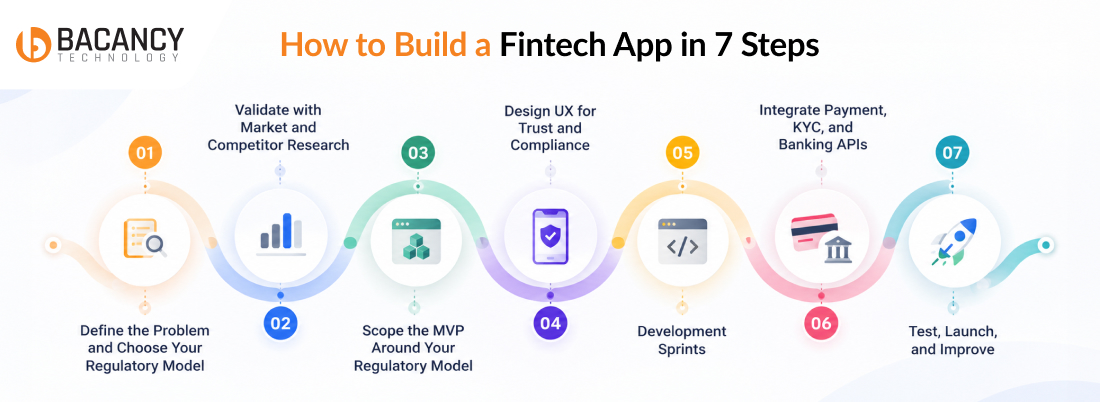
Step 1: Define the Problem and Choose Your Regulatory Model
Start with one clear problem and one type of user. A budgeting app for freelancers may need different features, sign-up steps, and rules than an app for retirees. Once you know your target users, decide who will handle the regulated money services: a BaaS partner, MSB registration, or your own license.
This is the decision most teams underestimate, because it shapes your MVP, integrations, and launch date. Fintech consulting services can help you compare the three models against your product before any code is written. If you plan to get your own license, bring in legal and compliance experts early as well.
Step 2: Validate with Market and Competitor Research
Talk to people who have the problem you want to solve. Find out how they deal with it now and what apps they use. Read App Store reviews and online forums to see what users like, dislike, and want to change.
If users have no strong reason to switch from the app they use now, change your idea before spending too much on development. This is the second step in the fintech app development process.
Step 3: Scope the MVP Around Your Regulatory Model
Your regulatory model affects what your MVP needs from day one. A BaaS-based neobank may need account creation and KYC. A budgeting app may only need read-only bank connections.
Start with the features you need to test your main idea, and add more only when users want them. Get your BaaS or banking partner’s approval before you build major integrations.
Step 4: Design UX for Trust and Compliance
Financial apps need clear flows that users can trust. Start with wireframes for signup, KYC, payments, and other key journeys before you spend time on detailed UI design.
When the flows work, build the full screens and UI system. Design is a key stage of the fintech app development process, so keep financial and compliance steps simple.
Step 5: Development Sprints
Break the MVP into smaller sprints, such as two-week cycles. Check security and compliance during development instead of leaving them for the end.
Sprints keep the fintech app development process moving in small pieces. They catch issues early and reduce costly rework. If you plan to get your own license, involve legal and compliance experts from the start.
Step 6: Integrate Payment, KYC, and Banking APIs
Connect the services your app needs for identity checks, bank connections, payments, and other financial functions.
For example, Plaid can connect bank accounts, while Persona and Jumio support identity checks. Stripe and BaaS providers such as Unit can support payments and other financial services, depending on your setup.
Integrations are the technical base of the fintech app development process. Choose providers based on your regulatory model. A lending app needs different integrations than a budgeting app that only reads balances.
Need Help Connecting Your Fintech App with the Right Banking, Payment, and KYC Providers?
Explore our fintech integration services to connect APIs securely and build reliable financial workflows.
Step 7: Test, Launch, and Improve
Test security, performance, and compliance before launch. Security testing looks for weak spots, performance testing checks how the app handles expected traffic, and compliance testing checks processes such as KYC, AML, and data handling.
Testing closes out this stage of the fintech app development process. Test throughout development, not just at the end.
Also plan for Apple App Store and Google Play review. Financial apps may get extra checks on payments, KYC, and data handling, and review times can vary if issues are flagged.
Keep app store review time separate from your own testing and compliance timeline, because you cannot control it.
Key Things to Consider Before You Build a Fintech App
Before you spend money and time figuring out how to build a fintech app, think about these points. They can affect your cost, timeline, features, and ability to launch.
Compliance adds to your costs. You may need legal help, licenses, audits, security checks, and other compliance work in addition to development costs.
Users need to trust your app. You may handle sensitive information such as bank details and identity documents. Strong security and clear communication are important from the start.
Your banking or BaaS partner may not approve your business. Banks and BaaS providers review businesses before working with them. If they reject your application, you may need to find another partner, and your launch could be delayed.
Plan how the app will make money. Your revenue model should cover development, compliance, partner, and operating costs. A model that works for a payments app may not work for a lending or insurance app.
Must-Have Features for a Fintech App
Knowing how to build a fintech app also means knowing which features it actually needs. A fintech app needs more than login, a dashboard, and notifications. The features you need depend on how your app handles money and which regulatory model you choose, such as BaaS, MSB registration, or your own license.
Core Features Every Fintech App Needs
Feature planning is a core part of the fintech app development process. Most fintech apps need these features, regardless of the product type.
Trust and Access
- Secure registration and MFA: Support MFA, biometrics, passkeys, and trusted-device checks for safer login.
- KYC identity verification: Verify users during onboarding while keeping the process simple.
- Role-based access control: Give employees access only to the data and actions they need. Viewing financial data should not automatically allow someone to move money.
- Encryption in transit and at rest: Use TLS 1.3 for data in transit and AES-256 for data at rest, and protect your encryption keys.
Visibility and Control
- Real-time account and transaction views: Show balances, transactions, and account activity clearly and update them promptly after transactions.
- Push notifications: Alert users about logins, payments, transfers, and balance changes so they can spot activity they do not recognize.
- Financial insights and reporting: Provide spending summaries, trends, reports, and downloadable statements.
Safety and Risk
- Real-time fraud detection: Check transactions and login activity for unusual amounts, locations, devices, and spending patterns. Machine learning can help detect changing fraud patterns.
- Scalable architecture: Build for growing users and transaction volumes so traffic spikes do not slow down or break the app.
Support and Accountability
- In-app support: Let users get help with blocked cards, incorrect charges, and other issues. Chatbots can handle simple questions, with a clear path to human support.
- Digital dispute management: Let users report unfamiliar transactions, submit supporting documents, and track dispute status.
- Audit trails: Record important financial actions, including what happened, who performed the action, and when.
Admin and Operations Tools
Your internal teams also need tools to manage accounts, review issues, and handle daily operations.
- Compliance and operations dashboard: Review flagged transactions, KYC exceptions, and account activity in one place.
- Admin user management: Let authorized staff view, restrict, or close accounts based on their access level.
- Dispute and fraud case management: Give support and compliance teams a clear process to investigate, track, and resolve cases.
Features That Change Based on Your Regulatory Model
The financial systems you need depend on whether you use a BaaS partner, register as an MSB, or operate under your own license.
BaaS-Backed App
A BaaS provider can handle services such as account creation, card issuing, and holding customer funds through its banking infrastructure. Your team can focus on the app and the features built on top of these services.
- Benefits: Faster launch and less infrastructure to build upfront.
- Tradeoffs: Less control over products, providers, and some operating terms.
MSB-Registered App
An MSB-registered business can provide certain money services directly. In the US, you register with FinCEN, and most states also require a money transmitter license. Unlike BaaS, your business takes on more compliance, operations, and infrastructure responsibility.
- Benefits: More control than a BaaS model without the scope of a full banking license.
- Tradeoffs: More compliance and operational work, with requirements varying by service and jurisdiction.
Fully Licensed App
A fully licensed model puts more financial infrastructure and regulatory responsibility on your business. This may include ledger management, fund custody, transaction monitoring, and regulatory reporting.
- Benefits: Greater control over products, pricing, and operations.
- Tradeoffs: More infrastructure, compliance work, technical resources, and time before launch.
Regulatory Model Comparison: BaaS vs MSB vs Full License
Have a look at the comparison between the three for a better understanding
| Feature | BaaS Partner
| MSB Registration
| Full License
|
|---|
| Account creation and KYC | Handled by partner
| Built in-house and follows MSB rules
| Built in-house
|
| Fund custody
| Held by sponsor bank
| Held by you, subject to MSB rules
| Held by you
|
| Card issuing
| Partner's card program
| Through a sponsor bank or program manager
| Requires a card network agreement
|
| Ledger management
| Managed by partner
| Built in-house
| Built in-house
|
| Transaction monitoring
| Partner provides basic tools
| You build or integrate the tools
| You build or integrate the tools
|
| Regulatory reporting
| Partner handles most reporting
| You file based on applicable state requirements
| You file directly
|
| Engineering team size at launch
| Smaller team, mainly focused on the app
| Medium-sized team
| Larger team with broader technical skills
|
| Typical time to launch
| 4 to 7 months
| 6 to 9 months
| 9 to 14 months
|
If you go the BaaS route, the partner you pick matters as much as the code you write. When you decide how to build a fintech app on a BaaS model, ask each provider these questions before you sign:
- Who owns the ledger? Ask whether your app, the BaaS provider, or the sponsor bank holds the system of record, and how often the three are reconciled.
- Which bank sits behind the program? Check the sponsor bank’s public enforcement history with the FDIC, OCC, or Federal Reserve.
- How are customer funds held? Ask whether funds sit in pooled FBO accounts or individual accounts, and how each customer’s share is tracked.
- What happens if the provider fails? Ask for a written exit plan, data export rights, and how long a move to another provider would take.
- What do they charge and require? Get program fees, minimum volumes, and compliance expectations in writing, and ask for their SOC 2 Type II report.
Choosing the Right Tech Stack to Build a Fintech App
Your fintech app’s tech stack depends on its features, regulatory model, security needs, and the financial services you plan to provide. Your regulatory model also determines which systems you need to build and which you can get from a partner.
For teams weighing how to build a fintech app on a tight timeline, React Native and Flutter let you build iOS and Android apps from one codebase, which can reduce development time and cost. Both support features such as biometric login and secure data storage.
Swift for iOS and Kotlin for Android make sense when you need deeper platform control, specific device features, or higher performance. The tradeoff is maintaining separate codebases.
A PWA can work for simpler products such as budgeting tools or read-only dashboards, but may not suit apps handling sensitive financial actions or frequent money movement.
Backend and Database for Financial Data
Backend choice is a practical part of how to build a fintech app: Node.js and Go are common choices for high-volume applications. Python with Django can be useful when your app needs fraud detection, credit scoring, or machine learning.
PostgreSQL is widely used for financial data because it maintains strong data consistency, which is important for payments, transfers, and account balances. Redis can handle caching, sessions, and frequently accessed data.
Choose your database and architecture with financial data accuracy in mind. Use a double-entry ledger, make payment APIs idempotent (safe to retry), and reconcile against your partner daily.
Cloud Infrastructure and Data Residency
Decide where customer data will be stored before development starts. Common hosting choices are AWS, Microsoft Azure, and Google Cloud; pick a region that matches your data residency rules. EU customers may bring GDPR requirements.
US apps should plan for GLBA, Reg E, and state licensing; UK apps for FCA authorisation; Australian apps for the Consumer Data Right and AUSTRAC rules.
Set data residency rules early. Moving data to another region later can require changes to your cloud setup and data architecture.
How Your Regulatory Model Shapes the Stack
Your regulatory model determines how much financial infrastructure your team needs to build.
Choose your regulatory model before your tech stack. It determines whether your team is building mainly on financial infrastructure provided by a partner or taking responsibility for more of that infrastructure itself.
Security and Compliance
Security is not a separate track from the fintech app development process; knowing how to build a compliant fintech app means building security in from day one. Fintech apps handle money and sensitive personal data, so you need controls that protect both and meet the requirements that apply to your business. You can build these controls in-house or work with fintech cybersecurity services to put them in place.
KYC and AML Implementation
KYC and AML sit at the center of how to build a fintech app that regulators and banking partners will trust. KYC verifies a user’s identity before they access certain financial services. AML (Anti-Money Laundering) monitors account activity for signs of fraud, money laundering, or other suspicious activity.
You do not have to build these systems from scratch. Providers such as Persona, Jumio, and Onfido (now part of Entrust) can handle identity verification, while transaction monitoring tools can flag unusual activity for review.
KYC happens during onboarding, while AML monitoring continues throughout the customer relationship. Build both into your workflows from the start.
PCI DSS and Data Encryption
Handling card data is one of the stricter parts of how to build a fintech app: PCI DSS applies to businesses that store, process, or transmit payment card data and systems that can affect its security.
You can reduce your PCI DSS scope by using a payment provider such as Stripe or Braintree to handle card data, depending on your setup. However, using a provider does not remove all PCI DSS responsibilities.
Encrypt sensitive data both in transit and at rest. Protect encryption keys and avoid storing sensitive card data unless it is required.
SOC 2 and Banking Partner Trust
SOC 2 evaluates how a company protects customer data and manages controls related to areas such as security, availability, and confidentiality. It is not a law like PCI DSS, but banking and BaaS partners may require or prefer a SOC 2 Type II report as part of their due diligence.
A Type II report requires an independent auditor to assess controls over a period of time, so the process can take several months. If you plan to work with a banking or BaaS partner, check their requirements early.
Audit Trails and Role-Based Access
Keep audit trails for important actions. Each record should show what happened, who did it, and when. These records help with investigations, audits, and regulatory reviews.
Use role-based access controls (RBAC) to limit what each employee can view and do. For example, a support agent may need access to transaction history but not money movement, while an engineer may need to fix technical issues without accessing live customer data.
Set access rules early and review them regularly. Fixing broad permissions later becomes harder as your team and systems grow.
Common Fintech App Development Mistakes That Delay Launch
Learning how to build a fintech app involves more than writing code. Avoid these common mistakes to save time, reduce extra costs, and avoid problems later.
- Leaving compliance until the end: Build compliance into the app from the start.
- Making the MVP too big: Start with the main features and test if the idea works.
- Ignoring security: Protect user and financial data from the beginning, not after a security issue.
- Choosing the wrong development partner: Work with a team that has real fintech experience.
- Ignoring work after launch: Plan for regular updates, security checks, and ongoing compliance costs.
- Choosing the wrong way to make money: Make sure your pricing and revenue model fit your regulatory model.
- Skipping partner approval: Get approval from your BaaS or banking partner before building major integrations.
How Much Does It Cost to Build a Fintech App? Cost and Timeline
Cost and timeline both come down to the same decision you made in section one: your regulatory model. Here’s the short version. For the full cost breakdown, including region-by-region rates and a line-item budget, see our complete fintech app development cost guide.
| Model | Typical Cost
| Typical Timeline
|
|---|
| Software-only (no money movement)
| $30,000 – $80,000
| 3 – 4 months
|
|
BaaS-backed
| $80,000 – $150,000
| 4 – 7 months
|
| Fully licensed
| $150,000 – $300,000+
| 9 – 14 months
|
Role of AI/ML in Fintech App Development
AI and ML are increasingly part of how to build a fintech app that can detect risks, understand user behavior, and automate routine work. When used in the right areas, they can make financial services faster, safer, and easier to manage.
- Real-time fraud detection flags unusual transactions and login patterns as they happen.
- Credit scoring and risk assessment use additional data along with traditional credit information to assess risk.
- Personalized financial insights that give users spending alerts and savings recommendations based on their activity.
- AI-powered customer support handles common questions through chatbots and sends complex issues to human agents.
- Automated KYC and document verification speeds up identity checks and reduces manual work.
- Predictive cash flow and budgeting tools use transaction history to forecast upcoming expenses and help users plan their money.
Want to see how AI can be applied to a real-world fintech use case? Take a look at how Bacancy Technology helped a North American fintech improve fraud detection and reduce false positives.
Case Study: AI-Powered Fraud Detection for a North American Fintech
Industry: Fintech
Region: North America
Core Technology: Python | TensorFlow | Scikit-learn | PostgreSQL | AWS
A North American fintech company wanted to reduce false fraud alerts from its rules-based monitoring system. We built ML models / LLM-driven agents: confirm which, and name the model family that analyzed transaction behavior, spending patterns, device signals, and risk scores to improve fraud detection.
The solution used adaptive machine learning models and continuous monitoring to identify changing fraud patterns, automate risk scoring, and reduce manual review. Real-time dashboards also gave the team better visibility into fraud trends and alerts.
Key Results:
- Reduced false positives
- Improved fraud detection accuracy
- Reduced manual investigation time
- Supported adaptive fraud monitoring
Looking to Add AI to Your Fintech App Without Making Development More Complex?
Explore our fintech AI development services to build practical AI features around your business needs.
In-House Team vs. Freelancers vs. a Development Agency
Once you know your regulatory model and budget, decide who will build and maintain the app. Staffing decisions can affect the fintech app development process as much as the budget.
In-House Team: Pros and Cons
Best for companies that want direct control and plan to build and maintain the fintech product for the long term.
Pros:
- Full control over the product and development process
- Product knowledge stays within the company
- Easy to work closely with internal teams
- Good fit for long-term product development
Cons:
- High hiring and salary costs
- Takes time to find fintech, security, and compliance experts
- You need to manage the entire team yourself
- More people may be needed as the product grows
A complex fintech app may need a product manager, backend and frontend developers, QA, DevOps, UI/UX, and security or compliance specialists. That is expensive for an early-stage startup.
Freelancers and No-Code
If you’re working out how to build a fintech app cheaply, freelancers and no-code tools can work for simple MVPs and prototypes, and they let you test an idea with a smaller upfront budget.
Pros:
- Lower starting cost
- Quick to get started
- Works well for simple MVPs and prototypes
- Useful for testing an idea
Cons:
- Limited fintech and compliance experience
- Harder to manage several freelancers
- No-code tools may not support complex requirements
- Can become difficult to scale or add custom security controls
Fintech Development Agency
A good fit when you need a ready team with fintech, security, compliance, and integration experience without hiring every role in-house.
Pros:
- Get a complete team without hiring every role
- Access to fintech, security, and compliance experience
- Easier to handle banking, KYC, payment, and BaaS integrations
- Can scale the team as the project grows
Cons:
- Higher cost than hiring individual freelancers
- Less direct control than having an in-house team
- You need to choose an agency with real fintech experience
Need a skilled team to build your fintech app without expanding your in-house team?
Hire fintech developers who can help you plan, build, and scale your fintech product based on your business and technical needs.
Essential Checklist to Follow When You Build a Fintech App From Scratch
This checklist mirrors the full fintech app development process from start to finish, covering the key product, security, compliance, and partner requirements before launch and to keep the app running after launch.
Pre-Launch Compliance and Security Checklist
- Define your regulatory model (BaaS, MSB, or full license)
- Validate the problem with real user interviews and competitor research
- Scope the MVP around your regulatory model’s minimum requirements
- Choose KYC, payment, and banking API partners
- Build core security: encryption, MFA, role-based access, and audit trails
- Complete PCI DSS and other required compliance reviews
- Run security (including an independent penetration test), performance, and compliance testing separately
- Submit for app store review early and account for extended review times on financial apps
- Confirm your BaaS or banking partner has approved your product
Post-Launch Monitoring and Compliance Checklist
- Monitor fraud and transaction patterns in real time
- Track KYC and onboarding drop-off rates
- Run scheduled compliance audits, not just at launch
- Keep documentation current as regulations or partners change
- Review infrastructure costs and scale as transaction volume grows
- Collect user feedback and prioritize the next roadmap cycle
- Renew licenses, certifications, and partner agreements on time
Conclusion
If you have been wondering how to build a fintech app, it starts with one key decision: what type of app are you building, and what rules apply to it? Your features, tech stack, team, cost, and timeline all depend on this choice. Getting it right early can help you avoid extra work and costs later.
If you need help with how to build a fintech app the right way, Bacancy Technology is an ISO 27001-certified fintech app development company with experience across payments, lending, and digital banking.
Our team can help you plan and build a fintech product based on your business requirements, technical needs, and compliance requirements.
Frequently Asked Questions (FAQs)
To build a fintech app, start by choosing the app type and regulatory model. Then validate the idea, plan the MVP, design the app, choose the tech stack, build the features, connect financial APIs, test everything, and launch.
The fintech app development process starts with defining the problem and regulatory model. It then covers market research, MVP planning, UX design, development, financial API integration, security checks, compliance testing, and launch.
A fintech app needs secure login, MFA, KYC checks, account and transaction views, notifications, fraud checks, support, audit trails, and role-based access. Other features depend on the type of financial service you offer.
You can build a fintech app without your own banking license by working with a licensed bank or BaaS provider for regulated services. The license or registration you need depends on your business model and location. For example, money transmission may require MSB registration and state licenses.
BaaS lets you offer banking services through a licensed financial partner, while a full banking license gives your business more control over regulated financial services. BaaS usually needs less time and infrastructure to get started.
A simple software-only MVP can take about 3 to 4 months. A BaaS-backed app may take around 4 to 7 months, an MSB-registered app 6 to 9 months, and a fully licensed product 9 months or more. App store review and partner approval can add time you don’t control.
Fintech apps may need KYC for identity checks, AML controls to detect suspicious activity, and PCI DSS when they handle payment card data. Other rules depend on the services offered, location, and regulatory model.
There is no single best tech stack for every fintech app. React Native or Flutter can work for the mobile app, while Node.js, Go, Python, PostgreSQL, Redis, and cloud services such as AWS can support the backend.
Build in-house if you already have the right product, fintech, security, and engineering team. A development company can be useful when you need these skills without hiring a complete team from the start.