Quick Summary
Through this blog guide, you will learn how Generative AI in the insurance industry transforms document-heavy workflows into fast, guided analysis. Discover high-value use cases across underwriting and claims, key financial ROI metrics, a multi-layer enterprise architecture, implementation budget models, regulatory compliance strategies, and a step-by-step roadmap to scale AI safely in production.
Table of Contents
Introduction
A commercial insurance submission can arrive with dozens of pages, multiple spreadsheets, loss runs, schedules, and broker emails, yet the underwriter may have only minutes to decide what deserves attention. So the problem is not about a lack of data. It is the time that is required to find, interpret, and connect the information that matters. That is the opportunity for Generative AI in the insurance market that turns hours of document-heavy work into minutes of guided analysis without removing the underwriter from the decision.
According to Deloitte‘s 2026 Global Insurance Outlook, insurers are shifting from pilot projects to enterprise-wide execution where success requires fixing data foundations, modernizing legacy systems and aligning security architecture to scale AI efficiently. The report also showcased that 76% of insurance executives had implemented generative AI in at least one business function. The real value of Generative AI in insurance is therefore not about generating text. It is about accelerating the work around human judgement while extracting submission data, summarising claims files, retrieving policy language, spotting exceptions and drafting routine communications.
How Generative AI Is Transforming Key Insurance Functions
The value of Generative AI in insurance IT services is highest where employees spend hours reading documents, searching for information, and writing summaries.
Underwriting and Risk Assessment: From Manual Review to Submission Triage
The commercial submissions arrive as loss runs, ACORD forms, property schedules, engineering reports, and broker emails. Where manual review can take hours, Generative AI simplifies it by extracting key information, identifying missing details, checking submissions against underwriting guidelines, and creating an initial risk summary. The underwriter still makes the final pricing and binding decision, but spends less time collecting information and more time assessing risk.
Claims Processing, FNOL, and Settlement Cycle Times
Teams handle large amounts of unstructured information, from claim descriptions and adjuster notes to repair estimates and policy documents. Generative AI in the insurance industry turns a free-form FNOL into a structured claim, summarizes supporting documents, and routes straightforward claims for faster review. This reduces manual work and helps adjusters focus on complex cases.
Fraud Detection and SIU Investigation Support
Traditional fraud models can flag suspicious claims, but they often do not explain why a claim looks unusual. Gen AI compares statements, claim notes, police reports, and previous claims to highlight specific inconsistencies. Investigators get a clear summary of the evidence instead of starting with a score and searching manually.
Policy Servicing and Customer Support Automation
Questions that are related to ‘deductions or coverage’ need representatives to search through policy documents and endorsements. But Gen AI can retrieve the relevant policy language and provide a grounded answer. This improves response times and helps customers to keep communication consistent.
Agent and Broker Enablement Across Distribution
Agents and brokers often need quick answers about appetite, products, and submission requirements. Generative AI for insurance provides instant appetite checks, identifies missing information, compares products, and drafts broker communications using approved carrier data.
Build Production-Ready Insurance AI With Expert AI Developers
Hire AI developers from Bacancy Technology to build Generative AI, RAG, AI agents, and intelligent automation tailored to your underwriting, claims, fraud detection, and policy servicing workflows.
Where Generative AI Delivers Most Value by Insurance Line
| Insurance Line
| Highest-Value Use Case | Typical Cycle-Time Gain
| Data Readiness
| Regulatory Exposure
|
|---|
| Commercial P&C
| Submission triage and risk summarization
| Quote turnaround down 40-60%
| Moderate, heavy PDF, thin labeling
| Low to moderate |
| Personal Auto
| FNOL triage and total-loss documentation
| Claims cycle down 30-50%
| Strong, high-volume structured history
| Moderate rate filings apply
|
| Homeowners
| Damage assessment support and adjuster notes
| Assignment to estimate down 25-40%
| Moderate, image plus text mix
| Moderate
|
| Life
| Application review and medical record abstraction
| Underwriting cycle down 35-55% | Weak, fragmented APS documents
| EU AI Act Annex III
|
| Health
| Prior authorization and adjudication support
| Determination time down 30-45%
| Moderate, HIPAA-constrained
| EU AI Act plus HIPAA
|
| Specialty and Reinsurance
| Wording comparison and treaty analysis
| Analyst review down 50%+
| Weak, bespoke, low-volume
| Low
|
| Workers' Comp
| Medical note summarization, return-to-work tracking
| Case review down 35-50%
| Moderate
| Moderate
|
Benefits of Generative AI for Insurance Companies: Loss Ratio, Cycle Time, and ROI Metrics
Most AI vendors talk about efficiency gains. But insurance CFOs think in terms of expense ratio, loss ratio, claims leakage, and combined ratio. The business case for Generative AI in the insurance industry therefore connects every deployment to a financial metric the insurer already tracks.
| Metric | Where the Impact Lands | Potential Improvement
| Measurement Window
|
|---|
| Expense ratio
| Fewer manual touches across policies and claims
| 0.5-2.0 points
| 3-4 quarters
|
| Claims leakage
| More consistent coverage and claims review
| 1-3% of paid indemnity | 4+ quarters |
| Loss ratio
| Better risk selection at submission
| 0.5-1.5 points
| 6+ quarters
|
| Quote-to-bind cycle
| Faster submission triage
| 30-60% reduction
| 1-2 quarters
|
| Claims cycle time
| Automated FNOL and document processing
| 25-50% reduction
| 2 quarters
|
| Underwriter capacity
| More submissions handled per FTE
| 20-40% increase
| 3 quarters
|
| SIU referral precision
| Better identification of relevant anomalies
| 15-30% fewer false positives
| 6+ quarters
|
The first measurable gains usually appear in cycle time and employee capacity, because these can be tracked soon after deployment. As the loss ratio takes longer, it changes in risk selection that may require an entire policy period and additional development before the financial impact becomes visible.
How a Generative AI Architecture Works Inside an Insurance Enterprise
A production Generative AI in Insurance architecture needs more than a model and a chatbot. It must connect trusted insurance data with retrieval, security controls, human review, and an audit trail that can stand up to model risk and regulatory scrutiny.
Source Layer
It connects policy administration, claims, billing, document management, and ACCORD feeds, establishing clear data so every AI-generated answer can be tracked back to its original record or document.
Ingestion and normalization
Use OCR for scanned documents, extract key entities such as policy numbers and named insureds, and apply PII controls before sensitive data moves into downstream AI systems.
Vector store and retrieval
Chunk, embed, and tag documents by line of business, jurisdiction, policy period, and other relevant attributes. The retrieval should respect these attributes because the coverage that applies in one state may not apply in another.
Orchestration and model layer
It routes tasks to the right model. The smaller models can handle extraction and classification, while more capable models handle complex reasoning over retrieved policy and claims information.
Guardrails
Add grounding checks, confidence thresholds, access controls, and refusal rules. If the system cannot find reliable supporting information, it should say so rather than generate an unsupported answer.
Human review and audit trail
For high-impact insurance decisions, human oversight is essential. This audit trail also gives risk and compliance teams the evidence they need to understand how an AI-assisted decision was produced.
Connect Generative AI to Your Core Insurance Systems
Leverage our Generative AI integration services to wire retrieval, orchestration, and guardrails into your policy, claims, and document systems.
Challenges and Risks of Generative AI Adoption in the Insurance Industry
For insurers, the biggest AI risks are not just technical. They affect coverage decisions, regulatory obligations, legacy systems, vendor dependencies, and even the liability protection surrounding the business.
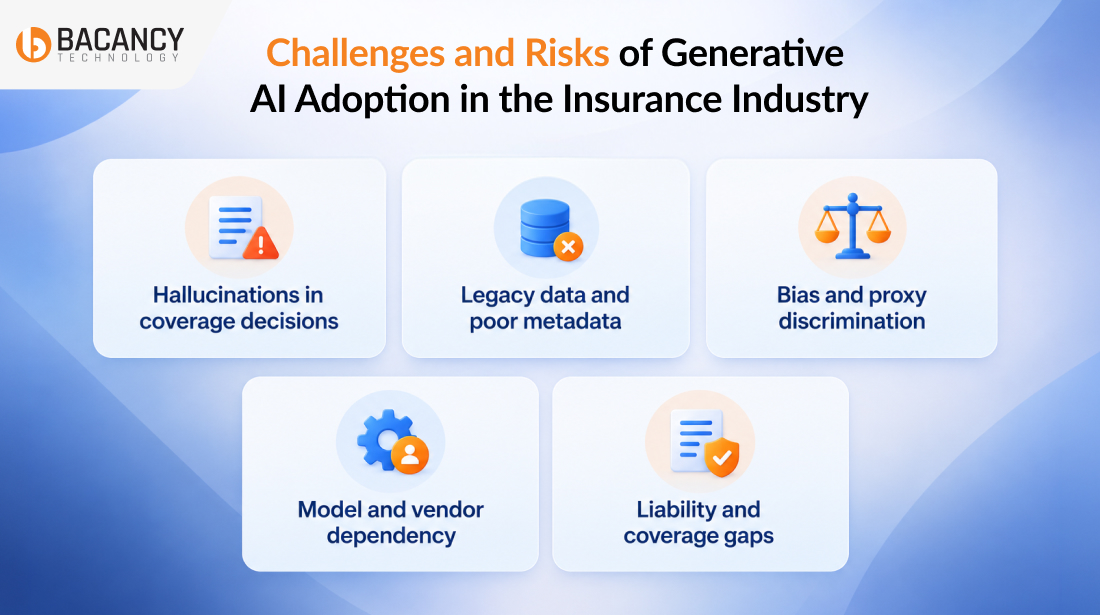
Hallucinations in coverage decisions
A confidently incorrect coverage answer is more than a customer-service error. It can create complaints, regulatory exposure, and potential bad-faith risk. The ground response in approved policy documents requires source citations and routes low-confidence or ambiguous cases to a human.
With decades of policy documents often sitting across mainframe-connected systems and document repositories with inconsistent formats and metadata. By cleaning, classifying, and establishing lineage for this data can become one of the largest and most underestimated parts of an AI implementation.
Bias and proxy discrimination
A model does not need a protected attribute such as race to produce discriminatory outcomes. Variables such as ZIP code, occupation, vehicle type, or other correlated attributes can act as proxies. Here, carriers need documented testing, monitoring, and governance rather than relying on model intent alone.
Model and vendor dependency
AI providers can change models, retire versions, alter pricing, or modify performance. If your application is tightly coupled to one model, every change can trigger another round of testing and validation.
Liability and coverage gaps
In 2026, ISO introduced generative-AI exclusion endorsements including CG 40 47, CG 40 48, and CG 35 08, giving carriers standardized ways to exclude certain AI-related exposures from commercial general liability coverage. The forms are not automatically attached to every policy, so insurers need to review the actual endorsements and coverage terms in their own programs.
Governance, Model Risk, and Regulatory Compliance for Insurance AI
For Generative AI in the insurance market, governance is no longer something to add after the pilot works. The regulators increasingly expect insurers to know where AI is being used, what data it relies on, how outputs are tested, and who is accountable for the resulting decisions.
NAIC AI Model Bulletin
The NAIC’s framework takes a principles-based approach, but that does not mean light-touch oversight. Insurers should be prepared to document their AI inventory, governance framework, risk assessments, testing, data controls, and human oversight.
EU AI Act
The EU AI Act creates additional requirements for certain high-risk insurance AI applications. In particular, AI used for risk assessment and pricing for natural persons in life and health insurance is classified as high-risk under Annex III. The requirements include risk management, technical documentation, logging, human oversight, accuracy, and post-market monitoring.
Colorado SB21-169
Colorado provides a concrete example of how state requirements can affect insurance AI. The law restricts unfair discrimination involving external consumer data and requires insurers to maintain a risk-management framework, assess discrimination risks, monitor results, and provide information to regulators when required.
How to Implement Generative AI in Insurance: A Step-by-Step Roadmap
A successful Generative AI rollout in the insurance industry should be measured by business outcomes, not launch dates. Set a clear exit criterion for every phase so the project moves forward only when the required evidence is in place.
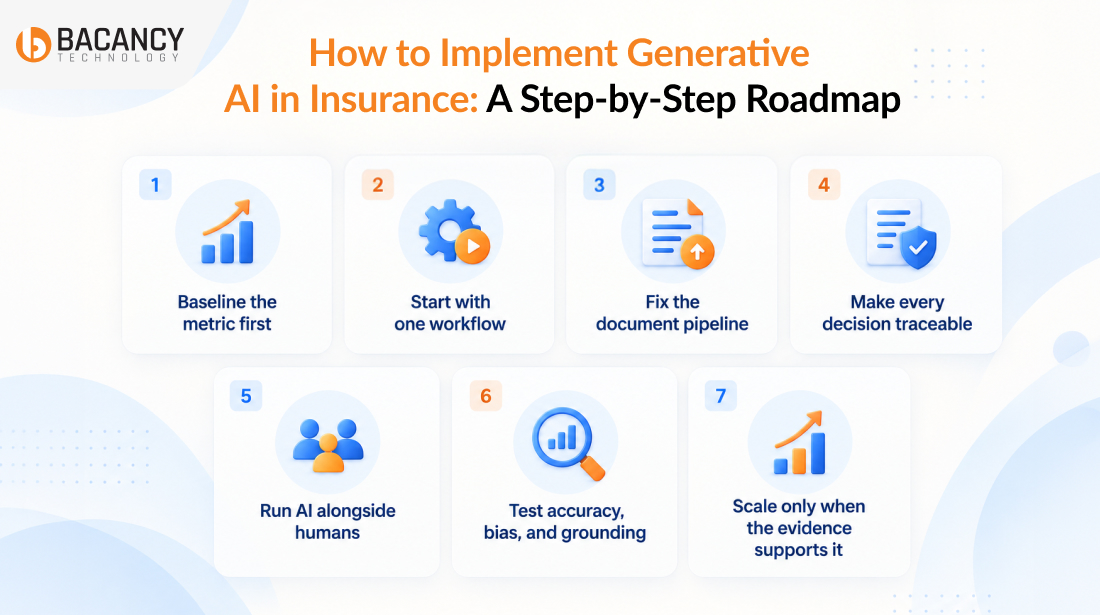
- Baseline the metric first: First, measure current cycle time, touch counts, and rework rate before building anything.
- Start with one workflow: Choose a high-volume, manageable process such as commercial submission triage or FNOL.
- Fix the document pipeline: Improve OCR, metadata, document quality, and lineage before introducing AI.
- Make every decision traceable: Capture the source, model version, prompt, context, output, and human reviewer from day one.
- Run AI alongside humans: Compare AI recommendations with real adjuster or underwriter decisions without affecting customers.
- Test accuracy, bias, and grounding: Challenge the system with edge cases, inconsistent inputs, and unsupported questions before release.
- Scale only when the evidence supports it: Launch with a controlled cohort, measure performance, fix gaps, and expand gradually.
Not Sure Where Generative AI Fits in Your Insurance Workflows
Start with our Generative AI consulting services to baseline metrics, pick the highest-value use case, and map a governed path to production.
Generative AI Implementation Cost in Insurance: Budget Ranges by Deployment Model
Budget ranges vary significantly based on your architecture, document complexity, and compliance requirements.
| Deployment Model
| Build Cost
| Annual Run Rate
| Best Fit
|
|---|
| API-based SaaS or vendor platform
| $75K-$250K
| $120K-$400K
| Standard workflows, fast validation, limited differentiation
|
| Private-cloud RAG on your own corpus
| $300K-$900K
| $250K-$700K
| Proprietary documents, moderate customization, most carriers
|
| Fine-tuned models in your own VPC | $900K-$3M+
| $600K-$1.5M
| Specialty lines, strict data residency, high volume
|
Budget note: Three costs are frequently underestimated in generative AI insurance programs: document remediation, which can account for 30%-40% of the initial build; model-risk validation and recurring revalidation; and change management for underwriters and adjusters.
How Bacancy Technology Helps Insurers Deploy Generative AI in Insurance
Bacancy Technology offers Insurance App Development Services, helping carriers, MGAs, and insurtechs move generative AI from a promising pilot to a governed production system. The focus is not just on making an AI model work, but on making the entire insurance workflow reliable, auditable, and ready for real-world deployment.
Our generative AI engineers first fix the foundation while remediating document pipelines, improving OCR for legacy loss runs and APS files; designing retrieval architecture around policy, state, and coverage-period context; grounding outputs against authoritative policy and claims data; adding guardrails for coverage-sensitive decisions; and building audit trails that capture what the system accessed, generated, and recommended.
Every generative AI engagement typically begins with a two-week AI readiness assessment covering data lineage, the highest-value use case, workflow and integration dependencies, and the governance gaps that could block production.
Conclusion
Generative AI in the insurance market has moved beyond the question of whether the technology works. The real question is whether insurers can deploy it at scale without losing control of data, decisions, or accountability. The carriers making progress are not necessarily the ones using the most advanced models. They are the ones connecting AI to measurable business outcomes, fixing the data and document foundations underneath it, and building governance into the system from the start.
The path to production is clear: you need to start with one high-value workflow, establish a baseline, remediate the underlying data, build traceability and human oversight into the architecture, and scale only after the results hold up in real operating conditions. A faster claims cycle, higher underwriting capacity, or fewer unnecessary SIU referrals is meaningful only when the improvement can be measured and defended.
Frequently Asked Questions (FAQs)
Predictive AI calculates numeric risk scores and outcomes using structured, historical data (e.g., predicting claim severity or fraud risk). Generative AI processes unstructured text and documents (e.g., medical records, loss runs, ACORD forms) to synthesize context, extract key facts, draft communications, and explain the reasoning behind complex insurance decisions.
Underwriting submission triage and First Notice of Loss (FNOL) processing yield the fastest return on investment. Because these workflows rely heavily on manual document extraction and summarization, automation drops quote turnaround and claims handling times by 30% to 60% within 1 to 2 quarters.
Under Annex III of the EU AI Act, AI models used for risk assessment and pricing are explicitly classified as high-risk for life and health insurance. While standard P&C underwriting is not explicitly targeted, systems impacting access to essential services or mandatory coverages (e.g., compulsory auto liability) may still face heightened scrutiny and require thorough risk documentation.
Generative AI in insurance implementation costs depend on the technical path chosen:
API-based SaaS / Vendor Platforms: $75,000-$250,000 (annual run rate: $120,000-$400,000) for rapid, standard workflow integration.
Private-Cloud RAG (Retrieval-Augmented Generation): $300,000-$900,000 (annual run rate: $250,000-$700,000) for secure, customized internal document processing.
Custom Fine-Tuned Models: $900,000 -$3,000,000+ for large-scale enterprise deployments with strict data residency requirements.
To prevent proxy discrimination, carriers must audit correlated variables (ZIP codes, occupation) alongside direct attributes. Effective mitigation requires:
Pre- & Post-Deployment Bias Audits: Testing using fairness frameworks.
RAG Grounding: Restricting outputs to approved policy data.
Human Oversight: Mandatory human review for high-impact decisions.
Continuous Compliance: Ongoing monitoring under NAIC and state rules (e.g., Colorado SB21-169).