Quick Summary
This blog covers the fintech trends shaping 2026 and 2027, from agentic payments, stablecoin settlement, and real-time payment rails to open banking, AI governance, identity, tokenized assets, and compliance engineering. It also explains what each trend means for fintech architecture and the key capabilities CTOs should prioritize and ship first.
Table of Contents
Introduction
Fintech trends in 2026 have stopped being feature bets and started being infrastructure decisions. Real-time payment adoption is expanding on both RTP and FedNow, stablecoins are moving into a formal federal licensing regime under the GENIUS Act, AI is becoming part of daily financial operations, and open banking is shifting from a compliance checkbox toward commercial use cases.
For CTOs, these fintech trends point to a broader shift: financial products are becoming more programmable, connected, and automated. Payments can settle in real time, software agents can initiate transactions on a customer’s behalf, and financial decisions can increasingly use live transaction data instead of periodic snapshots.
That’s a different engineering priority for 2026 heading into 2027. Teams need infrastructure that can support real-time events, stronger identity controls, interoperable APIs, automated compliance, and auditable AI systems.
The numbers show how strong the fintech market is. In the first half of 2026, US fintech companies raised $80.8 billion across 933 deals, according to KPMG. Most of this investment went into payments and AI, showing where the industry is heading. (Source)
The fintech trends that matter this cycle are no longer isolated technology bets. They’re changes that touch your platform architecture, operating model, risk controls, and ability to ship new financial products at all.
Why These Fintech Trends Made the List
Not every technology showing up in fintech headlines earns a place on a CTO’s roadmap. We filtered these fintech trends through three questions:
- Is financial infrastructure actually changing?
- Does it create a real impact on engineering?
- Is there strong market, regulatory, or industry evidence behind it?
We checked real sources before picking these trends: the CFPB, the CFTC, NIST’s AI Risk Management Framework, the Financial Stability Board, the Federal Reserve, and the payment networks’ own published rules.
The point is simple: separate the fintech industry trends that actually change your architecture, risk, compliance, or product strategy from the trends that just sound good on a conference slide and don’t really matter.
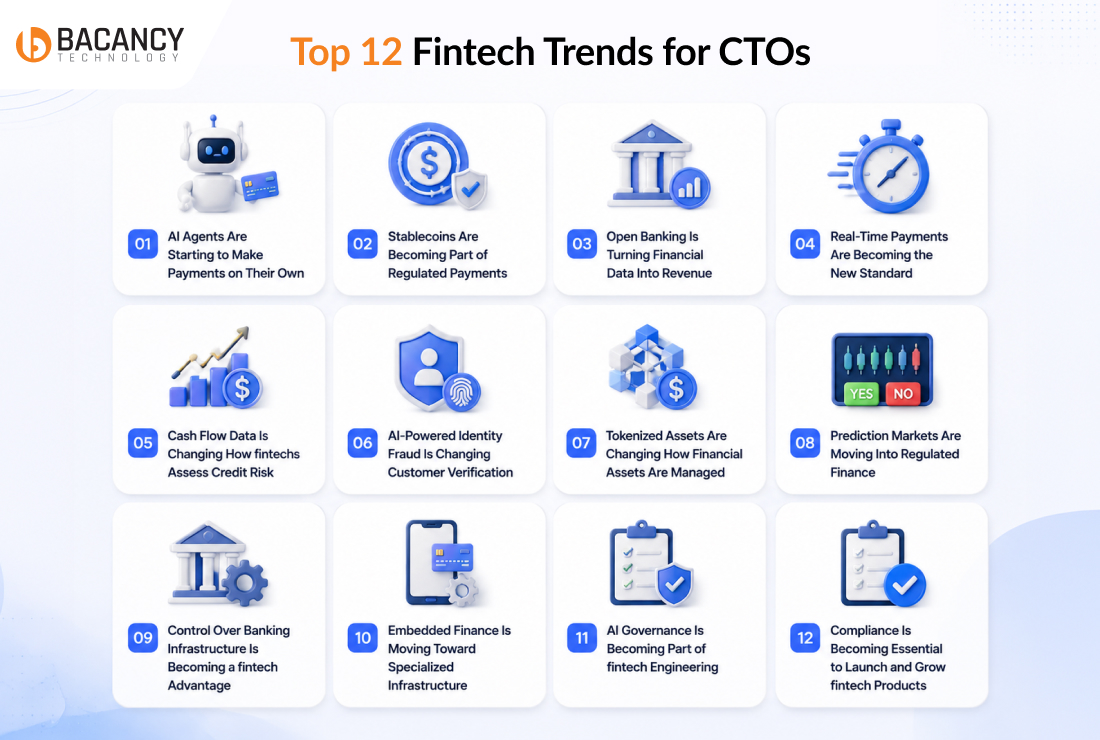
12 Fintech Trends Shaping the CTO Roadmap in 2026
The fintech trends shaping 2026 are changing how financial platforms handle payments, data, AI, identity, and compliance. Here are the key trends CTOs should watch and prepare for.
1. AI Agents are Starting to Make Payments on Their Own
AI agents are moving beyond recommendations into actions such as product discovery, booking, subscription management, and payments, one of the fastest-moving fintech trends in the payments space right now. That creates a new participant in the transaction flow: software acting on behalf of a customer.
Payment networks are already building infrastructure around this model, including mechanisms for agent identity, authorization, and transaction controls.
For merchant-facing fintechs, the question is shifting from whether agents will participate in commerce to whether their payment infrastructure can identify and safely authorize them.
Visa has already introduced infrastructure for agentic payments, including its Trusted Agent Protocol, while Mastercard has expanded Agent Pay and introduced machine-payment capabilities for autonomous transactions.
For merchant-facing fintechs, this changes the payment model.
A conventional payment flow assumes:
human → merchant → payment processor
An agentic flow can look more like:
user → AI agent → merchant → payment network
Your platform therefore needs to know more than whether a payment credential is valid. It needs to understand:
- Who authorized the agent?
- What is the agent allowed to purchase?
- What spending limits apply?
- Can the transaction be traced back to the original user intent?
- What happens if the agent makes an incorrect purchase?
- How are disputes and refunds handled?
What Your Team Should Ship
Build an agent-ready payment layer with delegated authorization, transaction limits, agent identity, tokenized credentials, audit trails, and clear human override controls, and bring in AI agent developers to engineer the authorization and identity logic these flows depend on.
You do not necessarily need to launch a consumer-facing agent in 2026. But if your platform serves merchants, payments, commerce, or financial workflows, your APIs should be designed for machine-initiated transactions.
2. Stablecoins are Becoming Part of Regulated Payments
Stablecoins are becoming harder for financial institutions to treat as a purely experimental crypto layer as regulated payment-stablecoin frameworks take shape, a shift that’s reshaping fintech industry trends around cross-border settlement specifically.
In the United States, the GENIUS Act has established a federal framework for permitted payment stablecoin issuers, with regulators now working through implementation requirements (Source). The OCC, for example, has issued implementation materials covering reporting and compliance for issuers under its jurisdiction.
That changes the CTO conversation. The question is no longer simply:
Should we support stablecoins? It becomes:
Where can stablecoin settlement improve our existing financial infrastructure, and what controls are required to operate it safely?
Potential applications include cross-border settlement, treasury movement, merchant payouts, and machine-to-machine payments.
The architecture also changes. Stablecoin support can introduce wallet infrastructure, blockchain connectivity, transaction monitoring, reconciliation, custody considerations, and additional compliance workflows.
What Your Team Should Ship
Do not start by building a token. Start with a stablecoin settlement architecture that isolates blockchain connectivity from your core ledger, supports transaction monitoring, provides deterministic reconciliation, and allows payment methods to be added without rewriting the financial core.
3. Open Banking is Turning Financial Data into Revenue
Open banking has often been treated as a regulatory requirement: provide access, obtain consent, connect APIs, and satisfy the relevant rules. That’s changing fast, and it’s one of the fintech trends most likely to catch teams off guard if they’re still building for compliance alone.
The next stage is more commercial. Access to financial data only matters if it improves a measurable business outcome. For a fintech, that could mean lower underwriting costs, better approval rates, higher customer retention, more accurate risk decisions, or new revenue from financial-data products.
The engineering priority therefore shifts from simply connecting accounts to building a reusable data layer that can turn permissioned financial data into product value.
The U.S. regulatory environment is still evolving. The CFPB’s Personal Financial Data Rights Rule has faced a court stay, while the bureau has also been reconsidering aspects of its implementation. (Source)
For CTOs, that uncertainty makes architecture more important, not less.
What Your Team Should Ship
Build an API-first financial data layer with:
- Consent and permission management
- Data normalization
- Provider abstraction
- Tokenized credentials
- Data lineage
- Revocation workflows
- Monitoring for API failures and stale data
The goal is to avoid hard-coding your product around one open-banking provider or one regulatory assumption.
4. Real-Time Payments are Becoming the New Standard
Real-time payments are moving from a premium capability to expected infrastructure, one of the clearest fintech industry trends showing up in customer and partner expectations alike. U.S. real-time payment infrastructure is expanding through both The Clearing House’s RTP network and the Federal Reserve’s FedNow Service.
For fintech teams, the important shift is not which rail wins. It is that instant payment capabilities are becoming part of the infrastructure customers and financial partners increasingly expect.
The important shift for engineering teams is not simply speed.
Real-time payments change how applications handle:
- Liquidity
- Fraud
- Settlement
- Reconciliation
- Notifications
- Refunds
- Treasury
- Cash-flow forecasting
A payment that settles immediately leaves less room for manual intervention after the fact.
What Your Team Should Ship
Move payment architecture toward event-driven processing.
That means idempotent transaction APIs, real-time fraud checks, event streams, automated reconciliation, payment-status webhooks, and clear failure-handling workflows.
If your platform still treats payments as a synchronous request followed by batch reconciliation, real-time rails will expose the architectural limitations quickly.
5. Cash Flow Data is Changing How Fintechs Assess Credit Risk
Traditional underwriting depends heavily on historical credit data, bureau scores, financial statements, and manually supplied information, a model several fintech trends in lending are actively working to replace.
For many businesses and consumers, those inputs provide only a partial view of current financial health.
Open banking and transaction data create another option: underwriting based on actual cash movement.
For a fintech lender, this can mean evaluating:
- Recurring income
- Account balances
- Revenue volatility
- Expense patterns
- Debt obligations
- Cash-flow gaps
- Business seasonality
The opportunity is not simply faster approvals. It is building a credit decision that can incorporate current financial behavior alongside traditional credit signals, giving lenders a more timely view of risk.
What Your Team Should Ship
Create a real-time cash-flow intelligence layer separate from the lending product.
It should normalize account data, calculate financial features, feed risk models, retain decision evidence, and support explainable credit decisions.
That foundation can later support lending, credit limits, collections, and personalized financial products.
6. AI-Powered Identity Fraud is Changing Customer Verification
Fraud prevention used to focus heavily on the transaction, but that’s shifting fast as one of the more urgent fintech industry trends in risk and compliance.
Generative AI has made identity fraud more sophisticated, including synthetic identities, manipulated documents, voice cloning, and deepfake-based impersonation.
For fintechs, this pushes fraud controls toward onboarding.
Instead of asking only: Does this transaction look suspicious?
Risk teams increasingly need to ask: Was this customer genuine when the account was created?
What Your Team Should Ship
Build layered identity verification rather than relying on one biometric or document check.
A stronger identity stack can combine:
- Document verification
- Liveness detection
- Device intelligence
- Behavioral signals
- Network intelligence
- Account history
- Risk scoring
- Step-up authentication
The architecture should also allow fraud signals generated during onboarding to remain available throughout the customer lifecycle. Your identity layer should feed those signals into transaction monitoring, account-risk scoring, authentication, and step-up verification rather than treating onboarding as a one-time compliance checkpoint.
Is your fintech platform equipped to detect increasingly sophisticated identity fraud?
Choose our fintech cybersecurity services to build stronger fraud defenses and protect every stage of the customer journey.
7. Tokenized Assets are Changing How Financial Assets are Managed
Stablecoins and tokenized real-world assets are often grouped under the broad “blockchain in finance” category, a mistake that flattens two very different fintech trends into one.
For CTOs, they should be treated as different infrastructure problems.
A stablecoin represents a payment or monetary instrument.
A tokenized real-world asset can represent ownership or economic exposure to something such as a security, fund interest, bond, commodity, or other asset.
That introduces different requirements around ownership records, transfer restrictions, investor eligibility, settlement, custody, reporting, and interoperability.
For a CTO, the important distinction is that tokenization can affect the asset lifecycle itself, not just the payment method. That makes the ledger, transfer rules, and compliance model as important as the blockchain connection.
What Your Team Should Ship
If tokenized assets fit your business model, build a modular asset infrastructure layer rather than embedding token logic throughout your core platform.
Separate:
- Asset representation
- Ownership
- Transfer rules
- Compliance checks
- Settlement
- Reporting
That keeps the platform flexible as standards and regulations develop.
8. Prediction Markets are Moving into Regulated Finance
Prediction markets have moved into a more serious regulatory conversation, making them one of the more unexpected fintech industry trends CTOs are now being asked about.
The CFTC describes event contracts as regulated financial products that have existed in U.S. markets for more than two decades. In 2026, the agency has continued issuing guidance and proposed rulemaking around prediction markets and event contracts as activity expands.(Source)
For fintech infrastructure providers, the opportunity is broader than building a prediction-market app. The more relevant question for most CTOs is whether existing capabilities in identity, payments, settlement, market surveillance, and compliance can support regulated event-based financial products without creating a separate technology stack.
There is demand for infrastructure around:
- Market data
- Risk controls
- Identity
- Payments
- Settlement
- Compliance
- Trading interfaces
- Market surveillance
What Your Team Should Ship
If your business plans to enter this space, prioritize a compliance-aware trading architecture.
Keep market logic, user identity, funds movement, surveillance, and regulatory reporting modular so that changes in permitted contract types or regulatory requirements do not force a full platform rebuild.
9. Control Over Banking Infrastructure is Becoming a Fintech Advantage
For years, fintechs could differentiate through a better interface sitting on top of someone else’s banking infrastructure. That’s no longer enough, and it’s one of the fintech trends forcing a harder look at who actually owns the rail underneath.
That model still works, but the strategic advantage is shifting toward control over the underlying financial rails.
Licensing, regulated partnerships, payment access, deposits, settlement relationships, and risk infrastructure can become difficult-to-replicate advantages.
The result is a growing divide between:
Fintech products that rent financial infrastructure and fintech platforms that control or deeply integrate with it.
What Your Team Should Ship
CTOs should map every critical financial dependency:
- Which bank actually holds funds?
- Who owns the ledger?
- Who controls payment access?
- Who performs KYC?
- Who owns transaction data?
- Who controls settlement?
- What happens if a banking partner exits?
The strategic question is therefore control: which parts of the financial stack should your company own or directly control?
10. Embedded Finance is Moving Toward Specialized Infrastructure
Embedded finance asks a different question: which parts of the financial stack should your company deliberately leave to a licensed infrastructure partner?
Embedded finance remains one of the strongest fintech industry trends. According to Grand View Research, the global embedded finance market was valued at $107.27 billion in 2024 and is projected to reach $588.49 billion by 2030, a 32.8% CAGR; the market is becoming less about simply adding financial features to a non-financial product.
The infrastructure underneath those products is becoming more specialized.
A company embedding payments, lending, cards, or accounts does not necessarily want to become a bank. It wants reliable financial infrastructure that handles licensing, compliance, settlement, risk, and operations.
That creates a stronger role for licensed infrastructure providers.
What Your Team Should Ship
Build your embedded-finance architecture around provider abstraction.
Do not let one banking-as-a-service or payment provider become inseparable from your product code.
Use a service layer that separates:
your product logic → financial orchestration layer → regulated provider
That gives your team more flexibility when pricing, coverage, compliance requirements, or partner relationships change.
11. AI Governance is Becoming Part of Fintech Engineering
AI adoption is accelerating across financial services, but governance is becoming part of the engineering problem, arguably the fintech trends section CTOs are least prepared to act on today.
The Financial Stability Board’s June 2026 consultation report set out 12 “sound practices” spanning organization-wide AI governance and full lifecycle management, from board-level oversight through data governance, explainability, and controls specific to generative and agentic AI. (Source)
The consultation closed in July, and the FSB is expected to publish final guidance in October 2026, so CTOs building AI governance now should treat these 12 practices as the working baseline.
For a CTO, an AI governance framework needs to answer operational questions:
- Which models are in production?
- What data do they access?
- Who approved them?
- What happens when the model changes?
- How are outputs evaluated?
- What happens when an agent takes an unauthorized action?
- Can the company reproduce a decision months later?
NIST’s AI Risk Management Framework and its Generative AI Profile provide additional guidance for managing AI risks across the lifecycle.
What Your Team Should Ship
Build an AI control plane.
Track model versions, prompts, evaluations, permissions, datasets, outputs, human approvals, incidents, changes, and model-risk assessments.
For agentic systems, add policy enforcement, action-level authorization, human escalation, and rollback controls.
The objective is simple: Every production AI action should be explainable, traceable, and controllable.
Need better control and visibility across your fintech AI Systems?
Our fintech AI development services help you build governed AI solutions with model monitoring, access controls, auditability, and human oversight.
12. Compliance is Becoming Essential to Launch and Grow Fintech Products
Compliance used to be treated as something that happened before launch, a pattern across fintech industry trends that’s now getting more expensive to maintain.
That model is becoming expensive, and it’s a big reason trends in fintech industry coverage keep circling back to compliance as infrastructure rather than paperwork.
Modern fintech products touch identity, payments, data sharing, AI, fraud, lending, digital assets, and cross-border transactions. Each new capability can create new regulatory obligations.
That means compliance needs to move closer to the product and engineering teams.
What Your Team Should Ship
Turn regulatory controls into reusable platform capabilities.
Examples include:
- Automated KYC and KYB workflows
- Transaction monitoring
- Consent management
- Audit logging
- Data retention controls
- Policy engines
- Explainable decision records
- Access controls
- Automated evidence collection
- Compliance dashboards
The goal is not to automate compliance for its own sake. It is to make compliance deployable.
When compliance controls are built into the platform, they can become an enabler for revenue rather than a launch blocker.
Entering a new market, onboarding a new financial partner, launching a new product, or increasing transaction volume becomes easier when the required controls and evidence are already part of the platform.
What Should Fintech CTOs Build First?
Not every fintech should invest in all 12 trends at once; chasing every one of the trends in fintech industry coverage is how teams end up with a scattered roadmap. The right priority depends on your product, regulatory exposure, transaction volume, and existing architecture.
The strongest investments are usually foundational capabilities that support several roadmap priorities at once.
| When Your Priority Is
| Build first |
|---|
| Faster payments | Event-driven payment and reconciliation infrastructure |
| AI adoption | AI governance, evaluation, and model-control infrastructure |
| Fraud reduction | Unified identity and real-time risk signals
|
| Better lending decisions | Real-time financial data and cash-flow intelligence |
| Embedded finance | Provider abstraction and financial orchestration |
| New markets | Reusable compliance and policy infrastructure
|
| Stablecoin payments | Settlement, reconciliation, and transaction-monitoring layers |
Choosing the right starting point often requires more than evaluating individual technologies. Fintech consulting services can help CTOs assess their existing architecture, identify the highest-impact opportunities, and create a practical roadmap based on business goals, regulatory requirements, and technical constraints.
How Bacancy Technology Helps CTOs Ship Against the 2026-2027 Fintech Roadmap
Bacancy Technology helps fintech and financial-services engineering teams turn emerging technology requirements into production-ready systems.
Whether you need a fintech developer to extend an existing platform or an engineering team to build a new financial capability, the focus is on creating reusable infrastructure without forcing you to rebuild your core platform for every new capability.
This is the same lens we use to track fintech industry trends 2026 across payments, compliance, and AI for our own clients.
Engagements can span architecture modernization, real-time payment infrastructure, financial data platforms, AI and ML systems, compliance automation, API integrations, and cloud-native engineering.
The focus is on building the underlying capabilities your team can reuse across products, markets, and future fintech initiatives.
Fintech Engineering Capabilities Include:
- AI and ML engineering for fraud detection, underwriting, risk scoring, personalization, and financial automation
- Generative AI and agentic AI development for intelligent financial workflows, copilots, and controlled autonomous systems
- Payment infrastructure engineering for real-time payments, payment orchestration, transaction processing, and reconciliation
- Fintech API development for open banking, embedded finance, third-party integrations, and financial data access
- Cloud and microservices modernization for scalable, resilient financial platforms
Data engineering for real-time financial analytics, risk intelligence, and decisioning
- Compliance and security engineering for auditability, identity, access control, monitoring, and regulatory workflows
The objective is not to build around a trend because it is popular.
It is to identify which trend creates a real business opportunity, determine the infrastructure required to support it, and ship that capability without compromising security, reliability, or regulatory readiness.
Conclusion
The biggest fintech trends of 2026 and 2027 are changing how money moves, decisions are made, identities are verified, and financial platforms operate.
AI agents, real-time payments, stablecoins, open banking, and AI governance are becoming part of the modern financial ecosystem. For CTOs, the focus should be on building flexible infrastructure that can adapt to these changes without compromising security or compliance.
If you’re ready to modernize your financial platform, a trusted fintech IT services and solutions provider can help you turn emerging trends into secure, scalable, and business-ready solutions.
The best fintech roadmap isn’t built to chase trends. It’s built to absorb them.
Frequently Asked Questions (FAQs)
The biggest fintech trends include AI, agentic AI, real-time payments, stablecoins, open banking, embedded finance, and digital identity. Together, these technologies are making financial services faster, smarter, more automated, and easier to access.
AI is helping fintech companies automate routine work, detect fraud, assess risk, personalize financial products, and improve customer support. Generative and agentic AI are taking this further by handling more complex financial tasks.
Digital payments remain one of the fastest-growing fintech sectors, and it’s consistently one of the fintech industry trends driven by real-time payments, embedded finance, and cross-border transactions. AI-powered fraud detection and financial automation are also creating strong demand across the industry.
Fintech companies face growing challenges around cybersecurity, regulatory compliance, fraud, data privacy, and technology costs. They must continue innovating while protecting sensitive financial data and meeting increasingly complex regulatory requirements.
No, most fintechs do not need to support agentic payments yet. The technology is still emerging, but payment companies should start preparing as AI agents increasingly participate in purchasing and financial transactions.
Fintech infrastructure costs vary widely based on features, integrations, security, compliance, and scale. Basic platforms can cost tens of thousands of dollars, while enterprise-grade infrastructure can require hundreds of thousands or more.
Companies should invest in trends that solve a clear business problem rather than simply following the market. For many fintechs, AI for fraud detection, automation, risk management, or customer service offers a practical starting point.
CTOs should evaluate each technology based on business value, security, compliance, scalability, and implementation costs. Prioritizing solutions that solve immediate problems while supporting future growth can help companies invest more strategically.