Quick Summary
Fintech choosing a cloud services provider require matching cloud capabilities with financial product requirements. The right cloud setup helps fintech teams run financial products reliably, connect existing systems, and accommodate changing transaction demands. This guide examines cloud platforms and deployment approaches to help CTOs make informed infrastructure decisions.
Table of Contents
Introduction
As fintech companies expand their services, cloud infrastructure has to keep pace with new customers, higher transaction volumes, and shifting market demands. The LSEG Global Cloud Survey found that 87% of financial services firms increased their cloud investment over the previous two years. Cloud is now central to how financial products are built and run.
Fintech choosing a cloud services provider is a complex decision. Price and capacity are only the starting point. But security, regulatory compliance, scalability, performance, and long-term cost all affect how well a fintech company can operate and grow. A weak choice at this stage is expensive to fix later.
Hence, we have curated this blog, which discusses the factors CTOs should evaluate first, compares AWS, Azure, and Google Cloud, and explains how to select a cloud model that matches your technical requirements and business goals.
Why Is Choosing the Right Cloud Service Provider Important for Fintech?
A fintech platform processes thousands to millions of transactions daily, connect with multiple payment networks, and manages sensitive financial records across numerous systems. Each of these operations places different demands on the cloud infrastructure.
A cloud service provider for fintech that cannot meet those demands can introduce transaction delays, service interruptions, or integration challenges that affect both business and customer operations.
For CTOs, the challenge is to assess how well a provider fits the platform’s technical and operational requirements before making a long-term commitment. The following 3 factors need particular attention:
- Transaction reliability: Evaluate uptime commitments, failover mechanisms, and disaster recovery capabilities to keep payment processing and other critical services available during disruptions.
- Security and compliance: Assess encryption, identity and access management, audit logging, and support for applicable financial regulations to protect sensitive data and meet compliance obligations.
- Scalability and technical fit: Check whether the provider supports existing banking APIs, payment gateways, databases, and third-party integrations while allowing infrastructure to expand as transaction volumes increase.
Price should be compared alongside these capabilities. The initial rates would be lower, and it may come with additional charges for data transfers, premium security features, support, or resource scaling.
What Should Fintech CTOs Look for in a Cloud Service Provider?
Choosing a cloud service provider for fintech requires a technical assessment of how its infrastructure will support payment processing, financial data protection, regulatory compliance, and business continuity.
The list of criteria below can help narrow the options.
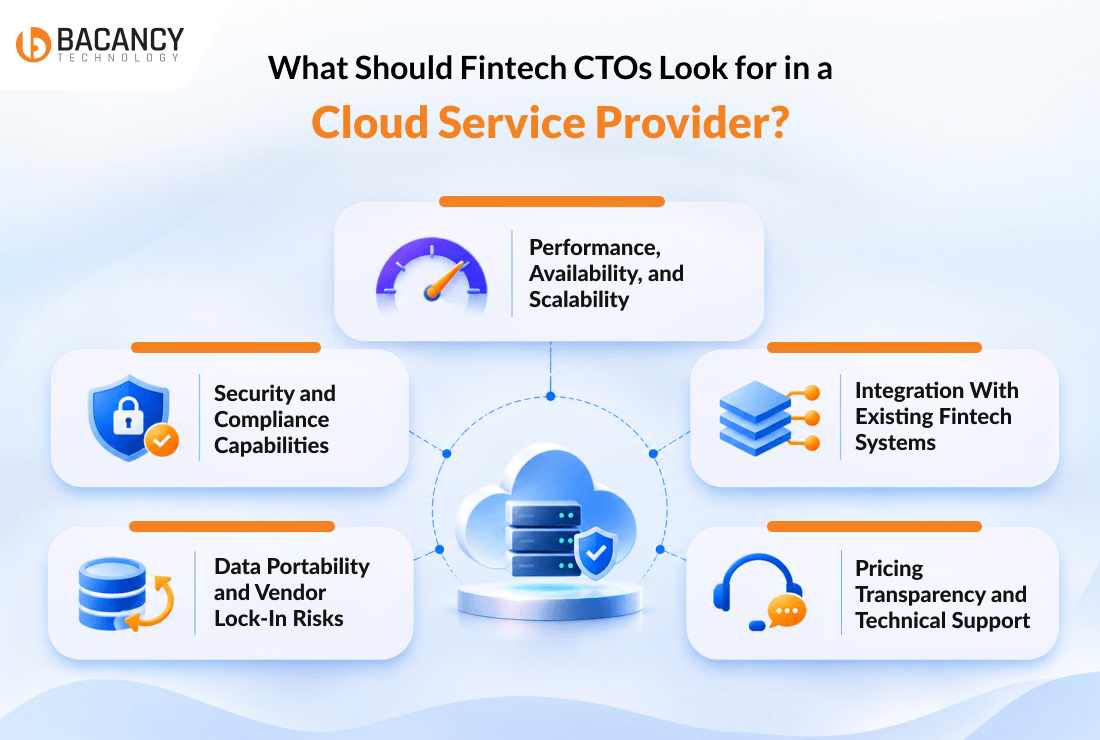
1. Security and Compliance Capabilities
Fintech platforms handle sensitive information, so ask what comes built in. If you want encryption at rest and in transit, customer-managed keys, HSM support, fine-grained access controls, and audit logs with restricted access.
CTOs also should verify how a provider protects the data, backups, and administrative access. You should ask for compliance capabilities for closer scrutiny. Request the provider’s SOC 2 Type II report and PCI DSS Attestation of Compliance, and confirm ISO 27001 status.
A provider that takes weeks to share can slow down your audit. To solve this issue, ask for relevant audit reports, certification scope, and documentation of shared security responsibilities.
Note: A provider’s certification alone does not make your fintech application compliant.
Cloud performance should align with the transaction patterns and service-level requirements of your fintech application. Eventually, your traffic will spike, which counts salary days, holiday sales, and market events. All of it will multiply load in minutes, so you need a provider that scales as fast as your customers arrive.
CTOs should ask for service-level agreements (SLAs), regional availability options, load-balancing capabilities, and support for multi-zone deployments. Read the SLA, then look at the architecture behind it.
Review the provider’s public status history for the past 12-24 months to understand its track record. Then load-test your own workload at 5-10x your normal peak to assess how the infrastructure handles traffic spikes.
Note: CTOs should define recovery time objectives (RTOs) and recovery point objectives (RPOs) for critical services, then verify these targets through failover and restoration tests.
3. Integration With Existing Fintech Systems
Cloud migrations often require more than moving applications and databases. For your fintech platform, you need to list what your functions are; it may depend on the core banking systems, payment gateways, KYC and AML services, credit bureaus, and a data warehouse.
CTOs should check if their provider supports the dependencies, languages, container tools, and API standards without excessive latency, complex workarounds, or fragile connections. If the connection is missing, then your team must build and maintain a custom one.
Note: Before selection, map the critical application dependencies and verify the required API protocols, private network connectivity, and hybrid-cloud connections.
Our fintech integration services help connect cloud platforms with your existing financial systems, reducing the need for custom workarounds and keeping data flowing across your fintech applications.
4. Pricing Transparency and Technical Support
Cloud costs in fintech keep expanding beyond virtual machines and database storage. CTOs should ask for a transparent pricing rate card and a cost tool your finance team can use or handle. It should also model costs using expected transaction volumes, peak demand, data retention periods, and recovery requirements.
Also, check whether the provider offers budget alerts, detailed usage reports, and resource-level cost allocations. You can clarify how data transfer and cross-region charges work, since they cause most billing surprises. To ensure technical support, get answers to these three questions:
- How fast does the provider respond to a critical incident?
- Do you get a named technical contact?
- Is 24/7 engineering support part of it, or is it an add-on?
Note: Investigating infrastructure or networking failures helps to distinguish a genuine cost-effective provider from an expensive operational overhead.
5. Data Portability and Vendor Lock-In Risks
A fintech platform can become dependent on provider-specific databases, serverless functions, analytics tools, or proprietary messaging services. CTOs should identify which components rely on their services and estimate the effort to replace them.
Check whether data can be exported in usable formats, whether database backups can be restored outside the provider’s environment, and what fees apply to large-scale data transfer. Review contract terms for data ownership, exit assistance, retention, and verified deletion.
If you are considering a move between cloud providers, read our AWS to Azure migration guide to understand the key migration considerations.
Note: You can limit the damage by choosing containers, Kubernetes, Terraform, and a PostgreSQL-compatible database where it fits.
Cloud Security and Compliance Requirements for Fintech Companies
Compliance is where numerous fintech cloud projects slow down. First, map your obligations and shortlist the providers that follow cloud security and compliance requirements. Here are the key areas to evaluate:
1. PCI DSS, SOC 2, and ISO 27001 Considerations
These 3 frameworks address different aspects of compliance and security.
- PCI DSS applies if you store, process, or transmit cardholder data. Version 4.0.1 is the current standard. Pick a provider that is a validated PCI DSS service provider, and scope your own environment separately.
- SOC 2 reports show how a provider handles security, availability, and confidentiality. Ask for Type II, since it tests controls over a period of time instead of on a single day.
- ISO 27001 confirms that the provider runs a formal information security program. Enterprise buyers and international partners often ask for it.
A certified provider does not make your application compliant. Their certifications include the infrastructure layer only. Your code, configurations, and processes still need their own assessment.
2. Encryption, Identity and Access Management, and Audit Logs
Set a baseline and check each provider against it:
- Encryption: Data encrypted at rest and in transit, with customer-managed keys and HSM support for key storage.
- Identity and Access Management: Role-based access, least-privilege policies, and enforced multi-factor authentication for every user with production access.
- Audit Logs: Immutable logs that capture who accessed what and when, with retention that matches your regulatory window.
If a provider cannot meet this baseline natively, you will pay for third-party tools. Our fintech cybersecurity services close that gap with encryption, access control, and audit logging set up from day one
3. Data Residency and Regulatory Requirements
Various regulators require customer data to stay in a specific country or region. GDPR limits transfers outside the EU. India and several other markets have local storage rules for financial data. In the EU, DORA sets operational resilience requirements for financial entities and their ICT providers.
List every market you serve and the rules that apply there. Then confirm that your provider has regions in each one, and that data stays in the region you choose unless you move it.
4. Shared Responsibility Between Fintech Companies and Cloud Providers
Cloud security operates through a shared responsibility model, but the division of duties depends on the service model and provider’s terms. A provider generally secures the underlying infrastructure, while the fintech company remains responsible for areas such as application security, user permissions, data classification, and compliance with its own obligations.
CTOs should document who manages operating system patches, database configuration, encryption keys, vulnerability remediation, incident notification, backup restoration, and access reviews.
Which cloud fits your fintech product?
We guide CTOs through provider selection, architecture, and compliance with our fintech consulting services so you get a clear roadmap for security, scale, and spend.
AWS vs Azure vs Google Cloud for Fintech: Which Should You Choose?
All the cloud providers can run a regulated fintech platform. The best one depends on your workloads, your team’s skills, and the markets you serve. Here’s how GCP vs AWS vs Azure compare on the points that matter:
Google Cloud leads in data and machine learning. BigQuery handles large-scale analytics, Vertex AI supports model development, and GKE is a strongly managed Kubernetes platform. Teams that build fraud detection or risk scoring often pick it for these tools.
AWS has the widest service catalog and the most fintech-specific tooling. It offers managed databases like Aurora and DynamoDB, key management through KMS and CloudHSM, and threat detection through GuardDuty and Security Hub. EKS also manages Kubernetes.
Azure works best when your company already runs on Microsoft. Entra ID (formerly Azure Active Directory), Microsoft 365, and .NET workloads connect with little extra work. For hybrid setups, Azure Arc and Azure Stack let you run Azure services in your own data centers.
Evaluate Based on Your Regional Availability, Reliability, and Integration Support
Start with your market list. Then check each provider’s current region map, since all 3 keep adding regions.
- AWS has the largest global footprint and a long operating history.
- Azure has broad regional coverage, which helps when local data rules apply in a market.
- Google Cloud has fewer regions, but it runs on a strong private global network.
On reliability, review each provider’s public status history and the zone design of the specific services you plan to use. Service-level behavior differs from one product to the next.
For integration, check the marketplace for the experts you already use, such as payment gateways, KYC providers, and core banking platforms.
What are the Pricing Models and Proprietary Service Dependencies?
All 3 offer pay-as-you-go pricing and discounts for committed use. These go by different names: Savings Plans and Reserved Instances on AWS, Reservations on Azure, and committed use discounts on Google Cloud. Azure also lets you apply existing Microsoft licenses to cut costs, which helps Microsoft-heavy teams.
The bigger cost risk comes in proprietary services. DynamoDB, Cosmos DB, and Spanner perform very well. They are also hard to replace later. It decides early which services are worth that trade. For everything else, lean on containers, Kubernetes, and open databases so you can move if you need to.
Match Each Provider to Your Fintech Workload Requirements
| Workload | Strong Fit
| Reason
|
|---|
| Payments and Core Transaction Systems
| AWS | Mature Services, Wide Ecosystem, Deep Fintech References
|
| Enterprise Banking on a Microsoft Stack
| AWS | Identity Integration, Hybrid Tools, Regional Coverage
|
| Fraud Detection and ML-driven Risk Models
| Google Cloud
| Strong Data and AI Platform
|
| Regulated Workloads that Must Stay Partly On-Premises
| Azure or AWS
| Hybrid Options Through Azure Arc, Azure Stack or AWS Outposts
|
Many fintechs end up on more than one cloud. If that is your path, standardize on containers and infrastructure as code from day one, so your team can run the same workloads across providers.
Public vs Private vs Hybrid Cloud for Fintech Applications
Your deployment model decides who controls the infrastructure, how fast you can scale, and what you pay to run it. Most fintech teams pick one of 3: public, private, or hybrid. Here is how they compare.
| Factor
| Public Cloud
| Private Cloud
| Hybrid Cloud
|
|---|
| Infrastructure Control
| Shared physical hardware with logical isolation. You manage your own configurations
| Dedicated hardware; you can control the full stack
| Split, since you can control the private side fully and share the public side
|
| Flexibility | Very high, and capacity is available in minutes
| Lower, and adding capacity takes planning and purchase time
| High for public workloads and lower for private ones
|
| Operating Cost
| Pay for what you use and low upfront spend
| High upfront spend, ongoing staff and hardware costs
| Mixed, as you pay for both, plus it includes the links between them
|
| Best Fit
| Customer-facing apps, analytics, and fast-growing workloads
| Core ledgers and data under strict local rules
| Firms with both sensitive and variable workloads
|
| Main Risk
| Misconfiguration and shared-environment concerns
| Slow scaling and heavy maintenance.
| Complexity and higher staffing needs
|
On control and cost, the public cloud wins on speed and entry price. You skip the hardware purchase and scale up payment spikes. Private cloud gives you full control over the environment, which some risk teams and regulators prefer, but you carry the cost of hardware, space, and the engineers who run it.
In hybrid, it includes 2 or more, which can be more expensive to operate than either alone, since you fund both environments. Public cloud is secure enough for most fintech workloads when it is configured well.
Need Expert Support for Your Fintech Cloud Migration?
Hire fintech developers from our team to move workloads, set up security controls, and keep your platform stable at peak load.
How to Evaluate Cloud Performance and Scalability for Fintech
CTOs should evaluate how well a cloud provider handles transaction loads, maintains response times, meets availability targets, and recovers from failures. These factors help determine whether the infrastructure can support current workloads and future business growth.
1. Support High Transaction Volumes and Payment Spikes
You need to test the infrastructure against expected transaction volumes, large traffic, and projected growth. Load testing should identify bottlenecks in payment APIs, application servers, and databases. Then verify that failed requests, retries, and interrupted transactions do not result in duplicate payments or inconsistent financial records.
Measure end-to-end transaction latency, including p95 and p99 response times, to identify delays that averages may hide. You need to evaluate database throughput, connection limits, and replication lag. Test autoscaling under sudden demand increases to make sure resources expand quickly enough to prevent timeouts and processing delays.
3. Define SLAs, Service-Level Objectives, and Availability Targets
First, you need to review provider SLAs alongside your application’s availability and performance requirements. Define measurable SLOs for crucial workflows, such as payment processing availability and API response time. You need to check SLA exclusions and service-credit terms and account for failures across payment gateways, databases, and other third-party dependencies.
4. Plan Disaster Recovery, Failover, and Business Continuity
Define recovery time objectives (RTOs) and recovery point objectives (RPOs) for critical financial services. Implement backup frequency, database replication, regional failover, and restoration procedures. CTOs must conduct regular recovery tests to verify data integrity, service restoration, and transaction reconciliation after an outage.
What Is the Cost of Choosing a Cloud Service Provider for Fintech?
There is no fixed price. Fintech cloud costs depend on the transactional volume, data size, redundancy, and compliance scope. An early-stage product may spend a few thousand dollars a month, while a scaled platform can spend hundreds of dollars. The monthly bill is only part of the total. Migration, security, compliance, and the cost of leaving later all add up.
Beyond compute and storage, data transfer and cross-region charges cause most billing surprises, so model them early. Also budget for security tooling, audit and compliance work, 24/7 support, and the effort of moving workloads in or out later. To keep spend predictable, estimate costs against your expected transaction volumes and peak demand, set budget alerts from day one, and review total cost of ownership over three years rather than month-one rates.
Conclusion
Fintech choosing a cloud service provider is a decision that shapes how your financial products evolve, how your engineering team operates, and how effectively your infrastructure supports business goals. The right choice should align with your current technology environment and accommodate new products, changing customer demands, and future expansion.
At Bacancy Technology, our team helps fintech businesses turn cloud decisions into engineering strategies. As an experienced fintech software development company, we work with your team to identify the best cloud approach for your product and build an infrastructure strategy that supports long-term business growth.
Frequently Asked Questions (FAQs)
AWS, Microsoft Azure, and Google Cloud are leading cloud service providers for fintech companies. The best choice depends on your application architecture, regulatory requirements, security needs, existing technology stack, and budget. Fintech companies should compare each provider’s compliance support, data residency options, integration capabilities, disaster recovery, and pricing before making a decision.
Fintech CTOs should compare AWS, Azure, and Google Cloud based on security controls, compliance certifications, service availability, integration with existing systems, scalability, and total cost of ownership. AWS offers a broad range of cloud services, Azure suits organizations invested in Microsoft technologies, and Google Cloud provides strong data analytics and AI capabilities. The right provider should align with your fintech platform’s technical and business requirements.
Yes, public cloud can support secure fintech applications when organizations configure services correctly and implement appropriate security controls. Providers offer encryption, identity and access management, monitoring, and compliance-related capabilities. However, fintech companies remain responsible for application security, access policies, data protection, regulatory obligations, and workload configuration under the shared responsibility model.
Cloud infrastructure costs for fintech companies depend on compute capacity, storage, data transfer, transaction volume, security controls, and compliance requirements. Additional expenses may include monitoring, backup, disaster recovery, managed services, and legacy system migration. Fintech CTOs should estimate total cost of ownership, review usage-based pricing, and account for future demand to avoid unexpected spending.
Consider When Choosing a Cloud Provider?
Fintech companies should assess compliance requirements based on their services, operating regions, and the financial data they process. The key considerations may include PCI DSS for payment card data, GLBA for applicable US financial institutions, GDPR for relevant personal data, and regional financial regulations. CTOs should also verify data residency, audit logging, encryption, access controls, incident response, and the provider’s available compliance documentation.