Quick Summary
A fintech API connects your product to the financial capabilities it needs. By the end of this guide, you will understand the major API types, where to use them, how to manage integration and compliance risks, and how to evaluate providers before making a decision.
Table of Contents
Introduction
A fintech product often needs various financial capabilities within the same application. Whether it is about bank account access, payments, KYC, lending, fraud checks, or financial data, each requires secure connections with external financial systems.
Standards such as the Open Banking API Specifications show how APIs can support secure account information access and payment initiation across the fintech ecosystem.
To build every capability in-house can add development effort, technical complexity, and compliance work. Fintech APIs give your product direct access to the financial services it needs. They can connect your app with banking systems, payment services, KYC platforms, and other financial solutions while keeping data exchange and financial workflows within your product.
For a financial product or owner, the right API strategy can reduce integration effort, support security and compliance needs, and add the financial capabilities your customers expect. In this blog, we will cover fintech API types, use cases, security integration, and implementation considerations.
What is a Fintech API?
A fintech API is a software interface that allows financial applications to securely connect with banks, payment providers, financial data services, and other financial systems to exchange data or perform financial actions.
In simple terms, a fintech API acts as a connection between an application and an external financial service. For instance, a digital banking app can use a banking API to retrieve account balances and transaction data, while a payment API can help the same app process customer payments.
Why Do Businesses Use Fintech APIs?
Fintech APIs help businesses add financial capabilities without the cost and complexity of building every service internally. It decreases the integration effort, connects multiple financial systems, supports automated workflows, and helps your product meet security and compliance requirements.
For a fintech business, the value of an API depends on how well it fits the product’s financial workflows, technology stack, data requirements, security controls, and regulatory needs.
What are the Types of Fintech APIs?
Fintech API supports different types of financial functions, so the right API depends on what your product needs to offer.
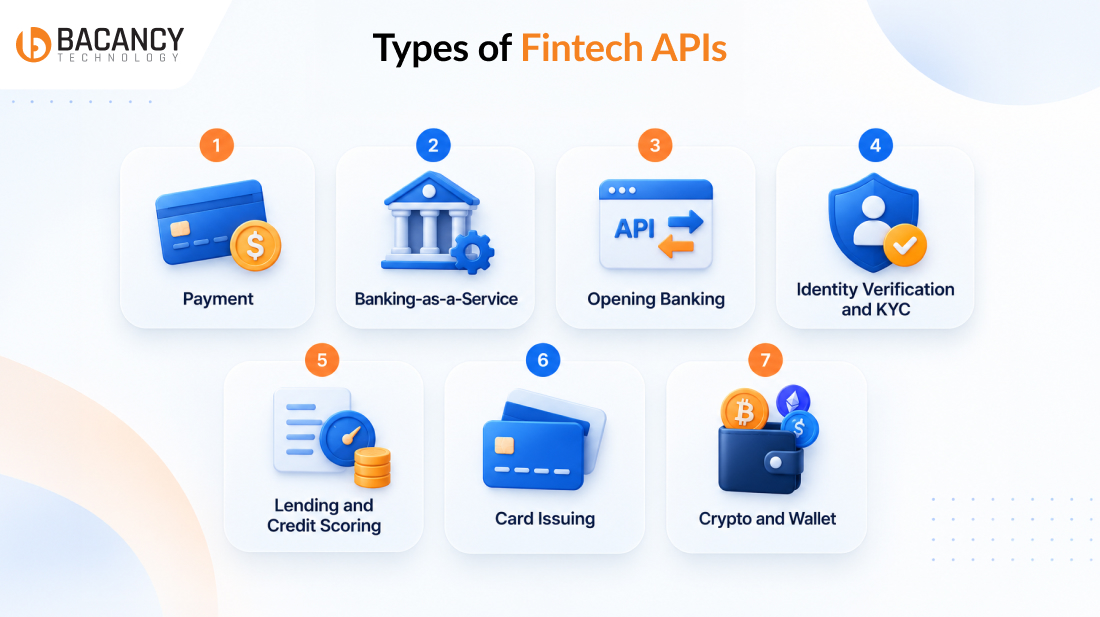
Payment APIs
Payment APIs let your application accept, process, and manage digital payments. You can utilize them to support your card payments, bank transfers, recurring payments, refunds, and transaction status updates without developing payment infrastructure from scratch.
Banking-as-a-Service (BaaS) APIs
BaaS APIs give your application access to core banking capabilities through APIs. It can help you offer services, such as bank account creation, deposits, transfers, transaction management, and other banking functions within your own fintech product.
Open Banking APIs
Open banking API lets your application access a customer’s financial information, with their authorization, from connected banks and financial institutions. It can support account aggregation, transaction history, balance checks, and payment initiation.
Identity Verification and KYC APIs
Identity verification and KYC APIs help you verify customers before they access financial products or services. It can support identity checks, document verification, customer authentication, and other onboarding processes required for financial compliance.
Lending and Credit Scoring APIs
Lending and credit scoring APIs give your application access to credit and financial information that can support loan applications and lending decisions. You can use them for credit checks, borrower assessment, underwriting workflows, and loan eligibility processes.
Card Issuing APIs
Card issuing APIs let you create and manage virtual or physical payment cards within your fintech application. Depending on your requirements, they can support card creation, activation, spending controls, transaction limits, and card management.
Crypto and Wallet APIs
Crypto and wallet APIs connect your application with cryptocurrency wallets, blockchain networks, exchanges, and digital asset services. It can support wallet creation, asset balances, cryptocurrency transfers, transaction history, and other digital asset functions.
Need Experts to Integrate Your Fintech APIs?
Hire fintech developers from Bacancy Technology to turn your selected APIs into secure, production-ready financial features across your application.
How Fintech APIs Work: A Step-by-Step Process
Fintech API connects applications with financial services, data, and payment infrastructure. Businesses can send specific requests through the API, receive verified financial data or transaction results, and use that information within their own product workflows.
The process starts when a user takes an action in your fintech application, such as checking an account balance, making a payment, applying for a loan, or completing identity verification.
Step 2: Application Sends an API Request
Your application sends an API request with the required information. The request may include customer details, transaction data, account information, or other parameters required for the financial service.
Step 3: API Passes the Request to the Financial Service
The API receives the request and sends it to the connected bank, payment system, KYC service, lending platform, or other financial system. Authentication and authorization controls verify that the request is valid and permitted.
Step 4: Financial Service Processes the Request
The connected financial service validates the request and performs the required action. For example, a payment service can authorize a transaction, while a banking service can retrieve account or transaction data.
Step 5: API Returns the Response
Once the financial service completes the request, the API sends a response back to your application. The response may contain transaction status, account data, verification results, or an error message.
Step 6: Application Displays the Result
Your application uses the API response to complete the user action. The customer may see a successful payment message, account balance, transaction details, verification status, or another result within the application.
For instance, if a user makes a payment through your fintech app, the app sends the payment details through a payment API. The payment service processes the transaction and returns its status, which your application then displays to the user.
Which Fintech API Does Each Business Model Need?
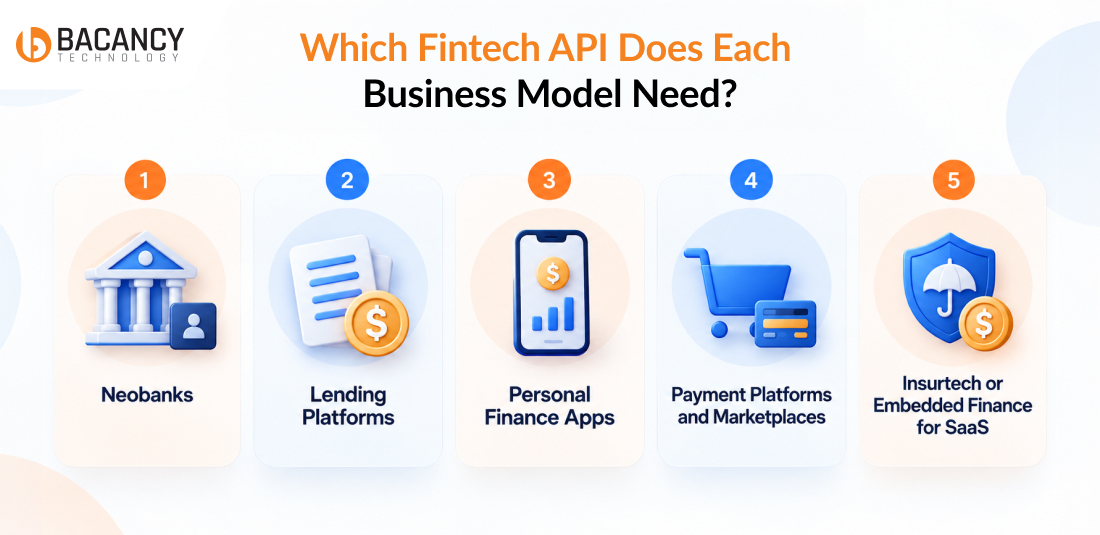
The fintech APIs your product needs depend on its business model, financial services, and customer workflows. Here is how the API requirements in finance differ across common fintech models.
Neobanks
Neobanks need APIs that support core banking functions within a digital-first experience. Banking-as-a-Service, payment, card issuing, KYC, identity verification, and fraud prevention APIs can support account creation, money transfers, card management, customer verification, and transaction controls.
Lending platforms need APIs that support borrower assessment, loan decisions, and fund movement. KYC, credit scoring, financial data, lending, payment, and bank account APIs can support borrower verification, credit checks, income assessment, loan applications, repayments, and disbursements.
Personal Finance Apps
Personal finance apps rely on APIs that bring financial information into one place. Open Banking, financial data, account aggregation, payment, and identity verification APIs can provide access to account balances, transaction history, spending data, and other financial information with customer authorization.
Payment platforms and marketplaces need APIs that manage money movement between customers, merchants, and other parties. Payment, payout, card issuing, fraud prevention, KYC, and bank account APIs can support payment acceptance, refunds, split payments, merchant payouts, card payments, and transaction checks.
Insurtech or Embedded Finance for SaaS
Insurtech products and SaaS platforms that add financial services need APIs that fit their specific customer workflows. Insurance, payment, banking, KYC, identity verification, and financial data APIs can support policy-related transactions, customer verification, account services, payments, and embedded financial products within the existing software experience.
The right API mix ultimately depends on the financial functions your product needs, the markets you serve, regulatory requirements, and how much control you need over the underlying financial infrastructure.
Finding It Difficult to Choose the Right Fintech APIs?
Get expert fintech consulting services from Bacancy Technology to identify the right APIs, evaluate providers, and build an integration strategy around your financial product.
What Challenges Come With Fintech API Integration?
An API for fintech integration can reduce your development effort, but your product still depends on external systems, financial partners, and regulatory requirements. The main challenges include:
🡲 Vendor Lock-In With a Single API Provider
A powerful dependency on one API provider can make it difficult to change providers when pricing, coverage, features, or service terms change. A modular API architecture can keep critical financial functions replaceable without major changes to your core application.
Some fintech products rely on middleware platforms or sponsor banks to access regulated financial services. A change in their terms, capabilities, compliance status, or service availability can affect your product. Your API architecture should account for these dependencies and define clear fallback options where possible.
🡲 Uptime and Reliability of Financial APIs
Your application may depend on external APIs for payments, account data, identity checks, or other critical functions. API downtime or slow response times can directly affect customer transactions. Health checks, retry policies, timeouts, monitoring, and fallback workflows can reduce the impact of service interruptions.
🡲 Regulatory Differences Across Regions
Financial API requirements vary by country and region. Data access, payment processing, customer verification, data storage, and consent requirements may differ across markets. Your API strategy should account for the regulations that apply to each market before you expand your product.
🡲 Hidden Costs at Scale
API costs can increase as transaction volumes, active users, data, and verification checks grow. Pricing may also vary by API call, transaction, account, or additional service. Review the provider’s pricing model and estimate costs at your expected production volume before you commit to an integration.
🡲 Reconciliation and Data Consistency
Financial data can come from multiple APIs and source systems, each with different formats, update cycles, and transaction states. Your application needs clear reconciliation rules to match transactions, handle duplicate records, resolve failed requests, and maintain consistent financial data across systems.
Security and Compliance Considerations for Fintech APIs
Security needs to cover every API request, data exchange, user permission, and financial transaction. Your fintech API architecture should include controls that protect sensitive financial data while meeting the regulatory requirements that apply to your product.
API Authentication and Authorization
Use strong authentication to verify API clients and authorization controls to determine which resources and actions each client can access. OAuth 2.0, API keys, signed requests, and other controls can be selected based on the API and use case.
Encryption
Protect financial and personal data during transmission with TLS and use appropriate encryption controls for sensitive data at rest. Encryption requirements should cover both application-to-API communication and stored financial information.
Token-Based Access
Use short-lived access tokens and scoped permissions where applicable to limit access to the resources required for each operation. Token rotation and secure storage can further reduce exposure if credentials are compromised.
Role-Based Access Controls
Define access permissions based on user roles and business responsibilities. RBAC can restrict sensitive financial data and administrative functions to authorized users and services.
Data Privacy
Collect only the data your application requires and define clear rules for data retention, access, deletion, and consent. Privacy controls should reflect the jurisdictions where your customers and financial data reside.
PCI DSS for Payment Card Data
If your product stores, processes, or transmits payment card data, PCI DSS requirements may apply. Your architecture should limit card-data exposure and use appropriate controls for payment data security.
KYC and AML Requirements
Products that offer regulated financial services may need KYC and AML controls. API integrations can support identity verification, customer screening, transaction monitoring, and other compliance workflows based on the applicable regulations.
GDPR and Regional Data Regulations
If your product handles personal data in regulated markets, apply the relevant privacy requirements, such as GDPR in the European Union. Other regions may have additional rules for data access, consent, storage, and cross-border transfers.
Audit Logs and Transaction Monitoring
Maintain detailed logs for API requests, authentication events, data access, and financial transactions. Transaction monitoring can help identify unusual activity, while audit trails provide evidence for compliance reviews and incident investigations.
The right fintech API provider should fit your product requirements, security standards, budget, and expected transaction volume. Before you select an API, check the following:
Fintech API Provider Selection Checklist You Must Follow
- Check certifications and security standards relevant to your product, such as SOC 2, ISO 27001, PCI DSS, or other applicable compliance frameworks.
- Review the documentation for clear endpoint references, authentication details, request and response examples, error codes, SDKs, and testing instructions.
- Confirm that the API supports the financial functions your product needs, such as payments, account data, KYC, lending, cards, or payouts.
- Review historical uptime, incident records, monitoring capabilities, and published service commitments before you connect critical financial workflows.
- Understand whether costs are based on API calls, transactions, users, accounts, verification checks, or monthly usage. Calculate expected costs at both current and future volumes.
- Check support channels, response times, escalation procedures, maintenance policies, and SLA commitments.
- Confirm whether the API can support your expected transaction volume, customer base, currencies, countries, and financial use cases as your product grows.
- Review where financial and personal data is stored, how long it is retained, how consent is managed, and which regional regulations the API supports.
- Make sure the provider offers a sandbox with realistic test scenarios for successful transactions, failures, refunds, authentication errors, and other critical workflows.
- Check SDK availability, webhook support, API versioning, authentication methods, and compatibility with your existing technology stack.
Conclusion
Fintech API gives your business the ability to add financial capabilities, connect with third-party services, and build smoother digital finance experiences without developing every component from the ground up. The right API strategy can simplify integrations, enhance scalability, and support new financial use cases as business needs evolve.
We are an experienced fintech provider; we help you connect the right APIs to your product without the guesswork. Our fintech integration services offer API strategy, security setup, and testing, so your team can add banking, payment, or KYC capabilities without slowing down your core product.
We work around your requirements, your existing stack, and your compliance needs at every step.
Frequently Asked Questions (FAQs)
Fintech API integration can cost anywhere from $5,000 to $50,000+, depending on the number of APIs, integration complexity, security requirements, compliance needs, application architecture, and development scope.
Yes. Fintech APIs can be integrated into existing web and mobile applications as long as the application’s architecture, authentication model, security controls, and technology stack support the required integration.
Fintech API integration typically involves selecting the required API, reviewing its documentation, setting up authentication, configuring endpoints, handling requests and responses, testing the integration, and implementing security and error-handling measures.
Businesses should evaluate API functionality, documentation, security, compliance, pricing, supported regions, reliability, scalability, integration requirements, provider reputation, and the level of technical support available.
A basic fintech API integration can take 2-6 weeks, while complex integrations involving multiple financial services, custom workflows, security controls, or compliance requirements may take several months.
Yes, modern payment and banking APIs are built for real-time or near-real-time processing, often under a second for authorization. Latency depends on the provider’s infrastructure, your own backend, and the payment rail involved (card networks, ACH, real-time payment networks like RTP or FedNow).
Match the provider to your specific need rather than picking a big name by default. Check documentation quality, uptime history, pricing at your expected volume, compliance certifications, and support responsiveness. Test with a sandbox environment before committing, since sandbox behavior often reveals integration friction early.