Quick Summary
This guide is written for CTOs, technology leaders, and decision-makers evaluating Forward Deployed Engineer vs Software Engineer for their AI projects. It explains the key differences between the two roles, including their responsibilities, skills, project workflows, first 90 days, and hiring costs for 2027 budgets. You’ll also learn when to hire each role, what challenges an FDE can solve, and how both engineers work together to get AI projects into production.
Table of Contents
Introduction
AI pilots often work perfectly in the demo, but moving them into production is a different challenge. Like suddenly you end up dealing with legacy ERP systems without clean APIs, lengthy security and access reviews, and customer data that looks nothing like your sample dataset. These roadblocks can turn a promising AI project into a stalled experiment.
The numbers back this up. Deloitte’s 2026 Research on the State of AI in Enterprise found that only 25% of companies have moved 40% or more of their AI pilots into production. The problem usually isn’t the model. It’s having engineers who can carry a working prototype through real systems, real data, and real users. That’s where the forward deployed engineer vs software engineer choice matters. This guide compares the two roles’ responsibilities, skills, working approaches, and costs, so you can decide which one your AI project needs.
Forward Deployed Engineer vs Software Engineer at a Glance
Consider FDE vs SWE this way: a software engineer builds a product for every customer, and forward deployed engineers build and run the solutions for one customer inside their private environment. If one role adds scalability to the codebase, then the other closes the gap between what the product does and what one business needs it to do in production. Let’s learn about major factors between a Forward Deployed Engineer vs Software Engineer here:
| Factor
| Forward Deployed Engineer
| Software Engineer
|
|---|
| Primary goal
| One customer’s outcome, live in production
| A product that works for every customer
|
| Where they work | Inside the customer’s systems, often on site
| Inside your codebase and dev environment
|
| Who sets priorities
| The customer’s problem and business stakeholders
| The product roadmap and engineering managers
|
| Typical work
| Integrations, agent workflows, evals, rollout
| Features, services, tests, performance |
| Success metric
| Adoption by named users and a measured business result
| Shipped features, uptime, code quality
|
| Time horizon
| Weeks to months per engagement
| Long-term ownership of a component
|
| Risk if misused
| One-off code that’s hard to maintain
| The right feature built for the wrong context
|
| Hiring difficulty
| Small talent pool, slower to fill
| Larger pool, faster to fill
|
Forward Deployed Engineer: Role, Responsibilities, and When to Hire
A forward deployed engineer works inside your environment, not from a distance. They combine engineering skills with hands-on problem solving to take an AI use case from a rough idea to a working system your team actually uses. Here is what the role covers, what an FDE does day to day, and when it makes sense to bring one in.
Role
An FDE owns a customer outcome from discovery through production and handoff. Here success is measured by whether the solution is live and used, not by how many tickets are closed.
Responsibilities
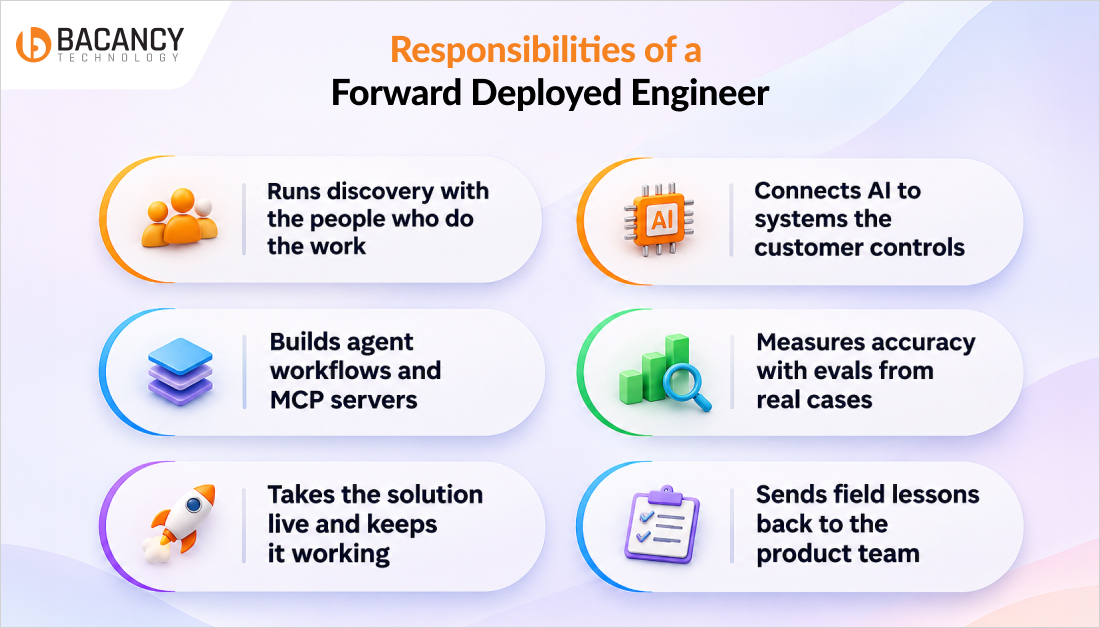
- Runs Discovery With The People Who Do The Work: An FDE sits with the operations team as well as the executive sponsor and maps how the process really runs. That includes the spreadsheets, email approvals, and workarounds nobody documented.
- Connects AI To Systems The Customer Controls: They build integrations with ERPs, CRMs, document stores, and legacy databases, often through VPNs, SSO, and strict access rules. When a system has no usable API, they find another way in, such as database views, file exports, or a vendor connector.
- Builds Agent Workflows And MCP Servers: They design the agent’s steps, decision points, and human approval checks. Then they build Model Context Protocol (MCP) servers that give the model scoped, auditable access to customer tools and data.
- Measures Accuracy With Evals From Real Cases: They turn the customer’s past records into test sets (evals), so accuracy is measured against real edge cases instead of a clean demo set. They check every prompt or model change against the same evals before it ships.
- Takes The Solution Live And Keeps It Working: FDE releases to named users, watches how the system is used, and fixes what breaks in the first weeks. They stay involved until the customer’s team can run it on their own.
- Sends Field Lessons Back To The Product Team: When the same fix comes up across customers, the FDE flags it to the product team. That’s what lets software engineers turn one customer’s custom work into a standard feature.
When to Hire a Forward Deployed Engineer
Hire an FDE when the problem is unclear, the environment is messy, and the deadline is tied to a business result. If your AI use case touches 3 or more internal systems or has to win over skeptical users, an FDE shortens the path.
Need Help Taking Your AI Project Live?
Hire Forward Deployed Engineers from Bacancy Technology to manage complex integrations, build AI workflows, and deploy solutions that work in your business environment.
Software Engineer: Role, Responsibilities, and When to Hire
A software engineer is the long-term owner of your product’s core. They build features from the roadmap, design systems other teams rely on, and keep everything running smoothly as usage grows. Here is how the role works and when hiring a software engineer is the right call.
Role
A software engineer owns a feature, service, or platform component over the long term. Their job is to keep that piece correct, fast, and easy to change for years.
Responsibilities
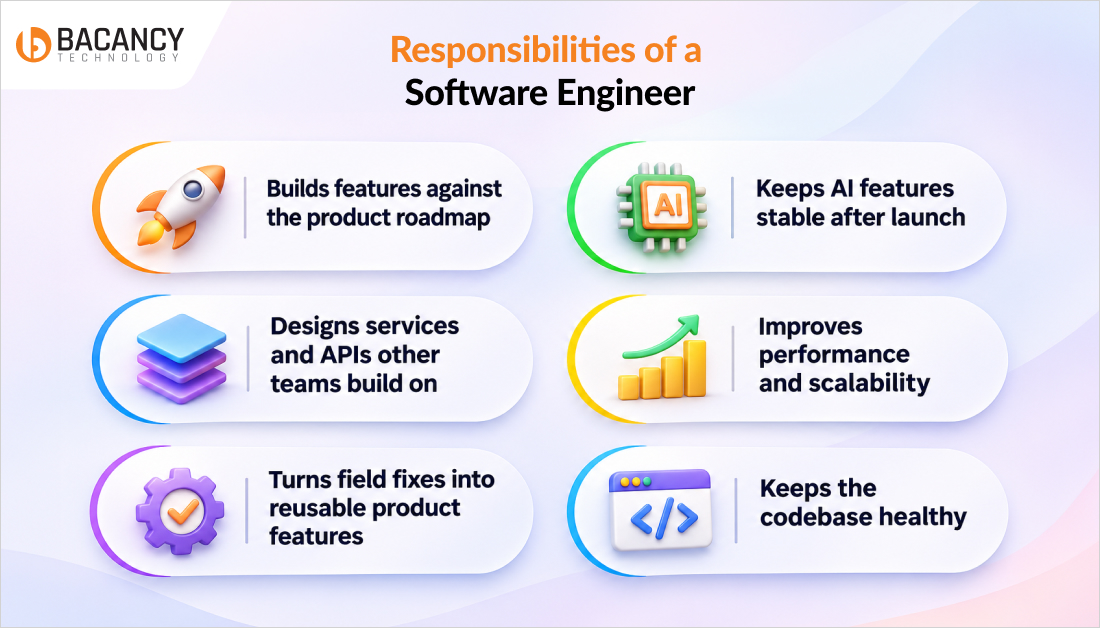
- Builds Features Against The Product Roadmap:
A software engineer takes scoped work from product managers, breaks it into tasks, and ships it on the regular release cycle. They build features that work the same way for every customer.
- Designs Services And APIs Other Teams Build On: They define clear interfaces, data models, and service boundaries, so new features can be added without rewriting what already works.
- Turns Field Fixes Into Reusable Product Features: When FDEs keep solving the same problem for different customers, the software engineer turns that fix into part of the core product.
- Keeps AI Features Stable After Launch: They track model and API version changes, add regression tests for prompts and outputs, and build fallbacks for when a model call fails or slows down.
- Improves Performance And Scalability: They profile slow paths, tune database queries, and design for 10x more load before it arrives.
- Keeps The Codebase Healthy: They write unit, integration, and end-to-end tests, review teammates’ code, pay down tech debt, upgrade dependencies, and patch security issues before they turn into incidents.
When to Hire a Software Engineer
Hire a software engineer when the problem is known, the requirements are defined, and many customers or users share the result. A software engineer is also the right long-term owner once an FDE hands over a solution.
Looking to build and scale your AI product?
Hire skilled Software Developers from Bacancy Technology to develop scalable features, strengthen your codebase, and build a reliable product that supports your long-term goals.
Software Engineer vs. Forward Deployed Engineer Skills
As both roles are written under production, the difference in the forward deployed engineer vs software engineer is where each role’s extra skill lies.
| Skill Area
| Software Engineer
| Forward Deployed Engineer
|
|---|
| Coding depth
| Deep in one stack, with a focus on clean architecture
| Full stack, fast, pragmatic; Python and TypeScript are common
|
| Systems integration
| Usually integrates with systems the team owns
| Core skill: APIs, SSO, ERP and CRM connectors, legacy databases
|
| AI and LLM work
| Varies; often calls AI APIs inside product features
| Prompting, RAG, agent orchestration, evals, MCP servers
|
| Communication
| Mostly with the internal team and product managers
| Daily contact with customer executives and end users
|
| Business context
| Receives requirements through specs and tickets | Translates a business process into a working system
|
| Ambiguity tolerance
| Moderate; works from scoped tickets
| High; requirements shift week to week
|
| Deployment and ops
| Owns CI/CD and on-call for their own services
| Owns rollout, monitoring, and triage at the customer |
| Documentation
| Design docs, API docs, code comments
| Runbooks and handoff docs for the client team
|
How FDE vs SWE Roles Handle a Project Differently
| Stage | Forward Deployed Engineer (FDE)
| Software Engineer (SWE)
|
|---|
| Kickoff | Works with the finance team to map its actual workflow, including exceptions and bottlenecks.
| Reviews the product requirements and breaks the work into development tasks.
|
| Data
| Works with real invoices to identify issues such as scanned PDFs, missing PO numbers, and split shipments.
| Uses test data and predefined schemas to develop the feature.
|
| Build
| Develops a working solution for the customer's ERP environment and tests it in staging.
| Builds a reusable invoice-processing feature that can work across multiple customers.
|
| Testing
| Creates evaluation datasets using the customer's historical invoices and real-world cases. | Writes unit and integration tests to check whether the feature meets requirements. |
| Rollout | Deploys the solution to selected finance users, monitors usage, and fixes issues based on feedback. | Releases the feature through the product's regular release process. |
| After launch | Documents the setup, prepares a handoff, and shares customer feedback with the product team. | Maintains the feature, fixes bugs, and improves its performance over time. |
What the First 90 Days Look Like for an FDE vs a Software Engineer
The forward deployed engineer vs software engineer difference shows up from the first week. An FDE spends the first month earning access and trust inside someone else’s systems, while a software engineer spends it learning a codebase they will own for years.
Forward Deployed Engineer: Day 1 to Day 90
Days 1 to 30: Access and First Integration
- FDE seeks environment access such as VPN, SSO, data permissions, and security review. This is often the longest blocker, so it starts on day 1.
- Next goes for data and systems audit in which systems hold the data, which have usable APIs, and how clean the data really is.
- Then stakeholder mapping they executive sponsor, process owner, end users, and the IT and security contacts who approve changes.
- Then the first integration runs into staging.
Days 31 to 60: Evals and Production Rollout
- They built an eval baseline from real customer cases, so accuracy has a starting number.
- Also check production rollout to a small group of named users.
- Set up monitoring for accuracy, latency, cost per task, and error rates.
Days 61 to 90: Adoption and Handoff
- They track user adoption and collect weekly feedback.
- Fix issues based on real-world usage.
- Prepare documentation covering architecture, alerts, and known issues.
- Train the internal team to manage and maintain the solution.
Software Engineer: Day 1 to Day 90
Days 1 to 30: Codebase Onboarding
- Architecture walkthroughs and reading the core services.
- Dev environment, CI access, and local test runs set up.
- First merged changes: small bug fixes and starter tickets.
Days 31 to 60: Component ownership
- Owns a specific component or service.
- Takes roadmap tickets and reviews teammates’ code.
Days 61 to 90: Full delivery
- Delivers a complete feature with tests.
- Ready for the on-call rotation.
- Joins sprint planning and estimates work.
Forward Deployed Engineer vs Software Developer Cost for 2027 Budgets
In any forward deployed engineer vs software engineer budget, salary is only part of the bill. The real total cost includes how long the seat sits vacant, what you pay to fill it, and how long the new hire takes to become productive.
Note: The figures below are the latest available (fall 2026), so you can use them to plan your 2027 hiring budget.
Per-Hour Rates for FDEs and Software Engineers in the US
To compare forward deployed engineer costs with software engineer costs for 2027 planning, start with estimated hourly earnings. You can calculate this by dividing annual compensation by 2,080 working hours.
- FDE: Median US total compensation is about $205,000 (fall 2026), or about $99/hour.
- Software Engineer: Median US total compensation is about $197,000 (fall 2026), or about $95/hour.
- All US Software Developers: The national median wage was $135,980 in May 2025, or about $65/hour.
At the median, the FDE vs SWE premium is small, roughly $4/hour. The bigger gap is between tech-company pay, which includes stock and bonus, and the wider market, which covers employers of every size.
Cost Factors That Change the Total for FDE and SWE
- Seniority And AI Or LLM Experience: Senior FDEs earn more, with compensation reaching $277K at the 75th percentile and $350K at the 90th percentile. But the production experience in AI agents and RAG systems can increase hiring costs.
- Location (On-Site Vs. Remote): Hiring costs depend on location and work arrangements. Remote hiring offers a wider talent pool, while on-site requirements may limit options and increase expenses.
- Travel Budget For The FDE: Budget for flights, accommodation, and daily expenses when FDEs need to visit customer locations for meetings, integration, and deployment.
- Time To Hire: Hiring an experienced FDE can take around 8 to 12 weeks. The limited talent pool can delay hiring and affect your project timeline.
- Recruiter Fees: Recruitment agencies typically charge 15% to 30% of a candidate’s first-year salary. For specialized AI roles, budget around 25%.
- Onboarding Time: Even experienced engineers need 2 to 4 weeks to understand your systems, codebase, workflows, and project requirements before becoming fully productive.
- Knowledge Transfer And Handoff: Budget 1 to 2 weeks for FDEs to document their work, prepare runbooks, and transfer technical knowledge to your internal engineering team.
Cost Comparison Table of Software Engineer vs Forward Deployed Engineer
The table below puts the cost items above side by side, so you can see what an in-house FDE and an in-house software engineer cost in the first year, from pay and recruiter fees to hiring time and handoff.
| Cost Item
| In-house FDE
| In-house Software Engineer
|
|---|
| Median annual total compensation (US, latest data: fall 2026)
| ~ $205,000 | ~ $197,000
|
| Hourly equivalent (annual ÷ 2,080)
| About $99
| About $95
|
| Recruiter fee at 15% to 30%
| ~$30,750 to $61,500
| ~$29,550 to $59,100
|
| First-year cost (pay + recruiter fee)
| ~$235,750 to $266,500
| ~$226,550 to $256,100
|
| Typical time to hire
| 8 to 12 weeks
| 6 to 8 weeks
|
| First production result | Days 31 to 60 (first rollout to users)
| Days 61 to 90 (first full feature)
|
| Travel | On-site weeks, budgeted separately
| Rarely needed
|
| Handoff
| Runbook plus 1 to 2 weeks of overlap
| Not needed; stays on the team
|
The first-year totals overlap, so salary alone rarely decides this choice. Time matters more. An FDE seat can take 2 to 4 weeks longer to fill, and your AI project can’t move to production while it sits empty. Factor both into your 2027 hiring plan.
SWE vs. FDE: Which One Is Right for Your Business?
The role sections explain what each engineer does. This section helps you check your own project against both. Look at where the work is stuck today, then see which list sounds more familiar.
Signs Your Software Engineering Team Is Enough
Your existing software engineering team may be all you need if most of the following situations apply:
- Clear Requirements: Tasks are well-defined, requirements are ready, and you need more engineers to clear the development backlog.
- Accessible Data: Your data is already available in company databases, warehouses, or applications with well-defined schemas.
- Simple Integrations: Systems have documented APIs and testing environments, so your team can build integrations without external help.
- AI Feature in Production: Your focus is on improving performance, reducing latency, controlling costs, fixing bugs, and increasing test coverage.
- Direct User Feedback: Engineers can get feedback directly from users through regular communication and product analytics.
- Approved Security Architecture: Security, compliance, and data access approvals are already in place, with no major deployment blockers.
Signs Your AI Project Needs a Forward Deployed Engineer
An FDE may be the better choice if your AI project faces several of these challenges:
- Your AI Demo Fails With Real Data: The model works in testing but struggles with actual customer data and workflows.
- Developers Need Business Inputs: Your team needs help understanding customer requirements, business rules, and exceptions.
- Customer Data Has Restrictions: Sensitive data must stay within the customer’s cloud or network.
- Every Customer Needs Different Integrations: Your AI product must connect with different ERPs, CRMs, databases, and systems.
- Your AI Pilot is Stuck: The demo works, but deployment and regular user adoption are still pending.
- You Lack Direct Customer Feedback: Your product team depends on sales calls and support tickets instead of direct customer interactions.
How Bacancy Technology Handles Forward Deployed Engineering
Bacancy Technology is an AI consulting and engineering partner for AI, Data, Healthcare, and Finance enterprises. When a client’s AI project stalls before production, we place forward deployed engineers who work as part of the client’s team and stay accountable for the result. Here’s how we set up these engagements:
Dedicated Engineering Team
We assign your project team before development begins. The same engineers stay involved from planning to deployment, which keeps context intact and avoids knowledge gaps.
Certified Security Practices
We are ISO/IEC 27001:2022 certified, and our security processes cover access control, data handling, and audit trails to simplify compliance reviews.
Industry-Specific Expertise
Our engineers have experience in healthcare and finance. They understand requirements such as patient data privacy and payment data security before the first meeting.
Complete Ownership of Deliverables
Your code, evaluation datasets, and runbooks stay in your repositories. Your in-house team can take over, maintain, and improve the solution independently.
See how our FDE Pods help businesses solve integration challenges and move AI projects from pilot to production. [Watch the video] to see how an engagement works in practice.
Conclusion
The selection between Forward Deployed Engineer vs Software Engineer depends on what your AI project needs to move forward. If your goal is to build scalable features, maintain your codebase, and improve product performance, a software engineer is the right choice. But if you need someone to handle customer-specific integrations, work with real-world data, and take AI solutions from pilot to production, an FDE is a better fit.
For many AI projects, both roles work best together. The FDE handles customer requirements, integrations, and deployment, while the software engineer focuses on building and improving the core product.
If you need experienced engineers to bridge the gap between AI development and production, Bacancy Technology can help. Our AI consulting services help you understand your project requirements, identify the right engineering approach, and build a team that can manage integrations and develop effective AI workflows. We help bridge the gap between AI development and real-world implementation, so your solutions deliver value in actual business environments.
Frequently Asked Questions (FAQs)
No. A Forward Deployed Engineer can write just as much code as a Software Engineer. The difference lies in the purpose of that code. FDEs typically build customer-specific integrations, AI agent workflows, and evaluation systems to solve problems in a particular business environment. Software Engineers focus on developing reusable product features and systems that serve multiple customers.
A software developer builds, tests, and maintains software products for multiple users, usually working from defined requirements and a product roadmap. A forward deployed engineer works directly with one customer to adapt and implement technology within their existing systems, data, and workflows. Software developer and software engineer describe the same role.
Based on the latest data (fall 2026), the median annual total compensation for a Forward Deployed Engineer in the US is approximately $205,000, or around $99 per hour. For a 2027 budget, also include recruiter fees, travel for on-site work, and onboarding time.
No. A Solutions Engineer typically supports the sales process by conducting product demonstrations, answering technical questions, and building proofs of concept for potential customers. A Forward Deployed Engineer works more closely on implementation, building integrations, writing production code, and deploying solutions within a customer’s environment.