Quick Summary
This guide explores the practical side of Data Analytics in Fintech, including five types of analytics behind modern financial products, six high-value use cases, the business benefits worth measuring, and how AI is reshaping the analytics stack. It also covers the architecture required for real-time decision-making and the compliance considerations fintech teams need to address in 2026.
Table of Contents
Introduction
Fintech companies may have multiple fraud models, sophisticated credit engines, and modern data warehouses, yet still make poor decisions if the right data does not reach the right system at the right time. That raises the real challenge for Data Analytics in Fintech. As digital financial products make decisions by continuously approving or declining a payment, flagging a transaction, assessing a borrower, personalizing an offer, detecting an account takeover, or reconciling a financial record. Such decisions depend on financial, transactional, behavioural, and external data coming together quickly enough to influence the outcome. When that data is delayed, fragmented, or inconsistent across systems, even an accurate model can produce the wrong business result.
The U.S. Federal Trade Commission reported that consumers lost $15.9 billion to fraud in 2025, based on roughly 3 million reports. At the same time, real-time payment infrastructure is compressing the window institutions have to detect and stop fraud. Services such as the Federal Reserve’s FedNow allow participating financial institutions to send and receive payments around the clock, so transactions can move within seconds.
As a result, fintech companies increasingly need to evaluate fraud and risk signals before or during a transaction rather than relying on analysis after a payment has been completed. It changes what fintech companies need to expect from analytics. Dashboards that perform well in offline testing are no longer enough. fintech data analytics has to operate closer to the transaction and business process that turns fragmented data into timely signals, supporting automated decisions and giving teams enough visibility to understand why those decisions were made.
What Is Fintech Data Analytics?
Fintech data analytics is a process that follows the discipline of turning multiple sources of financial and behavioural information into immediate, actionable decisions for digital financial services. What separates data analytics in financial services from generic business intelligence is a constraint set. Some decisions linked with Fintech are irreversible, latency budgets are measured in milliseconds, and every consequential decision may require an audit trail that can withstand a regulator’s questions years later.
The Five Types of Analytics Powering Financial Services
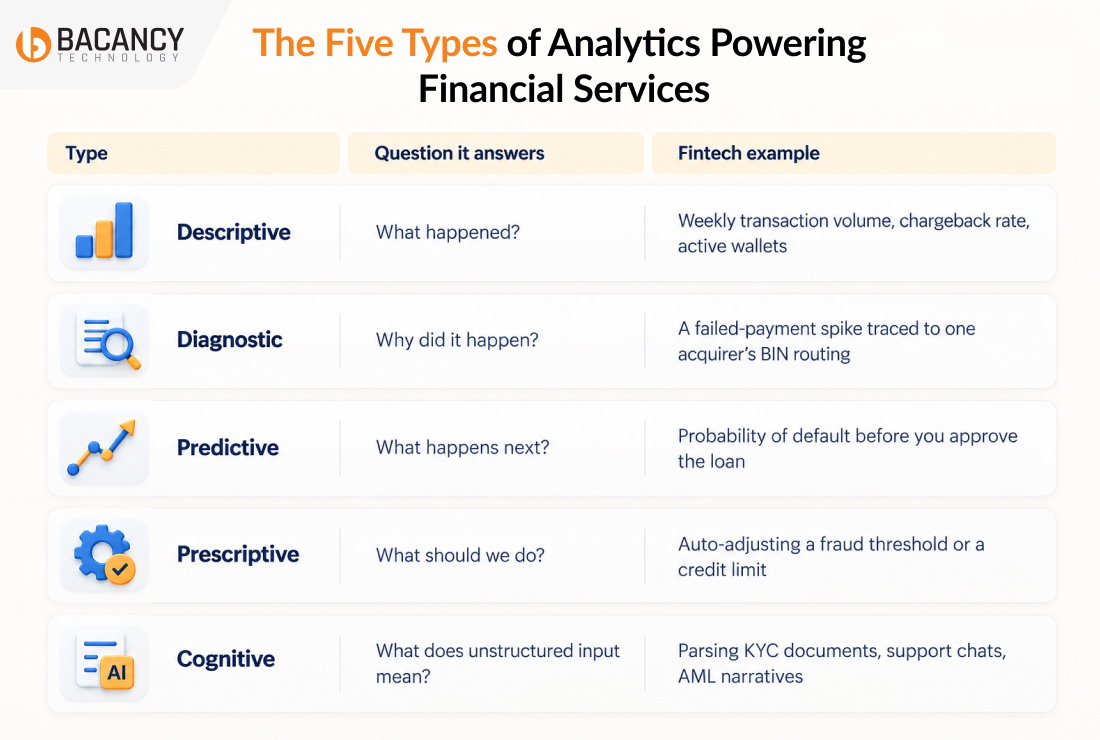
The five core types of analytics are descriptive, diagnostic, predictive, prescriptive, and cognitive that represent increasing levels of decision support. They move fintech teams from understanding to deciding what the product should do next.
1. Descriptive Analytics
Descriptive analytics answers what happened, such as chargeback rates by merchant category, approval rates by customer segment, decline rates by card BIN, or daily transaction volume. These metrics give product and risk teams visibility into current and historical performance.
2. Diagnostic Analytics
The diagnostic analytics goes one step further by explaining why something happened. It shows that the reason for the sudden increase in transaction declines, for example, may be traced to an issuer’s 3DS timeout rather than a change in internal risk rules. This distinction matters because the correct response depends on the underlying cause.
Build a Smarter Fintech Data Analytics Team with Experts
Hire data analysts from Bacancy Technology to analyze complex financial data, generate actionable insights, and enable faster, smarter business decisions.
3. Predictive analytics
Predictive analytics estimates what is likely to happen next. A fraud model might assign an account an 87% probability of first-party fraud, while a credit model might estimate a 4.2% probability of default over the next 12 months. These predictions turn historical and behavioural data into forward-looking risk signals.
4. Prescriptive analytics
Prescriptive analytics converts those predictions into recommended actions. They don’t just simply identify a risky transaction but determine whether to decline it, trigger biometric verification, request additional authentication, or approve it based on the expected cost of fraud and customer friction.
5. Cognitive analytics
Cognitive analytics focuses on unstructured information that traditional analytics cannot easily process, such as KYC documents, customer conversations, analyst reports, and AML investigation notes. By using NLP, machine learning, and LLMs, fintech companies can extract relevant information and convert unstructured data into signals that support risk, compliance, customer service, and other financial decisions.
6 Data Analytics in Fintech Use Cases in Payments, Lending & Trading
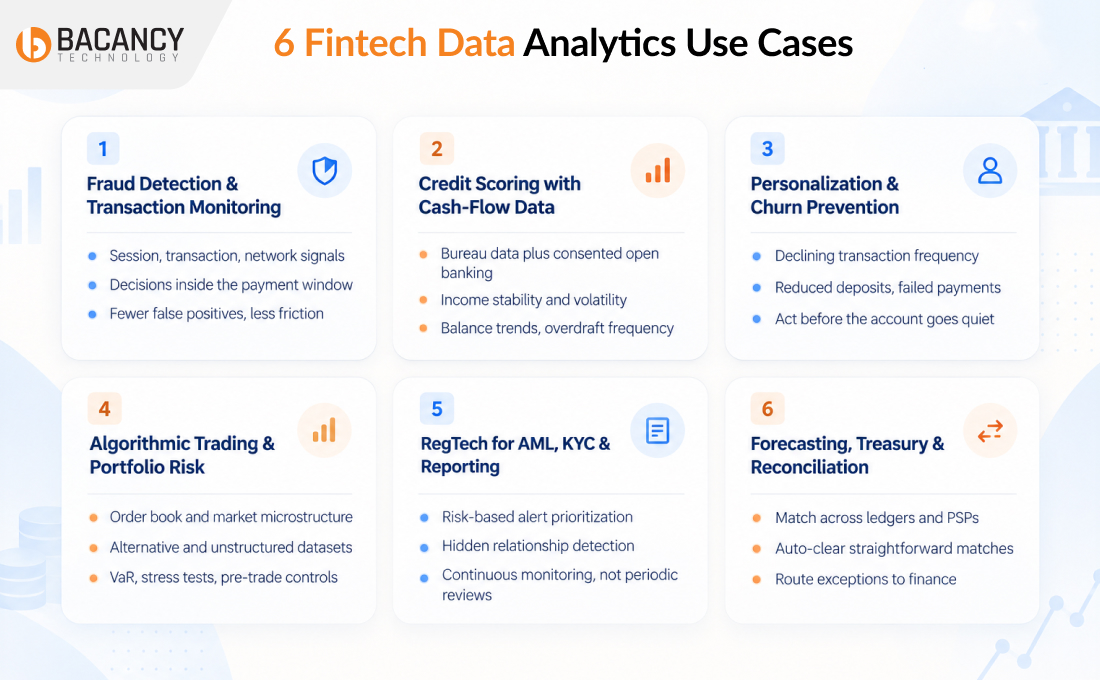
The highest-value applications of Fintech in Data Analytics do not lie in producing another dashboard. Rather, they are about improving decisions that can directly affect revenue, risk, customer experience, or operational efficiency. The six use cases that are mentioned below span the areas where Fintech companies generally see the clearest business impact.
1. Data Analytics for Fraud Detection in Fintech and Transaction Monitoring
Fraud detection through data analytics is a clear sign of how analytics is becoming a part of the product itself. When a payment is authorized in seconds, the fraud detection can happen within the same transaction window. Once funds move, especially through faster or irrevocable payment rails, the opportunity to intervene may be limited.
Modern fraud analytics combines multiple signal types, such as session signals that can capture changes in device behaviour, login patterns, typing cadence, or interaction with authentication screens. Transaction signals compare payment amount, frequency, merchant, location, and beneficiary activity against the customer’s historical behaviour. Network signals identify relationships between accounts, devices, IP addresses, cards, and beneficiaries that may indicate coordinated fraud.
The goal is not just to identify more suspicious transactions. It is to improve the balance between fraud prevented and legitimate customers disrupted. That makes precision, false-positive rates, approval rates, prevented losses, and customer friction important metrics alongside model accuracy.
2. Credit Scoring Using Alternative and Cash-Flow Data
Cash flow analytics provide insight into income stability, spending patterns, account balances, overdraft frequency, and recurring obligations. When allowed and appropriately disclosed, this information can complement traditional bureau data rather than simply replacing it.
A typical lending analytics workflow combines bureau information with consented open banking or account data, then derives features such as income volatility, recurring income, balance trends, cash flow coverage, and payment behaviour. The resulting signals can help lenders distinguish between applicants who look similar under a traditional score but have materially different cash-flow profiles.
3. Customer Personalization & Churn Prevention
Customer churn in fintech is often less visible than it is in traditional subscription businesses. A customer may not formally close an account, but may stop depositing money, reduce transaction activity, or move their primary financial relationship elsewhere.
Data analytics in financial services helps identify these changes before the customer becomes completely inactive. It detects useful signals such as declining transaction frequency, reduced deposit activity, changes in product usage, failed payment attempts, and deviations from the customer’s own historical behaviour.
4. Algorithmic Trading & Portfolio Risk Analytics
In trading and investment sectors, data analytics supports two critical functions: identifying market opportunities and managing risk. Firms analyse market microstructure, order-book activity, price and volume movements, alternative datasets, and unstructured information to generate trading signals.
Machine learning and language models can process large datasets at scale, but their effectiveness still depends on the quality, consistency, and timeliness of the underlying data. On the risk side, value at risk, stress testing, concentration analysis, liquidity monitoring, and pre-trade controls help firms assess portfolio exposure and prevent trades from exceeding defined risk limits.
5. RegTech Analytics for AML, KYC, and Regulatory Reporting
Compliance is another area where fintech analytics can turn large volumes of financial data into prioritized decisions. Regulatory reporting uses anti-money laundering, know-your-customer processes, and transaction monitoring to generate large amounts of structured and unstructured data, which must be viewed consistently.
Behavioral models help prioritize alerts according to risk, identify unusual transaction patterns, and surface relationships that may not be obvious from individual transactions. Natural language technologies also assist investigators by summarizing relevant case information and organizing supporting evidence for human review. This reduces time spent on low-risk alerts while keeping human oversight in place, so genuinely high-risk activity receives appropriate attention.
The same principle applies to KYC and ongoing customer monitoring. Instead of relying exclusively on periodic reviews, risk-based analytics can help identify changes in customer behaviour or circumstances.
6. Financial Forecasting, Treasury, and Reconciliation Analytics
Some of the most valuable applications of Fintech in Data Analytics are less visible to customers but have an immediate impact on operational efficiency and financial control. A common example can be considered reconciliation, where a growing fintech may have transaction records that spread across its internal ledger, payment service providers, banking partners, card networks, and settlement systems.
Data analytics can automate much of this process by matching transactions across systems using amount, timestamp, reference fields, transaction identifiers, and other contextual signals. The straightforward matches can be cleared automatically, while exceptions are routed to finance teams for manual review.
Benefits of Data Analytics for Fintech Companies
The value of fintech data analytics should not be measured by the number of dashboards created, models deployed, or reports generated. Its real value comes from improving financial and operational outcomes that are measurable. For fintech IT solutions and services, the most meaningful benefits can be tied directly to metrics such as fraud losses, approval rates, decision times, compliance costs, customer retention, and operational efficiency.
1. Reduce fraud losses without reducing legitimate approvals
A fraud model is only successful when it reduces losses without unnecessarily blocking good customers. It tracks fraud losses in basis points alongside approval rates and false decline rates. A reduction in fraud is not a meaningful improvement if it comes at the cost of rejecting a large number of legitimate transactions.
2. Expand credit access without increasing default risk
The analytics can help the lenders identify creditworthy customers who may be overlooked by traditional scoring methods, measuring approval rates alongside default and delinquency rates across different borrower cohorts.
3. Make financial decisions faster
While making payments, lending, and account opening, delays can affect conversion and customer experience. This shows how long the slowest typical cases take and exposes performance problems that the average can hide.
4. Reduce the cost of compliance
The compliance teams often spend significant time reviewing alerts that ultimately turn out to be false positives. Data analytics helps track metrics such as cost per alert, alert-to-case conversion rate, investigation time, and alert precision. It also improves precision, allowing teams to focus their resources on higher-risk cases without reducing required monitoring coverage.
5. Improve customer retention
Through data analytics, it is easier to identify customers who are likely to churn and help fintech companies intervene before they leave. It shows at-risk customers by comparing churn rates between customers who received the intervention and a comparable holdout group. Without that comparison, it is difficult to determine whether the intervention actually caused the improvement or not.
6. Increase operational efficiency
Data analytics also reduces the manual work involved in reconciliation, reporting, and financial operations. It tracks metrics, break rates, exception volumes, processing time, and days to close. The improvements in these measures can translate directly into lower operating costs, fewer manual interventions, and better use of working capital.
How AI Is Reshaping Fintech Data Analytics in 2026
The open question is no longer whether fintech companies use AI, but how deeply it is integrated into real business and analytical workflows. Based on 2026’s Global AI in Financial Services Report from the Cambridge Centre for Alternative Finance found that 81% of surveyed financial services firms have adopted AI at some level, 40% are scaling or transforming, but only 14% consider it transformational to strategy. Agentic AI is in active adoption at 52% of industry respondents, with fintechs ahead of traditional institutions at 57% vs. 45%. For data analytics in fintech, three changes are particularly important. Here they are:
1. Unstructured data is becoming usable at scale
With the help of AI integration services in Fintech, the extraction of information from KYC documents, customer chats, dispute records, and AML reports becomes easier. It turns information that was previously difficult to analyze into useful data for fraud detection, compliance, and customer service.
2. Analytics is moving closer to real time
For real-time analytics in financial services, modern data systems can update and deliver features within milliseconds. It allows fraud and credit models to use recent customer and transaction activity instead of relying on outdated batch data.
3. AI agents are beginning to support investigation and operational workflows
AI agents collect transaction details, organize case information, and prepare investigation summaries for human review. In financial services, these systems still need clear limits, human oversight, and detailed logs.
Note: AI in data analytics fintech products still fails when the underlying data is inconsistent, undocumented, or arrives too late to matter. For fintech companies, reliable data pipelines and real-time access to quality data are essential for AI to deliver meaningful results.
Compliance and Regulatory Challenges in Financial Services Data Analytics
The regulatory changes are impacting how fintech companies design and manage fintech Data Analytics in 2026. The major issue is no longer about collecting and analysing data, but ensuring that analytics systems are transparent, explainable, documented and ready for regulatory review.
In the EU, the AI Act timeline has shifted for certain high-risk AI obligations, giving fintech companies additional time to prepare for requirements around conformity assessments, technical documentation, and human oversight. The transparency requirements also apply, so companies using AI in financial services should continue building clear processes for documenting how their systems use data and make decisions.
In the U.S., the future of the CFPB’s Section 1033 rule remains uncertain. Fintech companies that are using consumer-permissioned financial data need to maintain consent records, data-sharing agreements, and alternative data sources under review rather than relying on a single regulatory framework.
Beyond such changes, the core compliance expectations remain important. Fintech companies need to consider model risk management, explainability, adverse-action reasoning, fair-lending requirements, data retention and residency, and PCI DSS requirements where cardholder data is involved.
Major Challenges in Building Reliable Data Analytics in Fintech
As Fintech in data analytics is becoming central to financial decision-making, there are many fintech companies that are still struggling to turn their data into reliable, real-time outcomes. The major challenges are often less about the analytics models and more about the data quality, infrastructure, governance, and how quickly insights reach the point of decision.
1. Fragmented Data and Ownership
The fragmented data is often spread across payments, lending, customer support, and core banking systems, where each has different formats and customer identifiers. It brings such sources of data together and resolves duplicate or inconsistent identities for reliable fintech Data Analytics.
2. Analytics that does not reach the decision point
A fintech company may have accurate fraud, credit, or risk models, but their value is limited if insights arrive too late. Because of batch pipelines and delayed data, Real-Time Analytics in Financial Services can be prevented from influencing decisions when they matter most.
3. Model Drift and Monitoring Gaps
Fraud patterns, customer behaviour, and credit risks change constantly. Without monitoring metrics such as precision, recall, score distribution, and population stability, model performance can deteriorate without being detected early. For reliable data analytics in Fintech, continuous monitoring and retraining are important overall.
4. Third-Party and Vendor Risk
Data Analytics in Financial Services depends on data aggregators, scoring providers, cloud platforms, and external APIs. Problems with data quality, availability, privacy, or security directly affect financial decisions. That makes strong vendor management, data governance, and fallback data sources essential parts of a fintech analytics stack.
5. Skills and domain expertise
Fintech teams need expertise across financial products, payment and lending processes, real-time data infrastructure, and model governance. It needs to combine such capabilities to help companies turn fintech data analytics use cases into reliable business outcomes.
Where Bacancy Technology Fits in Your Data Analytics in Fintech Stack
Fintech Data Analytics depends on more than building accurate models. It depends on whether the right data reaches the right decision at the right time. This is where Bacancy’s technology expertise across Data Analytics Services comes in. We build the engineering and data infrastructure that connects financial data to real-time decision-making. Our work spans data engineering, cloud technologies, streaming architectures, AI/ML, MLOps, API development, and scalable backend systems, the technology foundation required to take fintech Data Analytics from experimentation to production.
The Technology Layer Behind Every Fintech Decision We Make
- Build streaming and CDC pipelines that connect core banking, ledger, PSP, and card network data in real time.
- Develop reliable ML pipelines and feature stores that keep training and production data consistent.
- Design secure, scalable fintech analytics systems using AWS, Azure, or Google Cloud.
- Build low-latency APIs and decision engines for fraud detection, credit scoring, and risk assessment.
- Deploy, monitor, and manage models to detect drift and maintain reliable performance over time.
- Build data lineage, access controls, logging, and explainability into fintech analytics systems.
Conclusion
The future of fintech Data Analytics is not about building bigger models or collecting more data. It is about turning reliable data into better decisions at the moment they matter. A model that performs well on stale or incomplete data is little more than an expensive report. The real measure of success is whether analytics reduces fraud losses, improves approval rates, speeds up decisions, lowers the cost of investigations, and increases customer retention.
For fintech companies, the priority is clear. They need to connect high-quality data, real-time infrastructure, AI and machine learning, and strong governance into systems that can act, not just analyze. As financial decisions become faster and more automated, companies that can consistently deliver the right insights to the right systems at the right time will gain a stronger competitive advantage. Get expert Data Analytics Consulting services from Bacancy Technology to turn your data into smarter, faster, and more effective decisions.
Frequently Asked Questions (FAQs)
Fintech data analytics is a known process of analyzing financial, transactional, behavioral, and external data to support faster and better financial decisions. It helps fintech companies improve fraud detection, credit scoring, customer experiences, risk management, and operational efficiency.
Fintech companies use data analytics to analyze transaction patterns, customer behavior, device information, login activity, and connections between accounts and devices to identify suspicious activity. Also, they conduct real-time analytics to evaluate such signals during transactions and help approve, decline, or flag payments before funds move.
Data analytics helps fintech companies reduce fraud losses, improve credit decisions, increase approval rates, personalize customer experiences, reduce compliance costs, improve retention, and automate manual financial processes.
AI in Fintech helps companies to process their large volumes of structured and unstructured data, including KYC documents, customer conversations, transaction records, and AML reports. AI and machine learning also support real-time fraud detection, risk assessment, personalization, and automated investigations.
The requirements of compliance standards in Fintech data analytics vary based on product, location, and type of data, but commonly include data privacy, AML and KYC requirements, model risk management, fair lending requirements, explainability, data retention, and PCI DSS where cardholder data is involved.
Predictive analytics estimates what is likely to happen, such as the probability that a borrower will default. Prescriptive analytics recommends what action to take based on that prediction, such as approving, declining, requesting additional verification, or adjusting a credit limit.