Quick Summary
The popularity and applications of Artificial Intelligence (AI) are growing day by day across diverse industries. AI is no longer the futuristic concept that businesses were once hesitant to adopt; it is one of the most cutting-edge, game-changing technologies that can transform operations through automation, innovation, and efficiency. This blog is all about discovering the impactful Artificial Intelligence applications and their real-world examples. We will see the top AI use cases in major sectors like manufacturing, healthcare, finance, eCommerce, and automotive to enhance processes and decision-making. Let’s dive in.
Table of Contents
Artificial Intelligence Applications in 2026
Artificial Intelligence (AI) offers increased accuracy, availability, and ease of implementation. These advancements make artificial intelligence applications more readily applicable in modern businesses. Also, the improvements in neural network technology and computational power will make these applications of Artificial Intelligence cost-effective, more accurate, and more accessible to businesses in the future.
Do you know… recently computers started performing tasks that require perception and action, such as seeing and hearing? For example, Google’s image search and Siri’s speech recognition capabilities are useful for recognizing what is shown or spoken.
Artificial Intelligence applications have a widespread effect on many industries. Here, we have enlisted some real-world AI applications in various industries, let’s review them one by one:
Artificial Intelligence Applications in Manufacturing
Artificial Intelligence applications help manufacturers minimize production costs and improve time-to-market. In the post-pandemic world, manufacturers are eager to invest in scalable AI solutions in manufacturing that will help them automate tasks, predict downtime, forecast disruptions, and offer end-to-end visibility of operations.
Here are the top applications of AI in the manufacturing industry along with examples of how businesses are using AI in their daily operations.
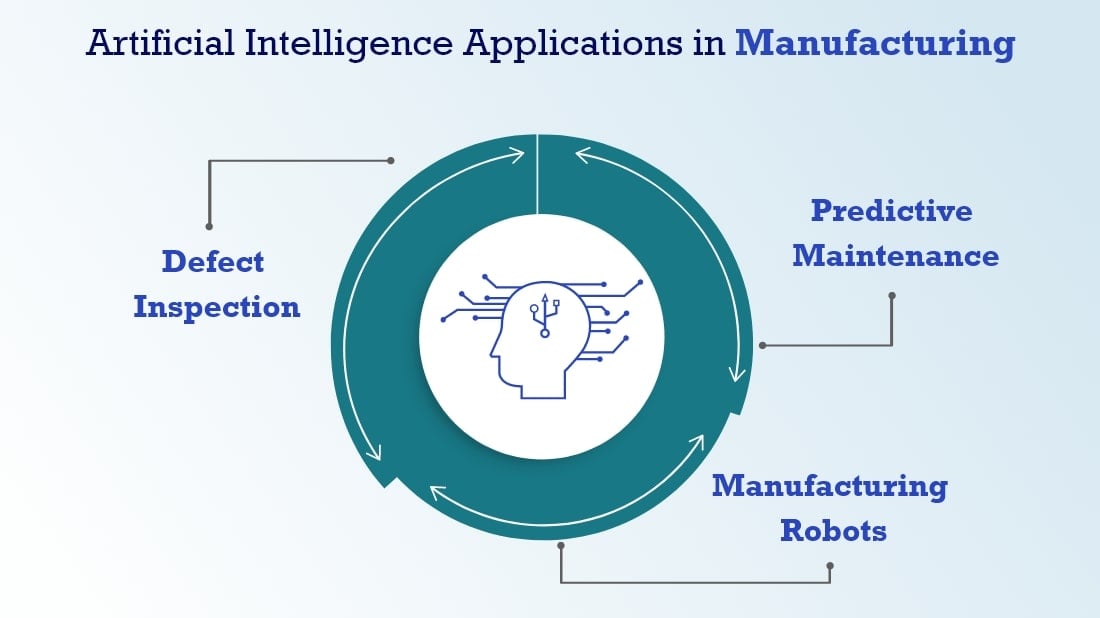
Defect Inspection
If naked eyes can see so much, AI sees so much more. Computer vision is helping manufacturers perform defect inspection using Automated Optical Inspection or AOI technique. The setup uses a bunch of cameras placed at different angles and is capable of identifying even the smallest scratch that human eyes failed to see.
For example, Shelton’s WebSPECTOR surface inspection system identifies defects and saves images and the accompanying metadata. It assigns grades to each defect as it passes from one production line to another. This is certainly an impactful artificial intelligence application in manufacturing that enhances product quality assurance.
Predictive Maintenance
Isn’t it great to know which machine will fail and for what reason before it happens? Predictive maintenance is the best AI use case that can identify potential equipment problems before they happen so you can undertake preventative actions.
For example, the AVEVA Predictive Analytics solution helps asset-intensive organizations discover equipment issues early and schedule repairs before failures occur, thereby increasing reliability and reducing downtime.
Manufacturing Robots
Companies using AI in manufacturing rely on autonomous mobile robots AMRs and cobots to automate tedious, repetitive tasks and extend the manufacturing workforce. Introducing the application of AI in the industry specifically benefits warehouse operations here heavy lifting, reaching, and repetitive motions are routine jobs and are capable of causing ergonomic injuries or quality lapses.
For example, The Texas Medical Research Innovation Institute in Houston tested a two-armed mobile robot called YuMi as a roving laboratory technician. The robot performs tasks like pipette liquids, classifies test tubes, and transports equipment. This demonstrates how artificial intelligence and its applications are reshaping the manufacturing industry.
Looking for dedicated AI developers to develop, design, and deliver feature-rich and innovative AI Solutioins?
Hire AI Developer from us who can work remotely for you.
AI Applications in Healthcare
Solutions powered by AI in healthcare support a variety of clinical and administrative procedures within the facility. The intelligent applications can streamline operations, enhance diagnostics, and aid in critical medical decisions within healthcare organizations. The evolving AI technology is making healthcare AI applications more sophisticated to perform human duties more efficiently, speedily, and at minimum costs.
Some interesting AI applications in healthcare are chatbots, virtual nursing attendants, record management, disease mapping, drug discovery, and more. Let us look at three dominating applications of AI in healthcare.
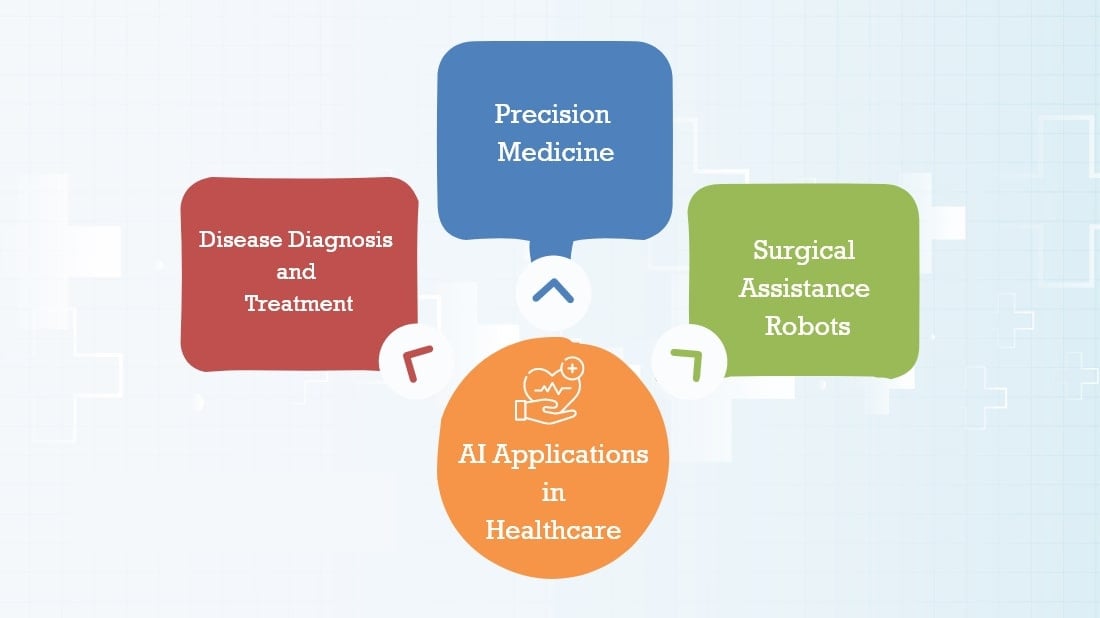
Disease Diagnosis and Treatment
The influence of AI applications in clinical diagnosis and treatment is growing. Leading AI technologies like Machine Learning and Deep Learning are playing a major role in patient diagnosis, treatment mapping, drug discovery, and risk identification.
For example, Infervision uses Deep Learning techniques to identify lung cancer based on X-Ray, CT, MRI, and text descriptions of symptoms and diagnostic reports. The company has worked with multiple top-notch hospitals in China to identify lung cancer in its early stage.
Precision Medicine
Precision medicine is an AI-powered medical model aiming to customize treatment and prevention strategies for a particular disease based on the individual’s genetics, lifestyle, and environment. It enables healthcare providers to move away from a one-size-fits-all approach and deliver highly personalized care.
With the help of machine learning algorithms, healthcare providers can predict how a patient might respond to specific treatments, which improves outcomes and reduces adverse effects.
For example, Ada exemplifies the expanding role of artificial intelligence in healthcare. By harnessing clinical data, it aids users in tracking symptoms, assessing severity, and exploring treatment options.
Surgical Assistance Robots
The evolving AI technology behind micro-surgical robots has made them more precise. Today, surgeons can perform complex surgeries without making large incisions using surgical robots. The AI-powered surgical robots use computer vision solutions to successfully navigate to a specific body area, avoiding nerves and other obstacles.
For example, The da Vinci Surgical System. Surgeons can easily control it and use it for minimally invasive surgery. A surgeon can see inside the patient’s body with optimum detail and take minute incisions that are impossible for human hands by leveraging magnified 3D and HD vision in the da Vinci System.
Artificial Intelligence Applications in Finance
Adopting applications of AI in finance has brought about significant changes in the finance and banking industry. For example, U.S. Bank is a significant player in the finance industry, using machine learning and AI in finance projects to predict customer needs and offer personal banking solutions.
Conversational chatbots, AI-enabled fraud detection, cyberattack prevention, claim automation, risk assessment, credit decisions, trading, and automated customer service are some of the distinctive AI-powered applications employed in the finance and banking industry.
Organizations in this sector leverage appropriate AI consulting services to implement and optimize these advanced technologies for seamless integration and optimal performance across their various financial processes.
Here are some trending artificial intelligence applications revolutionizing the finance and banking industry,
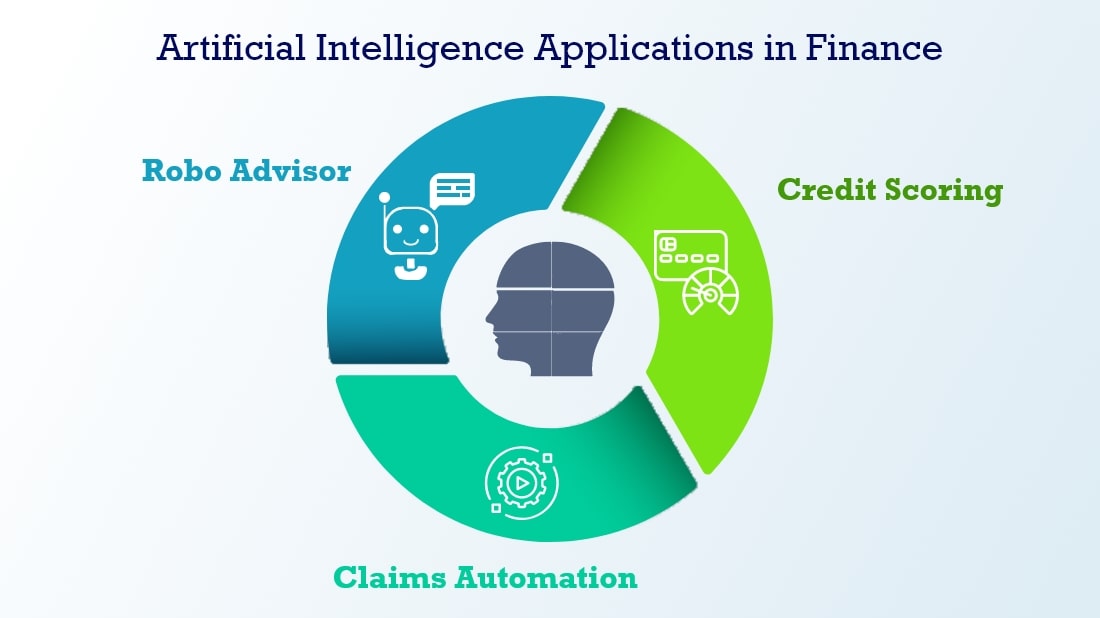
Robo Advisor
“Invention of artificial intelligence in trading is similar to caveman inventing fire.”
Robo Advisor is an automated portfolio manager empowered by artificial intelligence and ML algorithms that scans market data and predicts the best stock or portfolio for trading based on user preferences.
For example, Kavout developed “K Score” using its Kai intelligence platform. The trading bot processes massive sets of diverse data and runs predictive models to develop a stock-ranking system. Besides, it uses an AI-powered pattern recognition technology and a price forecasting engine to suggest top stocks to invest in and worst stocks to sell.
Credit Scoring
The artificial intelligence applications used for credit scoring analyze a huge amount of data collected from a variety of conventional and non-conventional data sources. The application is capable of analyzing and generating credit scores via an innovative lending system. The AI-based robust credit scoring model covers even people having a limited credit history.
For example, GiniMachine is a credit-scoring platform that analyzes historical loan data and creates a report using artificial intelligence. GiniMachine then uses a deep-learning neural network to calculate credit scores from the report.
Claims Automation
Insurance companies are using AI and ML-based technologies to automate many aspects of their operations. Recognizing human speech, images, and machine translation have helped digitize and automate the claims process.
For example, Fukoku Mutual Life, a Japanese Insurance company, developed an app using IBM’s Watson AI technology to process medical claims. The app automatically accesses all the relevant information for a case, mines it for insights, and calculates accurate pay-outs. Yet, they need humans to approve and release the pay-out.
Begin Your Journey To Embrace AI Intelligence
From strategy to execution, our AI development services can help your business build smarter, AI-driven solutions that align with your goals.
AI Applications in E-commerce
Applications of artificial intelligence in eCommerce are empowering online retailers to deliver superior customer experiences both on and off their websites. By utilizing data and AI-backed insights, businesses can make smarter decisions and accurately anticipate customer behavior efficiently.
Some of the trending artificial intelligence applications for the eCommerce industry in 2026 are,
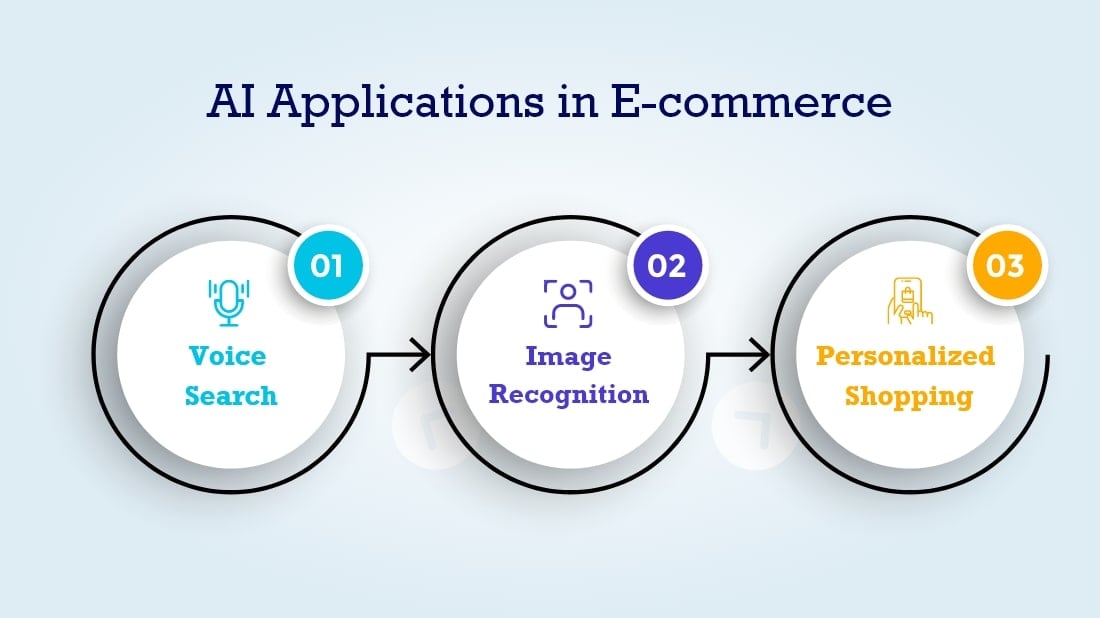
Voice Search
“Hey Siri, take me home in an Uber!”
“Alexa, check the price for Apple iPhone 13!” |
Isn’t it super easy and comfortable to shop without touching the device? AI applications are turning that convenience into reality.
Voice search in the e-commerce industry automates time-consuming shopper queries. The new generation of AI-enabled smart voice assistants like Alexa, Siri, and Cortana are making life easier and consumers happy.
For example, Johnnie Walker, the global Scotch whiskey brand, uses a voice search feature to offer virtual assistance by explaining its signature whiskey and building a connection with users. It asks users questions about their preferences and then recommends a Johnnie Walker product that is most appropriate for them.
Image Recognition
Augmented reality (AR) software is often paired with artificial intelligence (AI) technology in searches. From product matching to counterfeit detection and similar product recommendations to virtual try-on, image recognition offers many advantages to the e-commerce and retail industry.
For example, Zalando is a famous online retailer of shoes, fashion, and beauty products from Berlin. It uses an image recognition app that simplifies the users’ buying’ journey in many ways. It allows users to scan barcodes on individual items to find and buy similar products.
Personalization—which was earlier considered a good-to-have, has become a must-have AI application for eCommerce players. Personalized shopping experiences based on artificial intelligence are not limited to mere product recommendations, but it helps optimize the shopping experience for all shoppers in many ways. Using AI, marketers can deliver personalized incentives, catering to individual shopping preferences and behavior. This strategy effectively drives customer conversion rates.
For example, Sephora, with the help of its comprehensive mobile app, thrives by offering an omnichannel and personalized buying experience to its consumers. Using the app, consumers can book appointments, visit nearby stores, receive recommendations and shop for the products they tried in their retail stores.
Artificial Intelligence Applications in Automotive
Applications of Artificial Intelligence in the Automotive Industry are increasing. From manufacturing to the assembly line and sales to aftermarket, AI applications impact the automotive industry in many ways.
Let’s have a look at some of the prolific use cases of AI in the automotive industry that are making an impact.
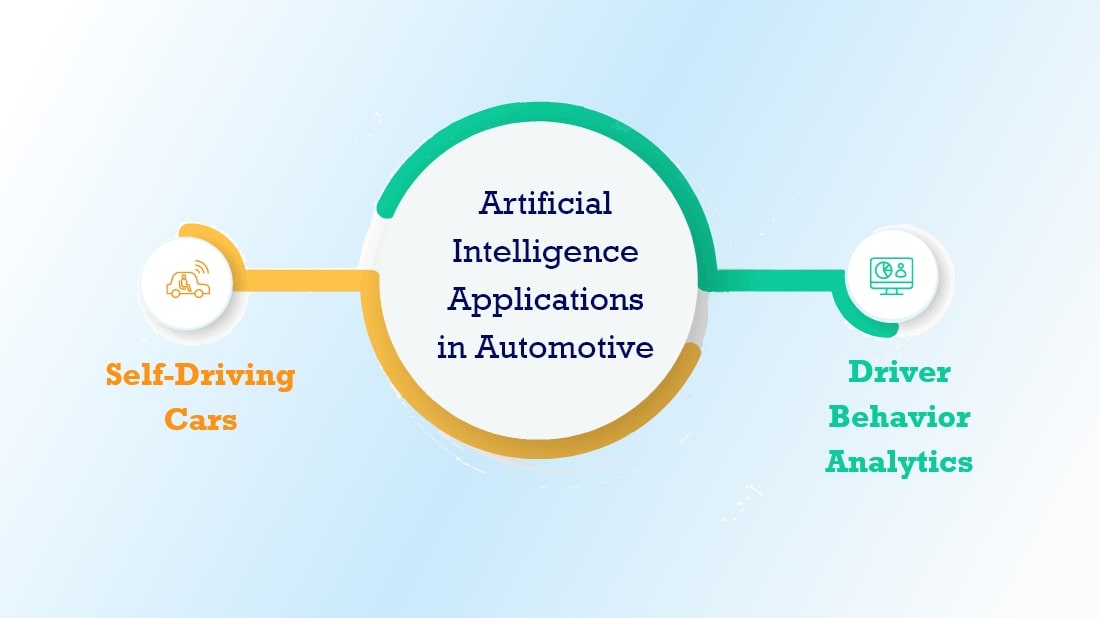
Self-Driving Cars
Artificial intelligence applications power the self-driving car systems used in research and development. Self-driving cars use image recognition systems, machine learning algorithms, and neural networks to drive autonomously.
For example, Waymo is Google’s self-driving car project. It uses different technologies and gadgets like sensors, LIDAR, and cameras to understand the position of the vehicle and its surroundings to prevent accidents and reach its destination autonomously. You can witness Waymo cars roaming the streets of Arizona with no one behind the wheel.
Driver Behavior Analytics
Automobile manufacturers interested in enhancing the safety of the car and the driver rely on driver behavior analytic solutions to prevent distractions behind the wheel. Among the many AI applications in various industries, the AI-powered Driver Behavior Alert system prevents accidents and saves lives. It does so by alerting the driver whenever it detects any signs of distraction.
For example, Nauto’s in-vehicle AI device provides fleets with a continuous feed of visual and audio data. The information is being used to coach drivers on how to drive safely. The device detects driver distraction and alerts distracted drivers with a sequence of audible tones growing in frequency until the driver responds positively.
Conclusion
We have discussed some of the leading Artificial Intelligence applications. We can conclude that businesses have a great deal of opportunity to improve efficiency and define new business models through AI. As more unstructured data becomes available, AI applications can help businesses across industries better analyze and help them gain a competitive edge. Open-source AI technologies have also made it easier to develop customized AI solutions. By leveraging AI consulting services, it will be feasible for businesses to experience the full potential of artificial intelligence, accelerate innovation, and make smarter decisions.