Quick Summary
AML transaction monitoring helps financial institutions identify suspicious activity across customer transactions. This blog explains the monitoring process, key red flags, causes of false positives, the role of AI, crypto AML monitoring, and what to look for in AML transaction monitoring software.
Table of Contents
Introduction
AML compliance becomes expensive when every unusual transaction demands the same level of attention. Financial institutions need monitoring processes that can identify meaningful risk without creating unnecessary investigation work for compliance teams.
However, it becomes increasingly difficult as transaction volumes rise and customers move money through multiple accounts, channels, and jurisdictions.
FinCEN recorded 4.8 million suspicious activity reports in FY2025, which demonstrate the scale of activity financial institutions must monitor and investigate. Traditional AML transaction monitoring remains central to this process, while AI is helping organizations analyze more signals and prioritize potential risks.
This blog covers how transaction monitoring works, the red flags that can indicate suspicious activity, why monitoring systems generate false positives, and what to consider when evaluating AML transaction monitoring software.
What is AML Transaction Monitoring?
AML transaction monitoring is a process of analyzing financial transactions to identify unusual or potentially suspicious activity that may indicate money laundering or any other financial crimes.
Banks and financial institutions use it to monitor customer activity, compare transactions against expected behavior and risk indicators, and identify patterns that may require further investigation.
The process typically involves collecting transaction and customer data, applying predefined rules or risk-based models, generating alerts for unusual activity, and sending relevant cases to compliance teams for review. For instance, a sudden high-value transfer, rapid movement of funds between accounts, or activity involving high-risk jurisdictions may trigger an alert.
By continuously reviewing transaction activity, AML transaction monitoring helps financial institutions detect suspicious patterns, investigate potential risks, and meet their anti-money laundering compliance obligations.
What are the Red Flags in AML Transaction Monitoring?
AML transaction monitoring systems look for patterns that indicate money laundering. The following are the red flags that show unusual activity that needs to be highlighted by your compliance team to investigate further.
Some common AML transaction monitoring red flags include:
1. Unusually Large or Frequent Transactions
A transaction that is significantly larger than the customer’s usual activity can raise a red flag. For instance, if an account normally receives small business payments but suddenly receives numerous high-value transactions, the change may require further review. The same applies when transaction frequency increases sharply without an obvious business reason.
2. Sudden Changes in Normal Transaction Behavior
Transaction monitoring systems can establish a picture of a customer’s typical financial behavior over time. A sudden shift, such as a customer who normally makes local payments beginning to send large international transfers, can appear unusual. The change itself is not proof of suspicious activity, but it may warrant investigation.
3. Multiple Transactions Just Below Reporting Thresholds
Repeated transactions that remain just below a regulatory reporting threshold can indicate an attempt to avoid triggering reporting requirements. Instead of making one large transaction, someone may split the amount into several smaller transactions. This pattern is often referred to as structuring or smurfing.
4. Rapid Movement of Funds Between Multiple Accounts
Money that moves quickly through several accounts can make the source and destination of funds harder to understand. For example, funds may enter one account and then move through several other accounts within a short period, without an apparent business or personal reason for the transfers.
5. Transactions Involving High-Risk Jurisdictions
Transactions involving jurisdictions associated with higher money laundering or financial crime risks may receive additional scrutiny. This does not mean every transaction involving such a jurisdiction is suspicious. Monitoring systems typically consider the jurisdiction alongside the transaction value, frequency, customer profile, and other risk factors.
6. Unusual Cross-Border Transactions
Cross-border activity can become a red flag when it does not match the customer’s known business, location, or financial behavior. For instance, a business that historically operates within one country may suddenly begin making frequent international transfers without an apparent commercial reason.
7. Dormant Accounts Becoming Highly Active
An account that has remained inactive for a long period and suddenly begins receiving or sending significant amounts of money can trigger an alert. Your compliance teams may investigate whether the activity is consistent with the customer’s current circumstances and expected account usage.
8. Multiple Accounts Sending Funds to a Single Account
When numerous unrelated accounts send money to one account, the pattern can indicate unusual fund aggregation. Let’s take it, several accounts may transfer money into one central account before the funds are moved elsewhere. Monitoring systems can identify these relationships by analyzing transaction flows across accounts.
9. Transactions With No Clear Economic Purpose
A transaction may raise concern when there is no clear commercial or personal reason for the movement of funds. For example, repeated payments between unrelated parties with no apparent connection to their businesses may require additional investigation to understand the purpose of the activity.
Money that is deposited and withdrawn almost immediately can create another monitoring signal, particularly when this behavior occurs repeatedly or involves large amounts. The pattern may suggest that the account is being used primarily to move funds rather than for normal financial activity.
11. Unusual Cryptocurrency Transactions or Wallet Activity
Crypto-related activity can also produce AML alerts when transaction behavior appears inconsistent with a customer’s profile. Examples may include unusually large transfers to or from cryptocurrency wallets, rapid movement between multiple wallets, or transaction patterns that differ significantly from the customer’s established financial behavior.
12. Transactions Inconsistent With the Customer's Known Profile
Perhaps the most important red flag is a mismatch between transaction activity and what the institution knows about the customer. For instance, a personal account associated with a low-income occupation suddenly handling frequent high-value international transfers may warrant review.
AML monitoring therefore considers transactions in the context of the customer’s KYC information, expected behavior, risk profile, and transaction history, rather than treating every unusual transaction as suspicious.
Could Your AML System Be Missing Hidden Red Flags?
Let Bacancy Technology’s financial services data analytics help you identify suspicious patterns, reduce AML blind spots, and improve investigations.
Why Do Transaction Monitoring in AML Systems Generate False Positives?
AML transaction monitoring systems flag legitimate activity as suspicious when that activity happens to match the rules built into the system. Broad thresholds, thin customer context, static rules, and shifts in a customer’s normal behavior all drive these false alerts. Systems that have not kept pace with digital transformation in financial services feel this most. They still run on rules written for a slower and simpler payment landscape.
For instance, a customer who usually makes domestic payments may suddenly make a large international transfer for a legitimate business reason. If the system only considers transaction amount and location, it may flag the payment without understanding the context.
As false positives increase, compliance teams face more alerts, more manual reviews, analyst fatigue, and higher compliance costs. Most importantly, excessive alerts can make it harder for analysts to prioritize genuine risks and investigate them promptly.
How AI Reduces False Positives in AML Transaction Monitoring
AI can reduce false positives in AML transaction monitoring by analyzing a transaction in context rather than relying only on fixed rules. It can examine multiple signals at the same time, identify patterns across customer activity, and determine whether an unusual transaction is consistent with the customer’s broader behavior.
Here is how AI can analyze different data points:
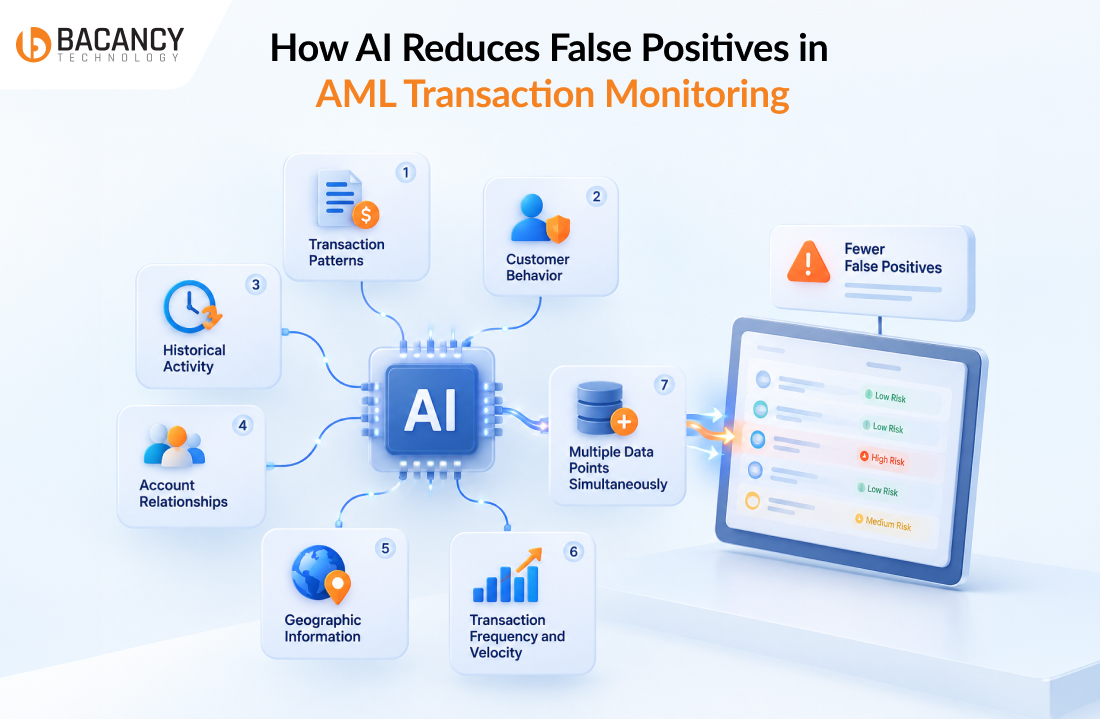
1. Transaction Patterns
AI can examine how money moves through an account instead of looking at individual transactions in isolation. It can identify patterns such as repeated transfers, unusual payment sequences, sudden increases in transaction values, or funds moving rapidly between accounts.
For example, a single large transfer may appear unusual. But if similar transfers regularly occur as part of the customer’s normal business activity, AI can consider that historical pattern when assessing the alert.
2. Customer Behavior
AI can learn what normal financial behavior looks like for a particular customer. It can consider factors such as typical transaction amounts, preferred payment methods, usual transaction locations, and regular counterparties.
If a transaction is unusual but still falls within a customer’s broader behavioral pattern, the system can reduce the likelihood of treating it as a high-priority suspicious alert.
3. Historical Activity
Past transaction activity provides important context for AML monitoring. AI can compare current transactions with historical behavior to identify whether a change is genuinely unusual or part of an established pattern.
For example, if a customer regularly sends international payments of similar value, a new payment may not be as concerning as the same transaction from an account with no history of international activity.
4. Account Relationships
Money laundering patterns can involve multiple accounts rather than a single account. AI can analyze relationships between accounts, customers, counterparties, and transaction flows to identify connections that may not be obvious when transactions are reviewed individually.
This can help distinguish legitimate business relationships from unusual networks of accounts moving funds between one another.
AI can consider the geographic context of transactions, including the customer’s usual locations, transaction destinations, and jurisdictions involved. Instead of automatically flagging every cross-border transaction, it can assess geographic activity alongside other customer and transaction information.
This provides greater context when determining whether an international transaction is unusual for that particular customer.
6. Transaction Frequency and Velocity
The speed and frequency of transactions can provide important signals. AI can identify sudden bursts of activity, multiple transactions within a short period, or rapid movement of funds between accounts.
It can also compare this activity with the customer’s normal transaction frequency. This helps differentiate a genuine change in behavior from a transaction pattern that is consistent with the customer’s history.
7. Multiple Data Points Simultaneously
The biggest advantage of AI is its ability to evaluate multiple signals together. Instead of treating transaction amount, location, frequency, customer profile, and account relationships as separate indicators, AI can assess how these factors interact.
For example, a large international transaction may not be particularly unusual on its own. But if it is followed by rapid transfers through several accounts, occurs in a location inconsistent with the customer’s history, and represents a significant departure from previous activity, the combined pattern may warrant greater scrutiny.
By analyzing these signals together, AI can help compliance teams prioritize alerts based on context and risk, reducing unnecessary manual reviews while directing attention toward transaction patterns that require deeper investigation.
How Does Crypto AML Transaction Monitoring Work?
Crypto AML transaction monitoring works the same way traditional transaction monitoring does, watching for behavior that doesn’t fit, but it has to account for a fund-movement layer that doesn’t exist in traditional banking: wallets, chains, and mixing services that were built to obscure exactly what compliance teams need to see.
The scale of the problem is growing fast. Chainalysis’s 2026 Crypto Crime Report puts illicit crypto transaction volume at $154 billion in 2025, with stablecoins now accounting for 84% of all illicit transaction volume, largely because their price stability and easy cross-border transferability make them the default settlement tool for laundering operations.
Behavioral analysis in crypto AML transaction monitoring covers 5 areas specifically:
- Wallet behavior: How a wallet has historically transacted, and whether new activity breaks that pattern
- Transaction patterns: Timing, size, and structuring behavior on-chain, the crypto equivalent of the red flags covered earlier
- Fund movement between wallets: Tracing how value hops across multiple wallets to obscure its origin
- High-risk addresses and services: Screening against known mixers, sanctioned wallets, and high-risk exchange addresses
- Cross-chain activity: Tracking funds as they move across different blockchains, which is increasingly where laundering activity hides since it breaks a single-chain view of the transaction trail
For institutions handling both fiat and crypto, cryptocurrency transaction monitoring for AML KYC needs to plug into the same case management and reporting workflow as traditional monitoring, not run as a separate, disconnected system. A crypto alert that never reaches the same analyst queue as a wire transfer alert is a blind spot.
How Do You Evaluate Transaction Monitoring in AML Software?
The right AML transaction monitoring software should reduce false positives without reducing detection, and be transparent enough that both analysts and regulators can understand why it flagged what it flagged.
| Capability | What to check for
|
|---|
| AI/ML capabilities
| Does it use behavioral models, or is it still rule-based logic marketed as AI?
|
| Behavioral analytics
| Can it build a per-customer baseline, or does it apply the same thresholds to every account?
|
| False-positive reduction
| Ask for real reduction numbers from existing deployments
|
| Real-time monitoring | Can it flag time-sensitive activity as it happens?
|
| Risk scoring
| Does it produce a graded risk score, or a binary flag/no-flag decision?
|
| Case management
| Does it give analysts the context they need in one place, or force them to pull data from multiple systems?
|
| Explainability | Can the system show why it flagged a transaction, in terms an examiner will accept?
|
| Audit trails
| Is every decision, human and automated, logged and retrievable?
|
| Integration capabilities
| Does it connect to your core banking, KYC, and case management systems without custom middleware for every connection?
|
| Regulatory reporting
| Can it generate SARs and other required filings directly from an investigation, or does that still happen manually?
|
Explainability deserves particular weight given where regulation is heading. A model that catches more risk but can’t explain its reasoning creates a different problem than the one it solved; an alert an analyst can’t justify to an examiner is barely more useful than a false positive. Fintech AI development that is built with explainability and human-in-the-loop review from the start tends to hold up better under supervisory scrutiny than models retrofitted with explanations after the fact.
How Can Bacancy Technology Control Transaction Monitoring in AML?
AML transaction monitoring needs more than fixed rules to keep up with complex transaction patterns. Bacancy Technology helps financial institutions build AI-powered monitoring solutions that analyze customer behavior, transaction history, account relationships, and risk signals to reduce false positives and prioritize genuine risks.
With our fintech consulting services, you can modernize AML workflows, integrate diverse financial data, and equip compliance teams with smarter monitoring capabilities. From AI/ML models to secure data integration, Bacancy Technology helps you build AML transaction monitoring solutions aligned with your compliance and operational needs.
Frequently Asked Questions (FAQs)
It applies rule-based logic and machine learning models to flag patterns like structuring, rapid fund movement, transactions with high-risk jurisdictions, or activity that deviates from a customer’s normal behavior. Flagged transactions generate alerts for compliance teams to investigate.
KYC (Know Your Customer) verifies customer identity at onboarding. AML transaction monitoring runs continuously after onboarding, watching ongoing account activity for red flags KYC alone can’t catch.
Yes. Any regulated financial entity, including fintechs handling payments, lending, or digital wallets, must implement AML monitoring to comply with regulations, such as the BSA, EU AMLD, and FATF recommendations. Non-compliance carries steep fines and licensing risk.
False positives happen when legitimate transactions match risk rules too broadly, like a customer’s routine large payment triggering a threshold alert. Reducing them requires tuning rule thresholds, layering in machine learning for contextual risk scoring, and refining customer risk profiles over time.
Building AML transaction monitoring software typically costs $40,000 to $250,000+, depending on the software’s complexity, transaction volume, AI/ML capabilities, integrations, compliance requirements, and deployment model.
Yes, AI-driven models reduce false positives by learning transaction patterns specific to each customer, rather than relying on static rules. It improves detection accuracy while cutting the manual review workload for compliance teams.
Insurance, payment processors, crypto exchanges, money service businesses, and lending platforms all fall under AML obligations if they move money or manage customer funds, not just traditional banks.