Quick Summary
This guide is designed for CEOs, CTOs, business owners, and decision-makers seeking to understand AI Governance for startups and small businesses and manage AI-related risks. It covers key frameworks, relevant regulations, essential controls, and practical steps for responsible AI adoption. It also includes a 30-day plan to help businesses establish clear policies, reduce risks, and build an AI governance approach that scales with their growth.
Table of Contents
Introduction
If you research AI adoption, you’ll realize that the majority of startups adopt AI before even establishing rules for using it. Sometimes, founders experiment with a chatbot, a developer integrates a large language model into the product, and the support team deploys an AI agent. After a few months, they begin to notice how their AI handles customer data, influences business decisions, and screens job applicants. Yet, no one has a complete picture of which tools are being used, what data they can access, or who is accountable for their decisions. AI governance framework for startups closes that gap by turning scattered AI adoption into a clear and accountable process.
AI Governance for startups and small businesses includes a set of rules, policies, responsibilities, and controls that guide how a company adopts, develops, and uses AI. It also defines which tools are approved to use, what information can be shared, and when human intervention is mandated. For startups, effective AI governance isn’t about replicating an enterprise compliance program; rather, it is about putting the right safeguards in place without adding unnecessary complexity or slowing down innovation.
The need for AI governance is becoming increasingly urgent. According to PagerDuty’s 2026 Shadow AI Survey, 40% of workers at companies with fewer than 1,500 employees had entered customer data into public AI tools compared with 27% at larger organizations. These findings highlight why startups and enterprises need clear AI usage policies, data protection controls, and accountability as AI adoption grows.
Common AI Risks Small Businesses Face and How AI Governance Reduces Them
Every AI risk present around AI Governance for startups and small businesses comes with practical steps and effective governance solutions if the right steps are taken to solve them. The solution doesn’t require stopping using AI; instead, it is meant to prevent avoidable mistakes before they impact business, customers, and reputation overall.
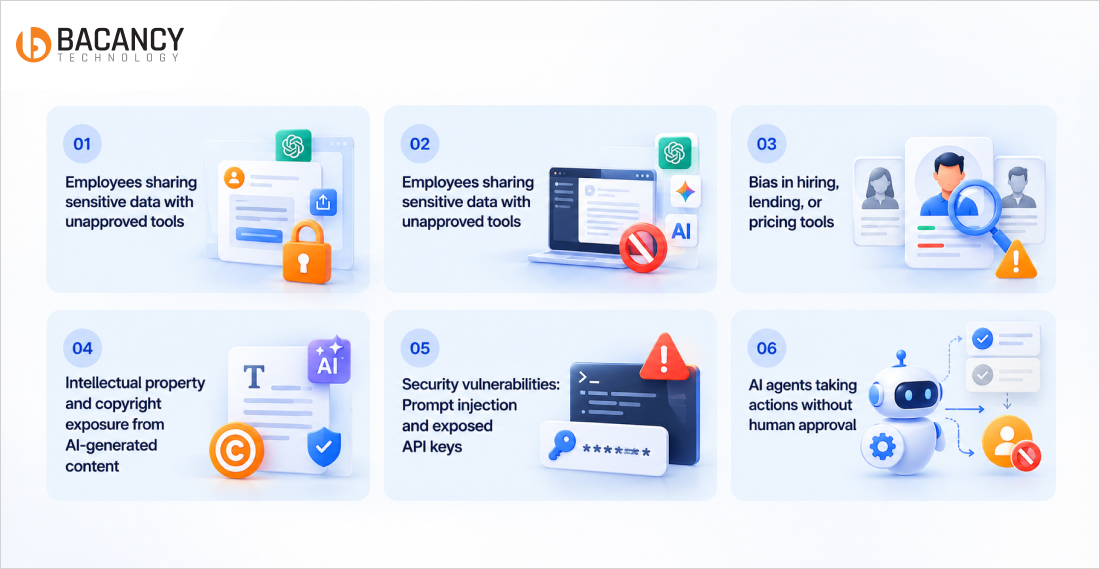
Most often, employees tend to paste customers’ details, their financial information, or internal documents into public AI tools just to ease their task without understanding the risks involved. It creates data privacy and security gaps that are difficult to trace.
Governance Fix: For effective AI governance for small businesses, it is necessary to maintain an approved AI tool list, define which data employees can share, and establish a clear set of rules against using unapproved tools.
Inaccurate or Hallucinated Outputs Reaching Customers
AI might generate convincing answers, but there is no guarantee they are accurate. From invented refund policies to misleading product recommendations, when these outputs reach customers unchecked, they can damage their lifelong trust and create costly disputes in the future.
Governance Fix: To avoid such instances, you need to align human review for high-impact or customer-facing outputs until accuracy has been validated through testing and ongoing monitoring.
AI systems can produce biased results in training data or might showcase unfair outcomes when used to screen candidates, assess eligibility, or set prices. These decisions can expose businesses to reputational and legal risks.
Governance Fix: For effective AI Governance for Startups and small businesses, you can classify consequential use cases as high risk, test outcomes across relevant groups, and regularly review decisions for signs of bias.
Intellectual Property and Copyright Exposure from AI-generated Content
AI-generated marketing copy, images, and code can raise questions about ownership, licensing, originality, and permitted use. If you publish or deploy content without proper checks, it can create legal and commercial complications ahead.
Governance Fix: To bypass such instances, you need to clearly define where AI-generated content can be used, review important outputs before publication, and assess vendor terms covering ownership and indemnity.
Security Vulnerabilities: Prompt Injection and Exposed API Keys
AI applications can introduce attack paths through malicious prompts, unauthorized data access, insecure integrations, or leaked credentials. These weaknesses can expose sensitive information or compromise connected systems.
Governance Fix: To fix this concern, you need to implement secret scanning, rotate exposed keys, restrict access permissions, and test applications against recognized LLM security risks.
AI Agents Taking Actions without Human Approval
Autonomous AI agents may send emails, issue refunds, modify records, or trigger transactions faster than teams can detect mistakes. Without clear limits, a single error can lead to financial losses or operational disruption in the business.
Governance Fix: You need to immediately enforce least-privilege permissions, set action and spending limits, log agent activity, and require human approval for irreversible or high-impact actions.
Core Pillars of an AI Governance Framework for Startups And SMBs
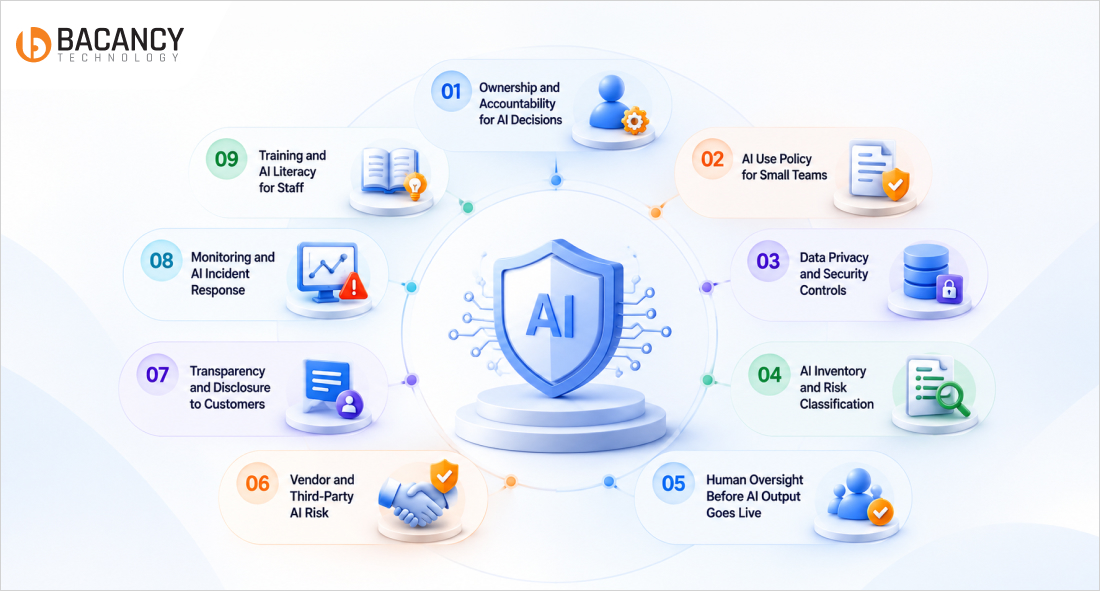
If your goal is to achieve effective AI Governance for startups and small businesses, you can manage it without requiring a dedicated compliance team. You need a few practical controls that clarify ownership, protect data, and keep AI use accountable as the business grows. These pillars draw on the same AI governance best practices larger organizations follow, scaled down to fit a small team. The following eight pillars provide a starting point for building an AI governance framework for startups that grows with your business.
Ownership and Accountability for AI Decisions
By assigning ownership to a specific person, typically the CTO, COO, or another senior leader, to own AI governance for a small business solves multiple problems beforehand. This person oversees AI tool approvals, maintains the AI inventory, coordinates risk reviews, and ensures incidents are addressed. It includes security, legal, or product specialists when needed, but responsibility should remain clear. A single accountable owner helps a small team make decisions quickly without creating unnecessary approval layers.
AI Use Policy for Small Teams
By using a clear AI use policy, employees can easily understand and follow the requirements. You need to cover approved tools, prohibited uses, data-sharing rules, and when AI-generated content must be disclosed or reviewed. Also use specific examples for better clarity, instances based on which you can tell employees not to enter customer personal information, confidential source code, or financial records into unapproved AI tools. You can always review AI policy as your tools, workflows, and business requirements evolve.
Data Privacy and Security Controls
You need to design clear controls based on how company data is used and classify it as public, internal, confidential, or restricted. Then specify which approved tools can process each category. For sensitive workloads, you need to evaluate data retention settings, model training terms, encryption, and access controls. Also ensure AI features that are connected with internal systems follow the same security principles as the rest of your infrastructure. If you process personal data, review applicable privacy laws, notices, and data-processing agreements to determine what additional safeguards are required.
AI Inventory and Risk Classification
Maintain a centralized register of AI tools, models, and use cases, including AI features embedded in existing software. Also record each tool’s purpose, owner, data access, vendor, and risk level. A simple spreadsheet can work well for a small team. For example, internal brainstorming may be low risk, AI-assisted customer communications may require review, and systems influencing hiring or other consequential decisions may need more rigorous assessment. You also need to revisit classifications whenever a tool’s purpose, permissions, or level of autonomy changes.
Human Oversight Before AI Output Goes Live
Always decide in advance which AI outputs require human approval before they reach customers or trigger important decisions. At minimum, that covers four points:
- Customer replies in regulated contexts
- Hiring and performance decisions
- Financial approvals such as refunds, credit, or pricing changes
- Any AI agent action that can’t be undone
Vendor and Third-Party AI Risk
You need to assess the risk beforehand using AI tools, not after a customer raises concerns. Ask your development partners how they retain and use data, whether it trains their models, which third-party providers they rely on, and where information is processed. Always review your relevant contract terms that cover data protection, security incidents, intellectual property, and liability. For higher-risk use cases, request appropriate security documentation and evidence of safeguards. These checks help you understand the risks introduced by external AI services and make well-informed procurement decisions.
Transparency and Disclosure to Customers
Be aware of when customers are interacting with AI or when AI-generated content could materially affect their understanding or decisions. The inclusion of a simple label, such as “This response was drafted with AI and reviewed by our team,” can set expectations without disrupting the experience. You need to identify where disclosures are needed, assign responsibility for providing them, and review applicable legal requirements as your products and markets expand.
Monitoring and AI Incident Response
AI Governance for startups and small businesses must continue even after deployment. You need to monitor relevant indicators such as output accuracy, customer complaints, unexpected costs, unusual agent actions, and potential data exposure. Also, you need to establish a straightforward incident process that explains who must be notified, how an AI feature can be restricted or disabled, and how issues are investigated and documented. A one-page response plan is a practical starting point. Review incidents and near misses to identify improvements before similar problems recur.
Training and AI Literacy for Staff
Always aim to provide employees with practical guidance on using AI safely and responsibly. You can cover approved tools, prohibited data sharing, output verification, bias, and the process for reporting problems. You can keep your training relevant to employees’ roles and the AI systems they use. For enterprises within its scope, the EU AI Act includes an AI literacy obligation that has applied since February 2025. With the help of the right training, employees can understand both the capabilities and limitations and make responsible AI use part of their everyday work.
Put AI Governance in Place Without Slowing Down
Leverage our AI governance consulting services to set up clear policies, risk controls, and human oversight for your startup or small business. Build a framework that fits your team today and scales as your AI use grows.
AI Compliance Regulations Every Founders Should Know
To ensure AI governance for startups and small businesses, you don’t need to act like a regulatory expert all the time. You just need to know which laws apply to your AI use cases and when compliance deadlines arrive.
EU AI Act
The Digital Omnibus Regulation (EU) 2026/1744 entered into force on July 27, 2026, and increased certain high-risk AI compliance deadlines:
- December 2, 2027: Standalone high-risk AI systems, including certain hiring and credit-scoring applications.
- August 2, 2028: High-risk AI embedded in regulated products, such as medical devices and machinery.
The applicable transparency obligations began on Aug 2, 2026, and AI literacy needs have applied since February 2025. Those providers who are currently using generative AI systems already in the market are also facing a content marking deadline till December 2, 2026.
What Startups Should Do: They should match each AI use case they offer to EU users with its deadline, and handle generative AI content labeling first because that date arrives soonest.
US state laws
Colorado’s SB 26-189 introduces requirements for certain AI-driven consequential decisions, including notices, human review, and recordkeeping. It is scheduled to take effect on January 1, 2027, with rulemaking still underway as of October 22, 2026. Startups that are serving Colorado consumers should monitor the final rules and should prepare accordingly.
What Startups Should Do: If your AI influences decisions about jobs, loans, insurance, or housing for Colorado residents, start drafting consumer notices and a human review process now instead of waiting for the final rules.
Sector-specific Rules to Apply When You Use AI
- Healthcare: HIPAA safeguards apply to covered entities and business associates handling protected health information.
- Lending: ECOA and applicable fair lending requirements still govern AI-assisted credit decisions.
- Hiring: Title VII anti-discrimination protections still apply to AI-assisted hiring, even when a third-party vendor supplies the tool.
What Startups Should Do: Before you deploy AI in these sectors, confirm that your vendor contracts and bias testing cover the AI tool. The vendor contract could be a HIPAA business associate agreement, for example. Legal responsibility stays with your business, not the vendor.
AI Governance Frameworks Startups Can Start From
To achieve AI governance for startups and small businesses, you don’t need to adopt an entire framework. You can choose practical guidelines that fit their use cases, business needs, and compliance requirements.
NIST AI Risk Management Framework (AI RMF)
For AI governance in startups and SMBs, the NIST AI Risk Management Framework (AI RMF) helps identify, assess, and manage AI risks through four functions: Govern, Map, Measure, and Manage. Its Generative AI Profile also covers risks such as hallucinations, data leakage, and harmful outputs.
How to Start: Download the free AI RMF Playbook and pick your two or three most critical AI use cases, such as a support chatbot or an AI feature inside your product. You can run each one through Govern, Map, Measure, and Manage, and record the owner, risks, and safeguards in a shared sheet. If you use generative AI, add the relevant risks from the Generative AI Profile (NIST AI 600-1) to the same sheet.
ISO/IEC 42001
ISO/IEC 42001 provides a structured approach to managing AI governance frameworks for startups through policies, risk assessments, and clear accountability. It’s especially useful for startups selling AI solutions to enterprise customers that expect formal governance practices.
How to Start: To achieve ISO/IEC 42001, you need to start with a gap assessment. Then compare your current AI policy, inventory, and risk reviews against the standard’s requirements and its Annex A controls to close the biggest gaps first. Also pursue formal certification through an accredited body only when enterprise buyers start asking for it in security questionnaires or contracts.
EU AI Act
The EU AI Act classifies AI Governance for startups and small businesses by risk and sets requirements accordingly. Startups can use its risk-based approach to identify sensitive use cases and determine which safeguards or legal obligations may apply.
How to Start: List every AI use case and place it in one of the Act’s four risk tiers: prohibited, high, limited, or minimal. Check each use case against the Annex III high-risk list, which covers areas such as hiring, credit scoring, and education. Wherever customers interact with a chatbot or AI-generated content, add a clear disclosure label.
OECD AI Principles
The OECD AI Principles promote trustworthy AI through transparency, accountability, safety, and respect for human rights. Startups can use them to establish basic responsible AI guidelines before building a more formal governance program.
How to Start: You need to turn the five principles into a short responsible AI statement with one concrete commitment for each, such as “a human reviews every AI-assisted hiring decision.” Add the statement to your AI use policy. Your team can also use it as a quick checklist whenever it approves a new tool or AI feature.
Singapore Model AI Governance Framework
Singapore’s AI Governance framework for startups offers practical guidance for responsible AI adoption, including agentic AI. Startups can use it to define AI agent boundaries, set human approval checkpoints, and maintain accountability for autonomous actions.
How to Start: For every AI agent, document three things: what it can access, which actions it can take on its own, and which actions need human sign-off. You can also set spending and action limits, and make sure someone can pause the agent instantly. For testing, the AI Verify toolkit developed by Singapore’s IMDA is open source and can help you check your AI systems against governance principles.
OWASP Top 10 for LLM Applications
OWASP highlights key security risks in LLM-powered applications, including prompt injection, sensitive data exposure, and excessive agency. Build checks for these risks into your development cycle from the start, rather than adding them after launch.
How to Start: Use the list as a pre-release checklist for every LLM feature. Test for prompt injection, sensitive data leaks, and agents with broader permissions than they need. Make these checks part of your code reviews, and run basic red-team tests before each major release.
Once you know your starting point, the next step is to understand what each framework covers. Some give you a basic risk structure, while others help you win enterprise deals or secure AI agents. The table below compares each framework by what it offers, the effort it takes, and the type of startup it suits best.
| Framework
| What it gives a startup
| Effort
| Best for
|
|---|
| NIST AI RMF
| Govern, Map, Measure, Manage structure for AI risk
| Low to medium | Every startup’s base layer
|
| OECD AI Principles
| Values for fairness, transparency, and accountability | Low | Every startup’s base layer
|
| ISO/IEC 42001
| Certifiable AI management system
| Medium to high
| Selling to enterprises, banks, hospitals |
| EU AI Act risk tiers
| Risk classification for each AI use case
| Low to high
| EU customers and high-risk uses
|
| Singapore agentic AI framework | Guardrails for AI agents acting autonomously
| Low to medium | Startups shipping AI agents
|
| OWASP LLM Top 10
| Security checklist for LLM features
| Low to medium
| Any product with LLM features |
Note: Regulated industries such as healthcare, finance, insurance, hiring, and education need AI governance from the start. Yet lower-risk businesses can start with basic safeguards and expand their governance practices as they grow and serve larger customers.
Build AI With Governance Built In
Good AI governance works best when it starts at the build stage. As an experienced AI development company, we design human review, access controls, and audit trails into your AI features from day one, so your product stays compliant and accountable as it grows.
Industry-Wise AI Governance Frameworks That Matter Most
Each industry carries different AI risks, so the frameworks a startup should prioritize depend on where it operates. The table below shows the high-risk AI uses common in each industry, the framework to prioritize first, and the frameworks to add as your compliance needs and customer base grow.
| Industry | Typical high-risk AI use
| Start with
| Layer on top
|
|---|
| Healthcare and healthtech
| Clinical decision support, diagnosis aids, patient chatbots, medical coding
| NIST AI RMF | ISO/IEC 42001 for hospital and payer buyers, OWASP LLM Top 10 for PHI leaks
|
| Fintech and BFSI
| Credit scoring, fraud detection, KYC/AML, robo-advice
| NIST AI RMF
| EU AI Act tiers (credit scoring is high risk), ISO/IEC 42001 for bank partners
|
| Insurance and insurtech
| Underwriting, pricing, claims triage
| NIST AI RMF
| EU AI Act tiers (life and health pricing is high risk), bias testing
|
| HR tech and recruiting
| Resume screening, candidate ranking, performance tools
| NIST AI RMF | EU AI Act tiers (employment AI is high risk), regular bias audits
|
| B2B SaaS
| AI features inside the product, AI agents acting for customers
| NIST AI RMF + OWASP LLM Top 10
| ISO/IEC 42001 for enterprise deals, Singapore agentic AI guidance |
| E-commerce and retail
| Recommendations, dynamic pricing, support chatbots, AI product content
| OECD principles + NIST basics
| EU AI Act limited-risk disclosure rules
|
| EdTech
| Grading, proctoring, admissions, learning tutors
| NIST AI RMF | EU AI Act tiers (education AI is high risk), human review of scores
|
| Logistics and manufacturing | Route optimization, demand forecasting, predictive maintenance
| OECD principles + NIST basics
| OWASP LLM Top 10 if agents touch operations
|
30-Day Plan to Set Up AI Governance for Startups and Small Businesses by Bacancy Technology
AI governance for startups and small businesses doesn’t need to take six months or require a dedicated team. It requires the right knowledge and industry expertise. At Bacancy Technology, our team of skilled AI engineers uses a startup-focused approach to turn scattered AI use into a well-governed system in four weeks. This includes tracking every AI tool, assigning clear responsibilities, prioritizing risks, and setting practical rules for your team to follow. Our team works alongside your product roadmap, keeping development on track while delivering a specific goal and measurable outcome each week.
In the first step, we identify every AI tool your team uses and record how each one is used. This covers several areas such as:
- Tools employees sign up for themselves, including free and personal accounts
- AI features inside existing software, such as CRM and help desk tools
- AI models, APIs, and agents built into your products
- Each tool’s purpose, owner, data access, and intended use
Week 2: Assign an AI Owner and Identify Risks (Days 8-14)
Our AI engineers help you choose one person, usually your CTO or COO, to manage AI use and approve new tools. Then, we group AI uses by risk:
- Low risk: Internal writing and brainstorming
- Medium risk: Customer-facing content that needs human review
- High risk: AI used for hiring, credit, healthcare, pricing, or actions taken without human approval
Week 3: Create a Simple AI Policy and Train Your Team (Days 15-21)
Next, our experts develop a concise, one-to-two-page AI usage policy tailored to your business. It defines the rules employees must follow when using AI, including:
- Approved AI tools and prohibited use cases.
- Data-sharing restrictions and confidentiality requirements.
- Situations requiring human review or approval.
- When customers need to be informed about AI use.
We then conduct a 30-minute training session using examples from your business. And publish the AI usage policy, train employees, and clarify expectations for responsible AI use.
Week 4: Set Up Regular Reviews and Incident Handling (Days 22-30)
In the final week, we help you keep AI governance for startups and SMBs up to date with clear review processes and accountability. This covers:
- Scheduled AI reviews, such as monthly or quarterly check-ins
- Approval procedures for new tools and use cases
- Incident reporting and response protocols, including who to notify and how to pause an AI feature
- A short practice exercise to prepare your team for potential AI issues
Conclusion
AI governance for startups and small businesses doesn’t need a strict rulebook or a dedicated team. You can start by listing AI tools your team uses, assigning one person to oversee them, and setting clear rules for data use and human review. By using simple steps, you can establish strong AI governance for small businesses, reduce AI risks, prevent customer-facing mistakes, and answer the AI-related questions enterprise buyers ask during security reviews.
As your business grows, your AI governance needs to grow with it. That means adding ISO/IEC 42001 when enterprise customers ask for it, preparing for EU AI Act obligations before entering the European market, and introducing stronger safeguards as your AI agents take on more tasks. With our Responsible AI consulting services, you get expert guidance to assess risks, set the right policies, and keep your AI systems secure, transparent, and compliant as you scale.
Frequently Asked Questions (FAQs)
Yes, the EU AI Act can apply to US startups if they offer AI systems in the EU or if their AI systems’ outputs are used in the EU. But the applicability depends on the startup’s activities and the specific provisions involved, not simply where the company is based.
At Bacancy Technology, our first step towards AI governance for a small business is creating an inventory of all AI tools, models, and features your business uses. We also form a record of who uses each tool, what data it accesses, and its purpose. This helps identify risks and decide which controls to implement first.
A CTO, COO, or another senior employee can take responsibility for AI governance. This person should approve AI tools, maintain the AI inventory, coordinate risk reviews, and ensure incidents are addressed. Smaller businesses can assign this role without creating a separate compliance team.
No. The Digital Omnibus changed certain implementation deadlines, particularly for high-risk AI systems. Under the revised timeline, rules for specified high-risk use cases apply from December 2, 2027, while rules for high-risk AI embedded in certain regulated products apply from August 2, 2028. Other obligations have separate timelines and are not all postponed.
It depends on your business needs. Certification can help startups demonstrate a structured approach to AI governance, particularly when enterprise customers expect formal controls. However, certification is voluntary, and smaller startups can begin with basic policies, risk assessments, and accountability measures before investing in certification.