Quick Summary
This guide is for business leaders, CTOs, AI & data teams, and technology decision-makers who want to build a reliable data foundation for scalable AI. By the end of this guide, you’ll learn how to assess your data against specific AI use cases, identify gaps in quality, governance, lineage, and context, and prepare data for predictive, operational, and generative AI. Also, you will explore how to avoid common AI data readiness mistakes and build a scalable and secure data foundation that can scale your AI initiatives across multiple industries.
Table of Contents
Introduction
Over time, AI models are becoming easier to develop. But ensuring the data behind them is ready for production is still the major concern. A model might be technically sound but can still deliver unreliable results when the data feeding it is incomplete, inconsistent, outdated, or missing the business context it requires.
As enterprises move beyond AI experimentation and begin deploying systems that support real business decisions, the question is no longer simply whether they have enough data, but whether that data is actually ready for AI.
A 2026 Cloudera and Harvard Business Review survey polled 230+ enterprise AI decision-makers. Only 7% called their data completely ready for AI. 27% said their data was not ready at all.
This reflects a major gap between enterprise AI ambitions and the readiness of the data required to support them in production. AI data readiness is therefore a major topic of discussion today, raising important questions about whether enterprise data can meet the quality, context, governance, and operational demands of AI systems.
What is AI Data Readiness and Why is it Important?
AI data readiness is the extent to which an organization’s data is prepared, validated, governed, and contextualized well enough for AI systems to use it reliably in real-world conditions. It goes beyond simply having clean or accurate data. For AI to produce dependable results, the underlying data needs clear business definitions, traceable lineage, appropriate access controls, and enough context to reflect how the business actually operates. This distinction matters because data can be technically clean and still be unsuitable for an AI system.
For example, a customer dataset may have no missing values or formatting errors, yet still create problems if sales and finance use different definitions of an “active customer.” Ensuring data readiness for AI means closing those gaps so data is accurate, relevant, consistent, explainable, and fit for every AI use case.
According to Gartner, organizations face a 60% failure rate in artificial intelligence (AI) initiatives that aren’t backed by AI-ready data, while 63% of organizations either lack or aren’t sure they need AI data management practices. When AI systems influence customer experiences, financial decisions, operations, or other business-critical processes, unreliable data can lead to inaccurate outputs, compliance risks, and expensive rework. For technology leaders, AI data readiness is more than just another data engineering task. It needs clear ownership, standardized definitions, governance, lineage, validation, and continuous monitoring.
How to Check if Your Data is Ready for AI?
Before putting an AI system into production, organizations need to know whether their data is ready to support it. A normal AI data readiness assessment can start with three questions: Does the data fit the use case? Is its quality sufficient for the expected results? And is it governed appropriately?
Does the data align with the AI use case?
You can not assume that available data is relevant to the problem your AI systems aim to solve. You need to assess whether the data reflects real-world conditions, including edge cases and exceptions, and whether the volume is sufficient for the chosen AI technique. Also check whether business definitions are clear and consistent and whether the data can be traced back to its source through reliable lineage.
Can the data quality meet the AI system requirements?
AI systems need data to support reliable performance during both development and production. So, first validate data quality, track dataset changes, run regression tests, and monitor changes over time. Continuous observability is important, as data or user behaviour can change after deployment that can affect model performance.
Is the data properly governed for the AI use cases?
Check whether the data has clear ownership, defined compliance requirements, appropriate access controls, and documented rules for how it can be used. Bias checks may also be required depending on the AI use case. The governance requirements should reflect the risks associated with the AI system and the data it processes.
The simple way to test AI data readiness is to choose an AI use case you are planning to deploy and evaluate its data against all three of these questions. If you cannot answer any of them with specific evidence, that gap should be addressed before scaling the initiative.
Why Data Readiness Looks Different for Predictive, Operational, and Generative AI
There is no fixed definition that qualifies AI data readiness. The requirements depend on what the AI system is expected to do. The same customer dataset may be suitable for a churn-prediction model but unsuitable for a real-time pricing engine because the two applications have different requirements for historical depth, freshness, context, and reliability.
Predictive & Forecasting AI
The predictive and forecasting AI data readiness depends on historical data consistency and temporal integrity. If the business rules, definitions, and data collection methods change over time without proper documentation, the resulting dataset can contain inconsistencies that affect what the model learns. It requires historical depth, consistency, and well-documented changes to ensure data readiness for AI.
Operational AI
Operational AI emphasizes data freshness, reliability, and failure tolerance. Those systems are assigned for real-time routing, automated approvals, or other live decisions; they cannot rely on data that is frequently outdated. Even a highly accurate model can still produce poor outcomes when the data reaching it is several hours behind current conditions.
Generative AI and Enterprise Copilots
For data readiness, Generative AI and enterprise copilots introduce a different set of requirements because much of their input comes from unstructured information such as documents, transcripts, and knowledge bases. Having documents available is not enough. It should be current, version-controlled, appropriately structured, and governed so that users and AI systems can access only information they are allowed to use.
How to Prepare Your Data for AI
Once you know where the gaps are, the actual work of building Data Readiness for AI splits into two tracks: what to do and what to avoid doing based on the mistakes we watch enterprises repeat.
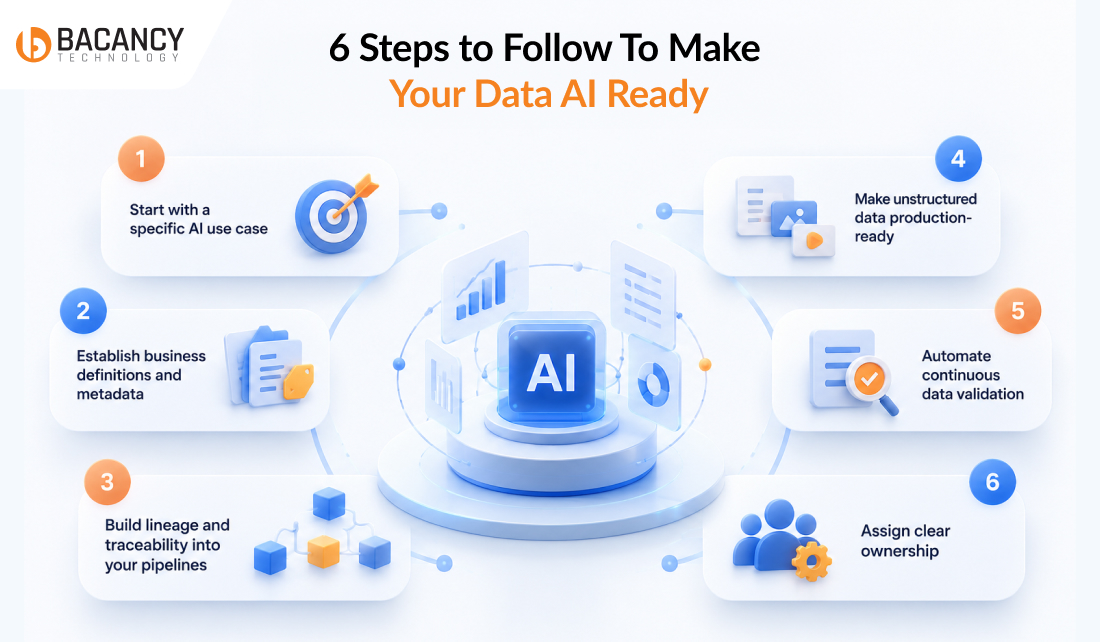
6 Steps to Follow To Make Your Data AI Ready
These six steps help you build the foundation for reliable, scalable AI by aligning data with business goals, strengthening governance, improving quality, and maintaining readiness over time.
1. Start with a specific AI use case
You need to avoid trying to make your entire data estate AI-ready without having any clear and defined objective. You need to identify the data requirements for the AI system that is intended to be built first. For example, a demand forecasting model may depend heavily on historical sales, seasonal patterns, and promotional calendars, while unrelated employee data may have no role in the model.
2. Establish business definitions and metadata
Data formatting alone does not make information usable. If “revenue” means gross revenue in one system and net revenue in another, even a perfectly formatted dataset can produce inconsistent results. You need to create shared definitions, maintain a data dictionary, and establish metadata standards so the team works from the same understanding of critical business information.
3. Build lineage and traceability into your pipelines
AI systems need traceable data so teams can understand where the data used by an application came from and how it was transformed. Establish lineage across key data sources, transformations, and datasets, with detailed documentation of how data moves through the pipeline. You can use tools such as dbt, Monte Carlo, and Collibra to support this process.
4. Make unstructured data production-ready
Documents, PDFs, transcripts, and other unstructured sources often contain valuable information for generative AI applications. So before using them, try to establish appropriate metadata, document processing, version control, and access permissions. The goal is retrieval with the right context and permissions, not just searchability.
5. Automate continuous data validation
Data quality needs to be monitored continuously rather than checked only during periodic audits. Try implementing automated freshness checks, validation rules, regression tests, and drift monitoring within your data and AI pipelines. This allows teams to identify issues before they affect AI systems or business decisions.
6. Assign clear ownership
Every important dataset that supports an AI system needs clear ownership for its quality, documentation, and ongoing maintenance. Without clear accountability, even well-designed data processes can become difficult to maintain when systems, teams, or business requirements change.
Need help preparing your data for AI?
Hire data engineers from Bacancy Technology to assess your existing data foundation, build scalable pipelines, improve data quality, and prepare reliable data infrastructure for production AI initiatives.
Key Mistakes to Avoid When Preparing Data for AI
From what we’ve seen across client engagements, the same handful of mistakes account for most failed efforts spent to achieve data readiness for AI:
1. Treating data readiness as a one-time project
Data readiness changes as business rules, source systems, customer behaviour, and AI requirements evolve. A dataset that was suitable six months ago may no longer meet the needs of the production system today. You need to treat readiness as a continuous process supported by monitoring, validation, and regular review.
2. Over-cleaning your data
If you are removing edge cases, exceptions, and unusual records simply to achieve a higher data quality score can make training data less representative of real-world conditions. The objective should be reliable and relevant data, not data that looks artificially perfect.
3. Preparing data without a defined AI use case
Do not try to make every dataset in the organization “AI-ready” before identifying an actual application that can consume significant time and resources. You need to start with a specific business problem and prepare the data needed to support that use case.
4. Waiting until production to address AI governance
Governance, compliance, access controls, and relevant bias checks should be considered during the preparation stage. If you introduce them only after an AI system encounters a problem, it can increase remediation costs and create unnecessary operational and compliance risks.
5. Assuming a platform migration will solve AI data readiness
While moving to a new warehouse, lakehouse, or data platform improves scalability and architecture, it does not automatically resolve inconsistent definitions, missing lineage, poor documentation, or unclear ownership.
How Can AI Ready Data Work For Your Industry?
AI Data Readiness looks different across industries because the data, risks, regulations, and business decisions vary. What matters is not simply having enough data, but making sure it is accurate, connected, governed, and structured for the AI use cases that matter to your business.
Healthcare
Healthcare AI depends on data from multiple clinical and administrative systems, where the same patient information can be recorded in different formats or terminology. Any inconsistencies here can lead to wrong information being shared with the end user, which can result in compliance issues.
We recently worked with a healthcare client whose patient readmission-risk model was undercounting high-risk patients. The same conditions were recorded using different terminology across electronic health record (EHR) systems, discharge notes, and diagnostic records.
What we built: We introduced a terminology normalization layer that mapped clinical terms to a consistent coding system before the data reached the model. We also applied role-based masking to protect identifiable patient information, allowing the model to work with standardized and appropriately governed data.
BFSI and Fintech
Keeping financial data current allows BFSI and fintech AI applications to use the latest rates, fees, transactions, and customer information in their outputs. If updates are delayed, those outputs may be based on outdated information.
A lending client’s pricing engine continued using an older rate table for several hours after the finance team had published updated rates. The underlying issue was not the model, but a fixed overnight pipeline that delayed changes from reaching the system.
What we built: We moved the ingestion process from scheduled batches to event-driven updates, allowing rate and fee changes to flow through as soon as they were published. We also added data freshness checks to flag data when it exceeds its expected refresh window, helping prevent stale inputs from reaching the pricing system.
Retail and E-Commerce
For retail and eCommerce, AI-led personalization works better when customer activity from different channels is connected. When those records remain separate, the recommendation engine may have an incomplete view of what a customer has bought or browsed, leading to less relevant product recommendations.
A direct-to-consumer (D2C) retail client had multiple customer profiles for the same person because of different email addresses, devices, loyalty accounts, and guest purchases. This fragmented purchase history limited the context available to its recommendation engine.
What we built: We implemented an identity-resolution layer that connected customer records using deterministic and probabilistic matching. This created a unified customer record with a more complete view of purchase behaviour, giving the recommendation system broader customer context for personalization.
Manufacturing and Logistics
In manufacturing and logistics, AI can be used for implementing predictive maintenance, quality inspection, and demand forecasting to help teams automate routine analysis and make operational decisions faster. These applications often depend on data from machines, production systems, maintenance schedules, inventory, and suppliers being available together, so AI can understand how different operational events relate to each other.
A manufacturing client’s predictive maintenance model was generating alerts during scheduled maintenance because it could see sensor changes but had no visibility into the maintenance calendar. The planned downtime was therefore being interpreted as potential equipment failure.
What we built: We connected the maintenance scheduling system to the same data pipeline as the equipment sensor streams. This gave the model the operational context needed to distinguish planned downtime from genuine anomalies and helped reduce unnecessary alerts for scheduled maintenance windows.
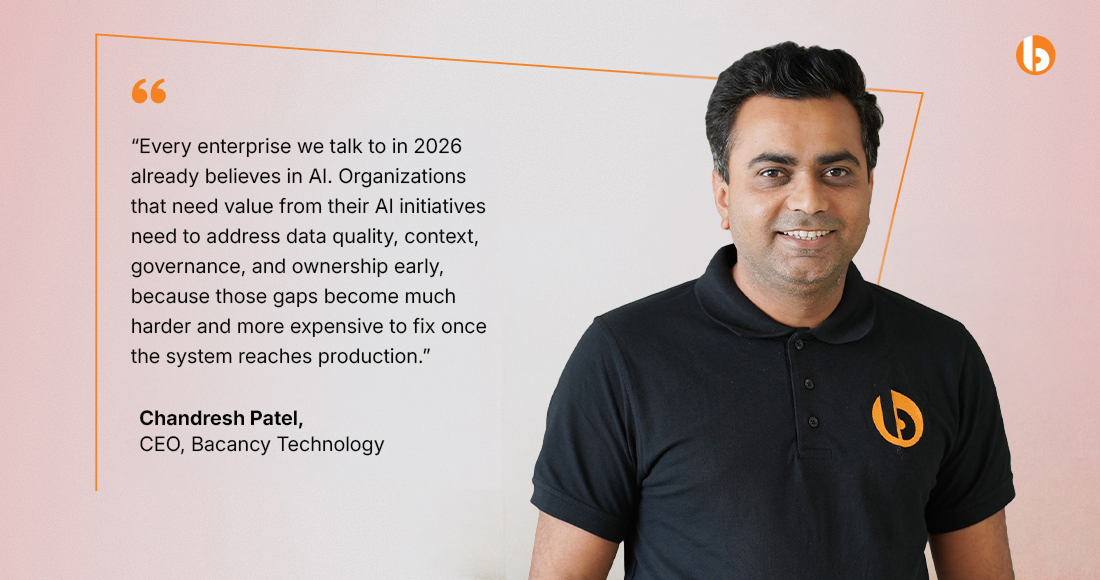
Our CEO’s Insights on AI Data Readiness for Enterprises
Here’s what our CEO, Mr. Chandresh Patel, has to say about AI data readiness for modern enterprises in 2026.
How Bacancy Technology Helps Enterprises Achieve AI Data Readiness?
At Bacancy Technology, we view data readiness for AI as a continuous business capability, not a one-time assessment. We evaluate where your data stands today, uncover gaps that could limit outcomes, strengthen governance and pipeline architecture, and establish processes for ongoing quality and optimization.
We combine AI consulting with data governance to conduct a structured diagnostic of your data platform and architecture, then recommend solutions aligned with your actual data needs and business objectives.
Before scoping an engagement, we also use an AI data readiness assessment checklist. Here are the questions we go through with our team before coming to a decision. You can also check these out and answer each question with “Yes”, “Partially Yes”, “No”, or “Not Sure”.
Data Architecture
- Can you trace critical data from its source through transformation pipelines to the AI systems that consume it?
- Can your team quickly identify the source and lineage of a specific data point used in a model’s output?
Governance and Security
- Is there a clearly accountable owner for each critical data domain supporting your AI initiatives?
- Do access controls, audit trails, and data policies meet standards like ISO/IEC 27001:2022 for the sensitivity and risk of each AI use case?
Team and Process Maturity
- Does your team have the skills to prepare data for AI, including feature engineering, embeddings, chunking, and other use-case-specific workflows?
- Is there a defined process for subject matter experts to review, validate, and correct AI-generated outputs?
Continuous Monitoring
- Do you have automated monitoring and drift detection to identify data quality issues before they affect AI outputs?
- When an upstream source changes, is there an established process and accountable owner to detect, assess, and resolve downstream impact?
If you answered “Not Sure” or “No” or “Partially Yes” more than a couple of times, that’s not a failure. It’s the starting point most enterprises are at in 2026, and it’s exactly the gap we aim to solve as an AI-led data engineering company. We assess these gaps across data quality, governance, architecture, and monitoring, and work with your team to address the issues that could affect AI outcomes.
Frequently Asked Questions (FAQs)
AI data readiness is the process of preparing data so AI systems can use it reliably in real-world conditions. It involves more than data quality and includes relevant context, consistent business definitions, clear ownership, governance, access controls, and continuous validation.
You need to first start by evaluating whether your data fits the specific AI use case, meets the required quality and confidence levels, and is governed appropriately. You should also be able to trace important data back to its source, identify accountable owners, and monitor changes after deployment.
Data quality focuses on whether data is accurate, complete, consistent, timely, and usable. Data readiness for AI goes further by considering whether that data has the context, lineage, governance, accessibility, and reliability required for a specific AI application.
The most common mistakes include treating AI Data Readiness as a one-time project, preparing data without a defined use case, and over-cleaning datasets in ways that remove important edge cases. These approaches can make data look cleaner without making it more useful for AI. Another common mistake is delaying governance until production or assuming that migrating to a modern data platform automatically makes data AI-ready.
Not necessarily. A platform migration can improve scalability, accessibility, and data architecture, but it does not automatically resolve issues such as inconsistent definitions, missing lineage, poor documentation, or unclear ownership.
There is no fixed timeline because readiness depends on the use case, data complexity, number of sources, governance requirements, and existing data maturity. A focused use case can often be assessed faster than an enterprise-wide initiative involving multiple systems, business units, and data domains.
AI agents typically require stronger controls because they can use data to perform actions, interact with systems, or make decisions with limited human intervention. This increases the importance of real-time data, permissions, source traceability, monitoring, and controls around what the agent can access and do.
Bacancy Technology helps enterprises assess their current data environment, identify readiness gaps, and build the data pipelines, governance, metadata, access controls, and monitoring needed for specific AI use cases.